
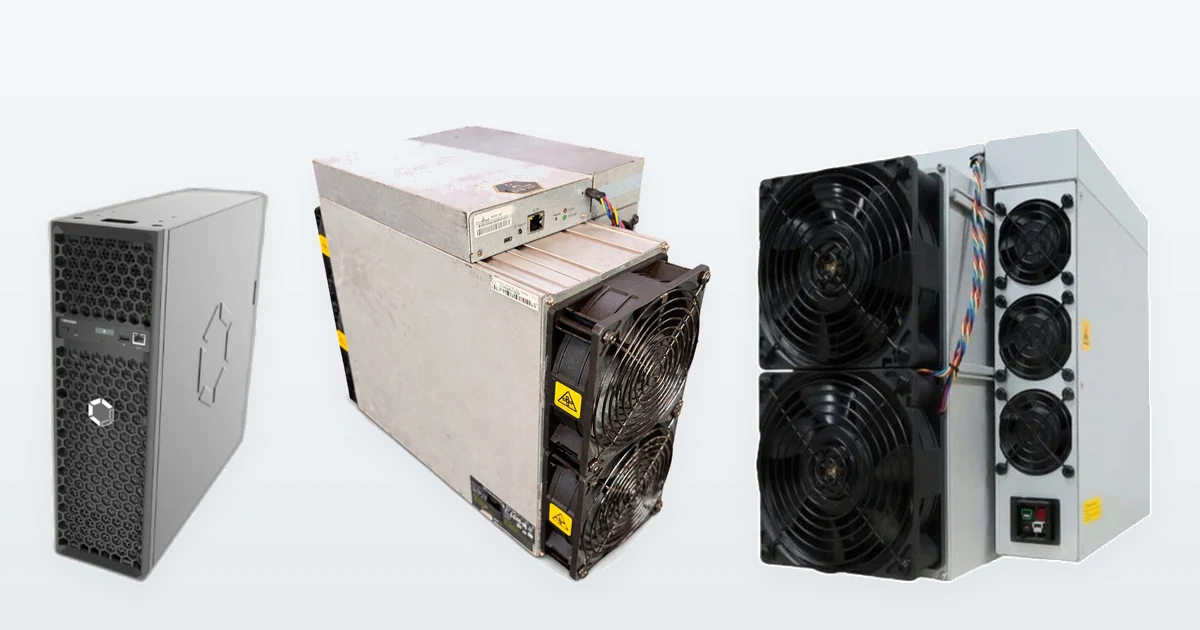
Most ASIC miner buying guides open with a list of models. Open with a division instead. Your break-even electricity rate — the price of power above which a machine loses money no matter how long you run it — is hashprice divided by (24 × the machine’s J/TH). That single line decides more than brand, warranty or hashrate ever will: whether you should buy a current-generation S21, a pallet of used S19s at scrap money, or nothing at all this quarter. This ASIC miner buying guide works through the whole decision — what every spec on the sheet actually means, what a miner really costs to run per month, and what hosting adds and takes away.
Every number in this guide is a snapshot, and snapshots go stale. The arithmetic below was re-derived from scratch on 10 August 2026 and uses these inputs:
- Hashprice $32.33 per PH/s per day, before pool fees — derived from difficulty, BTC price and the fee share measured over the last 144 blocks, not read off a chart
- Network difficulty 127.48 T after a +0.99% retarget, with two independent sources agreeing to the digit
- Network hashrate ~913 EH/s implied by that difficulty
- BTC $65,231, the median of three price feeds
- Transaction fees were 0.50% of block rewards over those 144 blocks — fee revenue is currently a rounding error
- US average residential electricity 18.44¢/kWh (EIA Table 5.3, May 2026, the latest month published; 18.11¢ year to date). Cheapest state Idaho ~12.35¢, most expensive Hawaii ~52¢
- US retail hosting $0.065–$0.09/kWh all-in — the band hosts publish themselves, read 16 August 2026 (Simple Mining $0.07–$0.08 in Iowa, $0.065 bundled; EZ Blockchain $0.067 air-cooled and $0.09 immersion; Terra Hosting from $0.075). Flat-rate alternatives $180–$350 per machine per month
Difficulty retargets roughly every two weeks and BTC moves every second, so hashprice changes daily. We are showing you the formulas precisely so you can redo them with today’s numbers on the day you buy. Do not treat any figure here as a forecast — it is arithmetic on a dated input, nothing more.
Refreshed 10 August 2026 — and here is how to refresh it yourself. Every break-even rate on this page is one division: hashprice ÷ (24 × J/TH). Hashprice is the only term in it that moves, so when it moves, every rate on this page moves by exactly the same proportion. That means you never have to wait for us to republish anything: look up today’s hashprice and multiply every break-even figure here by (today’s hashprice ÷ 32.33). The J/TH thresholds in the decision bands move by that same multiplier and in the same direction, because they are the same division rearranged: the best efficiency that still clears a given power price is hashprice ÷ (24 × that price). Checked again on 16 August 2026: hashprice $31.21, so today’s multiplier is 0.965 and every rate below is about 3.5% high. Difficulty still has not moved — the same epoch, 127.48 T, now with 963 blocks left to run and the next retarget estimated at −1.8% — so that entire move is the Bitcoin price, $65,231 down to $63,005, which is exactly the point: the number this page turns on can change by 3.5% in under a week without a single thing about the hardware changing. For scale, this guide first published on 11–13 July 2026 inputs, when hashprice was $30.88 and every rate below was 4.5% lower than it is today — which is roughly what a month of drift looks like, and why you should redo the division rather than trust a table. For the used-hardware version of this arithmetic — condition grades, landed cost per terahash, and fleet power and freight — see how to buy a used ASIC miner.
The one calculation that decides everything
Hashprice is what the network pays for a unit of work: dollars per petahash per second per day. Your machine’s efficiency (J/TH) is how many watts it burns per terahash. Put them together and the machine’s hashrate cancels out entirely:
Break-even electricity rate ($/kWh) = hashprice ($/PH/day) ÷ (24 × efficiency in J/TH)
That is worth sitting with for a second, because it is the whole game. Hashrate determines how much you earn. Efficiency determines whether you earn anything at all. A 300 TH/s machine and a 90 TH/s machine with the same J/TH have exactly the same break-even power price — the big one just gives you more of the same margin per unit of floor space. Which is why chasing terahash while ignoring joules is the single most expensive mistake new buyers make.
At $32.33/PH/day, here is where the machines you will actually be shopping for land. Rated figures are the manufacturer’s wall specification, typically ±3–5%:
| Machine | Hashrate | Wall power | Efficiency | Break-even power price | Power used per month |
|---|---|---|---|---|---|
| Antminer S21 XP 270T | 270 TH/s | 3,645 W | 13.5 J/TH | $0.100/kWh | 2,661 kWh |
| Bitdeer SealMiner A2 Pro Air 255T | 255 TH/s | 3,790 W | 14.9 J/TH | $0.090/kWh | 2,767 kWh |
| Antminer S21 Pro 245T | 245 TH/s | 3,675 W | 15.0 J/TH | $0.090/kWh | 2,683 kWh |
| Antminer S21+ 216T | 216 TH/s | 3,564 W | 16.5 J/TH | $0.082/kWh | 2,602 kWh |
| Avalon Q 90T | 90 TH/s | 1,674 W | 18.6 J/TH | $0.072/kWh | 1,222 kWh |
| Antminer S19 XP 141T (we stock it refurbished) | 141 TH/s | 3,010 W | 21.5 J/TH | $0.063/kWh | 2,197 kWh |
| Antminer S19k Pro 120T (we stock it used) | 120 TH/s | 2,760 W | 23.0 J/TH | $0.059/kWh | 2,015 kWh |
| Antminer S19 95TH (our used shelf, singles and lots) | 95 TH/s | 3,250 W | 34.2 J/TH | $0.039/kWh | 2,373 kWh |
Two things fall straight out of that table.
First: US average residential power does not work. At 18.44¢/kWh, nothing on that list breaks even — you would need hashprice to rise about 85% before even the most efficient machine in that table covers its own electricity in an average American house. If you are mining at home on standard utility rates, you are buying heat and a hobby, and you should decide that deliberately rather than discover it in month three.
Second: efficiency is a cliff, not a slope. An S19 at 34.2 J/TH needs sub-4¢ power. That is not a retail number; that is flared gas, curtailment contracts, behind-the-meter hydro, or a host running on stranded generation. This is exactly why used S19s now trade at a small fraction of what they cost new — the market has repriced them for the only buyers they still suit. That is not a knock on the machine. It is a very specific, very real use case, and we will come back to it.
What every spec on the sheet actually means
Hashrate (TH/s, GH/s, MH/s)
Work done per second, and therefore your share of network rewards. Manufacturers publish it with a tolerance — Bitmain typically quotes ±3% or ±5% — and the tolerance is real. A batch of ten "95 TH/s" S19s will show a spread. Always compare the same units: Bitcoin ASICs are quoted in TH/s, scrypt machines like the Antminer L9 in GH/s, and small solo miners in TH/s or GH/s depending on who wrote the listing.
Efficiency (J/TH) — the number that matters
Joules per terahash, i.e. watts of wall draw per TH/s of output. Insist on wall efficiency, not chip efficiency. Chip-level numbers exclude the power supply, the fans and the control board, and they flatter a machine by roughly 5–8%. If a listing quotes J/TH, divide the stated wattage by the stated hashrate and check the two agree. On the S21 Pro 245T: 3,675 W ÷ 245 TH/s = 15.0 J/TH. It checks out. When it does not check out, one of the two numbers is wrong, and you need to find out which before you wire money.
Efficiency also degrades. Thermal paste dries, fans slow, chips age. A used unit sold as "34 J/TH" may measure 36–38 at the wall.
Rated power vs measured wall draw
The spec sheet number assumes the factory firmware profile, a sane ambient temperature and a healthy PSU. Real draw moves with all three, and it moves a lot once anyone has tuned the machine. Buy on measured wall draw at the profile the machine will actually run. On used or tuned units, ask the seller for a meter reading — a photograph of the machine’s own web interface or a clamp meter on the feed — not a repeat of the factory spec.
Watch out for internally inconsistent listings. "95 TH/s at 2,800 W" would be 29.5 J/TH, and the BM1398 silicon in an S19 does not reach that. A low-power tune trades hashrate for watts; the tuned machine will hash below 95. Any seller — us included — who prints both the stock hashrate and the tuned wattage in the same breath is describing two different states of the machine.
Voltage and input requirements
Most modern ASICs are 200–277 V AC machines. They will not run on a North American 120 V outlet at all, and the voltage is only half the problem — see the electrical section below. A handful of machines are genuinely wide-input: the Avalon Q accepts 110–240 V, which is the honest reason it exists.
Then there is the split almost no buying guide mentions: single-phase versus three-phase. Everything above is a single-phase machine — two hot legs and a ground, the same service your house has. A second class of hardware wants 380–480 V three-phase, and that is not a bigger breaker on the same panel; it is a different service. Most hydro machines are in this class, and it is wider than it looks. Counted against the catalogue on 14 August 2026, 22 of the machines we list state a three-phase supply in their own specification, across six manufacturers: the MicroBT M63S and M66S families, most of Bitmain’s Hyd range, the Bitdeer SealMiner Hyd units, and the Canaan Avalon A1566HA, which Canaan publishes at AC 323–528 V. The part that catches people is that this is not a Bitcoin-only problem. The hydro Scrypt machines are three-phase too — the Antminer L11 HU6 and HU2 at 380–415 V, the ElphaPex DG Hydro1 at 380–480 V and the VolcMiner D1 Hydro at 380–415 V. Someone shopping Litecoin and Dogecoin hardware on J/GH alone has no reason to suspect a phase problem, and can get all the way to a purchase decision before finding out the building cannot feed the machine. Two more — the S19 XP Hyd 257T and the S21 XP IMM 300T — publish 342–418 V without saying which phase their supply takes, and those listings say so rather than guess. If you are reading a spec sheet that gives you a voltage in the 380–480 V band, treat it as three-phase until the manufacturer says otherwise in writing. Two consequences worth knowing before you shop on efficiency. First, you cannot convert your way in — a transformer or phase converter for a 7 kW continuous load is an electrical project, not an accessory, and nothing in the 110 V adapter category touches this problem. Second, nobody can tell you the amps from the spec sheet alone: current per line is watts over the square root of three times your line-to-line voltage times power factor, so the same machine is a different number on a 400 V service than on a 480 V one, and delta and wye differ again. Any seller who quotes you a single amp figure for a three-phase miner without asking what your service is has not done the arithmetic. Ours are grouped by supply type, with the amp column deliberately left blank for that class, on the circuit-sizing table.
Noise (dB)
Air-cooled industrial ASICs sit around 75–76 dB at one metre. That is vacuum-cleaner territory, continuously, forever. Perceived loudness roughly doubles for every 10 dB, so a 75 dB S21 is something like eight times as loud as a 45 dB Avalon Q — not 60% louder. There is no enclosure, no closet and no "I’ll put it in the garage" that makes a 75 dB machine acceptable next to a bedroom. Hydro and immersion units are much quieter at the machine but move the noise to pumps and dry coolers, and add a plumbing job. We wrote about this in more depth in our breakdown of ASIC miner noise.
Dimensions, weight and freight class
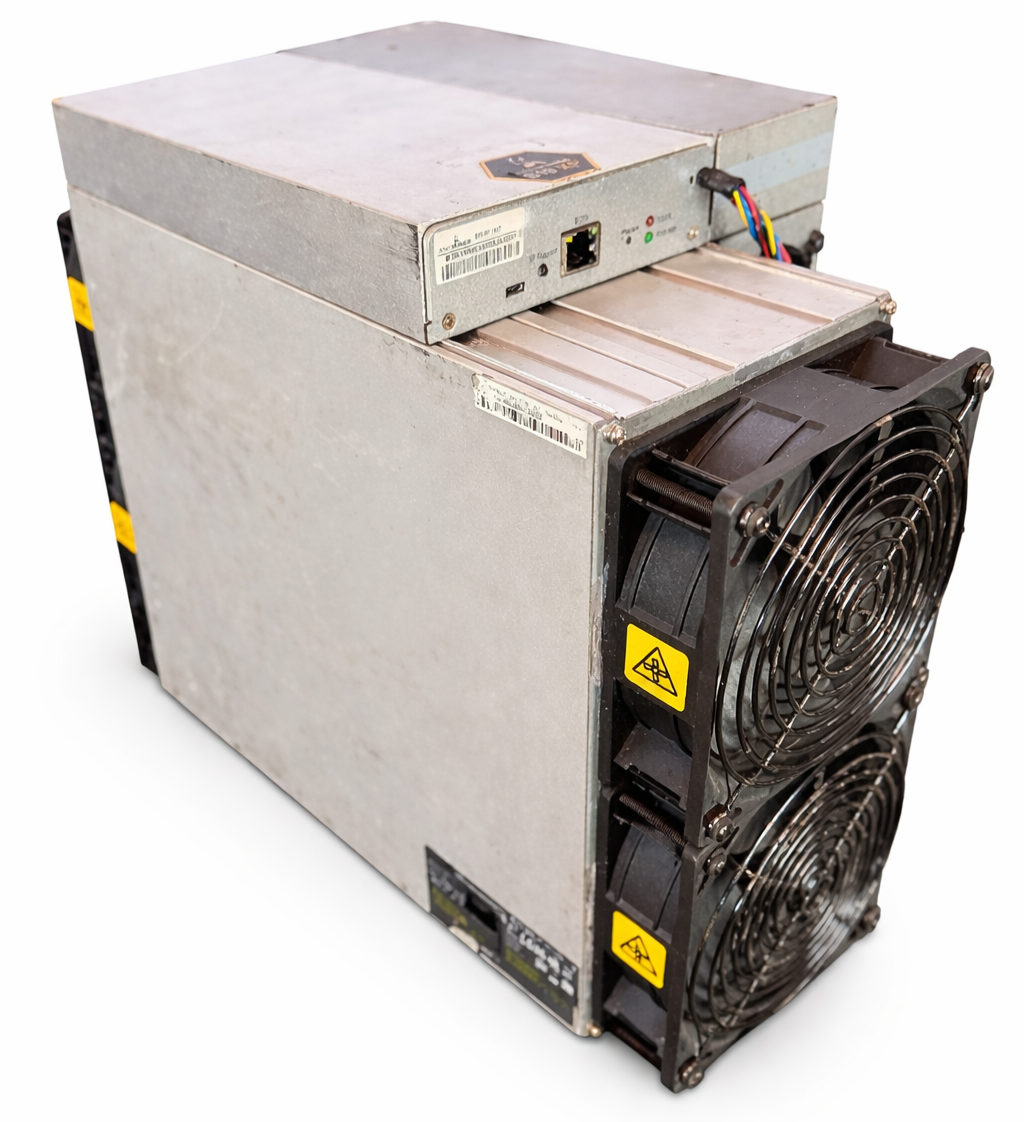
An S19-class machine is 400 × 195.5 × 290 mm and 14.2 kg bare on Bitmain’s own specification, and 570 × 316 × 430 mm at 16 kg boxed. Boxed and palletised it is heavier and much bulkier, and freight is usually billed on dimensional weight, not actual weight. This is why a single miner ships as an expensive parcel and forty miners ship as a cheap-per-unit pallet. If you are buying more than four or five units, ask for a palletised freight quote before you compare prices between sellers.
Cooling type
Air is plug-and-play and loud. Hydro pushes far more hashrate through the same footprint and runs quiet at the box, but requires a coolant loop, a radiator or dry cooler to reject the heat, and someone competent to commission it. Immersion needs a tank, dielectric fluid and a heat rejection loop. Do not buy hydro or immersion hardware before the cooling infrastructure exists — a hydro miner with nowhere to reject heat is a paperweight. The spec that decides whether a hydro loop works is the one buyers skip: Bitmain rates its Hyd machines on a coolant inlet temperature of 20–50 °C, not an ambient temperature, so the rejection side has to be sized for the hottest afternoon of the year rather than for the mild day you commission it. Air, hydro and immersion compared covers what each type makes you build.
Algorithm
An ASIC does one algorithm. SHA-256 machines mine Bitcoin and its forks. Scrypt machines like the L7 and L9 mine Litecoin with Dogecoin merge-mined alongside it. KHeavyHash machines mine Kaspa, Blake3 mines Alephium, and so on down our altcoin ASIC range. There is no switching. If the coin dies, the hardware is scrap. That concentration risk is priced into every non-Bitcoin ASIC and it should be priced into your decision too.
The electricity math, worked out
Monthly power cost is the least mysterious number in mining, so get it exactly right:
kWh per month = watts ÷ 1,000 × 730 (730 hours is a 365-day year averaged over 12 months)
Monthly cost = kWh × your all-in $/kWh
For a 3,675 W Antminer S21 Pro 245T, that is 2,683 kWh every month. What that costs:
| Your power price | Cost per month, one S21 Pro 245T | Cost per year |
|---|---|---|
| $0.045/kWh (industrial / behind-the-meter) | $121 | $1,449 |
| $0.070/kWh (typical good hosting) | $188 | $2,254 |
| $0.075/kWh (typical retail hosting) | $201 | $2,415 |
| $0.120/kWh (cheap US residential) | $322 | $3,863 |
| $0.1844/kWh (US residential average, EIA May 2026) | $495 | $5,936 |
Read the bottom row again and compare it to the machine’s purchase price. On average US residential power, one modern miner burns more electricity in a year than the miner itself costs. Power is not a line item in mining; power is the business.
Which is also why the question of where the power comes from is not a side issue. If you are considering generating it, what size solar array each miner needs converts the wattage on this page into kW of array and kWh of storage — and makes fairly clear why almost nobody buys panels to run one machine.
Now the other side. At $32.33/PH/day, that same S21 Pro 245T grosses about $7.92 per day, or roughly $241 per month, before pool fees. Set against $201 of hosted power, the margin on a $4,200 machine is thin — around $40 a month at these exact inputs, which is a payback period of more than eight years if hashprice never moves again. Nobody buys hardware on that assumption, and you should not either: the case for buying is a view on where hashprice goes, and you should be able to say what your view is. That is not a reason to panic and it is not a reason to buy; it is the reason you must run this calculation on the day you buy, with that day’s hashprice, instead of trusting a number in anyone’s blog post, ours included. Hashprice was materially higher earlier in 2026 and will move again at the next retarget.
Everything else that costs money
The sticker price is the part everyone compares. It is rarely the part that decides the outcome. Budget for all of this before you commit:
- Freight. Parcel for one unit, pallet for many, and international air freight for anything crossing an ocean. Get it quoted, not estimated — see our mining hardware shipping guide. Our own rates are flat and published rather than quoted case by case: $49.99 per unit by UPS Ground anywhere in the US and $250.00 per unit outside it — per unit, so three machines abroad is $750.00 and not $250.00 — with separate freight pricing on the fleet lots. They are on shipping and delivery, read off the checkout rather than estimated.
- Sales tax. One rate applies here — 6.25% Massachusetts sales tax, because the company is in Hanson, MA. Orders shipping anywhere else in the US are charged none at checkout, and whether you owe use tax at home is between you and your state. Check it before you compare two sellers’ totals: a taxed quote and an untaxed quote are not the same quote. The rate and what it applies to.
- Import duty, customs brokerage and VAT/GST if the hardware crosses a border. This is frequently the difference between two otherwise identical offers.
- Electrical work. A dedicated 240 V circuit installed by a licensed electrician typically runs a few hundred dollars per drop if your panel has capacity, and a great deal more if it does not. A panel upgrade or a new service is a four-figure job. Size the circuit before you ask for the quote. A miner runs continuously, so the NEC lets it occupy only 80% of its breaker: the 3,675 W S21 Pro 245T used above draws about 15.3 A at 240 V and therefore needs a 20 A two-pole breaker, not the 15 A the raw current suggests. Our power requirements page does that arithmetic for every machine whose full specification we publish — all of them bar the lots, the units sold for parts, the second listing of a bin already shown, and a few whose own published figures we have not been able to reconcile — including how many of them one panel will take.
- PDUs, cords and breakers. Industrial ASICs use C19/C20 connectors and want a proper rack PDU, not a power strip. Budget for the right cordage.
- Hosting deposit and setup. Most hosts want a deposit — commonly a month or two of estimated power — plus a per-machine setup or racking fee, before the first hash.
- Pool fee. Typically 0–2% of revenue. FPPS pools charge more than PPLNS and pay more predictably.
- Firmware dev fee. Braiins OS+ charges 2–2.5%, waived when you point the machine at Braiins Pool. VNish and LuxOS have their own arrangements. A "free" +10% hashrate that costs 2.5% of gross is still a good trade; just do it with your eyes open.
- Consumables and repair. Fans are wear parts and the cheapest thing on a miner to replace — a dual fan assembly costs less than a tank of gas. Power supplies are the next most commonly replaced item; a spare APW17-class PSU from the parts shelf turns a week of downtime into an hour. Hashboards are the expensive failures, and past a certain point they are not economic to repair at all. If you run more than a handful of machines, a hashboard tester pays for itself the first time it stops you shipping a good board back to a repair shop.
- Depreciation. The brutal one. Every new generation pushes the previous one down the efficiency table, and the break-even formula above shows exactly what that does to an older machine’s viable power price. Assume the machine is worth meaningfully less in a year, and that its resale market is other people with cheaper power than you.
Hosting versus running it yourself
For most buyers on retail electricity, hosting is not a convenience — it is the only version of the arithmetic that works. US retail hosting in 2026 runs $0.065–$0.09/kWh all-in, with some facilities instead charging a flat $180–$350 per machine per month depending on power draw. Those are rates hosts publish on their own pages, read on 16 August 2026: Simple Mining quotes $0.07–$0.08 across its Iowa sites and $0.065 on bundled deals, EZ Blockchain lists $0.067 air-cooled and $0.09 immersion with a $30 per-miner setup fee, Terra Hosting advertises from $0.075 in Texas, and Abundant Mines charges a flat $225 per machine per month all-inclusive on Oregon hydro. Rates above that band are real too — $0.10–$0.11 is quoted retail — and anything under $0.06 generally means the machines are not in the United States. Compare those two structures carefully: flat-rate pricing is a bet on your machine’s wattage, and it is usually the worse deal for an efficient machine and the better deal for a hungry one. Correction, 16 August 2026: this site published this range as $0.06–$0.09 on this page and on about, and $0.055–$0.085 on five others — seven documents, two different answers. Neither low end is a rate we can attach to a named US host, and both understated hosting in the direction that flatters a purchase. Every one of those pages now carries the figures above.
What "all-in" is supposed to include is power, rack space, network, basic monitoring and hands-on-site. What it very often does not include is the part that costs you money. Before you sign, get written answers to these:
- Who pays for repairs, and what is the labour rate? "We’ll fix it" and "we’ll fix it free" are different contracts.
- What is the uptime guarantee, and what is the remedy when it is missed? A guarantee with no remedy is a sentence, not a term.
- What is the curtailment policy? Facilities on demand-response programmes shut machines off during grid events. Ask how many hours last year, and whether you are credited.
- Do you control the pool? You should be mining to your own pool account with your own payout address. If the host holds the pool account, you have counterparty risk on every satoshi.
- What is the minimum term, the notice period and the exit process? Including who pays to ship your machines out, and what happens if you fall behind on an invoice.
- How is power measured and billed? Per-machine metering versus an assumed nameplate wattage is a real difference in dollars.
- Is the deposit segregated, and is it refundable?
Running machines yourself makes sense when you own the power, own the building, or are running few enough units that you genuinely enjoy the work. It stops making sense the moment you are paying retail utility rates for industrial hardware.
Can your house actually run this?
Three constraints kill more home mining plans than price does.
Circuit capacity. A continuous load is limited to 80% of the breaker rating. So a 240 V / 30 A circuit gives you 5,760 W of usable continuous draw, and a 240 V / 20 A circuit gives you 3,840 W. One 3,675 W S21 Pro fits on the 30 A circuit with headroom and fits on the 20 A circuit with almost none. Two of them need two circuits. On the 120 V side the numbers are brutal: a 15 A outlet is good for 1,440 W and a 20 A outlet for 1,920 W, while that same S21 Pro would pull 30.6 A at 120 V. You are a factor of two short on the circuit before you even reach the voltage problem.
That is the honest context for every "run your 240 V miner on 110 V" product on the market, including the ones we sell. They do not reduce how much energy the machine wants. They let you feed it from household supply at a reduced power level you set in firmware — you will be running an S19 at roughly a third of its rated wattage, and getting roughly a third of its hashrate. That is a legitimate way to run a machine in a house with no 240 V drop. It is not a way to run a full-power industrial miner on an extension cord, and anyone who tells you otherwise is selling you a fire.
Heat. Every watt becomes heat. A 3,675 W miner dumps about 12,500 BTU/h into whatever room it is in — roughly a one-ton air conditioner’s worth of load, running constantly. In winter in a cold climate that is a genuine offset against your heating bill. In summer it is a second electricity bill for the air conditioning fighting it.
Noise. Covered above, and consistently underestimated. If the machine must live in a house, buy a machine designed for that. The ~45 dB Avalon Q 90T and the near-silent NerdQAxe++ exist precisely because 75 dB does not work indoors.
New or used: how to actually decide
Skip the general arguments and use the break-even table. Your power price tells you which side of the line you are on.
- Above ~10¢/kWh: at today’s hashprice, nothing clears its own electricity — the most efficient machine in the table above, at 13.5 J/TH, breaks even at 9.98¢. Either find cheaper power, host, or wait. Buying hardware does not fix this.
- 9–10¢/kWh: only the very best current silicon clears, and only just. You need 13.5–15 J/TH and there is no room for a bad month, a fan failure or a pool fee you did not read.
- 6–9¢/kWh (most hosting, most industrial rates): you need current-generation efficiency — S21 XP, S21 Pro, SealMiner A2 Pro Air, the WhatsMiner M6x line. The bar moves hard across the band: at 6¢ anything under 22.4 J/TH clears, and at 9¢ you need 15.0 J/TH or better. Read the top of that band carefully, because it is tighter than the machine names suggest — on this page’s basis the S21 XP at 13.5 J/TH clears 9¢ with room, while the S21 Pro at 15.0, the SealMiner A2 Pro Air at 14.9 and the M66S++ at 15.5 all sit within a few per cent of the line, and a 3% move in hashprice decides them either way. At 6¢ every one of them is comfortable. This is the range where buying new hardware is genuinely the right answer, and the range where you should do the division on the day rather than trust a name.
- 4–6¢/kWh: the used S19 XP (21.5 J/TH, break-even 6.3¢) and S19k Pro (23.0 J/TH, 5.9¢) class becomes interesting, because you are buying capacity at a fraction of new-machine dollars-per-terahash and your power is cheap enough to carry the worse efficiency.
- Under ~4¢/kWh: used S19s at 34.2 J/TH work — precisely, below 3.94¢, and we show that arithmetic against the machine one shelf up in a boosted S19 at 3.94¢ against an S19k Pro at 5.86¢ — and at current used-market pricing they are the cheapest terahash you can buy anywhere. This is the flared-gas, curtailment, behind-the-meter and stranded-generation case, and it is a real and profitable business for the people who have that power.
The failure mode to avoid: buying old hardware because it is cheap, without checking which line you are on. A machine that costs nothing still loses money every hour if its break-even rate is below your power price. Cheap hardware does not rescue expensive power. Nothing does.
Where used genuinely wins is capital efficiency at scale. If you have the power, a lot of ten S19s is 950 TH/s for a small fraction of what 950 TH/s of new hardware costs — at the price of 32.5 kW of draw instead of about 14.3 kW, plus ten times the maintenance surface. That is the trade: cheap capital, expensive operations. Our used and refurbished range runs from single units up to fleet lots of 50 and 100, and the arithmetic scales linearly — a hundred S19s is 9.5 PH/s and 325 kW of connected load, which is a substation conversation, not an extension cord.
What firmware tuning actually buys you
Aftermarket firmware — Braiins OS+, VNish, LuxOS — is real and worth understanding, because a large share of the used market ships with it. On an S19 it will do roughly one of two things: give you around +10% hashrate at stock power, or the same hashrate at 8–12% lower power. The second is usually the more valuable one, because it moves your break-even rate.
Treat the headline claims with suspicion, including on our own listings. A Braiins install card advertised as "adds 10–20 TH/s" realistically adds about 10 TH/s to a 95 TH/s S19; +20 is a best case on well-binned boards, not a specification. Ours carried that claim in its own title until 10 August 2026; it does not now. Aggressive overclocking also runs the chips hotter, and heat is what kills hashboards. If you are buying a tuned machine, ask what profile it is on, what the measured wall draw is at that profile, and how long it has run there.
What to ask before you send money
This is the list we would want a buyer to hold us to. Get the answers in writing, from any seller:
- The measured wall draw and hashrate at the profile the machine will ship on — not the factory spec sheet.
- The exact condition grade, defined. "Used", "refurbished", "tested working" and "for parts" mean different things to different sellers. Ask what was tested, for how long, and what was replaced. Our explainer on hardware grading covers what the tiers should mean.
- Warranty: length, what it covers, and who honours it. A manufacturer warranty and a seller warranty are not the same asset, and on used hardware there is frequently neither. If a listing does not state a warranty, assume there isn’t one and ask.
- Hashboard and control board revision. It determines parts availability and whether common repairs are even possible. Which board codes and chip families actually interchange is set out in our Antminer parts compatibility guide.
- Is a PSU included? On used units, often not. That is a real cost, not a detail.
- Firmware, and whether it can be reflashed. Some units ship locked.
- Freight terms and who owns the risk in transit.
- Payment method and recourse. Wire transfers and crypto payments have none.
If a seller will not answer these, that is the answer.
Four of those decisions are worked through in full elsewhere on this site. Antminer S21 Pro vs SealMiner A2 Pro Air takes two current-generation air machines that sit within one percent of each other on efficiency, and moves the decision onto parts availability, warranty mechanics and resale. Avalon Q vs Antminer S19k Pro is the opposite case: a roughly 24% efficiency gap between a new, quiet, 110 V-capable machine and a used, loud, 240 V-only one, where the arithmetic really does decide it. Antminer S19 XP vs S21 Pro is the case neither of those covers: a cheap, thirsty used machine against an expensive, efficient new one, where daily margin and payback period give opposite answers and your power rate decides which of the two you should actually be optimising. NerdQAxe++ vs Antminer S19 is the fourth and the smallest case: a 78 W desk miner against a 3,250 W industrial one, where the more efficient machine is also the one that will never earn you anything, and the question stops being which machine earns more and becomes whether either of them earns at all where you live.
Which machine fits which situation
Honest routing, based on the arithmetic above rather than on what we would most like to sell. If you would rather read the numbers yourself first, every machine whose full specification we can stand behind is laid out on the ASIC miner comparison page, one shelf per algorithm — hashrate, wall power, J/TH and what the electricity costs per day. The lots are not on it, because a pallet of one machine would be a dozen identical rows: a lot’s per-unit figures are the figures of the single listing it is built from, and every lot page names which machine that is.
- You have industrial or hosted power at 6–9¢ and want the best margin per machine: current-generation air-cooled hardware. The Antminer S21 Pro 245T at 15 J/TH and the Bitdeer SealMiner A2 Pro Air 255T at 14.9 J/TH are the practical picks, with the S21 XP at 13.5 J/TH above them. One thing to know before you compare prices on that SealMiner: we list it as two separate batches — the January batch, which carries a price, and a December mix batch, which is quote-only. Same published hashrate and the same 14.9 J/TH; different bins and different stock. Ask us which one is actually on the floor before you plan around either. Browse the whole Antminer range and the wider Bitcoin miner catalogue. WhatsMiner’s M6x line competes directly at this efficiency and we stock it — the M66S++ 320T at 15.5 W/T is the most efficient machine on that shelf, and the M63S+ 442T at 16.5 W/T the biggest wall draw of the ones that publish it — but read the supply requirement before the efficiency figure, because that shelf splits in two. The four M50S++ and M60S+ machines are air-cooled on a 220–240 V single-phase circuit and land on a 20 A two-pole breaker each. The nine M63S and M66S machines, including the M66S++ above, are hydro units MicroBT rates at AC 380–480 V, three-phase with ground; their own listings state that no single-phase 200–240 V circuit runs one at any breaker size, and they need a coolant loop before they need a breaker. The circuit-sizing table now carries all thirteen and groups them by what you have to build. None of them carries a price on the site, so tell us your service voltage and phase and we will quote against the real unit.
- You have very cheap power and want maximum terahash per dollar of capital: used S19 fleet lots. A lot of 50 refurbished S19s or a lot of ten S19k Pro 115T — the S19k Pro at 23 J/TH is the sweet spot between old-machine pricing and survivable efficiency.
- The machine has to live in a house: the Avalon Q 90T. 110–240 V input, ~45 dB, 1,674 W on a normal circuit. Understand that at residential rates it will not pay for itself at today’s hashprice — buy it knowing that.
- You want to learn, or you want a lottery ticket: a NerdQAxe++ solo miner. Tens of watts, silent, and you learn how pools, stratum and firmware actually work for the price of a nice dinner.
- You are mining something other than Bitcoin: the Antminer L9 17G and the rest of the Litecoin and Dogecoin scrypt range — every L9 bin, 15G through 17G, runs at the same 210 J/GH, so compare those on purchase price per GH/s rather than on efficiency, or the Kaspa, Aleo, Kadena, Dash and CKB range, which includes the IceRiver Kaspa and Aleo machines. Run the same break-even formula with that coin’s hashprice, which is far more volatile than Bitcoin’s. The two bins buyers weigh against each other are compared in Antminer L9 16G vs 17G.
- You already own machines and something is broken: the repair parts, PSUs and test fixtures. Fans, power supplies, control boards, hashboard testers and chips.
The full catalogue is at all miners, and if you want us to check your arithmetic against your actual power contract before you buy anything, tell us your rate and your load and we will do it. We would rather talk someone out of a machine that does not suit their site than sell it and take the return.
Frequently asked questions
What is the most important spec when buying an ASIC miner?
Efficiency in J/TH, measured at the wall. It sets your break-even electricity rate through the formula hashprice ÷ (24 × J/TH), and that rate determines whether the machine can ever be profitable at your power price. Hashrate only determines how much of that margin you get. A high-hashrate machine with poor efficiency loses money faster than a small one.
How do I calculate what an ASIC miner costs to run per month?
Divide the machine’s wall wattage by 1,000 to get kilowatts, multiply by 730 hours, then multiply by your all-in electricity price per kWh. A 3,675 W miner uses about 2,683 kWh a month, which is roughly $201 at $0.075/kWh hosted and about $495 at the US residential average of 18.44¢/kWh (EIA, May 2026).
Is mining Bitcoin at home on residential electricity profitable?
At the inputs used in this guide — hashprice $32.33/PH/day on 10 August 2026 and the US residential average of 18.44¢/kWh — no machine currently on the market covers its own electricity at average residential rates. It can work on unusually cheap residential power, and the calculation changes with every difficulty retarget and every move in the Bitcoin price, so re-run it yourself before you buy. Treat home mining on standard utility rates as a hobby and a heat source unless your own numbers say otherwise.
Is it better to buy a new or a used ASIC miner?
It depends entirely on your electricity price. Above about 6¢/kWh you need current-generation efficiency, so new hardware in the 13–17 J/TH range. Between 4 and 6¢ the used S19 XP and S19k Pro class becomes attractive. Below 4¢ used S19s at 34 J/TH are the cheapest terahash available anywhere. Cheap hardware never compensates for expensive power.
What does ASIC hosting cost, and what should it include?
US retail hosting runs roughly $0.065–$0.09 per kWh all-in, read on 16 August 2026 from rates hosts publish themselves — Simple Mining $0.07–$0.08 in Iowa and $0.065 bundled, EZ Blockchain $0.067 air-cooled and $0.09 immersion plus a $30 setup fee, Terra Hosting from $0.075. Some facilities charge a flat $180–$350 per machine per month instead. All-in should cover power, rack space, network, monitoring and basic hands-on-site. Get written answers on repair costs, the uptime guarantee and its remedy, the curtailment policy, whether you control the mining pool account, the minimum term and exit process, and whether power is metered per machine or assumed from nameplate.
Can I run a 240 V miner on a normal 110 V household outlet?
Only at drastically reduced power, set in firmware. A 120 V 15 A outlet supports about 1,440 W continuously and a 20 A outlet about 1,920 W, while a full-power industrial miner wants 3,000–3,800 W. Conversion kits let you feed the machine from household supply at a derated wattage; they do not reduce how much energy it needs at full output. If you own the building, a dedicated 240 V circuit from a licensed electrician is the cheaper and safer answer.
How loud is an ASIC miner really?
Industrial air-cooled units run about 75–76 dB at one metre, continuously. Since perceived loudness roughly doubles every 10 dB, that is around eight times as loud as a 45 dB home miner such as the Avalon Q. No consumer enclosure makes a 75 dB machine liveable indoors.
How much heat does a miner produce?
Essentially all of its electrical draw becomes heat. A 3,675 W miner produces about 12,500 BTU per hour — comparable to a one-ton air conditioner’s load, running around the clock. That is a useful winter heat source in a cold climate and an expensive summer problem everywhere else.
Buying second-hand rather than new? The companion piece to this guide, how to buy a used ASIC miner, goes deeper on condition grades, landed cost per terahash, fleet freight and power arithmetic, and the difference between a factory S19 Pro and a boosted S19.