
IceRiver Kaspa and Aleo ASIC Miners
IceRiver builds ASIC miners for Kaspa and Aleo. Nothing on this shelf mines Bitcoin, and no firmware, pool setting or adapter changes that — KHeavyHash and zkSNARK are separate silicon, each built for one job. What makes IceRiver worth understanding as a range is that it sells the same efficiency in very different sizes, so the machine you want here is decided by your circuit and your room rather than by a spec-sheet ranking.
-
Add to WishlistAdd to Wishlist
-
Add to WishlistAdd to Wishlist
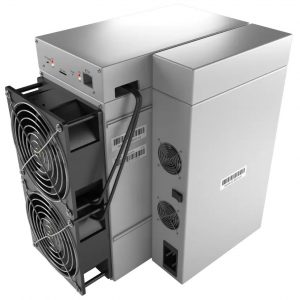
IceRiver AE3 2 GH/s Aleo Miner – 3,400W zkSNARK Prover
Condition: ask -
Add to WishlistAdd to Wishlist
-
Add to WishlistAdd to Wishlist
What IceRiver actually makes
Two families, four machines. On Kaspa, the KS7 30T is rated about 30 TH/s for about 3,500 W, and the KS7 Lite 4.2T about 4.2 TH/s for about 500 W. On Aleo, the AE3 is 2 GH/s at 3,400 W and the AE0 is 60 MH/s at 100 W with its power supply in the box.
Those are two different units of work and they do not convert into each other. A Kaspa machine is quoted in J/TH, an Aleo prover in J/MH, and neither compares with the J/TH of a Bitcoin miner — what a mining algorithm decides sets out why that division is meaningless across algorithms.
The range scales size, not efficiency
This is the useful thing about IceRiver and almost nobody says it. Divide each machine’s watts by its work and the pairs land on top of each other. The KS7 30T is 117 J/TH and the KS7 Lite 119 J/TH — about two per cent apart, across a seven-fold difference in hashrate. The AE3 is 1.70 J/MH and the AE0 1.67 J/MH — also about two per cent apart, and the small one is fractionally ahead.
So buying the bigger box does not buy you a better machine per watt. It buys density: fewer units, fewer IP addresses, fewer things to rack, and one 3.5 kW circuit instead of seven small ones. If density is not your problem, the small machines are not the compromise they look like.
On Kaspa, Bitmain is ahead on efficiency
We would rather you heard this from us than found it on a comparison site. The Antminer KS7 40T is rated 40 TH/s at 3,080 W, which is 77 J/TH. Against that, the IceRiver KS7 30T needs about 52% more power for the same work and the KS7 Lite about 55% more. On a machine that runs continuously, that gap is the whole running cost difference and it does not close.
What IceRiver has instead is the small end. There is no 500 W Kaspa Antminer, and if what you want is a few TH/s in a room rather than 40 in a shed, the Lite is the only shape of that in this catalogue. Buy the IceRiver for the size, and know what the size costs you.
The two Aleo figures do not reconcile
Both Aleo machines we stock publish a maker figure, and the two figures are not compatible. The IceRiver AE0 is 60 MH/s on 100 W — 1.67 J/MH. The Goldshell AE-BOX II is 54 MH/s on 530 W — 9.8 J/MH. That is nearly six times apart on the same algorithm, which is not a difference real silicon of the same generation usually shows.
We have not run the two side by side on one pool, so we are not going to tell you which is right or rank them as though the numbers were comparable. Either the vendors measure Aleo MH/s differently or one figure is wrong, and until we can test it the honest answer is that we do not know. If that number is what your purchase turns on, ask us and we will say so in writing rather than quote you a spec sheet.
How to choose
Start with the circuit, because it eliminates half the shelf. The AE3 and the KS7 30T are 200–250 V machines pulling 3.4–3.5 kW, and IceRiver rates the AE3 at 220–240 V nominal through a 20 A C19 inlet. There is no configuration in which either runs from a North American 120 V household outlet. The AE0 and the KS7 Lite accept 100–240 V and need no electrician. ASIC miner power requirements has the breaker arithmetic.
Then the room. The two big machines are around 75 dB, which is a garage, an outbuilding or a hosted facility — not a room anyone sleeps in. IceRiver publishes 45 dB for the AE0; we have not metered one ourselves, so treat that as the maker’s figure. The KS7 Lite’s listing describes it as quiet without giving a number, and we would rather leave that blank than fill it in.
Check what is actually in the crate. IceRiver ships the KS7 Lite without a power cord, and the AE0 with its PSU. Those are the two facts most likely to cost you a day, and neither is guessable from the price.
Treat a single-coin box as a position, not a purchase. A Kaspa or Aleo ASIC is worth what that one network is worth. A Bitcoin miner that stops paying still has a resale market; a zkSNARK prover has the market for zkSNARK provers. Altcoin mining risks is the honest version of that argument, including what happens when a chain changes algorithm.
Who this suits
Buyers who have already decided on Kaspa or Aleo and want the smallest or the largest version of that bet — the KS7 Lite and the AE0 for someone adding hashrate to a room on an ordinary circuit, the KS7 30T and the AE3 for someone with 240 V, ventilation and somewhere the noise does not matter. If you are still choosing a coin rather than a machine, start at mining hardware beyond Bitcoin instead.
Everything here is single-unit new stock; we hold no used IceRiver inventory and no multi-unit IceRiver lots, so this shelf is not where our volume pricing lives. That is on bulk used ASIC miners, which is SHA-256 hardware. For quantities of IceRiver machines, ask us for a quote and we will tell you what we can actually source and by when, rather than publish a tier table we cannot fill.
Full catalogue: all miners. Related shelves: Kaspa, Aleo, Dash and CKB miners and new ASIC miners.