
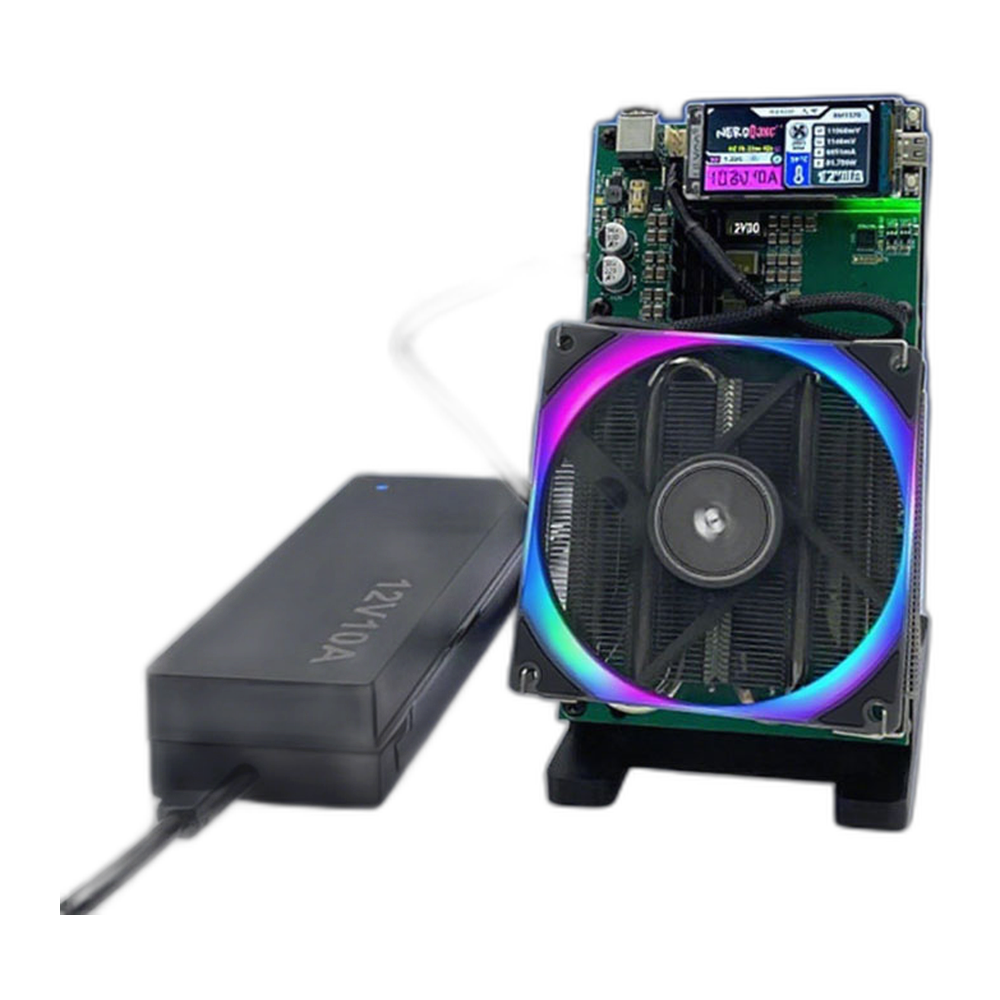
The little one is the efficient one. A NerdQAxe++ measures about 16.25 J/TH at the wall against 34.21 J/TH for a used Antminer S19 — it is 2.1 times better per terahash — and it is still not the machine to buy if you want income. That is the whole NerdQAxe++ vs Antminer S19 decision in one sentence, and the rest of this page is why it is true, with the arithmetic shown so you can re-run it on the day you buy.
Both machines are on our shelves: a new NerdQAxe++ 4.8 TH/s solo miner and a used Antminer S19 95TH/s. They are the two cheapest ways into Bitcoin mining we sell, they are separated by a factor of 20 in hashrate, and they are not competing for the same buyer at all.
The short answer
| You are… | Buy | Because |
|---|---|---|
| In a flat or a house on a normal power bill | NerdQAxe++ | 78 W on a household outlet, no electrician, no noise complaint. It will not pay you, and being wrong about it costs about $5.50 a month. |
| Learning — pools, firmware, running a node | NerdQAxe++ | Same stack, same stratum, same firmware concepts, a fraction of the money at risk. |
| Sitting on power under about 3.9 ¢/kWh | Antminer S19 | 95 TH/s earns real money down there. It is the only rate band where it earns anything at all. |
| Hosting machines at an industrial rate | Antminer S19 | Hosting is priced per machine, and a hosted slot only makes sense with real hashrate in it. |
| Wanting a quiet machine that still earns | Neither — look at the Avalon Q | 90 TH/s at about 45 dB is the middle ground these two do not cover. |
The two machines on paper
| NerdQAxe++ (new) | Antminer S19 95TH/s (used) | |
|---|---|---|
| Hashrate | 4.8 TH/s | 95 TH/s ±5% (factory) |
| Silicon | 4 × BM1370 | 228 × BM1398BB, 3 boards |
| Power at the wall | ~78 W measured (60–68 W rated) | 3,250 W (factory) |
| Efficiency | 16.25 J/TH measured · 14.17 rated | 34.21 J/TH |
| Break-even electricity | 8.12 ¢/kWh | 3.86 ¢/kWh |
| Supply | 12 V brick, ordinary household outlet | 200–277 V AC, dedicated circuit |
| Current draw | ~0.65 A at 120 V | ~13.5 A at 240 V |
| Heat into the room | ~266 BTU/h | ~11,089 BTU/h |
| Noise | ~40 dB per vendor listings — we have not metered ours | ~75 dB |
| Network | 2.4 GHz Wi-Fi only | Ethernet (RJ45) |
| Condition | New | Second-hand, VNish flashed |
| Warranty | Confirm the terms with us in writing | None — used hardware |
One number on that table does not divide, and it is on the new machine. The NerdQAxe++ is advertised at 15 J/TH and 68 W. But 68 W across 4.8 TH/s is 14.17 J/TH, and independent testing keeps landing at 72–80 W rather than 68, which is 16.25 J/TH. We use the measured end throughout this page, because that is the number that turns up on your electricity bill. Our own listing quotes both, and now says why.
NerdQAxe++ vs Antminer S19: what each one costs to run
Everything below rests on one identity, which is the same one the ASIC miner buying guide is built on:
break-even $/kWh = revenue per TH per day ÷ (24 × J/TH ÷ 1000)
Revenue per terahash per day comes out of network difficulty rather than out of anybody’s calculator: 86400 × subsidy × price × 1012 ÷ (difficulty × 232). On 29 July 2026 that is $0.031677 per TH/day, or about $31.68 per PH/day. Every figure on this page falls out of that one number.
- NerdQAxe++: 4.8 TH/s earns $0.1520/day gross and burns 1.872 kWh/day. Break-even 8.12 ¢/kWh.
- Antminer S19 95TH/s: 95 TH/s earns $3.01/day gross and burns 78 kWh/day. Break-even 3.86 ¢/kWh.
So the desk miner tolerates more than twice the electricity price the industrial machine does. Read that carefully, because it is the single most misunderstood thing about small miners: efficiency tells you the rate at which a machine dies, not how much it earns. The NerdQAxe++ survives to 8.12 ¢ and earns pennies the whole way; the S19 dies at 3.86 ¢ and earns real money below it.
The crossover sits at 3.75 cents, and that is bad news for the big machine
Two machines earn the same daily profit where the extra revenue exactly pays for the extra power. Here that is 3.75 ¢/kWh — and the S19’s own break-even is 3.86 ¢. The gap between those two numbers is the entire band in which owning the bigger machine earns you more dollars per day.
| Your power rate | NerdQAxe++ margin/day | Antminer S19 margin/day | NerdQAxe++ payback | S19 payback |
|---|---|---|---|---|
| 3.00 ¢ | $+0.096 | $+0.67 | 10.4 years | 239 days |
| 3.76 ¢ | $+0.082 | $+0.08 | 12.2 years | 5.7 years |
| 5.00 ¢ | $+0.058 | $-0.89 | 17.1 years | — |
| 7.50 ¢ | $+0.012 | $-2.84 | 85.8 years | — |
| 8.12 ¢ | $+0.000 | $-3.32 | never, in practice | — |
| 10.00 ¢ | $-0.035 | $-4.79 | — | — |
| 18.11 ¢ | $-0.187 | $-11.12 | — | — |
Four things fall out of that table, and none of them are the thing a spec sheet would have told you:
- Below 3.75 ¢ the S19 out-earns the NerdQAxe++ per day, and at genuinely cheap power it is not close — at 3 ¢ it is about 7 times the daily margin.
- Between 3.75 ¢ and 3.86 ¢ the S19 is technically positive and practically pointless. It is running 78 kWh a day to make less than a machine drawing 78 W.
- Above 3.86 ¢ the S19 loses money every hour it is switched on. That includes essentially every residential tariff in the United States.
- Above 8.12 ¢ neither machine covers its own power.
The transferable result, and it generalises past these two machines: when one machine is far more efficient but far smaller, the daily-margin crossover lands just below the thirstier machine’s break-even rate. Which means the big machine only out-earns the small one inside the band where it is profitable at all. Efficiency does not decide the comparison — it decides how wide that band is. Our L9 16G vs 17G comparison is the same algebra with the efficiencies equal, where the crossover collapses onto the break-even exactly. If you would rather see the efficiencies before the algebra, every machine we stock is on the ASIC miner comparison table with its power at the wall and its J/TH.
The capital side, taught as a division rather than a number
We do not print prices in articles, because prices move and articles do not. Open both listings and do this division yourself: purchase price ÷ hashrate. At the prices listed as this was written, the NerdQAxe++ costs about 45 times more capital per terahash than the used S19. That is not a criticism of the NerdQAxe++ — nobody buys 4.8 TH/s to compete on cost per terahash — but it is the reason the payback column above reads in decades rather than months. At 3 ¢/kWh the S19 returns its purchase price in about 239 days and the NerdQAxe++ in about 3,806, which is 10 years, which is not a plan.
The number that should actually decide it: what being wrong costs
Every comparison of these two machines you will read online argues about J/TH. Here is the argument we would actually make to you on the phone.
At the US average residential rate of 18.11 ¢/kWh, both machines lose money. But they lose it at completely different scales:
- NerdQAxe++: about $5.50 a month. Roughly a coffee. You would spend that on a hobby without thinking about it.
- Antminer S19: about $329 a month, every month, silently, on your utility bill.
That is a factor of 60 in the cost of being wrong about your own power rate. If you are certain about your rate and it is below 3.9 ¢, buy the S19 and buy several. If you are not certain — if you have not read a bill, checked whether your rate is tiered, or worked out what 78 kWh a day does to a residential tariff that steps up with usage — then the machine that punishes the mistake with $5.50 instead of $329 is the correct first purchase. That is not us talking you down to a cheaper machine; the desk miner is the more expensive item per terahash by a factor of 45.
Solo or pooled? The expected value is identical
The NerdQAxe++ is sold as a solo miner and the S19 is almost always pooled, so it is worth being precise about what that changes. It changes the variance and nothing else.
Pointed at a solo pool, 4.8 TH/s is about one part in 188,250,068 of the network. That is a mean time between blocks of roughly 3,582 years and a 0.028% chance of finding one in a given year — about 1 in 3,582. A block is currently worth about $198,773 in subsidy, before fees. Multiply the chance by the prize and you get $0.1520 a day, which is exactly what the same machine earns pointed at a normal pool. The expected value is the same either way, by construction.
So solo mining is not a strategy for earning more. It is a choice to take the same expected value as a lottery ticket instead of as a trickle, plus the genuine pleasure of mining against your own node. Both are legitimate reasons. Neither is a return.
You can also simply point a NerdQAxe++ at a pool and take proportional payouts like any other miner. Most pools have a minimum payout threshold, so at this hashrate expect to accumulate for weeks before anything moves.
Where each machine physically goes
This is where the comparison stops being arithmetic and starts being about your building.
It is also where solar stops being arithmetic. The NerdQAxe++ at about 80 W is the only machine in our catalogue a single panel can carry — roughly 0.5 kW of array — against about 21.7 kW for the S19. The array each miner needs sets the two side by side.
The NerdQAxe++ runs from a 12 V brick on an ordinary outlet — about 0.65 A at 120 V, roughly what a bright desk lamp draws. It puts about 266 BTU/h into the room, which you will notice in a small office in August and appreciate in January. Vendor listings commonly quote around 40 dB; we have not metered ours and will not publish a figure we did not measure. It joins 2.4 GHz Wi-Fi and has no Ethernet port, which is worth knowing if your network is 5 GHz-only or your router is at the other end of the house.
The Antminer S19 is an industrial appliance. 200–277 V only — it will not run on a North American 120 V outlet under any adapter — drawing about 13.5 A at 240 V. Under the NEC continuous-load rule you get 80% of a breaker’s rating, so a 20 A 240 V circuit gives you 16 A continuous: one machine per circuit, with no room for a second. It is about 75 dB continuously, and it puts roughly 11,089 BTU/h into the building — comparable to a large domestic space heater that never switches off. That is a shed, a garage, a warehouse or a hosting facility. It is not a spare bedroom, and no enclosure fixes the noise without creating a thermal problem that costs more than the noise did.
If you want hashrate that earns proportionally and can live in a house, neither of these is the answer — the Avalon Q is, and we put it head to head against a used machine in Avalon Q vs Antminer S19k Pro.
Repairs, parts and what happens in year three
A payback number assumes the machine survives long enough to reach it, and these two fail in completely different ways.
The S19 is repairable and we stock the parts. Fans go first by a wide margin — they are the only moving parts and they run in dust — then power supplies, then individual chips or voltage domains on a hashboard, then control boards. That ordering is our own bench experience rather than a published statistic, and we are not going to dress it up as one. We carry S19-family fan assemblies, used S19-class hashboards and a hashboard tester; the Antminer parts compatibility guide covers what actually fits what, which is the part that causes returns.
The NerdQAxe++ is open-source and effectively unrepairable at home. The schematics and firmware are public, which is genuinely useful for tinkering, but four BM1370 chips on one board with no spares market means a dead chip is a dead board. Against that: it is one board, one fan and one power brick, so there is very little to go wrong, and it is not carrying four years of thermal cycling the way a used S19 is.
Neither machine comes with a manufacturer warranty on our shelf as a matter of course. Ask us for the terms in writing before you pay — on either one. The used-miner buying guide lists what to demand: as-tested hashrate, as-tested wall draw, and who pays the freight when something arrives dead.
What we corrected on our own listings while writing this
Comparing two machines properly means reading your own product pages closely, and ours did not come out of it clean:
- 🔴 The NerdQAxe++ listing answered “Is this a complete, working machine?” with “No. This listing is on the parts and repair shelf.” It is a complete new miner and always was. That answer was boilerplate inherited from the parts category the product had been filed under, and it directly contradicted the description two paragraphs above it. Corrected.
- It was filed under Need Parts and nothing else, which kept a working Bitcoin miner off every Bitcoin miner category page, and made its structured data publish
category: Need Parts. It now sits in Bitcoin miner and New ASIC miners. - Its related-hardware block opened with “If you are repairing rather than buying” and then listed an Ethash miner, a pallet of S19k Pros and a Scrypt miner — none of them parts, none of them relevant to anyone reading that page. Replaced with the three machines a buyer genuinely weighs against it.
- The advertised 15 J/TH and 68 W do not divide into each other (14.17 J/TH, not 15). The listing now shows the division and quotes the measured figure alongside the rated one.
- The S19 listing told buyers to ask for the tuned hashrate without telling them which answer was a good one. It now publishes the threshold: at 2,800 W the tune only beats the factory efficiency at 81.8 TH/s or better.
- 🟡 The photograph on that S19 listing shows a machine whose factory label reads “S19 Pro_110”, while the listing sells a 95 TH/s S19. Same chassis, different model on the sticker. We cannot fix that with a keyboard — it needs a photograph of the actual unit, and it is on the list to be reshot. Ask us for photographs of the specific machine before you buy, on that listing or any other.
We publish these rather than quietly editing them, because you are entitled to know which direction our errors ran. On this occasion they ran against our own sale on the new machine and in favour of the vaguer answer on the used one.
So which one should you buy?
Buy the NerdQAxe++ if you are mining where you live, if you want to learn the stack properly, if you want a ticket in the draw against your own node, or if you are not yet certain what your electricity actually costs. It is the more efficient machine per terahash, it needs no electrician, and the worst case is that it costs you about $5.50 a month and teaches you the trade. Do not buy it expecting income. At 4.8 TH/s there is none to be had, and any seller implying otherwise is selling you something.
Buy the used Antminer S19 if your power is genuinely below about 3.9 ¢/kWh and you have somewhere to put a 75 dB, 3,250 W appliance on its own 240 V circuit. Down there it returns its purchase price in months, the capital at risk per terahash is tiny, and we can repair it. Buy more than one if that describes you — the refurbished S19 lots price very differently to singles, and there is also the Braiins-tuned 95TH/s and the more efficient S19k Pro on the same shelf.
Buy neither if you are on a residential tariff and expecting a return. At 18.11 ¢/kWh both machines lose money every day they run. That is an awkward thing for a hardware dealer to put in writing, and it is true, and we would rather say it than take the order and the return ninety days later.
Still deciding? The ASIC miner buying guide covers what the specs mean and how to total up running costs, and we have four other head-to-heads on the same arithmetic: S19 XP vs S21 Pro (used against new), Avalon Q vs S19k Pro (home against industrial), S21 Pro vs SealMiner A2 Pro Air (two flagships a hair apart) and L9 16G vs 17G (two bins of one machine). Or browse the new machines and the full catalogue.
The assumptions, so you can re-run it
| Input | Value | Source / date |
|---|---|---|
| Network difficulty | 126,231,507,121,868 | blockchain.info and mempool.space, agreed, 29 July 2026 |
| Bitcoin price | $63,607 | blockchain.info, 29 July 2026 — CoinGecko within 0.04% the same minute |
| Block subsidy | 3.125 BTC | post-2024 halving, before fees |
| Revenue per TH/day | $0.031677 | derived from difficulty, not copied |
| US residential power | 18.11 ¢/kWh | EIA, 2026 year to date, Electric Power Monthly table 5.3 |
Three honest caveats, because these numbers are generous rather than conservative. First, the revenue formula assumes 144 blocks a day; blocks are currently averaging about 636 seconds, so real revenue is running roughly 6% below the figures above, and the next difficulty retarget is estimated at -4.8%. Second, revenue is gross of pool fees. Third, it excludes transaction fees paid to miners, which push in the other direction. As a control on the whole derivation: this difficulty implies a network of about 904 EH/s against roughly 861 EH/s separately observed the same day, which is the 6% gap the slow blocks describe.
None of this is a profitability promise. It is arithmetic on inputs that move every single day, and the conclusion — which machine suits which buyer — is far more stable than the numbers underneath it.
Frequently asked questions
Is the NerdQAxe++ more efficient than an Antminer S19?
Yes, and by more than most buyers expect. At the ~78 W it actually measures at the wall, the NerdQAxe++ runs at 16.25 J/TH against 34.21 J/TH for a factory Antminer S19 95TH/s — about 2.1 times better per terahash. That is what current BM1370 silicon buys you over a 2020-generation BM1398 machine. It does not make the NerdQAxe++ an income machine, because it produces 4.8 TH/s against the S19’s 95.
Which one actually makes money?
On 29 July 2026 inputs — difficulty 126,231,507,121,868, Bitcoin at $63,607 — the Antminer S19 stops covering its own electricity above about 3.86 ¢/kWh and the NerdQAxe++ above about 8.12 ¢/kWh. The US average residential rate is roughly 18.1 ¢, so at a normal household rate neither one makes money. The S19 makes real money on genuinely cheap industrial or hosted power; the NerdQAxe++ never makes meaningful money at any rate, because 4.8 TH/s is not much hashrate however efficiently you produce it.
Can I run a NerdQAxe++ in an apartment?
Yes — that is the entire point of it. It draws about 78 W from a 12 V supply on an ordinary household outlet, which is roughly 0.65 A at 120 V, and it puts about 266 BTU/h into the room. Vendors commonly quote around 40 dB; we have not put a meter on ours, so treat that as a listing figure rather than our measurement. An Antminer S19 is the opposite on every count: 200–277 V only, about 13.5 A at 240 V, roughly 75 dB, and about 11,089 BTU/h of heat.
Is a NerdQAxe++ the same thing as a Bitaxe?
They are the same open-source family, not the same board. Bitaxe is the original single-ASIC open-hardware design; the NerdQAxe++ is a four-chip derivative in that lineage, which is why it is listed under both names across the market including in our own product title. If you are comparing listings, compare chip count and measured wall watts rather than the name on the box — a single-chip Bitaxe and a four-chip NerdQAxe++ are different machines.
What are the real odds of a NerdQAxe++ finding a block solo?
4.8 TH/s is about one part in 188,250,068 of the network, which works out at a mean time between blocks of roughly 3,582 years and a 0.028% chance — about 1 in 3,582 — of finding one in any given year. A block is worth about $198,773 at the current subsidy and Bitcoin price, excluding fees. Solo mining does not change your expected earnings at all; it changes them from a trickle into a lottery ticket with the same expected value.
How much does it cost me if I buy the wrong one?
That is the question we would actually ask in your position. At the US average residential rate the NerdQAxe++ loses about $5.50 a month and the Antminer S19 loses about $329 a month. Being wrong about the desk miner costs roughly the price of a coffee; being wrong about the S19 costs a car payment. If you are not certain about your power rate, that asymmetry is the whole argument.
Does the 2,800 W tune on your S19 listing make it a better buy?
Only if the tuned machine still hashes 81.8 TH/s or better. The factory pair is 95 TH/s at 3,250 W, which is 34.2 J/TH; 2,800 W divided by 34.2 J/TH is 81.8 TH/s. Above that figure the tune has genuinely bought efficiency, and below it you have given up hashrate for nothing. We will not guess the number for a specific unit — ask us and we will read the as-tested hashrate and the measured wall draw off that machine before you pay.
Which should a first-time miner buy?
The NerdQAxe++, in almost every case, unless you already have a shed or a garage with a spare 240 V circuit and power under about 3.9 ¢/kWh. It teaches you pools, stratum, firmware, hashrate variance and running your own node for a fraction of the money at risk, and it does it without an electrician, a sound problem or a neighbour. Buy the S19 second, once you know what you are doing and where you are going to put it.