
TL;DR:
- An ASIC miner is four subsystems in one box: hash boards carrying the chips, a control board running them, a power supply feeding them and a fan or hydro loop keeping them alive. The chips only ever run as fast as the weakest of the four allows, and every one of them is a replaceable part rather than a reason to scrap the machine. This guide covers what each part does, how the chips themselves hash, how they compare to CPUs and GPUs, and the trade-offs — noise, heat, algorithm lock-in and depreciation — that decide whether a miner earns.
An ASIC miner is not a chip. It is four subsystems bolted together — hash boards, a control board, a power supply and cooling — and the chips inside only ever run as fast as the weakest of those four allows. The chips themselves are application-specific integrated circuits built to do one job, SHA-256 hashing, and nothing else; if that is what you came for, read what an ASIC chip is first. This guide is about the machine they live in: what each component does, which one tends to fail first, how the chips are actually arranged and driven, and the trade-offs — heat, noise, algorithm lock-in and depreciation — that decide whether a miner earns in 2026.
Knowing which subsystem is which is also how you buy a spare for it. The ASIC miner buying guide covers the same parts from the purchasing side.
What the chips are, and why the rest of the machine exists
A mining chip is silicon specialized for one hashing algorithm — ASIC specialization is what separates it from every other kind of computing hardware. The term “mining chip” in cryptocurrency refers almost exclusively to ASIC chips, not CPUs or GPUs. ASIC stands for Application-Specific Integrated Circuit, meaning the chip is engineered from the ground up to do one thing and nothing else.
For Bitcoin, that one thing is SHA-256 hashing. The chip repeatedly processes a block header combined with a variable number called a nonce, producing a 64-character hash output. The goal is to find a hash that falls below the current network difficulty target. When a chip finds that valid hash, the miner earns the block reward. Every other computation a CPU or GPU can perform is irrelevant here, which is exactly why ASIC chips dominate.
Leading manufacturers in 2026 include Bitmain, MicroBT, and newer entrants like BGIN. Each company competes on two primary metrics: hashrate (measured in terahashes per second, or TH/s) and energy efficiency (measured in joules per terahash, or J/TH). The lower the J/TH figure, the less electricity you spend per unit of mining output.
How do mining chips work inside a complete mining rig
Understanding how mining chips work requires looking at the full system, not just the chip itself. A complete ASIC miner is built around several interdependent components, and a weakness in any one of them limits the performance of the chips.
Here is how the system fits together:
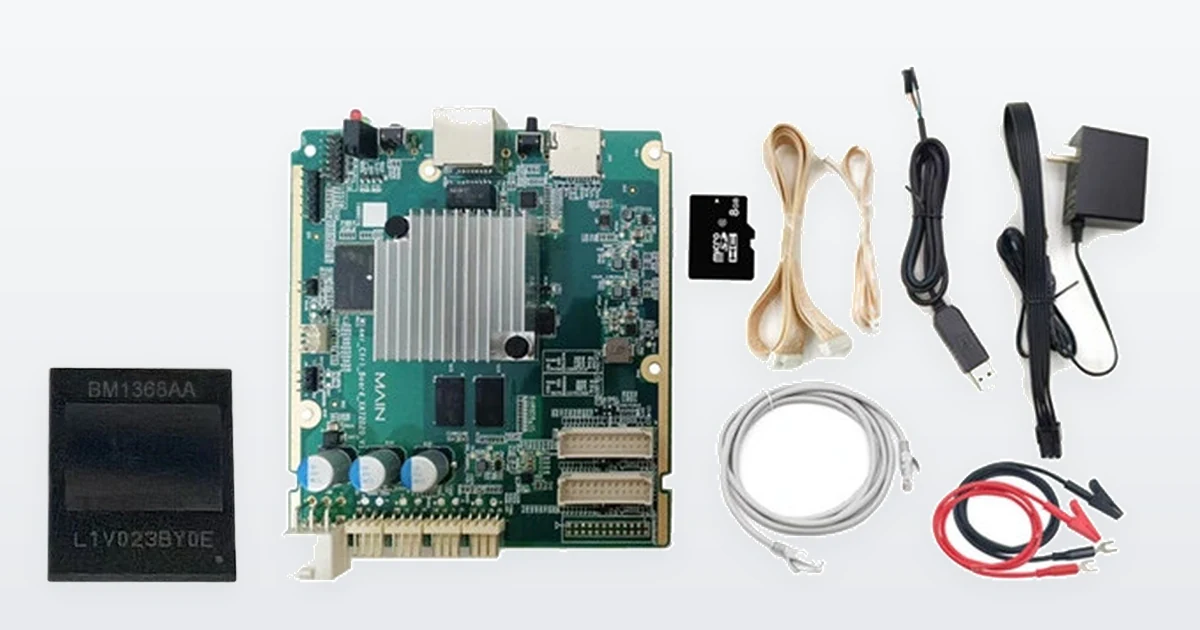
- Hash boards contain multiple ASIC chips soldered in rows. A single hash board might carry 30 to 100+ individual chips, and a miner typically uses two to four hash boards. The chips work in parallel, each independently running hash computations to maximize total throughput.
- The control board acts as the brain of the miner. It coordinates all chip operations, manages communication with your mining pool, and monitors chip status in real time. Control board errors can degrade performance even when every ASIC chip is physically healthy, which is a common source of confusion during troubleshooting.
- The power supply unit (PSU) converts AC wall power to the DC voltages the hash boards and control board require. Mining rigs draw consistent, high-amperage loads, so PSU quality and sizing directly affect stability.
- The cooling system removes the heat generated by chips running at full load. Most ASIC miners use high-speed axial fans. Some advanced deployments use immersion cooling, where miners are submerged in dielectric fluid for more efficient heat transfer.
The integrated system design of hash boards, control boards, cooling, and power supplies is what makes ASIC miners purpose-built machines rather than general computers with a mining program installed.
If a miner is underperforming, check the control board firmware and pool connection before assuming chip failure. A misconfigured control board is one of the most common causes of reduced hashrate that gets misdiagnosed as a hardware defect.
How do mining chips compare to CPUs and GPUs
The performance gap between ASIC chips and general-purpose processors is not marginal. It is orders of magnitude. The reason comes down to silicon allocation. A CPU like Intel’s Core i9 or AMD’s Ryzen 9 dedicates most of its transistors to branch prediction, cache management, floating-point operations, and instruction decoding. None of that is useful for SHA-256 hashing. A GPU like NVIDIA’s RTX 4090 is better at parallel computation, but it still carries significant overhead for graphics rendering pipelines.
An ASIC chip dedicates 100% of silicon to hash computation for its target algorithm. The result is a performance and efficiency advantage that general-purpose hardware simply cannot match.
| Hardware type | Typical hashrate (SHA-256) | Energy efficiency | Algorithm flexibility |
|---|---|---|---|
| CPU (e.g., Intel Core i9) | Under 100 MH/s | Very poor | High |
| GPU (e.g., NVIDIA RTX 4090) | Under 1 GH/s | Poor | Moderate |
| ASIC (e.g., Bitmain Antminer S21) | 200+ TH/s | ~17.5 J/TH | Very low |
The Antminer S21 achieves around 17.5 J/TH, a level of efficiency that CPUs and GPUs cannot approach for Bitcoin mining. That efficiency gap is the reason Bitcoin mining shifted entirely to ASIC dominance years ago. Running a GPU rig for Bitcoin today would cost far more in electricity than you would earn in block rewards.
The trade-off is flexibility. An ASIC chip built for SHA-256 cannot mine Ethereum Classic (Ethash) or Monero (RandomX). If the algorithm your miner targets becomes less profitable, you cannot repurpose the hardware. That is a real consideration when planning your operation, and it is why choosing the right ASIC model for your target coin matters from day one.
What are the design principles behind modern mining chips in 2026
Modern mining chip design is driven by three constraints: transistor density, power delivery, and thermal management. Advancing on any one of these without addressing the others creates instability, not performance gains.
The most significant recent development is the move to smaller process nodes. In 2026, companies like BGIN have achieved first-pass silicon success for 4nm ASIC chips, representing a meaningful step forward in transistor density and efficiency. Smaller nodes pack more transistors into the same die area, which increases hashrate without proportionally increasing power draw.
Key design principles shaping today’s mining chips include:
- Process node advancement. Moving from 7nm to 5nm to 4nm reduces the physical size of transistors, improving both speed and energy efficiency per hash operation.
- Thermal stability under load. Mining chips run at sustained maximum load, not the burst loads typical of consumer electronics. Chip designs must account for continuous heat generation without throttling.
- Electrical margin management. Thermal and electrical stability are critical when tuning chips. Pushing clock frequencies higher increases hashrate but also increases heat and power draw. Exceeding the chip’s thermal or voltage limits causes errors, throttling, or permanent damage.
- Hash board layout optimization. Chip placement on hash boards affects signal integrity and heat distribution. Engineers balance chip density against airflow paths to keep temperatures uniform across the board.
The practical implication for you as a miner is that newer-generation chips deliver more TH/s per watt, which directly reduces your electricity cost per unit of mining output. However, newer hardware also carries a higher purchase price. The power consumption trade-off between acquisition cost and operating efficiency is the central calculation in any hardware decision.
When evaluating a new ASIC model, calculate your break-even point at your actual electricity rate before purchasing. A chip with 10% better efficiency only improves your margin if the hardware cost does not extend your payback period beyond a reasonable timeframe.
What are the real benefits and challenges of mining chip technology
ASIC miners simplify deployment compared to GPU rigs in several meaningful ways. You receive a single, self-contained unit with a fixed power draw, a known hashrate, and a straightforward network configuration. There is no operating system to maintain, no driver conflicts, and no GPU compatibility issues. For anyone scaling beyond a few machines, that operational simplicity has real value.
The practical benefits of ASIC-based mining chip technology include:
- Predictable power draw. ASIC miners operate at a consistent wattage, making electrical planning straightforward. You know exactly what circuit capacity you need before you install the hardware.
- High hashrate density. A single ASIC miner delivers more SHA-256 hashrate than hundreds of GPUs while occupying far less physical space.
- Lower maintenance complexity. Compared to GPU rigs with multiple cards, risers, and operating system dependencies, ASIC miners have fewer failure points in normal operation.
- Established support ecosystems. Manufacturers like Bitmain and MicroBT provide firmware updates, replacement parts, and repair documentation for their major product lines.
The challenges are equally real and should not be minimized:
- Noise and heat output. ASIC miners generate significant noise and heat, comparable to industrial equipment. Running them in a residential space without proper ventilation and sound management is not practical.
- Algorithm lock-in. A SHA-256 ASIC cannot be repurposed for a different mining algorithm. If you are mining Bitcoin and network conditions change, your hardware options are limited to selling or continuing.
- Hardware cost and depreciation. ASIC miners in 2026 range from several hundred to tens of thousands of dollars, and newer, more efficient models continuously reduce the relative value of older hardware.
- Testing and verification matter. Every unit should be tested before deployment. At Ingmining, we inspect and verify each miner before it ships because undetected chip failures or control board issues destroy profitability quietly over time. Testing ASIC Miners: The Measurements That Matter covers the measurements to take before you commit to a setup.
What I’ve learned from years of working with ASIC mining hardware
The most common mistake I see from miners at every scale is treating ASIC hardware as a set-and-forget investment. It is not. Mining chips run at sustained maximum load for months or years. That kind of stress reveals manufacturing defects, cooling inadequacies, and power delivery problems that never show up in a spec sheet.
The second thing I have learned is that efficiency metrics matter more than raw hashrate for most operators. A chip with a slightly lower TH/s figure but meaningfully better J/TH will outperform a faster chip in net profitability at almost any electricity rate above $0.05 per kWh. Miners who chase peak hashrate without running the efficiency math often end up with hardware that looks impressive on paper but loses money in practice.
Stable power and a reliable internet connection are non-negotiable. I have seen miners lose days of output to unstable pool connections or voltage fluctuations that caused repeated reboots. Neither problem is glamorous, but both are fixable with proper infrastructure planning before you deploy.
Finally, depreciation is real and faster than most people expect. A top-tier ASIC today will be mid-tier in 18 months and potentially uneconomical in 36 months as newer process nodes arrive. Buy hardware with a clear payback timeline in mind, not an assumption that it will hold value indefinitely.
— Nick
Matching the parts to a machine you own
If you are ready to move from understanding mining chip technology to actually building or expanding your operation, the hardware you choose determines your outcome more than almost any other factor. Ingmining’s expert-reviewed 2026 mining hardware comparison covers the top ASIC models available today, with real efficiency data, power requirements, and cost analysis to help you make a grounded decision. For a deeper look at whether mining makes financial sense for your specific situation, the mining profitability guide walks through the key cost and revenue variables you need to evaluate before committing capital.
FAQ
What are the four main parts of an ASIC miner?
Hash boards, a control board, a power supply and a cooling system. The hash boards carry the ASIC chips that do the hashing, the control board runs them and talks to your pool, the power supply feeds them, and the fans or hydro loop keep them inside their temperature window. A fault in any one of the four caps or stops the whole machine, which is why a miner that has “died” is usually one replaceable part away from working.
How do mining chips generate cryptocurrency rewards?
Mining chips repeatedly hash a block header combined with a changing nonce value until the resulting hash falls below the network’s difficulty target, which constitutes valid proof-of-work. When a valid hash is found, the miner submits it to the network and earns the block reward.
Why are ASIC miners more efficient than GPU miners for Bitcoin?
ASIC chips dedicate 100% of their transistors to SHA-256 hash computation, while GPUs allocate silicon to graphics rendering pipelines and other general tasks. The Antminer S21, for example, achieves around 17.5 J/TH, a level of efficiency no GPU can reach for Bitcoin’s algorithm.
What is the latest advancement in mining chip technology?
In 2026, companies like BGIN have achieved first-pass silicon success with 4nm Bitcoin mining ASIC chips, representing the current frontier in transistor density and energy efficiency for mining hardware.
What are the main challenges of running ASIC miners?
ASIC miners produce substantial heat and noise, require stable high-amperage power supplies, and are locked to a single mining algorithm. Hardware depreciation is also significant, as newer chip generations continuously reduce the competitive value of older models.
Related reading
- What Is an ASIC Chip? Key Mining Benefits Explained
- How to Vet an ASIC Seller: Serials, Payment and Paperwork
- ASIC Mining: Why It Matters for Home Miners
- Types of Mining Algorithms: Boosting ASIC Efficiency
Read the silkscreen before you order any of these: our Antminer parts compatibility guide explains why the BHB code printed on the board decides what fits, and the model name on the lid does not.
Hashboards, fixtures and chips we stock
If you are doing this work yourself rather than sending the machine away, these are the fixtures and boards we keep on the shelf:
- Five – Bitmain BM1368AA ASIC Chip for Antminer S21 T21 S21hyd Replacement
- Used Bitmain Antminer S19 XP Pro 141TH/s Hashboard | AS-IS For Parts/Repair
- Whatsminer M20 M30 Series Test Fixture Diagnostic Tool Hash Board Tester
More in Need Parts, or the full ASIC miner inventory.