
Bitmain Antminer: S21, S19, L7, L9 and KS-Series Miners
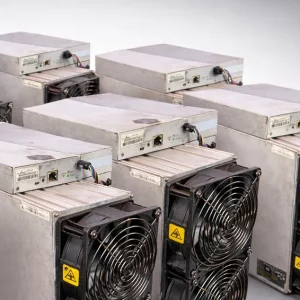
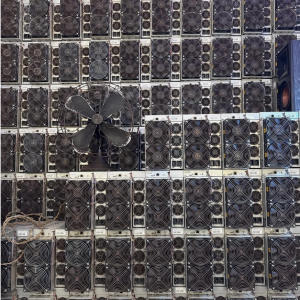
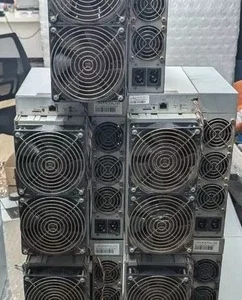
Every Bitmain Antminer we stock, on one shelf: S21 and S19 Bitcoin machines with fleet lots and S23 preorders, the L7, L9 and L11 Scrypt miners for Litecoin and Dogecoin, and the altcoin range — K7 on Eaglesong, KS7 and KS5 Pro on Kaspa, D9 on Dash. Antminer is the most widely deployed mining hardware in the world, which matters for a practical reason beyond performance: parts, firmware and repair knowledge are easier to come by than for anything else you can buy.
-
-
Add to WishlistAdd to Wishlist
-
Add to WishlistAdd to Wishlist
-
Add to WishlistAdd to Wishlist
-
Add to WishlistAdd to Wishlist
-
Add to WishlistAdd to Wishlist
-
Add to WishlistAdd to Wishlist
Decoding the model names
Bitmain’s naming tells you most of what you need before you open the spec sheet.
The letter tells you what it mines
This is the first thing to read and the easiest to get wrong, because the letter looks like a series and behaves like an algorithm. S is SHA-256, which is Bitcoin. L is Scrypt — the L7, L9 and L11 merge-mine Litecoin and Dogecoin and cannot mine Bitcoin at all. K is Eaglesong for Nervos CKB, KS is KHeavyHash for Kaspa, and D is X11 for Dash. An L9 is not a newer S9 and a K7 is not a cheap S7; they are different machines for different chains, and no firmware changes that.
The units move with the letter, which is the other trap. SHA-256 and the Kaspa and CKB machines are quoted in J/TH; the Scrypt machines are quoted in J/MH or J/GH. An L9 at 0.21 J/MH is 210 J/GH, and comparing that against an S21 Pro’s 15 J/TH is arithmetic with no meaning. Efficiency only ranks machines mining the same coin.
The number is the generation. S19 is the 2020 generation, S21 the current one, and S23 the next — the S23 machines listed here are preorder, not stock on a shelf. The efficiency gap between them is the whole buying decision: a stock S19 is about 34 J/TH, an S21 Pro is 15 J/TH and an S21 XP is 13.5 J/TH.
The suffix is the tier. Plain, then Pro, then XP, in increasing efficiency. k as in S19k Pro is a cost-reduced variant — 115 TH/s at 2,645 W, or 120 TH/s at 2,760 W, both 23 J/TH, which puts it between the S19 and S21 generations. A trailing + means a mid-cycle uplift.
Hyd and IMM are cooling, not performance. Hyd is hydro-cooled, IMM is immersion. Both hit efficiency numbers air cannot, and neither will run on a bare concrete floor. See hydro cooling and immersion cooling, or stay with air-cooled Antminers if you are plugging into an existing room.
Which one is actually worth buying
If you pay retail power, buy the most efficient machine you can afford and nothing else — an S21 XP or S21 Pro. If you have cheap power and space, refurbished S19-class hardware is still the better return per dollar, and it is what most of our fleet lots are. The middle of the range is the awkward part: an S19k Pro at 23 J/TH is a reasonable home machine and a poor industrial one.
A word on boosted units
Several listings here and in used ASIC miners run VNish or Braiins firmware above factory hashrate. A factory S19 is 95 TH/s; anything advertised at 105, 110 or 130 TH/s is overclocked and pulls well above the 3,250 W factory figure. Real numbers, real trade-off — but size your breakers off measured wall draw, not the title.
The Bitmain ladder in efficiency order
The suffixes tell you the ordering; these are the numbers behind it, for the SHA-256 Antminers on this page, ranked by the electricity price at which each one stops earning. It covers the S-series only, and deliberately: the threshold below is Bitcoin hashprice divided by a machine’s J/TH, and the same division for an L9 or a KS7 needs a Litecoin, Dogecoin, Kaspa or CKB revenue figure we have not measured. We would rather leave those machines out of the ladder than put a number under them we cannot show our working for. The hashprice behind those thresholds is $32.18/PH/day. We took it on 9 August 2026 off the previous 144 blocks, with Bitcoin at $64,959, difficulty at 127.48 T and roughly 912 EH/s on the network. Re-run the division on the day you commit; it will have moved.
Current generation. The S21+ Hyd 358T at 13.4 J/TH breaks even at 10.0¢/kWh. The S21 Pro 245T and the 234T at 15.0 J/TH break even at 8.9¢. The S21+ 216T and the 235T at 16.5 break even at 8.1¢.
The S19 generation. The S19 XP+ Hyd 293T and the 3U 558T at 19.0 J/TH break even at 7.1¢; the S19 XP Hyd 257T at 20.8 at 6.4¢; the S19K Pro 115T and 120T at 23.0 at 5.8¢; a factory-spec S19 95T at 34.2 at 3.9¢.
Not yet on our bench. The S23 318T and S23 Hyd 580T are preorders. Bitmain gives them 11 and 9.5 J/TH, which would land their thresholds at 12.2¢ and 14.1¢. Neither figure is one we have measured.
Read the ladder rather than the badge. Hydro shows up at 13.4 J/TH and again at 20.8, because Hyd describes how the heat leaves the machine and not what generation of chip is inside it — an S19 XP Hyd is S19-generation hardware with a plumbing requirement attached, and it will not out-earn an air-cooled S21 Pro that plugs into a room you already have.
Why an Antminer is the easiest one to keep alive
That line gets asserted by every dealer, so here is ours with a number on it. Our repair parts shelf runs to 39 listings. Twenty-eight of them name a Bitmain machine and nothing else: hashboard test fixtures covering the S9, S15, T15, S17, T17, S19 and T19, the AMLOGIC control-board unlock kit for the S19 family, APW12 and APW17 supplies plus an APW12 tester, a genuine Bitmain control board, S19-to-S21 dual fan assemblies, BM1368AA chips for the S21 and T21, and tested S19 hashboards sold on their own. Four name a different manufacturer and no Bitmain model at all — a WhatsMiner M20/M30 fixture, an IceRiver KS-series fixture, an Avalon 1166 Pro control board and a PSU for Goldshell boxes. The remaining seven are two cross-brand testers and five pieces of test and cooling hardware that name no manufacturer. Counted again on 15 August 2026; the shelf moves, so re-count it before quoting it.
That ratio is not a preference of ours, it is the market: Antminer is the most deployed SHA-256 hardware in the world, so the fixtures, the firmware and the people who know the failure modes all exist for it first. In practice it decides what happens on the bad day. A dead hashboard on an Antminer is a diagnosis, a part and an afternoon. On hardware nobody makes a fixture for, it is a machine you are quietly deciding whether to keep.
What the machine needs from the room
Power. Air-cooled Antminers in this category are 200–240 V machines, and the Scrypt L9s stretch that to 200–277 V on their own listings. Not one of them is a 110 V machine. Two go further and are worth knowing about before you buy rather than after: the L11 HU2 35G is specified three-phase 380–415 V with an LP34 inlet, and the L11 HU6 33G‘s own listing records that published sources disagree about its supply and refuses to pick one. Neither is a machine you wire on an assumption. An S19 at its factory 3,250 W will not start on a standard North American 120 V outlet, and a firmware-boosted unit draws meaningfully more than the figure on the sticker. Size the circuit off measured draw at the wall. If the only supply you have is 120 V, the conversion kits in repair parts are the honest route and they change what the machine plugs into, not what it produces.
Noise. Expect around 75 dB at full load, continuously. That is fine in a shop, a barn or a container and it is not fine in a house or a shared wall. Nothing on this shelf is the exception: across every machine here that publishes a figure, the range is 72 dB to 80 dB — the L9 15G is the quietest at about 72–74 dB and several L9 listings record up to 80 dB. There is no quiet setting on an S19, an S21, an L7, an L9 or a KS7. If the machine has to live somewhere people sleep, buy from Canaan Avalon or Fluminer home miners instead and accept less hashrate for it.
Airflow and heat. These are front-to-back machines and they need intake air that is cooler than the exhaust they just produced. A closed cupboard recirculates its own heat and throttles. Plan where roughly three kilowatts of heat leaves the building — in winter that is a feature, in August it is the reason a machine derates.
If the room cannot do any of that. Hydro-cooled and immersion machines hit efficiency air cannot and are far quieter, but they are not plug-in hardware: a loop and heat rejection, or a tank and dielectric fluid, has to exist before the miner arrives. Do not buy one on the assumption you will sort the infrastructure out afterwards.
Who this category suits, then. Anyone with a 240 V circuit and somewhere the noise does not matter — which covers most single-machine buyers and every site operator — and anyone who values that Antminer parts, firmware and repair knowledge are easier to come by than for any other hardware you can buy.
Keeping them running
PSUs, control boards, fan assemblies, hashboards and test fixtures are in repair parts. Browse all miners.
The Antminer line in this store runs across three generations of Bitcoin hardware and four other algorithms besides. The S21 Pro 245T and the S21+ 216T are current air-cooled SHA-256 machines at 15 and 16.5 J/TH. The Antminer S19k Pro 120TH is the previous generation running a VNish tune — read its description before you buy on the headline number, because an overclock is bought with watts and the watts are the part that decides your margin.
Older Antminers live or die on your electricity price, and a firmware-boosted unit is not the same machine as the factory model it imitates. Both are worked through in our used-miner buying guide.