
ASIC miner cooling: air, hydro and immersion
Buy air-cooled unless you are building a room, and read the cooling
line on the listing before the price line. The difference between the
three is not really thermal performance — it is how much of the cooling
system arrives in the box. An air-cooled miner arrives complete: plug it in and
it runs, loudly. A hydro miner arrives as a sealed cold plate with two hose
fittings and does nothing at all until you have built a loop that can carry
several kilowatts of heat away from it. An immersion machine arrives expecting a
tank of dielectric fluid you do not own yet.
None of the fifteen hydro and immersion machines in this catalogue ships with
its cooling system, and that is normal for the industry rather than a gap in our
stock. It is also the single most expensive assumption a first-time buyer makes.
This page is what each type actually requires, taken from the specification block
each listing publishes, plus the heat every one of them puts into your building.
Two neighbouring questions have their own pages, because they are genuinely
different decisions: which machine is worth
buying on efficiency and running cost, and what circuit it needs. This page is
only about the heat.
The short version, by who you are
If you are buying one or two machines for a garage, a basement or an
outbuilding, buy air-cooled and stop reading here. The two questions that will
actually decide whether you are happy are noise and where the hot air goes, not
cooling technology — and as the price column below shows, every hydro and
immersion machine in this catalogue is quote-only
rather than something you can add to a cart.
If you are filling a room, hydro is worth pricing properly, because at scale
the loop is a shared cost and the noise reduction is real. Our hydro listings
publish figures like approximately
40 dB and “under 60 dB” against
75 dB
or less for the air-cooled machine in the same family. That is the honest
argument for hydro, and it is a facilities argument rather than a mining one.
If you are considering immersion for fewer than a rack of machines, do not.
The tank, the fluid, the pumps and the heat exchanger do not get cheaper because
you only put one miner in them.
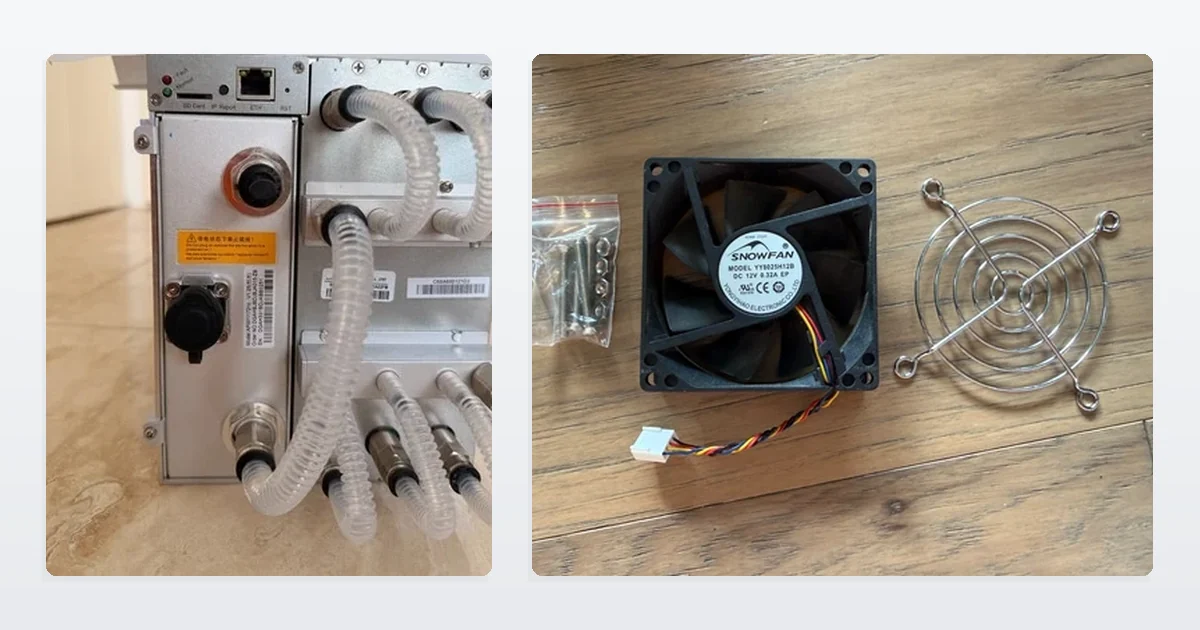
What each cooling type makes you build
Air. Nothing, mechanically — the fans and heatsinks are
in the chassis. What it makes you build is a room: somewhere that can
take 3–5 kW of heat and 70–75 dB of noise continuously,
with enough intake air that the machine is not breathing its own exhaust. That
is a real constraint and it is where most home deployments actually fail, not at
the miner.
Hydro. A closed loop: pump, heat rejection (a radiator or a
dry cooler), hoses, fittings, a filter, coolant, and something to control it. The
specification that matters is the one people skip — Bitmain publishes a
coolant inlet range of 20–50 °C on its Hyd machines, not
an ambient range. Your loop has to hand the machine water below 50 °C on
the hottest afternoon of the year, not on the mild day you commissioned it. Size
the rejection side for August.
Immersion. A sealed tank, dielectric fluid, circulation
pumps, a heat exchanger, and a power supply designed to be submerged. An
immersion PSU is fanless on purpose — it is cooled by the fluid it sits in,
so the fan apertures are empty. If you see a fanless supply described as faulty,
that is what happened.
In all three cases the miner is the part that arrives finished. Everything
downstream of the heat is yours.
Hydro machines: what each one says it needs
A hydro miner has no fans and no heatsinks you can blow air across. It has a cold plate and two hose fittings, and it is inert until you connect it to a loop that can take its heat away. Nothing in this column ships with a loop. Read the coolant column before the price column.
| Machine | Cooling as the listing states it | Power at the wall | Heat to remove BTU per hour | Input voltage as published | Price |
|---|---|---|---|---|---|
| Bitmain S19 XP+ Hyd 3U 558T – Ultra-Efficient BTC Miner3U rack-mount frame holding two hashing units, which is why it draws 10.6 kW - nearly a whole 12 kW radiator on its own. | Hydro / Water Cooling | 10,600 W | 36,167 | 220-240V | Price on request |
| Bitmain Antminer S21 XP Hyd 473T – 473 TH/s Hydro-Cooled Bitcoin Miner20-50 C coolant inletBitmain publishes a coolant INLET range, not an ambient range. Your loop has to be able to hand this machine water below 50 C on the hottest day of the year, not on the day you commission it. | Hydro-cooling | 8,466 W | 28,886 | 380-415 V AC | Price on request |
| Bitdeer SealMiner A2 Pro Hyd 510/512/514T – Hydro-Cooled Bitcoin Miner5 C - 40 C | Hydro Cooling System | 8,200 W | 27,978 | 200-240V | Price on request |
| Bitdeer SealMiner A2 Pro Hyd 506/508T – Hydro-Cooled Bitcoin Miner5 C - 40 C | Hydro Cooling System | 8,100 W | 27,637 | 200-240V | Price on request |
| Canaan Avalon A1566HA 480T – 480 TH/s Hydro-Cooled Bitcoin MinerThis listing does not itemise an AC input range, and its body states the machine needs industrial three-phase power. A single-phase 240 V branch circuit is not enough. Ask us and we will read the label. | Hydro (liquid) - requires a coolant loop, will not run air-cooled | 8,064 W | 27,514 | Not published — ask us | Price on request |
| Bitdeer SealMiner A2 Pro Hyd 516/518T – 518 TH/s Hydro-Cooled Bitcoin MinerThis listing publishes a power RANGE for the family rather than a figure for the unit - see the listing before you size anything. | hydro / liquid cooling system | 7,900 W | 26,955 | industrial 200-240 V input | Price on request |
| VolcMiner D1 Hydro 30G – 30 GH/s Hydro Scrypt Miner5 C - 45 C ambient~7,600 W (+/-10%) as published on the listing. Not in the comparison table, so this figure is read from the listing itself.Closed-loop, per its own copy. | Hydro-cooling system, designed for high-density mining farms | 7,600 W | 25,931 | 380-415 V (three-phase) | Price on request |
| Antminer L11 HU2 35G – 35 GH/s Hydro Scrypt Miner | Advanced Hydro (Closed Loop) | 5,775 W | 19,704 | Not published — ask us | Price on request |
| Antminer L11 HU6 33G – 33 GH/s Hydro Scrypt MinerThe only machine here that is not purely one thing or the other. Its own spec sheet says hybrid, so that is what this row says. | Hydro + Air combined | 5,676 W | 19,367 | Not published — ask us | Price on request |
| Bitmain Antminer S19 XP+ Hyd 293T – 293 TH/s Hydro-Cooled Bitcoin Miner20-50 C coolant inlet | Hydro-cooling | 5,567 W | 18,995 | 380-415 V AC | Price on request |
| Bitmain Antminer S23 Hyd 580T Mix – 580 TH/s Hydro-Cooled Bitcoin Miner5-40 C (with proper hydro setup)Hydro does not automatically mean three-phase. This one states an ordinary 200-240 V industrial input. | Hydro Cooling System | 5,510 W | 18,800 | 200-240V industrial input | Price on request |
| Bitmain Antminer S19 XP Hyd 257T – Hydro Bitcoin Miner5-40 C operatingListed noise is <60 dB, water-cooled - the quietest figure on any full-size machine in this catalogue. | Hydro-cooling | 5,350 W | 18,254 | 342-418 V AC | Price on request |
| ElphaPex DG Hydro1 20G – 20 GH/s Hydro-Cooled Scrypt Miner (LTC, DOGE)The listing carries 5,200 W +/-10%; ElphaPex distributors publish 6,200 W for the DG Hydro 1. We are not picking the flattering one - both heat figures are shown and we will read the rating label off the unit before you size a loop.Listed noise <=50 dB. | Advanced hydro-cooling system | 5,200–6,200 W | 17,742–21,154 | Not published — ask us | Price on request |
| Bitmain Antminer S21+ Hyd 358T – 358 TH/s Hydro-Cooled Bitcoin Miner20-50 C coolant inlet | Hydro-cooling | 4,795 W | 16,361 | 380-415 V AC | Price on request |
Immersion machines: what each one says it needs
An immersion machine is built to run submerged in dielectric fluid. The tank, the fluid, the pumps and the heat rejection are all yours to build, and the fluid alone is usually the largest single line in that budget.
| Machine | Cooling as the listing states it | Power at the wall | Heat to remove BTU per hour | Input voltage as published | Price |
|---|---|---|---|---|---|
| Bitmain Antminer S21 XP IMM 300T – 300 TH/s Efficient Bitcoin Miner5 C - 40 CNo heat figure here on purpose. This listing publishes 5,550 W at 300 TH/s and 18.5 J/TH, which are the Antminer S21 Imm's numbers, while the S21 XP Imm it is named after is a 4,050 W machine at 13.5 J/TH. Until we confirm which unit is actually on the shelf, sizing a tank off either figure would be guessing. It is excluded from the comparison table for the same reason. Ask us.IMM is immersion: built to run submerged in dielectric fluid rather than air-cooled. The tank, the fluid, the pumps and the heat-rejection loop are all things you build around it, and none of them are part of this listing. Its own copy also declines to print a breaker size, because the current per line depends on whether your 342-418 V supply is single- or three-phase and the listing does not state which. | Advanced IMM cooling | See listing | — | 342-418 V AC | Price on request |
The other half of the system, which you also have to buy
Every machine in the tables above is quote-only. These are not, and they are the parts people forget to budget for: the loop has to give its heat to something, and a submerged machine needs a power supply built to sit in fluid.
| Part | What it does | Price |
|---|---|---|
| 12KW Intelligent ASIC Water Cooling Radiator 15-Fan Brushless Pump Miner12 kW rated, 15 fans, brushless circulation pump, coolant reservoir and temperature control that tracks water temperature. | Rejects the heat a hydro loop collects | $999.99 |
| 12kW Radiator Auto Temperature Control – Smart Cooling for Mining & Industrial Systems12 kW rated with automatic temperature regulation. | Rejects the heat a hydro loop collects | Price on request |
| APW12 10000W Immersion Cooling PSU Power Supply for ASIC Bitcoin MinerAPW12 form factor, 10,000 W, 12-15 V DC out, conformal-coated PCB, two AC inlets. Fanless on purpose - an immersion PSU is cooled by the fluid it sits in, so the fan apertures are empty. | Powers a submerged machine | $849.99 |
| APW12 10000W Immersion Cooling PSU Power Supply for ASIC MinerAPW12 form factor, 10,000 W, built for submerged overclocking rigs. | Powers a submerged machine | $799.99 |
Hydro-cooled stock → · Immersion stock → · Compare every machine on efficiency → · Browse everything in stock →
Where the heat actually goes
A miner does no mechanical work and stores nothing, so essentially every watt
it draws leaves the box as heat. That makes the arithmetic unusually simple:
watts × 3.412 = BTU per hour. It is the same number in
different units, not an estimate, which is why we are willing to print it.
The consequences are worth stating plainly, because they are the part buyers
underestimate:
- A 3,510 W air-cooled Antminer S21 Pro puts out about
11,976 BTU/hr. A large window air conditioner is rated around
12,000 BTU/hr, so one miner will fully occupy one air conditioner —
and that air conditioner will itself draw power you also pay for. - An 8,466 W S21 XP Hyd is about 28,886 BTU/hr, roughly
2.4 tons of cooling for a single machine. - The 10,600 W S19 XP+ Hyd 3U is about 36,167 BTU/hr, which is
why it is a 3U rack machine with two hashing units in one frame rather than
something you put in a spare room.
The practical rule that follows: size your heat rejection from the
total wattage on the loop, not from the number of machines. A 12 kW
radiator does not cool “a few miners”. It rejects 12 kW, and in
this catalogue that is one machine, sometimes with very little margin.
What we would tell you on the phone
We buy, test and resell this hardware, so the failures we see are the ones
that follow from these decisions rather than from the brochure.
Hydro machines are not a home upgrade. They are quieter, and
that is the reason people ask about them — but the quiet costs you a
plumbing project, and in this catalogue every hydro and immersion machine is
quote-only rather than something you can add to a cart. If quiet is what you
actually want, the honest answer is a machine built to be quiet: the
Avalon
Q publishes 45–65 dB depending on power mode, runs on
110–240 V with an integrated supply, and you can buy it today.
Check the voltage and the cooling line together. They are
independent, and assuming one from the other is how people order a machine they
cannot energise. Some of our hydro stock runs on 200–240 V; some needs
380–415 V; one states three-phase without itemising a range at all.
The table above prints exactly what each listing says, and where a listing says
nothing we have left it blank rather than filling it in.
Where a specification is disputed, we will not print it. The
S21
XP IMM is in the immersion table with no heat figure, because its model name
and its specification block describe two different machines and sizing a tank off
the wrong one is an expensive mistake. Ask us and we will confirm which unit is
on the shelf before you commit to anything.
We sell hardware; we do not run your loop. We stock the
rejection and immersion parts listed above and we will talk through what a
machine needs, but the design, the installation and the commissioning of a
cooling system are yours or your contractor’s. If you want help planning a
deployment, that is what our consulting
page is for.
Frequently asked questions
Do hydro-cooled ASIC miners come with the cooling loop?
No. Not from us and not from the manufacturer. A hydro miner ships as a sealed cold plate with two hose fittings, and the pump, the radiator or dry cooler, the hoses, the fittings, the coolant and the controls are all yours to buy and assemble. Four of our hydro listings answer this question on the listing itself for exactly this reason. Budget for the loop before you budget for the machine.
Can I run a hydro miner on a 240 V circuit?
Yes, effectively always – and this page said otherwise until 11 August 2026, because five of our own listings did. Every hydro and immersion machine in this catalogue now publishes a three-phase supply: 380-415 V on the S21 XP Hyd 473T, the S21+ Hyd 358T, the S19 XP+ Hyd 293T, the S19 XP+ Hyd 3U 558T and the Antminer S23 Hyd; 380-480 V on the three SealMiner A2 Pro Hyd bins and on the WhatsMiner M63S, M63S+ and M66S families; 342-418 V on the S19 XP Hyd 257T; and 323-528 V on the Avalon A1566HA. None of them will run on a single-phase 240 V circuit at any breaker size, so if you are pricing a hydro machine against a 240 V feed you already have, the feed is the thing that is wrong, not the breaker. The one unit we still cannot state cleanly is the Antminer L11 HU6, where the published sources genuinely disagree – its listing sets out the disagreement rather than picking a side.
How much heat does an ASIC miner put out?
Essentially all of its input power, because a miner does no mechanical work – watts in, watts of heat out. Multiply the wall wattage by 3.412 for BTU per hour. A 3,510 W air-cooled S21 Pro is about 11,976 BTU/hr, which is more than a typical window air conditioner can remove. An 8,466 W S21 XP Hyd is about 28,886 BTU/hr, or roughly 2.4 tons of cooling for one machine.
Is immersion cooling worth it for a home miner?
No. Immersion means a sealed tank, dielectric fluid, pumps, a heat exchanger and a power supply built to sit in fluid, and the fluid alone is usually the largest line in the budget. It is a technique for a room full of machines where the capital is spread across dozens of units. With one or two machines, air cooling in a space you do not live in is the honest answer.
What is the difference between hydro and immersion cooling?
Hydro keeps the coolant inside the machine: water runs through a cold plate bolted to the hashboards and leaves through two hoses, and the miner itself stays dry. Immersion submerges the whole machine in a non-conductive fluid, which is why an immersion power supply is fanless – it is cooled by the fluid it sits in. Hydro needs plumbing; immersion needs a tank and a fluid inventory.
How many hydro miners will one 12 kW radiator cool?
One big one, or two of the smallest – and the answer is a sum of wattages rather than a machine count. A 12 kW rated radiator rejects about 12 kW. Our hydro machines draw between 4,795 W and 10,600 W each, so one radiator covers a single S19 XP+ Hyd 3U at 10.6 kW with almost no margin, or two S21+ Hyd 358T at 4,795 W each with about 2.4 kW to spare – but two 8,466 W S21 XP Hyd would need nearly 17 kW and one radiator will not carry them. Size the rejection side from the total wattage on the loop.
Where to go next
- Compare every machine on efficiency, power
and running cost — the same catalogue sorted by what it costs to run. - ASIC miner power requirements
— the voltage and breaker each machine needs, which is a separate question
from the heat. - Hydro-cooled stock and
immersion stock. - Parts, testers and cooling hardware —
including the radiators and immersion supplies above. - ASIC miner noise explained
— if quiet, rather than density, is what you are really solving for. - Solar-powered Bitcoin mining — the array and battery each machine needs if the power is not coming from a utility.
- Types of
mining farm — where cooling choice sits inside the larger build. - Power,
cooling and firmware, in order — tuning a machine that already runs. - Support — what we test before a machine ships,
and what to do in the first 48 hours after it arrives.