
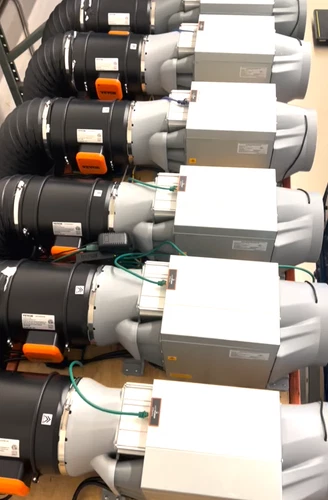
We have both of these on the floor right now, and buyers keep picking the wrong one. A refurbished Antminer S19 boosted to 110 TH/s is $249.99. A used Antminer S19k Pro at a factory 115 TH/s is $379.99. Nearly the same hashrate, $130 apart, and the cheap one looks like the obvious buy. It is not. The S19 burns about 816 kWh a month more than the S19k Pro to produce slightly less Bitcoin, and at any electricity price above about two cents a kilowatt-hour that gap swallows the $130 before the first quarter is out. Buy the S19k Pro unless your power is nearly free.
Here is the whole argument with the numbers shown, including the case where the cheaper machine genuinely wins.
The two machines, exactly as our own listings describe them
Nothing in this table is scraped from a spec site. It is what each listing states, and where a listing states nothing, this says so.
| Antminer S19, boosted | Antminer S19k Pro | |
|---|---|---|
| Price | $249.99 | $379.99 |
| US freight | $49.99 | $49.99 |
| Hashrate | 110 TH/s, firmware-boosted from a 95 TH/s base machine | 115 TH/s, the factory rating |
| Wall power | At least 3,763 W. No metered figure exists for this unit; ask and we will meter it | 2,645 W ±5% at 115 TH/s |
| Efficiency | 34.2 J/TH at best, and an overclock cannot hold that | 23 J/TH ±5% at stock |
| Input voltage | 200–277 V AC | 200–240 V AC only, 20 A |
| Noise | ~75 dB, four fans | 75 dB |
| Silicon | BM1398BB, 76 chips per board, 228 per machine | BM1366, per our used-miner guide; the listing itself does not state it |
| Generation | Launched May 2020 — about six years old | A later generation; the 23 J/TH is the proof |
| Firmware as it ships | Braiins OS | Braiins OS |
| PSU | Not stated. Confirm in writing before ordering | Included |
| Condition | Refurbished: deep-cleaned, new fan covers, parts replaced as needed, one-hour tested | Used, fully tested on our bench |
| Warranty | ING Mining 30-day guarantee, stated on the listing | See the Shipping & buying tab; ask us to put the term in writing |
Two things in that table do the damage, and neither is the hashrate. The S19k Pro reaches 115 TH/s on 2,645 W. The S19 reaches 110 TH/s on 3,763 W if you are lucky. That is 1,118 more watts, forever, for five fewer terahashes.
Where the 3,763 W comes from, and why it is a floor and not a number
Bitmain rates the base S19 at 95 TH/s and 3,250 W, which is 34.2 J/TH. Firmware cannot add hashboards, so getting a base S19 to 110 TH/s means pushing the same 228 chips harder. Scale the factory draw with the hashrate and you get 3,250 × (110 ÷ 95) = about 3,763 W.
That arithmetic assumes the overclock is free, and it never is. Power climbs faster than hashrate on the voltage-frequency curve of every ASIC ever built, so a machine driven to 110 TH/s is worse than 34.2 J/TH, not equal to it. We are using the floor anyway, deliberately: it is the most generous assumption the cheap machine can be given, and it still loses the comparison below. If the real draw turns out to be 4,100 W, its break-even falls from 3.9¢ to 3.6¢ and every conclusion here gets worse for it.
The honest position is that nobody has published a metered figure for this unit at 110 TH/s, including us. Ask before you order and we will put a clamp on it and send you the reading. That is the one number that would settle this page, and it is free.
The electricity gap: 816 kWh a month
At 730 hours a month, the boosted S19 pulls about 2,747 kWh and the S19k Pro about 1,931 kWh. Both figures are the machine only, before PSU losses and before cooling.
| Your power price | S19, monthly bill | S19k Pro, monthly bill |
|---|---|---|
| 3¢/kWh | $82 | $58 |
| 5¢/kWh | $137 | $97 |
| 7¢/kWh (typical hosting) | $192 | $135 |
| 12¢/kWh (cheap US residential) | $330 | $232 |
| 18.44¢/kWh (US residential average) | $507 | $356 |
At hosting rates the S19 costs $57 a month more to run. The entire $130 price advantage is gone in ten weeks, and after that you are simply paying more every month to mine slightly less. There is no version of this where the gap closes back up, because it is a property of the silicon.
Break-even: 3.9¢ against 5.9¢
Break-even is the electricity price at which a machine mines exactly what it costs to run. It is one division — hashprice divided by twenty-four hours of the machine’s own draw — and the hashrate cancels out entirely, which is why efficiency is the only spec that decides it.
Assumptions, stated exactly, because these move every single day: BTC at $65,231, network difficulty 127,479,855,693,691, and a measured 144-block reward giving a hashprice of $32.33 per PH/s per day — $0.0323 per terahash per day — all read on 10 August 2026. Block subsidy plus the fees actually paid on the day, which were adding about 0.5%. Re-run it against your own rate on the day you buy; the method is in our ASIC miner buying guide.
| S19, boosted | S19k Pro | |
|---|---|---|
| Gross mined per day | $3.56 | $3.72 |
| Electricity used per day | 90.3 kWh | 63.5 kWh |
| Break-even power price | 3.94¢/kWh | 5.86¢/kWh |
| After a 2.5% firmware dev fee | 3.84¢/kWh | 5.71¢/kWh |
Read that bottom row before anything else on this page. The S19k Pro has almost two full cents more headroom. In practice that is the difference between a machine that survives a real hosting contract and one that only works behind your own meter. Both units arrive with Braiins OS already installed, and Braiins publishes a 2 to 2.5% dev fee collected in hashing power — on Braiins Pool that is offset against the pool fee, elsewhere it is not. Ask us to confirm the installed version and its fee setting on the actual unit before you pay; on a pre-flashed used machine that setting is a running cost you inherit.
Payback, and the two-cent crossover
Landed cost is $299.98 for the S19 and $429.98 for the S19k Pro, both including $49.99 of US freight. Days to return that, after the dev fee, at today’s hashprice:
| Your power price | S19, boosted | S19k Pro |
|---|---|---|
| 2.0¢/kWh | 181 days | 183 days |
| 2.5¢/kWh | 248 days | 211 days |
| 3.0¢/kWh | 396 days | 250 days |
| 3.5¢/kWh | 979 days | 306 days |
| 4.0¢/kWh | never | 396 days |
| 5.0¢/kWh | never | 954 days |
| 6.0¢/kWh | never | never |
The crossover is at 2.04¢/kWh. Below it, the $249.99 machine returns its money first and is the correct buy. Above it, the $379.99 machine wins at every single rate, and the margin widens fast: at 3¢ the cheaper machine takes 146 days longer to pay for itself despite costing $130 less.
Two cents is not a residential rate and it is not a hosting rate. It is behind-the-meter generation, curtailed wind or solar, flare gas, or a demand-response contract that pays you to be interruptible. If that is you, you already know it. If you are reading a number off a utility bill, it is not you. Your circuit, breaker and voltage requirements for either machine are laid out in our ASIC miner power requirements page.
What the price tag leaves out
Three costs sit outside both listings, and all three run against the cheaper machine.
The power supply. The S19k Pro ships with a PSU. The S19 listing does not state that one is included, so this page does not claim one is — and a boosted S19 asks more of its supply than a stock one, so the rating matters as much as the presence. A stock S19 PSU is a 3,250 W-class unit; you are asking it for 3,763 W or more, continuously. Confirm the PSU, its rating, the cord and the plug standard with us in writing before you order.
The circuit. At 240 V the boosted S19 draws about 15.7 A. The continuous-load rule puts a breaker at 125% of that — 19.6 A of a 20 A breaker, with nothing at all in reserve, and the real draw is above the floor we used. Plan a 30 A circuit. The S19k Pro draws about 11.0 A, which is 13.8 A after the same rule and sits comfortably on the 20 A supply its listing calls for. If an electrician has to run one more heavy circuit for you, that alone is larger than the $130.
The heat and the noise. Both machines are about 75 dB and neither will run on a North American 110 V outlet under any adapter. But the S19 turns 1,118 more watts into heat in the same room, and it is louder in practice because those fans run harder. Neither belongs in a house. If that is what you actually need, read the Avalon Q versus S19k Pro head-to-head instead — the Avalon Q is the one that runs on household voltage at about 45 dB.
612 days to the halving
Block 1,050,000 is about 612 days away, roughly twenty months. On that day block revenue halves and the power bill does not. Holding price and difficulty still, break-even goes from 3.94¢ to 1.97¢ on the S19 and from 5.86¢ to 2.93¢ on the S19k Pro. That is the deadline every used machine on the market is racing, so the right question is not what either one earns per day — it is what it clears in total before that date.
| Your power price | S19, total by the halving | S19k Pro, total by the halving |
|---|---|---|
| 2.0¢/kWh | +$717 | +$1,012 |
| 2.5¢/kWh | +$440 | +$817 |
| 3.0¢/kWh | +$164 | +$623 |
| 3.5¢/kWh | −$112 | +$429 |
| 4.0¢/kWh | −$389 | +$235 |
| 5.0¢/kWh | −$942 | −$154 |
Net of the purchase, net of the freight, net of the dev fee. Notice that the S19k Pro clears more money at every rate, including the two-cent one where it pays back two days slower — because paying back sooner and earning more are not the same thing. Notice also that both columns go red well before any ordinary electricity price, which is the real state of six-year-old SHA-256 hardware in 2026 and the reason these are $250 and $380 machines rather than $2,500 ones.
So which one should you buy?
- Power under about 2¢/kWh, behind your own meter: the boosted S19 at $249.99. It pays back first, it puts the least capital at risk, and cheap watts are exactly the condition that forgives 34 J/TH. Get the metered draw from us first and size the circuit for 30 A.
- Power between 2¢ and about 5.7¢/kWh — which is every hosting contract worth signing: the S19k Pro at $379.99, without hesitating over the $130. It has two cents more headroom, it comes with its own PSU, it fits a 20 A circuit, and it clears three to four times as much money before the halving.
- Power above about 5.7¢/kWh: neither. Not as a compromise, not “just to try it”. Above that rate both machines mine less than they cost to run, every day, forever. Spend the money on a current-generation miner — the comparison table ranks everything we stock by the power price it breaks even at — or spend it on nothing.
- It has to live where people live: neither. 75 dB and 200 V minimum, both of them, and no adapter changes either fact.
- You want to learn to repair these: the S19, and this is a real answer rather than a consolation. It is 228 accessible BM1398BB chips on three boards, it is the most documented machine in mining, and at $249.99 a mistake costs less than the test fixture you make it with. Our repair-part prices and the point at which a board stops being worth fixing are in used vs new ASIC miners.
One more option worth naming, since it undercuts our own argument in the S19’s favour: a stock-rate 95 TH/s S19 is a better economic buy than a boosted one. Fewer terahashes, the same 34.2 J/TH the boosted machine can only aspire to, and a smaller bill. We keep those on the used ASIC miner shelf too. Boosting a base S19 buys headline hashrate and sells efficiency, and efficiency is the spec that decides whether you make money.
If you are weighing either of these against something newer, the S19 XP versus S21 Pro comparison runs the same arithmetic a generation up, and how to buy a used ASIC miner carries the break-even table for every used S19 variant we stock. We bench every machine before it ships — the six-step procedure is published in full — so if you want the measured hashrate and the measured draw on the specific unit rather than the number in the title, ask. +1 (781) 577-0377 or ns@ingmining.com.
Questions buyers ask about these two
Is 110 TH/s on an S19 the same as an S19 Pro?
No. Bitmain’s S19 Pro reaches 110 TH/s on 114 chips per hashboard; the base S19 has 76. Firmware cannot add chips, so a base S19 driven to 110 TH/s produces the same headline hashrate at a much worse efficiency and a higher bill. Our listing for this unit is the boosted base machine, and it says so.
Why does the cheaper miner cost more to own?
Because the S19 needs at least 3,763 W to make 110 TH/s and the S19k Pro needs 2,645 W to make 115 TH/s. That is about 816 kWh a month more electricity for slightly less Bitcoin. At 7¢/kWh the difference is roughly $57 a month, so the $130 saved on the purchase is gone in about ten weeks.
At what electricity price is the $249.99 S19 the better buy?
Below about 2.04¢/kWh. At that rate the two machines pay back within two days of each other and below it the cheaper one wins. Two cents means behind-the-meter generation, curtailed renewables or flare gas, not a utility bill. Above two cents the S19k Pro returns its money sooner at every rate.
Can either of these run on a normal household outlet?
Neither. The S19 takes 200 to 277 V and the S19k Pro takes 200 to 240 V, and no adapter converts a North American 120 V outlet into either. Both are also about 75 dB. If the machine has to share a building with people, the Avalon Q is the one that runs on household voltage at roughly 45 dB.
Does the boost make the machine more efficient?
Never. Power rises faster than hashrate on the voltage-frequency curve of every ASIC, so a boosted machine is always worse per terahash than the same machine at stock. A boost buys hashrate and sells efficiency. It is worth running only when your electricity is cheap enough that efficiency has stopped being the constraint.
Will these still be worth running after the halving?
On these figures, only with very cheap power. Block 1,050,000 is about 612 days away, and when the subsidy halves the break-even rate halves with it — to about 1.97¢/kWh for the boosted S19 and 2.93¢/kWh for the S19k Pro. Judge either machine on what it clears before that date, not on what it earns today.