
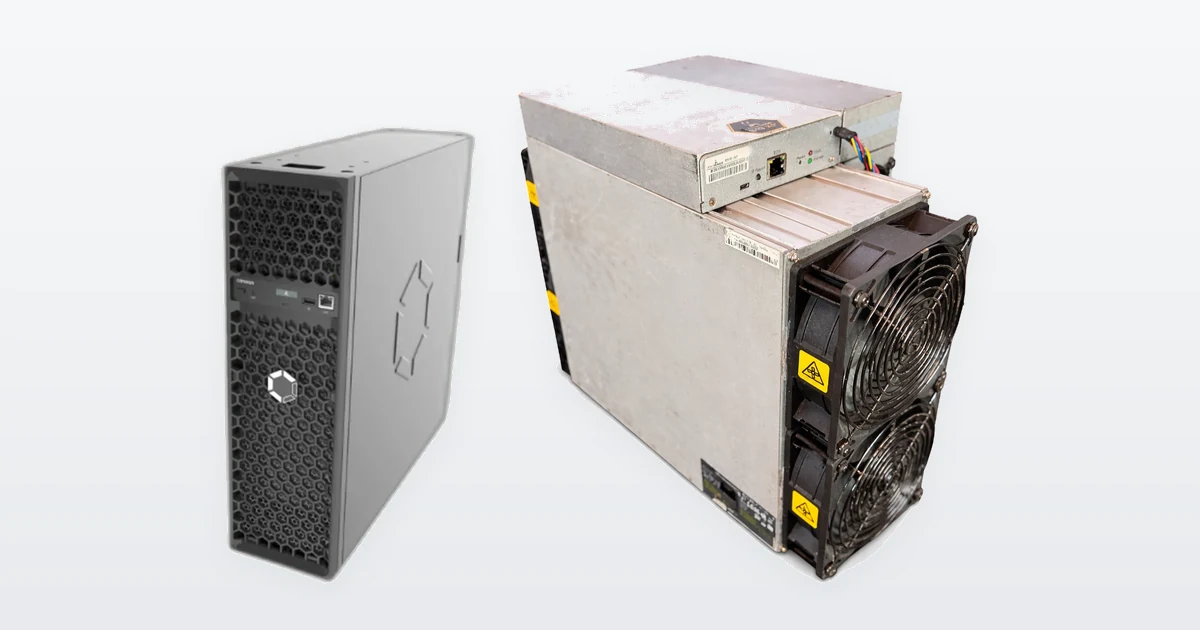
If you are choosing between a Canaan Avalon Q and a Bitmain Antminer S19k Pro, the decision is almost never about hashrate. It is about where the machine has to live and what you pay for electricity. The Avalon Q vs Antminer S19k Pro question has a clean answer at both ends: if the miner is going in a house, an office or anywhere on 120 V service, buy the Avalon Q, because the S19k Pro physically cannot run on a North American household outlet and would be intolerable in a living space if it could. If you have 240 V, a garage or a hosted rack, and electricity under about 3.8 cents, buy the S19k Pro, because it will out-earn the Avalon Q every day and cost a fraction as much to acquire.
Between those two extremes it gets more interesting, and the crossover point is a number worth knowing before you spend anything.
The numbers this post is built on
Every figure below is derived from these inputs. They move daily — re-run them on the day you buy.
| Input | Value | Source and date |
|---|---|---|
| Hashprice | $32.71 per PH/s per day | derived, 27 July 2026 |
| Network difficulty | 126.23 T | mempool.space, 27 July 2026 |
| Network hashrate | ~867 EH/s | mempool.space, 27 July 2026 |
| BTC price | $65,230 | 27 July 2026 |
| Fee share of block reward | ~0.69% | Luxor, 13 July 2026 |
| US average residential power | 18.44 cents/kWh | EIA, May 2026 |
| US retail hosting | $0.065–$0.09/kWh all-in | Published host rate cards, 16 August 2026 |
Hashprice is derived rather than copied from a dashboard, using the same formula our ASIC miner buying guide sets out. As a control, that formula returns $30.88 at the 13 July difficulty and BTC price — which is exactly what Luxor published that day. Nothing here contains a profitability projection; these are today’s rates applied to today’s specs.
Verified specifications, side by side
These are manufacturer and distributor figures, cross-checked across multiple sources. Where sources disagree, both numbers appear rather than the flattering one.
| Canaan Avalon Q 90T | Antminer S19k Pro 120T | |
|---|---|---|
| Hashrate | 90 TH/s (±5% is normal) | 120 TH/s |
| Power draw | 1,674 W at full output | 2,760 W ±5% |
| Efficiency | 18.6 J/TH | 23 J/TH |
| Silicon | 160 chips, 4 nm | BM1366-series (BM1366BS), 5 nm class |
| Hashboard code | not published separately | BHB56902 |
| Input voltage | 110–240 V | 200–240 V |
| Rated noise | 45–65 dB, depending on mode | 75 dB |
| Fans | 2 | 4 |
| Power modes | Eco ~800 W / Standard ~1,300 W / Super 1,674 W | fixed; firmware tuning only |
| Dimensions | 455 × 130 × 440 mm | published as both 400 × 195 × 290 mm and 370 × 195 × 290 mm |
| Weight | 10.5 kg | quoted 12.8–13.0 kg |
| Operating temperature | −5 to 35 °C | quoted 0–40 °C and 5–45 °C |
| Connectivity | Ethernet plus Wi-Fi | Ethernet |
| Power supply | integrated | integrated |
| Manufacturer warranty | 360 days from device registration | expired on any used unit |
Two notes on our own listings, because we would rather correct them in public than quietly. Our Avalon Q page previously stated a 6 nm process and a flat 45 dB noise rating. The verified figures are 4 nm across 160 chips and a 45–65 dB range that depends on which power mode you run. Both have been corrected on the product page. The 45 dB number is what the machine does at its quietest, not what it does at 90 TH/s.
The comparison you can actually make on our floor is new against used
This matters more than it looks. The Avalon Q we stock is new, in quantity, with a live manufacturer warranty. The S19k Pro 120T we stock is used and firmware-tuned. We do carry new S19k Pro listings — 120T and 115T — but they are quote-only listings with no checkout price, so the purchase most buyers are actually weighing is a new Avalon Q against a used S19k Pro. Every capital comparison below assumes that, and it is the single biggest reason the two machines are not interchangeable.
Efficiency: the Avalon Q wins by 24%, and it is not close
Our buying guide derives the one formula that makes J/TH mean something. Hashrate cancels out of it entirely:
Break-even electricity rate ($/kWh) = hashprice ($/PH/day) ÷ (24 × J/TH)
At $32.71 hashprice:
| Machine | Efficiency | Break-even $/kWh |
|---|---|---|
| Canaan Avalon Q | 18.6 J/TH | $0.073 |
| Antminer S19k Pro 120T | 23.0 J/TH | $0.059 |
Above those rates the machine burns more electricity than it produces in Bitcoin, at any hashrate, forever, until hashprice moves. The Avalon Q tolerates 7.3 cents; the S19k Pro taps out at 5.9. That is a 24% wider operating window, and it is the Avalon Q’s single real technical advantage.
It is worth pausing on what that means at a normal power bill. At the US residential average of 18.44 cents, the Avalon Q burns about $7.41 of electricity a day to produce about $2.94 of Bitcoin. The S19k Pro burns about $12.21 to produce about $3.93. Neither is a business. The Avalon Q loses roughly $134 a month and the S19k Pro roughly $249. If your power comes from a normal residential meter, the honest recommendation is that you are shopping for a heater with a rebate, not an investment, and you should read the rest of this page with that in mind.
The 3.8-cent crossover: when more terahash beats better efficiency
Efficiency decides who survives at high power rates. It does not decide who earns more at low ones. The S19k Pro produces 30 TH/s more and consumes 1,086 W more, so there is a rate at which those two facts cancel:
- The S19k Pro’s extra 30 TH/s is worth $0.98 a day at today’s hashprice.
- Its extra 1,086 W costs 26.06 kWh a day.
- $0.98 ÷ 26.06 kWh = $0.0377/kWh.
Below 3.8 cents, the S19k Pro out-earns the Avalon Q every single day. Above it, the Avalon Q does. This is the opposite of what we found when we compared the S21 Pro against the SealMiner A2 Pro Air, where the crossover sat above both machines’ break-even and was therefore useless in practice. Here the crossover lands inside the range where both machines still make money, which makes it a real decision boundary rather than trivia.
That gives four bands, and you are in exactly one of them:
| Your all-in power rate | What happens | Daily margin, Q vs S19k Pro |
|---|---|---|
| Under $0.038 | Both profitable; the S19k Pro earns more | at $0.03: +$1.74 vs +$1.94 |
| $0.038 – $0.059 | Both profitable; the Avalon Q earns more | at $0.05: +$0.94 vs +$0.61 |
| $0.059 – $0.073 | Only the Avalon Q is profitable | at $0.07: +$0.13 vs −$0.71 |
| Over $0.073 | Neither is profitable | at $0.1844: −$4.46 vs −$8.29 |
Note where retail hosting sits. At $0.065–$0.09/kWh all-in, a hosted S19k Pro is past its break-even at every rate in that range before the host has taken any margin, while a hosted Avalon Q is marginal at best — and most hosts will not take a 1.7 kW consumer machine into a rack anyway. Hosting is an S19k Pro answer, and only at the bottom of that range.
The capital side, which the daily margin hides
Daily margin is only half the arithmetic. The other half is what you paid, and the two machines are not remotely in the same bracket — the used S19k Pro sells for a small fraction of a new Avalon Q. We are not going to print prices in a blog post that will still be here in six months; check both listings and do the division yourself:
Months to payback = purchase price ÷ monthly margin at your rate
Run that at 5 cents and the answer is uncomfortable for the Avalon Q. Its margin is higher, but it is recovering many times more capital, so it pays back over years while the S19k Pro pays back in months. Run it at 3 cents and the S19k Pro wins on both axes at once. This is the same conclusion our used ASIC miner buying guide reaches by a different route: cheap used hardware wins on landed cost per terahash whenever you have the power and the tolerance to run it, and loses everywhere else.
The counterweight, and it is a real one: you are buying a used machine with a finite remaining life and no manufacturer warranty, against a new machine with 360 days of coverage. A payback period only counts if the machine reaches it.
The part that actually decides it: can you even plug it in?
This is where most of the real-world decisions get made, and it is not close.
The Antminer S19k Pro accepts 200–240 V. It is not a 120 V machine and there is no setting that makes it one. If your intended location is a standard North American outlet, the S19k Pro is not a candidate at all — you need a 240 V circuit, of the kind a dryer or an EV charger uses, and at 2,760 W it draws about 11.5 A, so a 20 A 240 V circuit is the sensible minimum under the 80% continuous-load rule.
The Avalon Q accepts 110–240 V, which is genuinely unusual and is the reason the machine exists. But “runs on household voltage” is not the same as “runs on any household circuit”:
- Super mode, 1,674 W: about 14 A at 120 V, or 15.2 A if your line sags to 110 V. A 15 A circuit is only rated for 12 A continuous, so this needs a dedicated 20 A circuit with a NEMA 5-20R outlet. Do not run it on a shared 15 A bedroom circuit.
- Standard mode, ~1,300 W: about 10.8 A at 120 V, which fits inside a 15 A circuit’s 12 A continuous limit — on its own, with nothing else on it.
- Eco mode, ~800 W: about 6.7 A at 120 V. Comfortable almost anywhere.
- On 240 V: about 7 A at full output, and the wiring stops being the constraint.
Those three power modes are a bigger deal than the spec sheet makes them look, because they are the only way either machine adapts to the circuit it is on. The S19k Pro has no equivalent short of firmware tuning. One honest gap: we have not found Canaan publishing the hashrate at Eco and Standard, only the wattage, so treat 90 TH/s and 18.6 J/TH as the Super-mode figures. Derating usually improves J/TH and always reduces output, but we are not going to put a number on it that we have not measured. Ask us and we will measure it on a unit before you buy.
Noise and heat: 30 decibels is not a small difference
45–65 dB against 75 dB understates the gap, because decibels are logarithmic. A 30 dB difference is a thousandfold difference in sound power and roughly an eightfold difference in perceived loudness. Even comparing the Avalon Q at its loudest against the S19k Pro, you are still looking at about twice the perceived volume.
In practical terms: the Avalon Q at Eco or Standard is a loud desktop PC and is liveable in a garage, a basement, a workshop or a spare room with the door shut. It is not silent, and at 65 dB in Super mode it is audible through a wall. The S19k Pro is a four-fan industrial machine. It belongs in a garage, an outbuilding or a hosted facility, and anyone telling you it is fine in a house has not tried it.
Heat is the other half of siting, and it is simple arithmetic — every watt becomes heat:
- Avalon Q at full output: ~5,712 BTU/hr
- S19k Pro: ~9,418 BTU/hr
For scale, a 1,500 W space heater — the largest thing you can safely plug into a normal outlet — puts out about 5,100 BTU/hr. The Avalon Q is one of those. The S19k Pro is closer to two of them running continuously. In a cold climate, in winter, that offsets heating you were paying for anyway and genuinely changes the arithmetic above. In July, in a closed room, it is a problem you will have to solve with ventilation.
Parts and repair: the asymmetry nobody puts on a spec sheet
We buy, repair and resell this hardware, so this section is written from the parts shelf rather than from a datasheet.
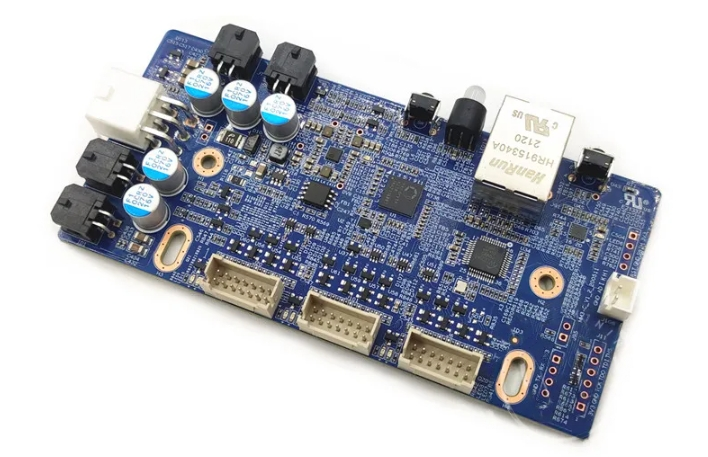
The S19k Pro sits inside the deepest repair ecosystem in Bitcoin mining. Its BHB56902 hashboards carry BM1366-series chips, and we stock the diagnostic gear for exactly that family: a BM1366 series chip tester covering the BS variant these boards use, a K3L hashboard tester for S19 and S21 boards, universal S19-family test fixtures, and a 20-piece hashboard repair kit. A dead board on an S19k Pro is a diagnosable, fixable, sourceable problem, and that is a large part of why used S19-class machines are worth buying at all.
We stock nothing that fits an Avalon Q. The only Avalon part on our shelf is an A1166 Pro control board, which is a completely different machine. That is not a criticism of the hardware — the Q launched in 2025, it is a tightly integrated consumer product, and the third-party repair market for it has not had time to exist. But it is a fact you should price in. If an Avalon Q fails inside 360 days it is a Canaan warranty claim. If it fails in month 13, your options are thin, and we cannot currently promise to fix one for you. If that changes we will update this page.
Everything on our repair parts and test gear shelf is worth a look before you commit to either machine, because it tells you which one you can keep alive. For the S19k Pro side of it specifically, our Antminer parts compatibility guide covers which hashboards, power supplies and control boards actually fit.
Condition, firmware and what each listing does and does not say
The Avalon Q listing is straightforward: new, shipping from the USA, integrated power supply, no separate PSU to buy. Canaan publishes a 360-day warranty running from first device registration, not from purchase, which is a distinction worth caring about — register it promptly. Confirm the power cord type for your region with us before ordering.
The used S19k Pro needs more care, and two things about it need saying plainly.
The “VNish 130TH” figure is a tune, not a spec
Our own listing is titled “VNish 130TH Optimized”, and until today its copy claimed the tune could “improve efficiency”. That was wrong and we have corrected it. Overclocking an ASIC raises power faster than it raises hashrate — that is the shape of the voltage-frequency curve on every chip ever made. A unit pushed from 120 TH/s to 130 TH/s is drawing meaningfully more than 2,760 W and is therefore worse than 23 J/TH, not better. Firmware can buy you hashrate or it can buy you efficiency by underclocking. It cannot buy you both at once.
Every break-even number on this page uses the factory 120 TH/s at 2,760 W, because that is the only figure with a manufacturer behind it. If you are buying a tuned unit, ask us for the measured hashrate and the measured draw at the wall on the actual machine, and size your breakers off the measured number. This is the same trap we describe at length for S19 lots titled “110TH/s” in the used miner guide.
Grade and warranty
The S19k Pro 120T listing does not state a condition grade, and we are not going to invent one here. Ask us in writing for the grade, whether the PSU is included, the board revision and the measured wall draw before you pay. Our S19k Pro 115TH listing does state used-but-fully-tested with a PSU included, which is a more complete disclosure, and there is a ten-unit lot if you are buying at scale. Whichever you take, get the answers in writing — the used-miner guide lists exactly what to demand and why each item matters.
So which one should you buy?
Buy the Canaan Avalon Q if the machine has to live somewhere people also live. It is the only one of the two that runs on North American household voltage, the only one quiet enough to be near a person, the only one with a live warranty, and the only one still profitable in the 5.9–7.3 cent band. If you are mining at home, in an office, in an apartment building’s utility space, or you want a heater that partly pays for itself, this is the machine and it is not a close call. Browse the rest of the Avalon range if you want the smaller Nano3s or Mini3 instead.
Buy the Antminer S19k Pro if you have 240 V, a place where 75 dB is nobody’s problem, and power under about 5 cents. You get 33% more hashrate for a small fraction of the capital, it pays back in months rather than years, and if it breaks you can actually fix it. Under 3.8 cents it beats the Avalon Q on daily margin as well, which means it wins on both axes at once. See the rest of the used ASIC miners and the wider Antminer BTC range.
Buy neither if you pay anything close to 18.44 cents. At the US residential average both machines destroy money every day they run, and no firmware, tune or accessory fixes a break-even rate. The honest options at that point are hosting the machine somewhere cheap, waiting for hashprice to move, or not buying. We would rather tell you that before you order than process the return afterwards.
If you are between the bands, or you want the measured figures off a specific unit before you commit, message us. We would rather sell you the right machine once.
Both machines on this page are rows in our comparison table, and seeing them there makes the 24% gap concrete: the Avalon Q sits at 18.6 J/TH and the S19k Pro at 23, with three other Bitcoin machines between them. The table also carries a used S19k Pro at the same 23 J/TH as the new one, which is the point this page makes about condition — wear does not change a machine’s efficiency, it changes what you pay for it and what it is likely to cost you later.
One machine narrows this gap: the refurbished Antminer S19 XP at 21.35 J/TH is 15% behind the Avalon Q on efficiency where the S19k Pro is 24% behind it, and it still costs about a quarter as much per terahash — $4.96 against $22.21. If the efficiency argument is what is holding you on the Avalon Q, that is the machine that tests it: we put the S19 XP against the S19k Pro in Antminer S19k Pro vs S19 XP.
FAQ
Can the Antminer S19k Pro run on a normal 110 V household outlet?
No. Its input range is 200–240 V and there is no configuration that changes it. Running one at home requires a 240 V circuit like a dryer or EV charger outlet, sized for about 11.5 A of continuous draw, so a 20 A breaker is the practical minimum. Adapters that claim to run a 240 V miner from a 110 V outlet do not reduce the machine’s power demand; they change how it is supplied, and getting this wrong is a fire risk rather than a savings.
Is the Avalon Q really quiet enough to run in a house?
Quiet for an ASIC, yes. Silent, no. It is rated 45–65 dB depending on which power mode you run, so in Eco or Standard it is comparable to a loud desktop computer and liveable in a garage, basement, workshop or spare room. In Super mode at 65 dB it is audible through a wall. It also puts about 5,712 BTU/hr of heat into whatever room you leave it in, which matters as much as the noise.
Which is more profitable, the Avalon Q or the S19k Pro?
It depends entirely on your electricity rate, and the boundary is 3.8 cents per kWh at today’s hashprice. Below that the S19k Pro earns more per day because its extra 30 TH/s outweighs its extra 1,086 W. Between 3.8 and 5.9 cents the Avalon Q earns more. Between 5.9 and 7.3 cents only the Avalon Q makes money at all. Above 7.3 cents neither does. These boundaries move with hashprice, so re-run them on the day you buy.
What electrical circuit does the Avalon Q need?
In Super mode at full 1,674 W it draws about 14 A at 120 V, or 15.2 A at 110 V, which exceeds the 12 A continuous rating of a 15 A circuit. It needs a dedicated 20 A circuit with a NEMA 5-20R outlet. Standard mode at about 1,300 W draws roughly 10.8 A and fits a 15 A circuit if nothing else is on it. Eco mode at about 800 W draws about 6.7 A. On 240 V it draws about 7 A at full output.
Does VNish or Braiins firmware make the S19k Pro more efficient?
Not when it is used to raise hashrate. Overclocking increases power faster than it increases hashrate, so a unit tuned from 120 TH/s to 130 TH/s is less efficient than 23 J/TH, not more. Custom firmware can deliver either more hashrate at worse efficiency or lower power at better efficiency — you choose one. Always ask for the measured hashrate and the measured wall draw on a tuned unit rather than reading the number off the listing title.
What warranty comes with each machine?
Canaan publishes a 360-day warranty on the Avalon Q, running from first device registration rather than from purchase, so register it promptly. A used S19k Pro has no manufacturer warranty remaining — the S19k Pro line launched in 2023. Ask us in writing what coverage we provide on a specific used unit before you pay; do not assume a figure you read elsewhere.
Which one is easier to repair?
The S19k Pro, by a wide margin. Its BM1366-series chips and BHB56902 hashboards sit inside a mature repair market, and we stock chip testers, hashboard testers, test fixtures and repair kits for exactly that family. We currently stock no parts that fit an Avalon Q, and the third-party repair market for it is thin because the machine only launched in 2025. Inside its 360-day warranty that is Canaan’s problem; after that it is yours.
Should I buy either at the US average residential rate?
No. At 18.44 cents per kWh the Avalon Q loses roughly $134 a month and the S19k Pro roughly $249, at today’s hashprice. Both break even far below that. If you have no access to cheaper power, the realistic paths are hosting the machine somewhere in the 5.5–8.5 cent range, buying a machine you also value as a heat source and accepting the running cost, or waiting. Buying either one as an investment at residential rates does not work.