
Hydro-Cooled ASIC Miners and Radiators
Hydro-cooled miners and the cooling hardware to run them — nine MicroBT WhatsMiner hydro units across the M63S and M66S families, Antminer S19 XP Hyd, S19 XP+ Hyd, S21+ Hyd, S21 XP Hyd and the S23 Hyd on preorder, the Canaan Avalon A1566HA, three Bitdeer SealMiner A2 Pro Hyd, the Scrypt hydro machines for Litecoin and Dogecoin, plus radiator units. Nearly everything on this shelf is three-phase. MicroBT rates the M63S and M66S families at 380–480 V AC three-phase with ground; Bitmain rates its Hyd machines at 380–415 V; Bitdeer rates the A2 Pro Hyd at 380–480 V; Canaan rates the A1566HA at 323–528 V; and the hydro Scrypt machines are three-phase too. That is a different electrical service from the 200–240 V single-phase most air-cooled miners run on — not a bigger breaker on the same panel. Water carries heat away from the hashboards far better than air can, which lets these machines hold higher hashrate and better efficiency than any air-cooled equivalent, in a quieter and much denser package.
-
Add to WishlistAdd to Wishlist
-
Add to WishlistAdd to Wishlist
-
Add to WishlistAdd to Wishlist
-
Add to WishlistAdd to Wishlist
-
Add to WishlistAdd to Wishlist
-
Add to WishlistAdd to Wishlist
-
Add to WishlistAdd to Wishlist
Read this first: hydro miners are not plug-in hardware
A hydro miner has no fans and no way to cool itself. Connect it to power without a working loop and you will damage it in minutes. Before you buy, you need a closed coolant loop with adequate flow rate, a dry cooler or other heat rejection sized to the full thermal load, manifolds and quick-disconnects rated for the pressure, treated coolant, and leak detection. That is a facility project with a real budget and a lead time.
We say this plainly because hydro units look like a bargain on a spec-sheet comparison and are not, unless the infrastructure already exists or is genuinely funded.
What you get in exchange
Better efficiency at a given hashrate, because the silicon runs cooler. Far higher density per square foot. Dramatically less noise — no fans means these are quiet in a way no air machine can be. And usable waste heat: a hydro loop outputs hot water, which is genuinely worth something if you have somewhere to put it.
How to choose
Size the loop to the machine, not the other way round. Total kW of the units you plan to run is the number your heat rejection must handle, with headroom for the hottest week of the year.
This shelf is not one manufacturer. Bitmain, Canaan and Bitdeer all build hydro Bitcoin miners, and ElphaPex, VolcMiner and Bitmain’s own L11 build hydro Scrypt machines for Litecoin and Dogecoin — which mine a different coin and cannot be pointed at Bitcoin. Check the algorithm on the listing before the cooling method.
Match the generation. The S19 XP Hyd and S19 XP+ Hyd are the previous generation; the S21+ Hyd and S21 XP Hyd are current and materially more efficient. The S23 Hyd 580T listed here is next-generation and preorder only — it is not stock that can ship this week, so do not build a schedule around it. If you are building a loop from scratch, build it around current-generation hardware — the infrastructure outlives the miners.
Confirm electrical service. These draw well above air-cooled units per box. Verify your service before ordering.
Twenty-one of the 23 miners here need three-phase service
None of them runs on 240 V single-phase. The page above tells you to confirm your electrical service. Here is what there is to confirm, because on this shelf it is not a detail that varies by machine — it is the shelf.
Correction, 14 August 2026, and it reverses what this page used to say. Until today this section sorted these machines into “need 380 V” and “run on ordinary 200–240 V single-phase”, and told a reader with a 240 V building that the Bitdeer SealMiner A2 Pro Hyd range was the shelf for them — “the only part of this page a 240 V service can energise”. That is wrong, and it is wrong in the most expensive direction. All three Bitdeer bins, the S23 Hyd and the S19 XP+ Hyd 3U were re-specified on their own listings against the manufacturers’ published ratings, and every one of them is three-phase. If you sized a service or placed an order off the old wording, tell us what you were quoted and we will work it through with you.
What the listings publish today. Twenty-one of the 23 miners on this shelf state three-phase supply in their own specification: the nine MicroBT M63S and M66S units and the ElphaPex DG Hydro1 20G at 380–480 V; the S21+ Hyd 358T, S21 XP Hyd 473T, S19 XP+ Hyd 293T, S19 XP+ Hyd 3U 558T, S23 Hyd 580T, L11 HU2 35G and VolcMiner D1 Hydro 30G at 380–415 V; all three Bitdeer bins — 506/508T, 510/512/514T and 516/518T — at 380–480 V; and the Canaan Avalon A1566HA 480T at 323–528 V. There is no single-phase 240 V circuit that runs any of them, at any breaker size. Not a bigger breaker, not a different cord.
The two we will not sort, and why. The S19 XP Hyd 257T publishes 342–418 V AC without stating the phase, so we print no amp figure for it — but 342 V is not a 240 V circuit under either reading, and that is the part that decides whether you can buy it. The L11 HU6 33G has distributor sheets giving three-phase 380–415 V at 12 A and others giving 220–277 V single phase at 20 A, and its own arithmetic — 5,676 W on one 220 V phase is about 26 A — breaks the second sheet’s own rating. We will read the label off the actual unit before you size anything.
So what should a 240 V building buy? Not hydro. The honest answer is that if your service is single-phase 200–240 V, this entire category is closed to you until the service changes, and the machine you want is on the air-cooled shelf — the Antminers there, or the WhatsMiner M50S/M60S units, which run on a 20 A two-pole breaker. We would rather lose the hydro sale than sell you a machine your building cannot energise. Full working for all of this is on ASIC miner power requirements.
Sizing heat rejection, using the radiator on this shelf
A hydro miner turns essentially all of its wall draw into heat and hands that heat to the water, so the number your loop must reject is the machine’s wattage. In the unit dry coolers are actually sold in: the S21+ Hyd 358T at 4,795 W is about 16,400 BTU/hr, the S21 XP Hyd 473T at 8,466 W about 28,900, and the S19 XP+ Hyd 3U 558T at roughly 10,600 W about 36,200 — the largest single-box heat load on this page, from a machine that is neither the fastest nor the most efficient on it.
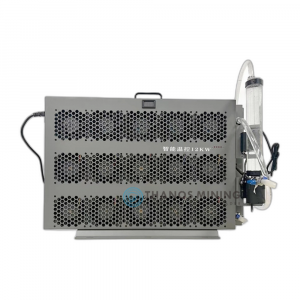
The 12 kW radiator we stock puts that in proportion, because 12 kW is a heat rating and not a miner count. Two S21+ Hyd 358T come to 9.6 kW and fit with real margin. One S21 XP Hyd 473T at 8.5 kW fits comfortably. One S19 XP+ Hyd 3U 558T at 10.6 kW sits at 88 per cent of rating before August has been taken into account, which is not margin, it is a hot loop waiting for weather. And it is a dry cooler, not a chiller: it rejects into the air around it and cannot produce coolant colder than that air. Anyone quoting you a three-machine-per-radiator figure is selling you a throttled summer.
The efficiency spread inside this shelf is 1.55 to 1
Ranked on the figures on their own listings, the non-preorder Bitcoin machines here run: S21+ Hyd 358T at 13.4 J/TH, the two Bitdeer A2 Pro Hyd bins at about 15.9, the Avalon A1566HA 480T at 16.8, the S19 XP+ Hyd 293T at 19 and the S19 XP Hyd 257T at 20.8. Top to bottom that is a factor of 1.55 — and the best air-cooled Antminer we list is 13.5 J/TH, which is to say it is level with the best machine on this page. Water is not the variable. The generation is.
Put those through break-even rate = hashprice ÷ (24 × J/TH), at a hashprice of $32.18/PH/day derived on 9 August 2026 from the last 144 blocks at a Bitcoin price of $64,959, and they stop earning at 10.0¢, 8.4¢, 8.0¢, 7.1¢ and 6.4¢/kWh respectively. Re-run it on the day you buy; hashprice moves daily.
Two figures on this shelf we will not put in that ladder. The S21 XP Hyd 473T is self-consistent at 8,466 W for 473 TH/s, but that is a long way from Bitmain’s published efficiency for a machine of that name, and one of the two is wrong. The A2 Pro Hyd 516/518T gives a power range rather than a figure. Ask us and we will read the plate rather than repeat the sheet. The Scrypt machines are rated in joules per gigahash and belong on a different axis entirely — that ladder is on the Litecoin and Dogecoin page, and comparing 165 J/GH against 13.4 J/TH tells you nothing about either.
Who this suits
Operators with a facility, a heat rejection plan and enough machines to justify the plumbing. Everyone else should buy air-cooled and be happier for it. If you are evaluating tanks instead of loops, see immersion cooling.
Talk to us before you order hydro — we will ask what your loop looks like, and if the answer is “not built yet” we will tell you to wait. Full range: all miners.
Nothing on this page runs on air. The S21 XP Hyd 473T, the S21+ Hyd 358T and the S19 XP Hyd 257T all need a sealed loop, a dry cooler and somewhere for north of five kilowatts of heat per box to go — these are considerably higher-draw machines than their air-cooled equivalents, not the same machine with a water block on it. Hydro is the right answer at scale and the wrong answer for one machine in a garage — if that is what you are doing, air-cooled miners is the category you want.
Efficiency is the one thing hydro does not automatically buy you. On our own ASIC miner comparison table the air-cooled S21 Pro 234T and the hydro SealMiner A2 Pro Hyd 516/518T both read 15 J/TH — at 3,510 W and 7,900 W a box respectively. Hydro buys density and heat you can actually move, not joules per terahash, and the table is sorted so you can check that for yourself.