Search

ASIC Miner Repair Parts, PSUs and Testers

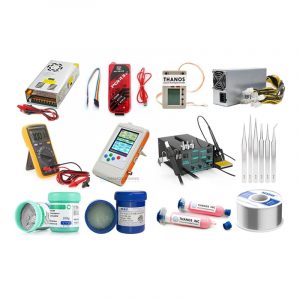
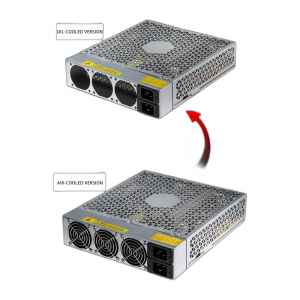
Repair parts, diagnostic fixtures and test gear for ASIC miners — hashboard testers, EEPROM and chip programmers, APW12 and APW17 power supplies, control boards, fan assemblies, replacement BM-series chips, and voltage conversion kits. A small number of listings are units and hashboards sold as-is for parts; those say so in the title and in the description.

Showing 112 of 39 results

Read this before you buy a part

Most dead miners are not dead. In our experience the failures that actually take a machine down, in rough order of how often we see them, are: a failed power supply, a fan that stopped and cooked a board, a corrupted control board, and only then genuine hashboard or chip failure. A tester pays for itself the first time it tells you the board is fine and the PSU is not.

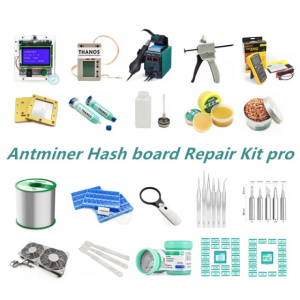
Buy the fixture before you buy the parts. Guessing which hashboard is bad and swapping chips blind is how a repairable machine becomes scrap. A hashboard test fixture, an EEPROM tool and a working known-good PSU will diagnose almost everything on an S19-class machine.

Check compatibility by model, not by generation. Bitmain changed connectors, control boards and chips between and within series. An APW12 is not an APW17. A control board for an S19 is not a control board for an S19j Pro without the right unlock. Every listing here states the models it covers — match that list against your machine, and ask us if your exact revision is not named.

Know when to stop. A hashboard with a handful of dead chips is a repair. A board that has been through a water event, or one with visible burn damage across a voltage domain, is scrap on an S19-generation machine — the labour is worth more than the board. We will tell you honestly which one you have if you send photos.

When a repair is worth doing, and when to harvest

The parts above will fix almost anything on an S19-class machine. Whether they should is a separate question, and it is arithmetic rather than judgement.

A hashboard restores one third of a three-board machine. A whole working machine restores all three. So the rule is short: buy the board only when it costs less than a third of what an equivalent working machine costs you.

That threshold sits low enough that the answer flips inside a single model. A used S19 bought on its own is comfortably worth a replacement hashboard. The same machine bought inside a hundred-unit lot is not — at fleet pricing the board is worth more than the miner, and the right move is to strip the good boards, the supply, the control board and the fans and let the carcass become spares for the rest of the fleet. Two dead boards in a single unit is already marginal once you count your own hours. Three is never worth it at any used price.

The rule inverts completely on current-generation hardware, and that is the argument for buying new that almost nobody makes: on a machine that costs thousands, every part on this page is a rounding error, so it stays worth fixing for its whole service life. On a machine that costs a hundred, almost none of them are. What the extra capital buys is not only efficiency — it is that repair stays rational.

Two things before you spend anything. Diagnose first. A fault you have not isolated is not a hashboard fault yet: all three chains missing at once is far more often the control board, a power rail or a ribbon cable than three simultaneous board deaths, and those are among the cheapest items here. And check the rest of the machine — the rule above assumes the supply and the control board are sound, because a good board fitted to a machine with a failing PSU fails again.

Diagnosis is a cost in its own right, and it scales the wrong way for a single owner. A universal test fixture earns its keep across a fleet and never earns it on one machine. If you own one miner, buy a tested replacement hashboard rather than the equipment to find out which board it is.

A repair has to pay its own power bill

The rule above is a capital test, and on its own it is half the answer. Fitting a hashboard is not a rescue, it is a small purchase of hashrate: you are buying back roughly a third of the machine, and that third burns electricity at the machine’s own efficiency. So it faces exactly the same break-even rate the whole machine does.

On a 95 TH/s S19 — 34.2 J/TH — that rate is 3.9¢/kWh, against a hashprice of $32.18/PH/day derived on 9 August 2026. Below it a replacement board is one of the quicker paybacks in mining — a couple of months of the restored output on genuinely cheap power. Above it, the board is not worth fitting even if somebody gives it to you, because the hashrate it hands back cannot cover the electricity it draws. More efficient silicon holds on longer for the same reason it was worth buying in the first place: a board in an S19 XP clears its own power bill out past six cents.

So the complete test is two halves, and a repair has to pass both. The part must cost less than a third of an equivalent working machine, and your electricity must be below that machine’s break-even rate. Run the first on its own and it will cheerfully tell you to rebuild a miner that then loses money slightly faster than it did broken.

Ask what we can actually source before you plan a repair

Parts depth is not the same across generations, and this page reflects that whether we say so or not. Antminer S19 hardware has a wide open aftermarket. For the S19 XP and S19k Pro generation we carry the fixture and the chip tester and no tested boards. For Whatsminer and IceRiver we carry the diagnostic tooling and no parts at all — we can tell you which chip died and we cannot sell you the board. Send us the model and the code off the board and we will tell you what exists before you spend anything on it.

Start with the symptom, not the part

The most expensive way to repair a miner is to buy the part you assume has failed. Work down this list instead — it is ordered the way the failures actually arrive on our bench.

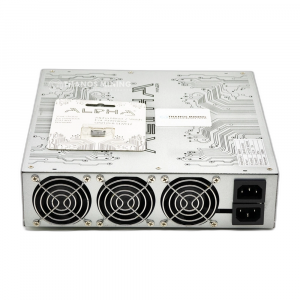
Nothing at all: no lights, no fan twitch, no web interface. Suspect the power supply before anything else. An APW12 PSU tester applies a load and the correct enable signal to an APW12 outside the machine and gives you a straight answer, which is worth having before you order a replacement supply you may not need.

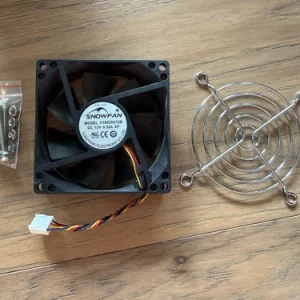
Fans spin up, then the machine throttles or shuts down within minutes. That is thermal, and on an air-cooled Antminer it is usually a fan rather than silicon — they are the only moving parts in the box. A fan tester spins a 12 V four-wire fan on the bench and shows PWM duty and real RPM, so you can tell a dead fan from a dead header. The replacement for S19, S20 and S21 machines is a dual fan assembly, which arrives with the mounting backplate rather than as a loose fan.

It powers up but never appears on the network, or healthy fans report errors. Those symptoms point at the control board, which is the part that fails in ways that look like everything else. A tested ctrl_C55 control board covers Bitmain machines and a genuine Avalon 1166 Pro board is the Canaan equivalent. Before you replace one, note that an Amlogic-based S19-family board that is locked or corrupted can often be recovered instead — that is what an Amlogic unlock kit is for, with the honest caveat that no unlock kit works on every board and every firmware revision.

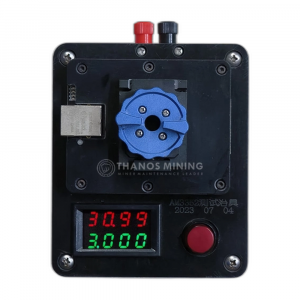
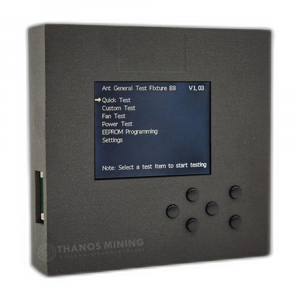
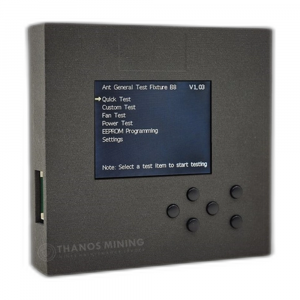
The web interface is up and a hashboard is missing, or the chip count is short. Now it is a board, and this is the point where guessing gets expensive. A fixture powers and clocks the board off the machine and tells you which chip position failed. The K3L fixture covers S19, S21, T21, KS3 and KS5 boards; a universal hashboard tester adds EEPROM editing, which is the difference between diagnosing a board and returning it to service; the K8 and K9 also test supplies and signal faults. Whatsminer boards need Whatsminer tooling — an M20 and M30 fixture — and IceRiver Kaspa boards need an IceRiver KS fixture. An Antminer fixture will not test either of them.

The fixture has named a chip. That is component-level work: hot air, paste and a stencil, not a plug-in part. A BM1366 chip tester gives a pass or error on a single BM1366-series ASIC of the kind used on S19 XP and S19k Pro boards, BM1368AA chips are what the S21 and T21 generation runs on, and an AM3352 tester checks the Sitara processor on BeagleBone-style control boards before you commit it to a repair.

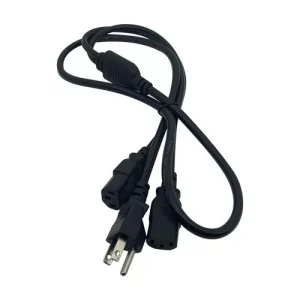
The machine is fine and the circuit is the problem. This is not a repair, but it is one of the most common reasons a working miner will not run. Most modern ASICs are 200–240 V machines and will not start on a standard North American outlet. A 110 V power kit and the Loki kit exist for that situation. Read them before you buy: they change what the machine can be plugged into, not what it can do.

If your symptom is not on this list, send us photos of the board and the error and we will tell you which of the two answers you are in — worth repairing, or not worth repairing.

A note on the category name

“Need Parts” is historical. The bulk of what is here is the parts and the tools themselves, not broken machines. If you want a working unit, go to used ASIC miners or new ASIC miners. If you are keeping a fleet alive, you are in the right place.

Anything marked AS-IS is sold with no claim that it works and no warranty. We do not know what is wrong with those units, we say so in the listing, and the price reflects it. Do not buy an as-is board expecting a tested one.

Full catalogue: all miners.

Diagnose before you buy the part. A universal hash board tester tells you whether a board is worth saving at all, and the BM1366 series chip tester does the same job at chip level on BM1366 boards. Once you know what has failed, a genuine Avalon 1166 Pro control board is the kind of part you order. Buying the replacement first is how people end up with two dead boards instead of one.

Most of what fails on a used miner is on this page rather than in the machine itself. Our used-miner buying guide ranks the common failures and explains which repairs are still economic at today’s hashprice.

Before you order a replacement, check what actually fits: our Antminer parts compatibility guide reads the fitment off the BHB code on the board rather than the model name on the lid, and covers APW12 against APW17 supplies, control board markings and fan current ratings.