
How to Buy a Used ASIC Miner Without Getting Burned (2026)
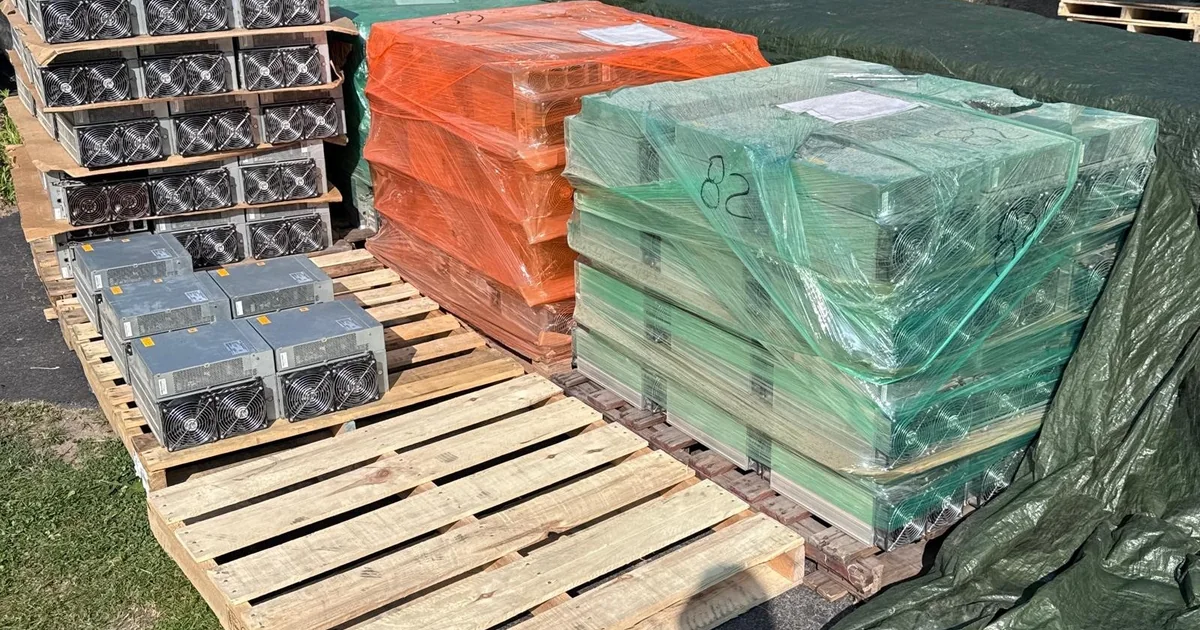
A used ASIC miner is not a cheap miner. It is a cheap machine, and the machine is the small part of what it costs you. The sticker price on a used Antminer S19 is usually a fraction of the electricity it will burn in its first three months. So the way to buy one is to stop comparing prices and start comparing two numbers: landed cost per terahash, and the electricity rate at which the thing stops making money. Everything below is how to work both out, what the grades on a used listing actually mean, and the specific trap that catches most people buying a used S19 in 2026.
We buy, repair, host and resell this hardware, so this guide takes positions rather than listing options. Some of those positions are about our own listings.
The numbers this guide uses, and when they were true
- Hashprice: ~$32.7 per PH/s per day (27 July 2026)
- Network difficulty: 126.23 T (last retarget −0.74%)
- Network hashrate: ~866 EH/s
- BTC: $65,247; transaction fees ~0.7% of the block reward
- US average residential electricity: 18.44 ¢/kWh (EIA, May 2026)
- US retail hosting: $0.055–$0.085/kWh all-in, or flat $150–$350 per machine per month
All of this moves every day, and difficulty moves against you between the day you order and the day the machine is plugged in. Re-run the arithmetic on the day you buy. Hashprice above is derived from difficulty, BTC price and fee share using the standard formula; the same formula reproduces Luxor’s published 13 July 2026 figure of $30.88 exactly, which is why we trust it enough to publish.
How to buy a used ASIC miner: start with landed cost per terahash
The listing price is one line in the bill. What you actually spend to get a used machine hashing is:
- the purchase price
- freight — an S19 is 14.5 kg before packaging, so a pallet of them is a freight shipment, not a parcel
- the PSU, if it is not included, and it is often not included on lots
- power cords and the right receptacle — these are 200–277 V machines
- spares — buy fans and at least one spare PSU with the machines, not after one dies
- a failure allowance — on any used lot, assume some percentage arrives dead or dies early
Add all of it, divide by the total terahash you are actually buying, and you have $/TH landed. That is the only figure that lets you compare a single machine against a lot of twenty against a lot of three hundred.
Do this yourself, on our listings and everyone else’s. Per-unit price does not fall smoothly with lot size — not on our store and not anywhere else, because lots get priced by what came in the door, not by a volume curve. The lot of 100 S19s and the lot of 300 are not in the order you would guess on a per-machine basis, and neither are the 20-unit and 10-unit lots. Divide before you assume the bigger pallet is the better deal.
What the grades actually mean — and what they don’t
There is no industry body grading used ASICs. The words below are conventions, not standards, and any seller can use them however they like. What matters is what each one should commit the seller to, and what you should therefore ask for in writing.
Tested working
The machine was powered up and hashed. That is all it means. It does not mean every chip is healthy, it does not mean the hashrate was measured, and it does not mean it ran for more than a few minutes. Ask what hashrate it produced, at what wall draw, for how long, and at what ambient temperature. “Tested working” with no numbers attached is a claim about the power button.
Refurbished
Should mean someone opened it: cleaned the heatsinks, replaced the thermal pads, repaired or swapped failing hashboards, replaced worn fans, and re-tested. In practice it ranges from a genuine board-level rebuild to a compressed-air blowout and a fresh sticker. Ask what was actually replaced. A refurb that did not touch the thermal interface material on a machine from 2020 has not been refurbished; the pads are the thing that has aged.
As-is / for parts
Means the seller does not know or will not say. Buy it as a bag of components at component prices, and assume the most expensive thing in it is broken. Our as-is S19 XP hashboard listing says outright that we do not know what is wrong with it, which is the only honest way to sell one.
No grade stated
The most common case, including on some of our own listings, and the one people misread most. If a listing does not state a grade, it has not made a claim — it has left a blank. Do not read a blank as “tested”. Our 300-unit lot states tested and working; our 40-unit lot does not state a grade at all, and its page says so in plain words rather than implying one. Ask us, and get the answer in writing before you pay.
The S19 trap: “110 TH/s” is two completely different machines
This is the single most expensive misunderstanding in the used market right now, and it is worth more to you than the rest of this guide.
Bitmain built the S19 at 95 TH/s and 3,250 W, which is 34.2 J/TH. It also built the S19 Pro at 110 TH/s and 3,250 W, which is 29.5 J/TH — same power envelope, considerably more hashrate, genuinely better silicon binning.
You can also take a factory 95 TH/s S19, install Braiins OS or VNish, raise the voltage and frequency, and make it report 110 TH/s. That is not an S19 Pro. It is the weaker machine pushed past its design point, and because power rises faster than hashrate when you overclock, its efficiency is worse than the 34.2 J/TH it started at — not better, and nowhere near the Pro’s 29.5.
Both get listed as “S19 110TH/s”. They are not the same purchase and they are not worth the same money.
Being specific about our own stock: the lots on this site titled “S19 110TH/s — Braiins OS / VNish OS — Refurbished”, including the 20-unit VNish lot, are boosted 95 TH/s machines, not factory S19 Pros. We say so on the product pages and we are saying it here. If you are sizing electrical service off “110 TH/s at 3,250 W” you will trip breakers, because that combination does not exist on a boosted unit. Ask us for the board revision and the measured wall draw on the actual pallet before you buy.
The same caution applies to any listing whose title advertises a gain, including our own Braiins microSD card titled “Adds 10-20 TH/s”. Realistically that is about +10 TH/s on a 95 TH/s S19; treat +20 as a best case on well-binned boards, and treat every terahash of it as bought with watts.
What the specs mean on a machine that has already run for years
On a new miner the spec sheet is a promise. On a used one it is a starting point. What changes:
Rated hashrate vs measured hashrate
A used machine with one weak or dead hashboard still boots, still shows a dashboard, and still hashes — at roughly two-thirds. An S19 has three hashboards. Always ask for hashrate measured at the pool, not reported by the miner, and for how long it held it.
Rated power vs measured wall draw
This is the number that decides your bill, and it is the one nobody sends you. Rated power assumes a healthy machine at stock settings and a specified ambient. A tuned, dusty, six-year-old machine in a warm room draws more. Size your circuits on measured draw with margin, never on the spec sheet.
Efficiency (J/TH) — the number that actually decides it
Watts divided by terahash. It is the only spec that determines whether the machine survives a difficulty rise, because it sets your break-even electricity rate. If a listing quotes hashrate, watts and J/TH and they do not divide correctly, the listing is wrong — and that is common enough on legacy copy across this industry (including, historically, on some of ours, which we have been correcting) that it is worth checking with a calculator every time.
Board revision and chip generation
An S19 uses BM1398 chips; the S19 XP and S19k Pro use BM1366; the S21 and T21 use BM1368. This decides what spares fit and whether anyone can repair it. A machine whose chip family has no repair channel is a machine you throw away when it fails, and that belongs in your price. Our parts compatibility guide goes through the board codes family by family, and what one replacement board gives back on each machine.
PSU condition
The power supply is the most-worn part in the box — it has been at full load, hot, for years. Assume it is the next thing to fail and price a spare in.
The cleanest like-for-like version of this argument is on the site already: Avalon Q vs Antminer S19k Pro sets a new 1,674 W, 18.6 J/TH machine against a used 2,760 W, 23 J/TH one and works out the electricity price at which the cheaper purchase stops being the cheaper machine.
Power and hosting: the number that kills most used-miner purchases
Break-even electricity rate is hashprice ÷ (24 × J/TH). Hashrate cancels out entirely, which is why efficiency is the spec that matters. The full derivation and the equivalent table for current-generation hardware is in our ASIC miner buying guide; here is what it says about the machines you can actually buy used.
| Used machine | Hashrate | Power | J/TH | Break-even $/kWh |
|---|---|---|---|---|
| Antminer S19 XP | 141 TH/s | 3,010 W | 21.5 | $0.063 |
| Antminer S19k Pro | 120 TH/s | 2,760 W | 23.0 | $0.059 |
| Antminer S19k Pro | 115 TH/s | 2,645 W | 23.0 | $0.059 |
| Antminer S19 Pro | 110 TH/s | 3,250 W | 29.5 | $0.046 |
| Antminer S19 | 95 TH/s | 3,250 W | 34.2 | $0.040 |
| S19 95TH boosted to “110 TH/s” | ~110 TH/s | ask for measured | >34.2 | below $0.040 |
Read the last two rows again. A used S19 at 34.2 J/TH needs electricity under 4 ¢/kWh to break even on power alone — before freight, before repairs, before the machine itself. The US residential average is 18.44 ¢/kWh. At that rate a single S19 burns roughly $431 of electricity a month to produce about $93 of Bitcoin. It is not close, and no firmware tune closes a gap that size.
Sub-4 ¢ power is real, but it is a specific thing: flared gas, curtailed wind or solar, behind-the-meter generation, stranded hydro, or a genuine industrial contract. That is why used S19s trade near scrap. They are not a bargain machine for a home miner; they are an instrument for someone with stranded energy. If that is you, the fleet lots are the right product and the arithmetic works. If it is not you, buy efficiency instead.
Hosting, and the flat-rate trap
Hosting is billed two ways, and the difference matters enormously on old hardware.
Per kWh, all-in ($0.055–$0.085 is the current US retail range). Easy to compare against the table above. At $0.07/kWh, a used S19 loses about $70 a month, an S19k Pro 120T loses about $21, and an S19 XP loses about $13. None of the used S19 family clears retail hosting rates at today’s hashprice. That is an uncomfortable thing for a hardware seller to publish, and it is true.
Flat per machine per month ($150–$350). This looks simpler and is usually worse, because it is priced against a machine’s power draw, not its output. A $225/month flat rate on a 3.25 kW S19 works out to about 9.6 ¢/kWh equivalent — more than double that machine’s break-even. Do the division every time: monthly fee ÷ (kW × 720) = your real $/kWh.
Also confirm what the rate includes: uptime and curtailment policy, who pays for downtime, whether repairs are billed separately, deposit and exit terms, and whether they will even accept a 34 J/TH machine. Many hosts now refuse old hardware, because a rack of S19s produces the same heat as far more productive machines.
If you have not yet settled where the machines will physically run, the comparison of farm types sets out hosted, containerised and behind-the-meter options against the power access each one assumes.
What actually breaks, and what it costs to put right
In rough order of how often it takes a machine down and how cheaply it is fixed — this is an operator’s judgement from working on this hardware, not a published failure statistic:
- The PSU. Most common and usually the cheapest real fix. Test before you condemn a machine: an APW12 PSU tester settles it in minutes, and a bad power cable imitates a dead supply convincingly.
- Fans. Bearings wear, the machine throttles or refuses to hash, and people diagnose it as a hashboard fault. A dual fan assembly is a consumable; buy them with the machines.
- Hashboards. The expensive failure. A board with dead chips drops you to two-thirds or one-third hashrate. You cannot diagnose this by looking — it needs a fixture such as a K3L hashboard tester or a universal S19 test fixture. Replacement boards exist, including tested working S19 Pro hashboards.
- The control board. The “won’t boot, no IP address” case. A tested control board is a straightforward swap.
- Cabling and connectors. Cheap, and the first thing to rule out.
The whole repair-parts range lives under repair parts and test fixtures. If you are buying a lot of any size, buy the diagnostic fixture at the same time. Without one you cannot tell a worn fan from a dead hashboard — a difference of two orders of magnitude in what the fix costs — and you will either scrap repairable machines or pay someone else to find out.
Buying new instead is a legitimate answer to all of this. The S21 Pro versus SealMiner A2 Pro Air comparison works through the two current-generation air machines we stock and what separates them once efficiency does not.
When a used miner is not worth buying, and when it is not worth repairing
Clear positions, because vague ones cost people money:
- Do not buy a used S19 to run on residential power. Not at 18 ¢/kWh, not at 12 ¢, not with a tune. The arithmetic above is not close enough to argue about.
- Do not buy a single used machine as an experiment if what you actually want is to learn. A low-power desktop unit like the NerdQAxe++ teaches you pools, firmware and dashboards for a few watts on a normal outlet, with none of the noise, heat or breaker work.
- Do not repair a machine whose repaired value is under the cost of parts plus your time. On a 34 J/TH machine that threshold arrives fast. A hashboard repair on an S19 is often uneconomic today; the same repair on an S19 XP or S19k Pro usually is not, because the machine it saves is worth keeping.
- Do not buy as-is stock unless you own the fixture and can do board work, or you are buying explicitly for parts and have priced it that way.
- Do buy used if you have cheap power and want terahash per dollar of capital, and buy the newest efficiency you can afford within that. An S19k Pro at 23 J/TH or an S19 XP at 21.5 J/TH survives conditions that kill a plain S19.
Buying a lot: freight, power and per-unit testing
Fleet purchases are a different transaction, not a bigger one. Run these three numbers before you talk price on any lot, using a 300-unit S19 lot as the worked example:
- Total hashrate: 300 × 95 TH/s = 28.5 PH/s. At current hashprice that is about $933/day gross.
- Total power: 300 × 3,250 W = 975 kW, or 23,400 kWh/day. At 4 ¢/kWh that is about $936/day — which is the whole story: at 4 ¢ a 300-unit S19 fleet is dead even before you have paid for the machines. At 3 ¢ it clears roughly $230/day. The energy contract is the investment; the hardware is an accessory to it.
- Total weight and heat: 300 × 14.5 kg = 4,350 kg (about 9,590 lb) of freight, and 975 kW of continuous heat — roughly 3.3 million BTU/hr to remove. This is three-phase distribution, real PDUs and real ventilation, not a garage.
Then ask about testing methodology: were all units tested, or a sample? On a 300-unit lot nobody bench-tests every machine, and a seller who claims otherwise is either exceptional or careless with words. Ask what percentage was tested, what the pass criterion was, and what happens to dead-on-arrival units. Smaller lots — 5, 10, 50 — are where a stated grade is most worth paying for, because the failure allowance on a small lot is lumpy: one dead machine out of five is a 20% loss, and out of three hundred it is a rounding error.
Whole-fleet listings are under used ASIC miners, and the single-unit used machines sit alongside them in Antminer BTC miners.
What to demand in writing before you send money
Every one of these is a question we will answer about our own stock, and the ones we cannot answer we say so rather than guess:
- The exact model — S19, S19 Pro, S19j Pro, S19k Pro or XP — not just the advertised hashrate.
- Whether the advertised hashrate is factory or firmware-boosted, and if boosted, the measured wall draw at that hashrate.
- Measured hashrate at the pool, and how long it was held.
- Board revision and chip family, so you know what spares fit.
- The condition grade in words, and what specifically was replaced if it is called refurbished.
- Whether PSUs are included, and their condition.
- Warranty or return terms, in writing — including whether there is any. On used hardware “no warranty” is an acceptable answer; a vague one is not.
- Freight terms — weight, pallet count, who packs, who insures, and who eats a unit damaged in transit.
- For lots: the testing methodology and the DOA policy.
If a seller will not put those in writing, that is your answer. Ask us and we will put ours in writing, including the blanks.
Frequently asked questions
Is a used Antminer S19 worth buying in 2026?
Only if your electricity costs under about 4 cents per kWh. At 34.2 J/TH and a hashprice around $32.7 per PH/s per day, that is where an S19 stops paying for its own power. Below that rate it is a genuinely cheap way to buy terahash; above it, the machine loses money every day it runs no matter what you paid for it. On US average residential power at 18.44 cents it burns roughly $431 of electricity a month to produce about $93 of Bitcoin.
What is the difference between an S19 Pro and an S19 boosted to 110 TH/s?
The S19 Pro is a factory machine that produces 110 TH/s at 3,250 W, which is 29.5 J/TH. A boosted S19 is a 95 TH/s machine running overclocked firmware to reach a similar hashrate, and because power rises faster than hashrate when overclocking, its efficiency is worse than the 34.2 J/TH it started at. They are frequently listed under the same “S19 110TH/s” heading and they are not worth the same money. Ask for the model, the board revision and the measured wall draw.
What does “refurbished” actually guarantee on a used miner?
By itself, nothing standardised — there is no industry body grading used ASICs. It should mean the machine was opened, cleaned, had thermal pads replaced, had failing hashboards repaired or swapped, had worn fans replaced and was re-tested. In practice it ranges from a full board-level rebuild to compressed air and a sticker. Ask specifically what was replaced. A refurbishment that did not renew the thermal interface material on a machine built in 2020 has not addressed the part that ages.
How do I work out the real cost of hosted mining?
If you are billed per kWh, compare that rate directly against the machine’s break-even, which is hashprice divided by 24 times J/TH. If you are billed a flat monthly fee, convert it first: monthly fee divided by (kilowatts times 720) gives your effective rate. A $225 monthly flat fee on a 3.25 kW S19 is about 9.6 cents per kWh, which is more than double that machine’s break-even rate.
How much of a used lot should I expect to arrive dead?
There is no reliable published figure, and any seller quoting you a precise one is guessing. What matters is that you agree the number in advance: ask what percentage of the lot was tested, what the pass criterion was, and what happens to dead-on-arrival units. On a five or ten unit lot a single failure is a large percentage loss, which is why a stated condition grade is worth paying more for on small lots than on large ones.
Do I need a hashboard tester to buy used miners?
For a single machine, no. For any lot, yes. Without a test fixture you cannot distinguish a failed fan or power supply from a dead hashboard, so you will either scrap repairable machines or pay someone else to diagnose them. A universal S19 fixture or a multi-function hashboard tester pays for itself on the first pallet.
Can I run a used 240 V miner on a normal household outlet?
Not at full power. These are 200–277 V machines, and a standard 15 A 120 V circuit supplies about 1,800 W against a 3,250 W demand. A converter kit lets a machine run on 120 V but it does not reduce the machine’s energy demand — you run it derated in firmware and get proportionally less hashrate, and the conversion itself is slightly lossy. Anyone selling it as a way to run a full-power S19 on a wall socket is selling you a fire.
Is it better to buy one newer used miner or several older ones?
At the same landed cost per terahash, buy the newer, more efficient machines. Efficiency sets your break-even rate, so a 23 J/TH S19k Pro survives an electricity price or a difficulty rise that shuts down a 34.2 J/TH S19. Older machines only win when your power is cheap enough that the efficiency gap stops mattering, and at that point you are optimising for capital cost per terahash instead.