
Immersion-Cooled Miners and Power Supplies
Immersion-cooled Bitcoin mining hardware — an immersion-configured Antminer, a WhatsMiner M66S++ that MicroBT publishes only as a hydro or immersion unit, and the sealed, fanless power supplies built to sit in the tank with them. Immersion means the hashboards sit directly in a dielectric fluid that carries heat away by contact with every component at once. It is the most effective cooling method available to miners, and the one with the highest barrier to entry.
-
Add to WishlistAdd to Wishlist
-
Add to WishlistAdd to Wishlist
-
Add to WishlistAdd to Wishlist
-
Add to WishlistAdd to Wishlist
What immersion requires before the miner arrives
A tank, dielectric fluid, circulation pumps, a heat exchanger and heat rejection sized to full load, and the handling procedure to go with them. An immersion-configured miner has no fans, is shipped without the sealing an air unit has, and cannot be run in air even briefly. If you do not have a tank, this is not the category to buy from — nothing here will work.
The fluid itself is a meaningful cost and a meaningful commitment. Plan for its volume, its price, its disposal and the mess of servicing hardware that comes out of a tank wet.
What it buys you
The best thermal performance of any method, which means the silicon can hold higher clocks at better efficiency. Extremely high density. Near-silent operation. Dust and humidity stop existing as failure modes, which genuinely extends hardware life in dirty or coastal environments. And the highest-grade waste heat of the three cooling approaches, if you have a use for it.
How to choose
Size heat rejection to the total kW of everything going in the tank, with headroom for your hottest week. Confirm the miner is factory immersion-configured rather than an air unit someone has stripped — converted units are a warranty and reliability problem. Match tank and manifold fittings to the specific model before ordering.
What this shelf holds, and the part people order wrong
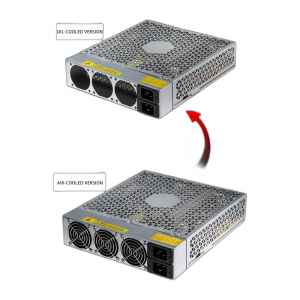
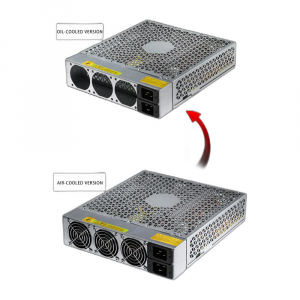
Worth being plain about what this shelf actually holds: two immersion-capable miners and two 10,000 W supplies in the APW12 form factor (one, two). The supplies are the part people order wrong, so three things about them. They are fanless because the dielectric fluid does the cooling, and the same chassis is also sold with three fans fitted for air — run the fanless one in open air and it cooks itself. They output 12–15 V DC and take two AC cords, because 10 kW at 220 V is about 45 A, which is two separately protected circuits settled with an electrician before the crate arrives. And they are not Bitmain products: Bitmain’s own APW12 is an air-cooled supply in the 3,600 W class and there is no 10 kW immersion APW12 in its catalogue. These are aftermarket supplies built to that form factor. That is an established category and not a criticism — but you are not buying Bitmain QC or a Bitmain warranty, and our structured data for those listings asserts no manufacturer for exactly that reason.
What this shelf does not prove about efficiency
Immersion is usually sold on efficiency, and on the figures on its own listing the one miner here does not demonstrate it. The Antminer S21 XP IMM 300T is 5,550 W for 300 TH/s, which is 18.5 J/TH and a break-even of 7.2¢/kWh at a hashprice of $32.18/PH/day derived on 9 August 2026. The air-cooled S21 XP 270T on our air-cooled shelf is 13.5 J/TH. Same manufacturer, same generation, and the immersion box is the less efficient of the two on the numbers we hold.
We are not going to explain that away. Either the listing’s wattage is wrong or the machine is genuinely binned lower than its air-cooled sibling, and the difference between those two matters if you are sizing a tank around it — so ask us to confirm it against the unit before you plan capacity. Note also that it takes 342–418 V and will not run on 240 V at all, which rules the machine out for most buildings before cooling is even discussed. What each method asks of the building is set out on ASIC miner cooling.
The second miner here is the more efficient one
The WhatsMiner M66S++ is on this shelf because MicroBT builds the M66S family only as hydro or immersion machines — there is no air-cooled version of it — so the same listing also sits on the hydro shelf. It bins at 318, 320 or 322 TH/s and MicroBT rates it at 15.5 W/T, which is 15.5 J/TH. Its listing computes the 4,929–4,991 W range from that rating rather than quoting a connected load, because MicroBT publishes no specification page of its own for the ++ variant.
At 15.5 J/TH it covers its own electricity up to about 8.7¢/kWh on the same 9 August 2026 hashprice used above, against 7.2¢ for the Antminer. So the efficiency argument for immersion on this shelf rests on the MicroBT machine and not the Bitmain one — and even 15.5 J/TH does not reach the 13.5 J/TH of the air-cooled S21 XP two shelves over. On the numbers we hold, immersion here is buying density, near-silence and hardware life in a dirty or humid room. It is not buying efficiency, and we are not going to imply that it is.
Neither machine here runs on a single-phase supply
Before the tank, before the fluid, before the heat exchanger: check the service. The Antminer takes 342–418 V AC. The M66S++ is a three-phase machine at AC 380–480 V — and since MicroBT publishes nothing for the ++ specifically, that rating comes from its M66S and M66S+ siblings in the identical chassis and from distributor sheets, so confirm it with us before anyone wires anything. What is not in doubt is that no single-phase 200–240 V circuit will run either machine, and nothing in a house or a typical small commercial building supplies what they want. On a shelf where the tank is usually treated as the hard part, the panel is the thing that stops most buyers first.
Who this suits
Operators already running immersion, and builds where density or heat recovery is the binding constraint rather than capital cost. It is not a first deployment.
If you are choosing between cooling methods rather than committed to one, hydro cooling gets most of the benefit for materially less complexity, and air-cooled machines run today with no infrastructure at all. Talk to us about the tank before you talk to us about the miner.
Full range: all miners.
The Antminer S21 XP IMM 300T is one of two miners here, alongside a WhatsMiner M66S++ that MicroBT builds only as a hydro or immersion unit. Immersion is not a cooling upgrade you bolt on: it needs a tank, dielectric fluid, a heat exchanger and a machine built without fans. If you are not already running a tank, air cooling or hydro will serve you better.
Immersion is a site decision before it is a hardware decision — the manifold and coolant-distribution infrastructure it needs cannot be improvised in a garage. Types of mining farms sets out what each cooling approach asks of the building it lives in, and at what scale it starts to pay.