
An air-cooled Antminer is rated at about 75 dB, and there is nothing you can bolt onto it that changes that. Noise on an ASIC is not a setting, it is a consequence of the cooling design: four fans have to move enough air to carry roughly 3,000 watts of heat out of a shoebox, and moving that much air makes that much sound. Across the 61 machines we list with a published noise rating, the range is 33 dB to 76 dB — and where a machine lands in that range is decided almost entirely by how it is cooled, not by how new it is or how much it costs.
So the useful question is not “how do I quieten this miner”. It is “which machine can I actually live with, and how far from me does it need to sit”. This page answers both with the ratings off our own listings.
What 75 dB actually means
Decibels are logarithmic, which trips up nearly every first install. Three consequences matter:
- +10 dB is ten times the sound intensity, and sounds roughly twice as loud to a person. A 75 dB S19 against a 65 dB Avalon Q is not “a bit louder” — it is about double the perceived loudness.
- Two identical miners are +3 dB, not double. Two S19s side by side make about 78 dB, ten make about 85 dB. Noise scales far more slowly than machine count, which is why a hosted facility is a roar rather than an impossibility.
- Distance is worth more than anything you can buy. In open air, sound pressure falls about 6 dB every time you double the distance from the machine. A 75 dB miner measured at 1 m is roughly 69 dB at 2 m, 63 dB at 4 m, 57 dB at 8 m and 51 dB at 16 m. Moving the machine 50 feet down the garden does more than any enclosure you can build.
One honest caveat on every figure on this page, ours included: manufacturer noise ratings are measured at a set distance under controlled conditions, usually at a fixed fan speed. A real install is louder, because rooms reflect sound and because fans ramp up as ambient temperature rises. Treat a published rating as the floor, not the number you will measure in August.
Where the noise actually comes from
Effectively all of it is the fans. On a standard S19 that is four of them, spinning up to around 6,000 RPM, and the sound is a mix of blade-passing tone and the broadband rush of air through the heatsink fins. Everything else is a rounding error.
Two things routinely listed as noise sources on other pages are not, and this page carried both until it was rewritten: electrical interference does not produce audible sound, and thermal expansion of components is not something you can hear across a room. Coil whine from a power supply is real, but it sits tens of decibels below the fans. If your machine has developed a new noise that is not fan noise, that is a fault to diagnose rather than an acoustic property — a dry or failing fan bearing is the usual answer, and it is audible as a rattle or a grind well before the fan stops.
That matters commercially, because it means the only levers that exist are fan speed, fan count, and getting the heat out some other way.
The noise ladder, from our own catalogue
Every figure below is the manufacturer rating on that machine’s own listing. The pattern is the point: the quiet end is small machines and liquid cooling, and the loud end is every full-size air-cooled miner ever made, regardless of brand or generation.
| Machine | Rated noise | Cooling | Power |
|---|---|---|---|
| Avalon Nano3s 6T | 33–40 dB | Low-speed integrated | 140 W |
| Goldshell Mini DOGE III 700M | 35 dB | Low-speed integrated | 400 W |
| Fluminer L2 1.2G | ~40 dB | Low-speed integrated | 280 W |
| Avalon A1566HA 480T | 40 dB | Hydro | Farm-scale |
| ElphaPex DG Home1 2.1G | ≤50 dB | Air | 630 W |
| Fluminer T3 115T | ~50 dB | Air | Home-rated |
| Avalon Mini3 37.5T | 33–55 dB by mode | Air | 800 W |
| Antminer S19 XP Hyd 257T | <60 dB | Hydro | Farm-scale |
| Antminer S21 XP IMM 300T | <60 dB | Immersion | Farm-scale |
| Canaan Avalon Q 90T | 45–65 dB by mode | Air | 800 / 1,300 / 1,674 W |
| Used Antminer S19 95TH/s | ~75 dB | Air, 4 fans | 3,250 W factory |
| Antminer S21 Pro 245T | 76 dB | Air, 4 fans | Full power |
Read down that table and the rule falls out: below about 55 dB you are buying either a small machine or a liquid-cooled one. There is no full-size, air-cooled, three-kilowatt miner anywhere on the market that is quiet, and any listing claiming otherwise is quoting a fan-off or eco-mode number.
The Avalon Q is the interesting row, because it is the only machine here that is both close to full hashrate and liveable: 90 TH/s at 45–65 dB depending on which of its three power modes you run. That spread is not marketing — 45 dB is Eco mode at about 800 W, and 65 dB is Super mode at 1,674 W and the full 90 TH/s. You choose your noise by choosing your hashrate, and 65 dB is still audible through a wall.
What the law says, and the 85 dB figure everyone quotes wrongly
There are two completely separate standards here, and mixing them up is how people conclude that a 75 dB miner in a spare bedroom is legally fine.
Occupational limits are about your hearing. The OSHA permissible exposure limit is 90 dBA averaged over 8 hours, with an action level at 85 dBA, and NIOSH recommends 85 dBA over the same period. A single 75 dB miner does not put you near either. Ten of them in a small room does, and that is a room you should not be working in all day without protection. The occupational exposure literature and the wider research on noise and health agree that chronic exposure at those levels does measurable damage — hearing loss first, cardiovascular and sleep effects after.
Residential ordinances are about your neighbours, and they are far stricter. Municipal limits are commonly in the region of 55 dBA during the day and 45–50 dBA at night, measured at the property line rather than at the machine. Against a night-time limit in that range, a 75 dB miner needs roughly 30 feet of open distance before it is even arguably compliant — and it runs at 3 a.m., which is exactly when the limit is lowest and when a complaint gets made. Your actual number is local: look up your own city’s noise ordinance before you buy, not after the first complaint. This is also the most common reason a home-mining setup gets shut down, well ahead of electricity cost.
What actually reduces noise, and what does not
In order of how much they are worth:
- Distance and location. A detached garage, a basement with a concrete floor, or an outbuilding beats every other intervention combined, and costs nothing. The 6 dB-per-doubling rule is doing the work.
- Buying a quieter class of machine. Going from a 75 dB S19 to a 45 dB Eco-mode Avalon Q is a 30 dB reduction. No enclosure achieves that.
- Power mode and firmware tuning. Underclocking drops fan speed because there is less heat to move, and it is the one software lever that genuinely changes the noise. It costs hashrate roughly in proportion — see the buying guide for what a tune actually trades away.
- Liquid cooling. Hydro and immersion machines rate at 40 dB and under 60 dB respectively, because the fans are not on the box. The noise moves to the dry cooler outside, which is a real solution at farm scale and an expensive one at home.
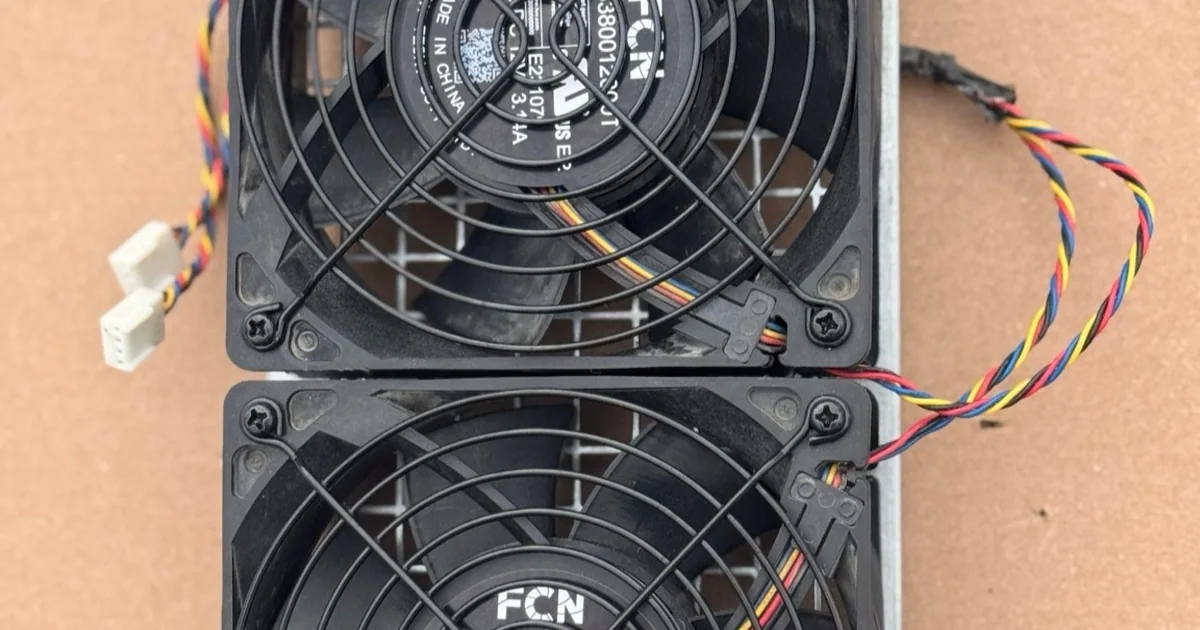
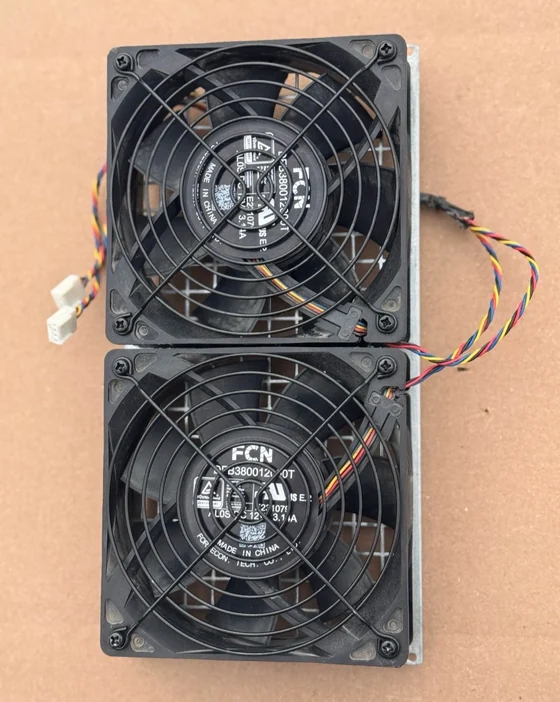
- Replacing a failing fan. This fixes a machine that has got louder; it does not make a healthy machine quiet. A dual fan assembly is $24.99, and a rattling bearing is worth changing before it takes the board behind it with it.
What does not work, honestly: sealed soundproof boxes. Every one we have seen built at home traded noise for heat, and a miner that cannot get rid of its heat throttles, runs its fans harder, or dies. If you build an enclosure it needs ducted intake and exhaust with baffles, at which point you have built a small piece of HVAC — and you have probably not gained 10 dB. Nor is there anything to gain from “lubricating moving parts”: these fans are sealed units, and a fan that needs oil needs replacing.
If you need quiet, buy quiet
For a house or an office, three machines are worth shortlisting: the Avalon Nano3s 6T at 33–40 dB if you want a real miner in a room with people in it, the Avalon Q 90T at 45–65 dB if you want meaningful hashrate and can put it behind a door, and the Fluminer T3 115T at around 50 dB. Everything else we sell in volume — the S19 lots, the S21s — belongs in a garage, a shed or a hosted facility.
Buying used at fleet scale changes the question rather than the answer: 75 dB per machine and +3 dB per doubling means noise becomes a site-selection problem, not a hardware one. If that is the plan, the used ASIC miner inventory is the right starting point, and the site rather than the machine is what needs solving.
Frequently Asked Questions
How loud is an ASIC miner?
Full-size air-cooled miners such as the Antminer S19 and S21 Pro are rated at 75–76 dB. Small home machines run 33–50 dB, and hydro or immersion machines rate 40 dB to under 60 dB. Across the 61 machines we list with a published rating the full range is 33 dB to 76 dB, and cooling design is what decides it.
What actually makes an ASIC miner noisy?
The fans, and effectively nothing else. A standard S19 uses four fans running up to around 6,000 RPM to move roughly 3,000 watts of heat out of the case. Electrical interference and thermal expansion are sometimes listed as noise sources but are not audible; a new non-fan noise is a fault, usually a failing fan bearing.
Are two miners twice as loud as one?
No. Decibels are logarithmic, so two identical machines add about 3 dB and ten add about 10 dB. Two S19s are roughly 78 dB rather than 150. Distance matters far more: sound pressure falls about 6 dB each time you double your distance from the machine.
Can I soundproof an ASIC miner?
Only if the enclosure is ducted for intake and exhaust. A sealed box traps heat, which makes the miner throttle or fail and drives the fans harder. Distance, location and buying a quieter class of machine all beat an enclosure, and underclocking is the only software change that meaningfully lowers fan speed.
Is a 75 dB miner legal to run at home?
That depends on your local noise ordinance, not on OSHA. OSHA’s 90 dBA limit and NIOSH’s 85 dBA recommendation are workplace hearing-protection standards. Residential ordinances are commonly around 55 dBA by day and 45–50 dBA at night, measured at the property line, so a 75 dB miner typically needs substantial distance or an outbuilding. Check your own city’s ordinance before buying.
More on noise
- why mining hardware fails
- Differences in ASIC Miner Models: Choosing for ROI
- 7 Essential ASIC Miner Maintenance Tips for Reliability
- ASIC Test Fixtures: Which Tester Proves Which Fault
Machines that are realistic to live with
For a home or small-office install, these are the realistic options:
- Avalon Nano3s 6T – 6 TH/s Silent Bitcoin Miner — 33–40 dB
- Canaan Avalon Q 90T Home Bitcoin Miner — 45–65 dB by mode
- Avalon Q 90T – 90TH/s Bitcoin Miner — 45–65 dB by mode
- Fluminer T3 115T – 115 TH/s SHA-256 Bitcoin Miner — ~50 dB
More in Fluminer Home Miners, or the full ASIC miner inventory. Circuit capacity, heat output and noise for a home install are covered in the buying guide.