
Antminer L9 16G vs 17G: Same Machine, Different Bin
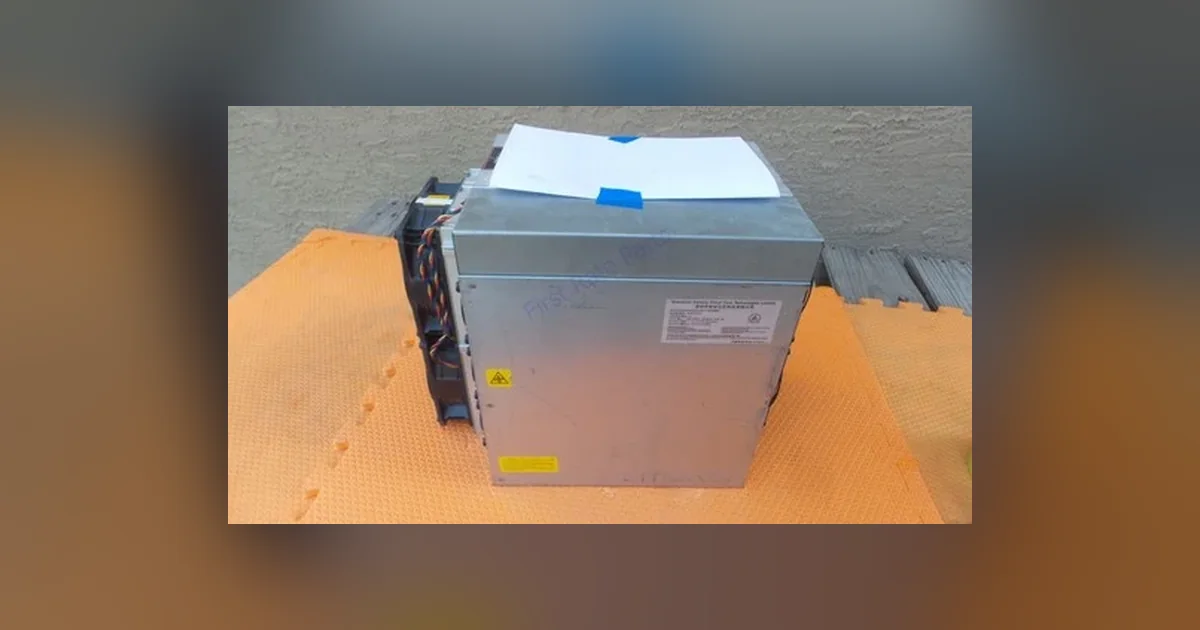
Buy the 17G. At every electricity rate where an Antminer L9 earns anything at
all, the 17G makes more money per day than the 16G — and it does it at exactly the same
efficiency, because the two are the same machine with different chips sorted into different boxes.
There is one situation that flips the answer, and it is electrical rather than economic: 3570 W
will not fit a 220 V 20 A circuit and 3360 W will. That is the entire honest version of the
Antminer L9 16G vs 17G question.
The bigger question sits underneath it, and neither product page will tell you: on the numbers
below, about 90% of an L9’s revenue is Dogecoin, not Litecoin. You are not buying
a Litecoin miner with a DOGE bonus. You are buying a Dogecoin miner with a Litecoin rounding error
attached, and you should size the risk accordingly.
The numbers this post is built on
Everything below is derived from difficulty and coin price, not copied from a calculator. All of
it moves daily. Re-run it on the day you buy.
| Input | Value | Source, 27 July 2026 |
|---|---|---|
| Litecoin difficulty | 93,821,903.06 | CoinWarz, block 3,149,793 |
| Litecoin price | $46.68 | CoinWarz, 21:12 UTC |
| Litecoin block reward | 6.25 LTC | next halving at block 3,360,000 |
| Dogecoin difficulty | 27,160,763.09 | CoinWarz, block 6,307,593 |
| Dogecoin price | $0.0721 | CoinWarz, 21:16 UTC |
| Dogecoin block reward | 10,000 DOGE | fixed since 2015 |
Expected revenue for a machine of h GH/s on a chain is
86400 × reward × price × 109 ÷ (difficulty × 232)
per GH per day. Block time cancels out of that expression, so it needs only difficulty and price
— no dependence on a noisy “estimated network hashrate” figure. Worked through:
- Litecoin: $0.0626 per GH per day. 3600 LTC issued daily.
- Dogecoin: $0.5340 per GH per day. 14.4 million DOGE issued daily.
- Combined: $0.5966 per GH per day — 10.5% Litecoin, 89.5% Dogecoin.
As a check on the arithmetic: the difficulty figures imply a Dogecoin network hashrate of
1.94 PH/s, against the 1.99 PH/s separately observed on the same day — within 2.5%. The
Litecoin difficulty implies 2.69 PH/s against 2.20 PH/s observed, meaning LTC blocks are currently
running slower than the 2.5-minute target, so the Litecoin side of this estimate is conservative.
Pool fees are not deducted. Merged chains beyond LTC and DOGE (Bellscoin and others) are not
counted; pools handle them differently and they are small.
What the two spec sheets actually say
| Antminer L9 16G | Antminer L9 17G | |
|---|---|---|
| Hashrate | 16 GH/s | 17 GH/s |
| Power at the wall | 3360 W | 3570 W |
| Efficiency | 0.21 J/MH (210 J/GH) | 0.21 J/MH (210 J/GH) |
| Algorithm | Scrypt | Scrypt |
| Coins | LTC + DOGE merge-mined (AuxPoW), plus smaller Scrypt chains | |
| Supply | 200–277 V AC, dedicated circuit — no 120 V operation | |
| Noise | published figures range from about 75 dB to 80 dB | |
| Consumption | 80.64 kWh/day | 85.68 kWh/day |
| Gross revenue | $9.54/day | $10.14/day |
Both are listed new, and both listings state a six-month warranty. Get the warranty terms and
the as-tested hashrate in writing before you pay — on any seller, including us.
What the spec sheets disagree about
Worth knowing before you plan a rack. Across the sheets we checked, the L9’s weight
is quoted at 13.5 kg, 14.2 kg and 16 kg; dimensions at 400 × 195 × 290 mm
and at 370 × 195.5 × 290 mm; fan count at both two and four; and
operating temperature at 5–45 °C, 0–40 °C and wider. We have not
metered a unit ourselves, so we are not going to pick a winner among those. Measure your own space
against the largest figure and you will not be caught out. The numbers that decide the purchase
— hashrate, wattage and efficiency — are consistent everywhere, and they are the ones
above.
Antminer L9 16G vs 17G: why efficiency cannot break the tie
Look at the wattage column again and multiply:
- 15 GH/s × 210 = 3150 W
- 16 GH/s × 210 = 3360 W
- 16.5 GH/s × 210 = 3465 W
- 17 GH/s × 210 = 3570 W
Every published L9 rating is the bin’s hashrate multiplied by 210 J/GH, exactly. That is not a
coincidence and it is not marketing. It is what binning looks like from the outside: Bitmain builds
one machine, tests the chips, sorts them by how fast they run clean, and derives the rated wattage
from the bin at a fixed efficiency. The 15G and the 17G came off the same line.
This matters because efficiency is normally the number that decides a head-to-head. It decided
nothing here. When we compared the
Avalon Q against the S19k Pro the efficiency gap was 24% and the arithmetic
simply handed down a verdict. When we compared the
S21 Pro against the SealMiner A2 Pro Air the gap was under 1% and we had to
move the decision to parts, warranty and resale. Here the gap is zero, and that turns out
to be a more useful result than either.
Why zero is a useful result: the crossover collapses
The standard way to settle “more hashrate or better efficiency” is the crossover
rate — the electricity price at which the two machines earn the same, found by dividing the
difference in daily revenue by the difference in daily kWh. Run it here:
- Revenue difference: 1 GH/s × $0.5966 = $0.5966/day
- Consumption difference: 210 W × 24 h = 5.04 kWh/day
- Crossover: 0.5966 ÷ 5.04 = $0.118/kWh
Now compute the break-even rate for either machine on its own — revenue per GH divided by
24 hours of draw per GH, or 0.5966 ÷ (24 × 0.210):
$0.118/kWh. The same number.
That is not a fluke of these inputs, it is algebra. Daily margin is
h × (R − 24 × e × c) for hashrate h, revenue per GH
R, efficiency e in kW/GH and power price c. When two machines share the
same e, the bracket is identical for both, so the difference in margin is just
(h₁ − h₂) times that bracket. The bigger bin wins whenever the
bracket is positive — which is precisely the condition for either machine to be worth
running at all.
The practical consequence: there is no electricity rate at which a rational
operator prefers the 16G for its running cost. Above 11.8 cents the 16G does lose less money than
the 17G, and at 18.83 cents — the US residential average — the 17G bleeds $5.99 a day
against the 16G’s $5.64. Losing $169 a month instead of $180 is not a purchasing argument. It is an
argument for not plugging either one in.
| Your power rate | 16G margin/day | 17G margin/day | |
|---|---|---|---|
| 3 ¢/kWh | +$7.13 | +$7.57 | 17G ahead |
| 5 ¢/kWh | +$5.51 | +$5.86 | 17G ahead |
| 7 ¢/kWh | +$3.90 | +$4.14 | 17G ahead |
| 10 ¢/kWh | +$1.48 | +$1.57 | 17G ahead |
| 11.8 ¢/kWh | break-even | break-even | the crossover |
| 18.83 ¢/kWh | −$5.64 | −$5.99 | both losing badly |
At 7 cents — a realistic hosted rate — the 17G clears about $124 a month and the 16G
about $117. The entire operating advantage of the bigger bin is around $7.31 a month.
Hold that number; it is what any price premium on the 17G has to be measured against.
The thing that actually decides it: your breaker
This is where the two machines genuinely differ, and it is the one place the 16G can be the only
correct answer. Continuous loads may occupy 80% of a breaker’s rating, so:
| Circuit | Continuous limit | 16G (3360 W) | 17G (3570 W) |
|---|---|---|---|
| 208 V, 20 A | 3328 W | does not fit | does not fit |
| 220 V, 20 A | 3520 W | fits | does not fit |
| 240 V, 20 A | 3840 W | fits | fits |
| 208 V, 30 A | 4992 W | fits | fits |
| 240 V, 30 A | 5760 W | fits | fits |
Read the 220 V row twice. If your supply measures 220 V and you have a 20 A circuit, the 16G is
inside the continuous-load limit and the 17G is not. No amount of arithmetic about margins changes
that, and derating the 17G in firmware to make it fit turns it into a more expensive 16G.
Two other things get missed on this machine. The first is that 208 V is extremely common in US
commercial buildings on three-phase service, and at 208 V a 20 A circuit will not carry
either L9 — you need 30 A. The 17G pulls 17.2 A at 208 V against 14.9 A at 240 V, and
that is the same machine on the same day; low voltage costs you headroom, not power. The second is
that you cannot double up: two 16G units draw 6720 W, which is over the 5760 W continuous limit of
a 240 V 30 A circuit. One L9 per circuit, either bin.
Measure your actual voltage at the outlet before you order. “240 V” on a panel
schedule and 228 V at the receptacle are different facts, and only one of them is yours.
The bins overlap, and the tolerance says so
The label is a bin, not a guarantee, and the published tolerance is wide enough to matter:
- At ±3%, quoted on several Bitmain-derived sheets: a worst-case 17G is
16.49 GH/s and a best-case 16G is 16.48 GH/s. They touch. - At ±5%, which is what our own listing publishes: a worst-case 17G is
16.15 GH/s and a best-case 16G is 16.80 GH/s — an overlap of 0.65 GH/s. A
bad 17G is genuinely slower than a good 16G.
So the honest way to think about the premium on a 17G is that you are buying a higher
expected value, not a contract. If two units are close on cost per gigahash, take the 17G. If
the 17G carries a real premium, remember you are paying it for roughly $7.31 a month of extra
margin at 7-cent power and a bin label with 5% of slack in it.
Cost per gigahash is the only price question
We do not quote prices in articles, because they go stale and because the arithmetic is more
useful than the number. Do this instead, on our listings or anyone else’s:
- Take the delivered price — hardware plus freight plus any import charge. A 14–16 kg
machine is not cheap to ship. - Divide by the rated gigahash: 16 or 17.
- Compare the two dollars per GH/s figures directly.
Because the efficiencies are identical, cost per GH is a genuinely complete comparison here
— which is rare, and it is why this pairing is easy to decide once you have done the
division. If the 17G is at or below the 16G’s cost per GH, buy it and stop reading. If it is
meaningfully above, the 16G is the better value and you give up about $7.31 a month at 7-cent
power. And if you have exactly one 220 V 20 A circuit, the calculation is irrelevant: buy the 16G.
The same division applies to the 15G and 16.5G bins if you find them, and to the wider
LTC and DOGE Scrypt range. The method for a second-hand unit is
different and we set it out separately in
how to buy a used ASIC miner.
Nine-tenths of your revenue is Dogecoin
This is the part that should change how you size the purchase, and it is not on either spec
sheet.
Litecoin and Dogecoin are merge-mined through AuxPoW: one Scrypt share is valid on both chains,
so the machine is paid twice for the same work. That is why an L9’s break-even rate looks good. But
the two chains do not contribute equally. Dogecoin issues 14.4 million coins a day to Litecoin’s
3600, and even at 7.21 cents against $46.68 the sheer volume dominates:
89.5% of the revenue is DOGE and 10.5% is LTC.
Read that as a risk statement. If Dogecoin halved in price tomorrow and Litecoin did not move,
an L9’s revenue would fall by about 45% and its break-even rate would drop from 11.8 cents to
roughly 6.5 — putting most hosted operators underwater overnight. Litecoin’s own halving,
due at block 3,360,000, will cut the smaller tenth of the revenue rather than the bulk of it. The
exposure that matters here is DOGE, and it is not diversified by the presence of LTC on the
sticker.
None of that makes the machine a bad buy. It makes it a specific bet, and anyone selling you an
L9 as a “Litecoin miner” is describing about a tenth of what you are actually buying.
How this compares with the Bitcoin machines on the same shelf
Using the same-day SHA-256 hashprice of $32.53 per PH/s per day and the identical break-even
method, on 27 July 2026:
| Machine | Efficiency | Break-even $/kWh |
|---|---|---|
| Antminer L9 (any bin) | 210 J/GH | $0.118 |
| Antminer S21 XP 270T | 13.5 J/TH | $0.100 |
| SealMiner A2 Pro Air 255T | 14.9 J/TH | $0.091 |
| Antminer S21 Pro 245T | 15.0 J/TH | $0.090 |
| Avalon Q 90T | 18.6 J/TH | $0.073 |
| Antminer S19 XP 141T | 21.5 J/TH | $0.063 |
| Antminer S19 95TH | 34.2 J/TH | $0.040 |
On that one measure the L9 beats everything we sell for Bitcoin, by 1.8 cents over the best of
them. It is a real advantage and it is worth saying out loud. It is also the narrowest possible
view of the decision. Bitcoin hashprice is set by a deep, heavily capitalised market; the L9’s
advantage rests on the Dogecoin price and on Scrypt difficulty that a single large deployment can
move noticeably, because the whole Scrypt network is around 2 PH/s. A machine that breaks even at
11.8 cents today can break even at 8 next quarter without anything happening to your power bill.
The method for pricing that risk is in the
ASIC miner buying guide.
So which one should you buy?
Buy the Antminer L9 17G if your circuit is 240 V, or 30 A at
any voltage, and the cost per gigahash is at or near the 16G’s. It earns more every day at any rate
worth mining at, it occupies the same rack slot, it takes the same freight and the same
installation labour, and it costs nothing extra to look after.
Buy the Antminer L9 16G if you are feeding it from a 220 V
20 A circuit — where it is the only one of the two that legally fits — or if the 17G
carries a premium that outruns roughly $7.31 a month of extra margin at 7-cent power. Neither is a
consolation prize. It is the same machine.
Buy neither if you are paying a residential electricity rate. At the US average
of 18.83 cents an L9 loses about $180 a month, and the bin you chose is irrelevant to that outcome.
If your power is not genuinely cheap, hosting is the question to be asking, not 16 versus 17.
And think twice if you would not knowingly take a large, undiversified position
in Dogecoin. That is what the revenue split makes this machine, whichever bin is on the box.
If you want a hand matching a bin to your actual service, tell us your measured voltage and
breaker size and we will tell you which one fits — get in touch. You
can also browse the full new ASIC miner range or the whole
inventory.
What we corrected on our own listings while writing this
Checking the specs for this comparison turned up errors in our own product copy, all of them
flattering the machine. They are fixed, and we would rather say so than quietly patch them:
- The 16G listing published 3260 W and 0.20 J/MH. Both wrong: it is 3360 W and
0.21 J/MH. - The 17G listing published no wattage and no efficiency at all — just
“high-efficiency design”. It now states 3570 W and 0.21 J/MH. - The 16.5G listings published 3260 W and 3300 W against a real 3465 W.
- The 17G Oct listing published 3400 W against a real 3570 W.
- Several described a machine that runs at roughly 75–80 dB as “low noise”,
“quiet” or “energy-saving”, and suggested it suited a home. It does not.
That wording is gone.
Every one of those either understated the power draw or omitted it, which understates your
electricity bill. Against the figure the 16G listing used to show, the machine actually costs
2.4 kWh a day more — about $5 a month at 7-cent power; against the 17G Oct figure it is
4.1 kWh a day, about $9 a month. We are sorry about that. If it changes your decision,
talk to us.
Frequently asked questions
Is the Antminer L9 17G more efficient than the 16G?
No. Both run at 0.21 J/MH — 210 joules per gigahash — and so do the 15G and the 16.5G. Bitmain sets each bin’s rated wattage at hashrate × 210 exactly: 16 × 210 = 3360 W, 17 × 210 = 3570 W. The 17G is not a better machine per watt; it is the same machine doing about 6.25% more work for about 6.25% more power.
So is the 17G always the better buy?
On operating margin, yes — at every electricity rate where an L9 earns anything at all. Because the efficiencies are identical, the rate at which the 16G would overtake the 17G is exactly the rate at which both machines stop being profitable. Below that line the 17G is ahead; above it the 16G only “wins” by losing money slightly more slowly, which is not a reason to buy one. The two things that can still make the 16G the right choice are a lower cost per gigahash at purchase and a circuit that cannot carry 3570 W.
Will an Antminer L9 run on a normal household outlet?
No. The L9 needs a 200–277 V supply and a dedicated circuit. A standard North American 120 V outlet cannot run it at any hashrate. Under the NEC’s continuous-load rule a breaker may be loaded to 80% of its rating, so a 240 V 20 A circuit gives you 3840 W and takes either machine; a 220 V 20 A circuit gives you 3520 W and takes only the 16G; a 208 V 20 A circuit gives you 3328 W and takes neither. Have an electrician confirm your actual measured voltage.
How much of an L9’s revenue is Litecoin and how much is Dogecoin?
On 27 July 2026 the split was about 10.5% Litecoin and 89.5% Dogecoin. Both chains are mined with the same Scrypt work through AuxPoW merged mining, so you are paid on both at once, but Dogecoin issues 14.4 million coins a day against Litecoin’s 3600 and that is what dominates. Anyone selling you an L9 as a “Litecoin miner” is describing a tenth of the machine.
What electricity rate does an Antminer L9 break even at?
About 11.8 cents per kWh, using the difficulty and coin prices of 27 July 2026 and counting nothing but LTC and DOGE. That is the gross break-even before pool fees, and it moves every day with difficulty and with the Dogecoin price. Re-run it on the day you buy — the method is in our ASIC miner buying guide.
Can a 17G unit actually be slower than a 16G unit?
It can. Bitmain publishes a hashrate tolerance on the L9, and the figure differs between spec sheets. At ±3% the bins effectively touch — a worst-case 17G lands at 16.49 GH/s and a best-case 16G at 16.48 GH/s. At the ±5% our own listing publishes, they genuinely overlap: a worst-case 17G is 16.15 GH/s and a best-case 16G is 16.80 GH/s. Ask for the as-tested hashrate rather than trusting the label.
Is an L9 a better buy than a Bitcoin miner right now?
On break-even electricity rate alone, at 27 July 2026 numbers, yes — 11.8 cents beats every SHA-256 machine on our shelf, including the S21 XP at about 10.0 cents. But that advantage is built almost entirely on the Dogecoin price, which is a far thinner reed than the Bitcoin hashprice. Treat the L9 as a leveraged bet on DOGE that happens to look like a miner.