
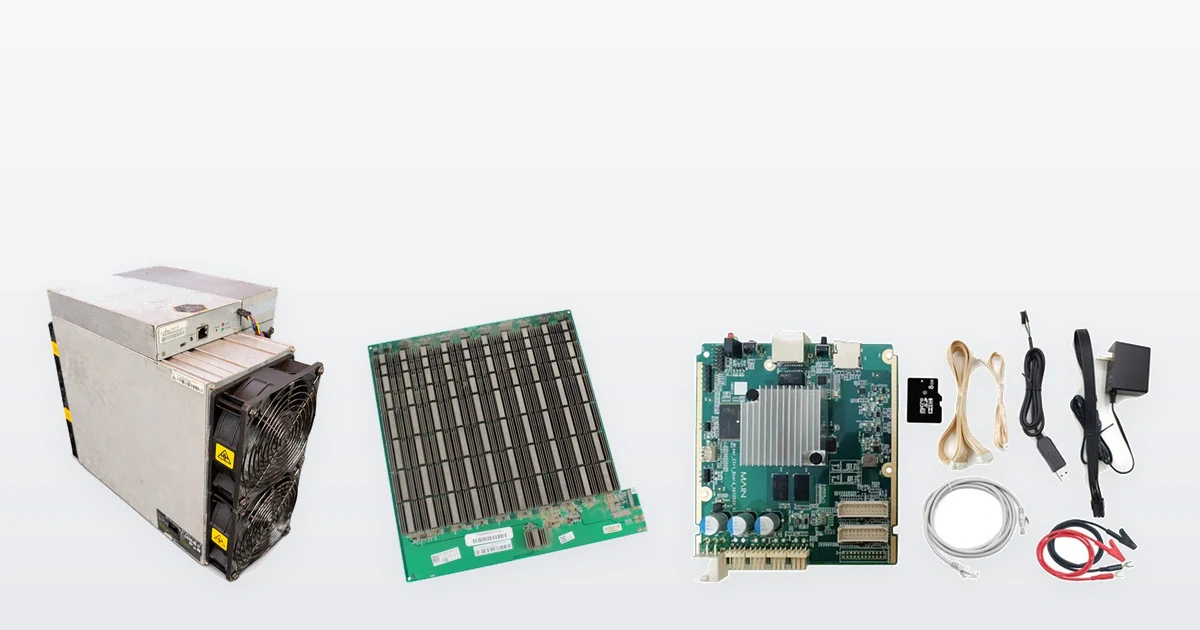
For Bitcoin, mining hardware means one thing: an
ASIC — a sealed appliance whose chips compute SHA-256 and
nothing else. Not a fast PC, not a graphics card, not something you assemble.
Anything sold to you as Bitcoin mining hardware that is not an ASIC is either
for a different algorithm or is not competitive, and that has been true since
2013. This page is the plain version: what the numbers on a listing mean, what
the machine needs from your building, what it is worth two years later, and
where to go for the detail on each.
The ASIC-versus-GPU comparison itself is settled and lives on one page: ASIC vs GPU
mining, and which actually pays. FPGAs sit between the two and are a research curiosity for SHA-256 rather than a purchase. We do stock a graphics card, and it is listed as a graphics card.
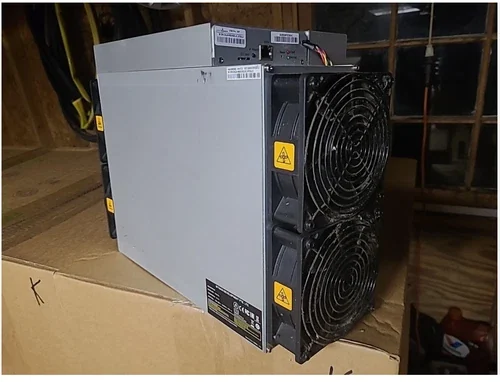
The four numbers on any listing, and what each one is for
Every miner is sold on the same four figures. Only two of them decide whether
you make money, and the one buyers lead with is not among them.
| Number | What it is | What it decides |
|---|---|---|
| Hashrate (TH/s) | How many hashes a second the machine computes | Your share of the network, and nothing else. It does not tell you whether the machine earns. |
| Efficiency (J/TH) | Joules of electricity per terahash of work | Everything. It sets the electricity price at which the machine stops paying, and no firmware, cooling or tuning moves it much. |
| Wall power (W) | What the meter actually sees | Your circuit, your breaker, your monthly bill and the heat in the room. |
| Voltage and noise | Input range in volts, sound level in dB | Whether the machine can physically go where you intend to put it. Not a performance spec; frequently the deciding one. |
Hashrate and wall power are not independent: divide watts by terahashes and
you get the efficiency. A used Antminer
S19 is 95 TH/s at 3,250 W, so 34.2 J/TH. A new S21 Pro 245T
is 245 TH/s at 3,675 W, so 15.0 J/TH. Very nearly the same power
bill; two and a half times the work. That is the entire generational story in
one comparison, and mining
profitability metrics defines each term properly.
What the machine is actually doing all day
It is repeatedly hashing a block header with a different nonce, looking for
an output below the network target. There is no puzzle being solved in any
interesting sense and no equation being worked out — it is guessing, very
fast, at a rate the Bitcoin developer documentation describes in full. Almost all
of it happens in a pool, so the machine receives work from a pool server,
returns shares, and is paid a proportion of what the pool finds.
Practically, that means a miner is a headless network appliance. It takes an
Ethernet cable and a DHCP address, has no monitor output and no operating system
you install, and everything after power-on happens in a web interface from
another machine. Setting
one up is a twenty-minute job when the circuit already exists.
What it needs from your building before it will run
This is where most first purchases fail, and every figure is on the listing
rather than in a rule of thumb:
- Voltage. Most Bitcoin machines are 200–277 V
only and will not run from a North American 120 V outlet under any adapter.
The exception we stock is the Canaan
Avalon Q at 110–240 V. - Breaker. Mining is a continuous load, so the circuit is
sized at 125% of the draw: a 3,250 W S19 pulls 13.5 A at
240 V, which needs a 20 A circuit. One machine per breaker is the
practical floor. - Heat. Essentially all of the wattage leaves as heat —
about 11,100 BTU/hr for a single S19, permanently. Plan the air path before
the machine arrives. - Noise. About 75 dB continuous on a full-size Antminer;
45–65 dB on the Avalon Q. The measured ladder across the catalogue is
in ASIC miner
noise.
The electrical detail, including what changes when it is ten machines rather
than one, is in the mining
safety checklist, and the physical side of what turns up on the pallet is in
what a mining rig actually
is.
What it costs to run, and the one division that settles it
Break-even electricity price = hashprice ÷ (24 × J/TH). At a
hashprice of $31.29 per PH per day (16 August 2026,
difficulty 127.48 T, network 902 EH/s, BTC $63,006):
| Machine | Efficiency | Break-even | Price | $ per TH/s |
|---|---|---|---|---|
| S21 Pro 245T, new | 15.0 J/TH | 8.7¢/kWh | $4,200 | $17.14 |
| Avalon Q 90T, new | 18.6 J/TH | 7.0¢/kWh | $1,999 | $22.21 |
| S19 XP 141T, refurbished | 21.35 J/TH | 6.1¢/kWh | $699.99 | $4.96 |
| S19k Pro 115T, used | 23.0 J/TH | 5.7¢/kWh | $379.99 | $3.30 |
| S19 95T, used | 34.2 J/TH | 3.8¢/kWh | $159.99 | $1.68 |
The US residential average is 18.44¢/kWh (EIA, May 2026, the latest month published). Nothing in that
table clears it. Mining hardware run at a residential rate loses money on every
machine we sell — a sentence worth reading twice before buying one, and
the reason the useful question is never “which miner is best” but “which miner
survives the rate I actually pay”. The full purchase decision is in the ASIC
miner buying guide.
What mining hardware is worth two years after you buy it
Not what its condition suggests. Resale tracks efficiency, because
efficiency sets the break-even price and that sets how many people are still
able to run the machine at all. Read the last two columns of the table above
together: the oldest machine is a tenth of the price per terahash of the newest,
and it dies at 3.8¢ where the newest survives to 8.7¢. Age barely appears in that. The used shelf is that curve made visible, and if you want the other side of it we publish what we will pay for used machines, any quantity, broken units included.
What that means in practice is that a machine loses most of its value when a
new generation is announced, not gradually as it wears out, and that a
well-maintained old machine and a neglected one of the same model sell for
roughly the same money. The curve and the US tax treatment are worked through in
ASIC
depreciation and US tax treatment, and the point at which repair stops being
worth it in why mining
hardware fails. Machines past that point are not scrap either — they are the need-parts shelf, and a dead machine is a tested parts supply to somebody who runs a bench.
Which page answers which question
“Mining hardware” covers a lot of ground. Rather than half-answer each of
these, here is what owns what:
| If your question is… | Go to |
|---|---|
| Is an ASIC or a GPU better? | ASIC vs GPU Mining: Which Actually Pays |
| What is inside the box, and what does each part do? | Mining Rig Parts and What’s Inside an ASIC Miner |
| Which chip is in which machine? | What Is an ASIC Chip? |
| What am I committing to by buying one? | What You Commit To When You Buy an ASIC Miner |
| Which machine should I actually buy? | Best ASIC Miners 2026 |
| Used or new? | Used vs New ASIC Miners |
| What does the whole setup cost? | Every Line Item |
| I want ten, or fifty, or three hundred | Buying ASIC Miners by the Pallet and whether a lot pays for itself |
Frequently Asked Questions
What is mining hardware, and how does it work?
For Bitcoin it is an ASIC: a sealed appliance whose chips compute SHA-256 and
nothing else. It repeatedly hashes a block header with different nonces looking
for a result below the network target, usually as part of a pool, and is paid a
share of what the pool finds. It is a headless network appliance —
Ethernet in, no monitor, configured through a web interface.
Which spec on a mining hardware listing actually matters?
Efficiency, in joules per terahash. It sets the electricity price above which
the machine burns more than it earns, and nothing you do to the machine moves it
far. Hashrate tells you the size of the machine, not whether it pays; wall power
tells you what circuit it needs; voltage and noise decide where it can
physically go.
How much do electricity costs actually matter?
They usually decide the outcome on their own. At a hashprice of $31.29 per PH
per day, a used S19 at 34.2 J/TH stops earning above 3.8 cents per kWh and a new
S21 Pro at 15.0 J/TH above 8.7 cents. The US residential average is 18.44 cents
(EIA, May 2026), which is above both, so mining at a domestic rate loses money on
every machine we sell.
What are the common pitfalls when buying mining hardware?
Buying on hashrate rather than efficiency; buying before the 240 V circuit
exists; underestimating heat and noise in an occupied building; and assuming
resale tracks condition when it tracks efficiency. The fifth is not testing
inside the claim window — a fault found on day two is a conversation, the
same fault on day thirty is an argument.
Related reading
- Why Mining Hardware Fails: Heat, Dust, PSUs and Repair Costs
- What a Mining Algorithm Decides When You Buy an ASIC
- Mining Profitability Metrics: What Each Number Means
- Mining Hardware Shipping: Logistics and Costs
Power supplies, converters and cabling in stock
The power-side hardware this comes down to, all of it in stock:
- Antminer Hashboard Repair Tool Kit New Version Full Set 2024
- Antminer S19 / Pro / S19j Pro / SE / XP / T19 – AMLOGIC Control Board Unlock Kit
- Bitaxe NerdQaxe++ 4.8TH/s Bitcoin Solo Miner
More in Bitcoin miner, or the full ASIC miner inventory.