
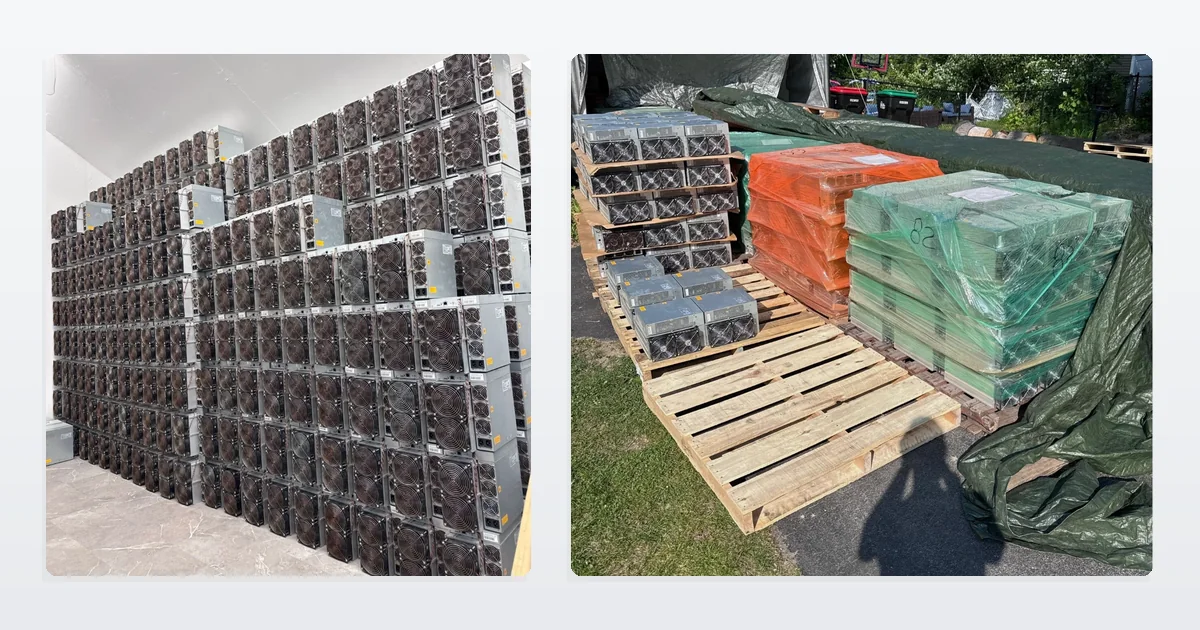
A mining profitability calculation has four moving parts — hashrate, efficiency in joules per terahash, hashprice, and network difficulty — and only one of them decides whether a machine earns or burns. This page defines each number, gives you the formula it lives in, and says what it does not tell you, so a calculator result stops being a black box.
The short version: hashrate tells you your share of the network, power tells you your bill, and the ratio between them — J/TH — is what you are actually buying. Divide hashprice by 24 times J/TH and you get the electricity price at which a machine breaks even, with hashrate cancelling out entirely. The full derivation and a table of current machines is in our ASIC miner buying guide, which is the hub for this topic.
This page covers the metrics themselves. For the ASIC-versus-GPU question see ASIC vs GPU mining; for chains other than Bitcoin see altcoin mining risks.
Every figure on this page was measured on 15 August 2026: BTC $62,975, network difficulty 127.48 T, network hashrate 896 EH/s, hashprice $31.27/PH/day, fees 0.69% of the block reward, US residential electricity 18.44¢/kWh (EIA, May 2026 — the latest month published). Mining numbers move daily. Re-run them before you spend money.
Hashrate: your share of the network, and nothing else
Unit: TH/s (terahash per second). What it measures: how many candidate block headers your machine tries per second.
Hashrate is the number every listing leads with and the number that tells you least on its own. It sets your share of the network’s total work, and nothing else. At 896 EH/s network-wide, one 115 TH/s machine is running roughly one eight-millionth of Bitcoin’s hashrate — which is why solo mining a block with it is a lottery ticket, and why essentially everyone points at a pool and gets paid in proportion to the shares they submit.
What it does not tell you: anything about cost. A 95 TH/s S19 and a 90 TH/s Avalon Q are within 6% of each other on hashrate and draw 3,250 W and 1,674 W respectively. Two machines with almost the same TH/s can have completely different economics. Never compare miners on hashrate alone.
J/TH: the number you are actually buying
Unit: joules per terahash (numerically identical to watts per TH/s). Formula: J/TH = wall watts ÷ TH/s.
This is the ratio that decides everything. It is the price of one unit of work in energy, and because energy is the only recurring cost that scales with output, it is the machine’s whole economic identity. Lower is better.
Worked from our own shelf, wall power divided by factory hashrate:
- Antminer S21 Pro 245T — 3,675 W ÷ 245 TH/s = 15.0 J/TH
- Refurbished S19 XP 141T — 3,010 W ÷ 141 TH/s = 21.35 J/TH
- Used S19k Pro 115T — 2,645 W ÷ 115 TH/s = 23.0 J/TH
- Used S19 95T — 3,250 W ÷ 95 TH/s = 34.2 J/TH (factory pair)
What it does not tell you: whether the pair is real. J/TH is only as honest as the two numbers behind it, and a tuned machine is where that breaks down. A firmware tune that drops an S19 from 3,250 W to 2,800 W also drops its hashrate; quoting the old TH/s against the new wattage invents efficiency that does not exist. At 2,800 W that machine only matches its factory 34.2 J/TH if it still hashes 81.8 TH/s or better. Ask for the measured pair — wall draw and hashrate read at the same moment, on the same unit — not one number from the factory sheet and one from the tune.
Hashprice: revenue per unit of work
Unit: $/PH/day (dollars per petahash per second, per day). Today: $31.27.
Hashprice is what the network currently pays for one petahash per second of work, per day. It folds the coin price, the block subsidy, the fee share and the difficulty into one number, which makes it the single most useful figure in mining and the one fewest buyers know. Multiply it by your hashrate to get gross revenue before power:
Gross revenue per day = TH/s × $31.27 ÷ 1,000
So at today’s hashprice, before any electricity is paid for: the S21 Pro 245T grosses $7.66/day, the S19 XP 141T $4.41, the S19k Pro 115T $3.60, and the S19 95T $2.97.
What it does not tell you: your margin. Hashprice is revenue, not profit, and it is the most volatile input on this page — it tracks the BTC price almost one-for-one. A hashprice quoted in a blog post three months ago is decoration, not data.
Break-even electricity price: the one number that settles it
Unit: ¢/kWh. Formula: break-even $/kWh = hashprice ÷ (24 × J/TH).
This is the metric the whole page exists to get you to. It is the electricity price at which a machine earns exactly what it costs to run. Above it you lose money every hour the machine is on; below it you make money. Note what is missing from that formula: hashrate cancels out entirely. A 500 TH/s machine and a 90 TH/s machine at the same J/TH break even at the same electricity price. Size changes how much you make, not whether you make it.
At $31.27/PH/day, for the four machines above:
| Machine | J/TH | Break-even | Gross/day | Net/day at 5¢ | Net/day at 3.5¢ |
|---|---|---|---|---|---|
| S21 Pro 245T (new) | 15.0 | 8.7¢ | $7.66 | +$3.25 | +$4.57 |
| S19 XP 141T (refurbished) | 21.35 | 6.1¢ | $4.41 | +$0.80 | +$1.88 |
| S19k Pro 115T (used) | 23.0 | 5.7¢ | $3.60 | +$0.43 | +$1.38 |
| S19 95T (used) | 34.2 | 3.8¢ | $2.97 | −$0.93 | +$0.24 |
Read the bottom row, because it is the whole lesson: at 5¢/kWh the S19 loses money every day it runs, and at 3.5¢ it makes 24 cents. A machine is not cheap or expensive in the abstract — it is cheap or expensive against your power rate. Against the 18.44¢ US residential average, every machine on that table loses money, which is why home mining on grid power is a hobby rather than a business.
Network difficulty: what it does, and what it has actually been doing
Unit: T (trillions). Today: 127.48 T. Retargets: every 2,016 blocks, roughly every two weeks.
Difficulty is the network’s thermostat. It adjusts so that blocks keep arriving about every ten minutes regardless of how much hardware is plugged in. When difficulty rises your machine earns less; when it falls it earns more. It reaches you through hashprice, so you do not need to model it separately — but you do need to know which way it has been going.
Here is where most mining content is out of date. The standard framing is that difficulty is a one-way ratchet that quietly makes your hardware worthless. That is not what the chain’s own retarget record shows:
- Difficulty is 127.48 T today, essentially flat against a year ago — about 1.5% lower, though the exact figure moves between roughly −1.5% and −1.7% depending on which fortnightly retarget you anchor to.
- It is 18.3% below its peak of 155.97 T, set on 29 October 2025.
- The last six retargets ran +1.7%, −10.1%, +7.2%, −5.0%, −0.7%, +1.0% — choppy and sideways, not a climb.
- The next retarget is estimated at −2.9%.
A network that has gone sideways for twelve months is one where a machine’s economic life is longer than the “obsolete in eighteen months” rule of thumb assumes. That is the honest argument for buying used, and it is worth more than any discount: see how mining hardware actually depreciates.
What it does not tell you: the future. Difficulty follows hashrate, hashrate follows profitability, and a sustained BTC rally would put both back on the climb. Twelve flat months is evidence about the present, not a forecast.
$/TH: the acquisition metric, and what changes at lot scale
Unit: dollars per TH/s of capacity.
Break-even tells you whether to run a machine. $/TH tells you whether to buy it. Divide the purchase price by the hashrate:
- S19 95T at $159.99 ÷ 95 TH/s = $1.68/TH
- S19k Pro 115T at $379.99 ÷ 115 TH/s = $3.30/TH
- S19 XP 141T at $699.99 ÷ 141 TH/s = $4.96/TH
- S21 Pro 245T at $4,200 ÷ 245 TH/s = $17.14/TH
Used capacity costs a fraction of new capacity per terahash — but the cheap terahash is also the least efficient, so $/TH on its own will always point you at the oldest machine on the shelf. The two metrics have to be read together: $/TH tells you what capacity costs, break-even tells you whether you can afford to run it. The S19 at $1.68/TH is the best buy on that list if your power is 3¢ and the worst on it if your power is 5¢.
Buying a lot changes two things. First, per-unit price falls with quantity, which improves $/TH and does not touch break-even — efficiency is a property of the silicon, not of the invoice. Second, three costs appear that a single-unit calculation ignores entirely: freight on the pallet, an allowance for units that arrive dead, and the labour to test and rack the batch. Budget them explicitly. A lot priced at $1.50/TH where 8% of units are dead on arrival is really a lot at $1.63/TH, and that is before you have paid anyone to find out which 8%. We state what has been tested and what is included on each lot listing rather than publishing a blanket failure rate, because the honest number varies by batch and by model — ask us for the grading detail on a specific lot.
Payback period: the most abused number in mining
Unit: days or months. Formula: purchase price ÷ net profit per day.
Payback is the number every seller quotes and the number most likely to be wrong, because it compounds every assumption on this page. It divides a fixed, known cost by a figure that is neither fixed nor known. At today’s hashprice and 3.5¢/kWh power, the S19k Pro pays back in roughly nine months and the S21 Pro in roughly two and a half years. At 5¢/kWh the same S19k Pro takes about two years four months, and the S19 never pays back at all, because it is loss-making at that rate.
Those spans are arithmetic, not predictions. All of them assume the machine runs 24/7 with no downtime, that hashprice stays exactly where it is today, and that nothing breaks. None of the three is true over a two-year horizon. Treat payback as a way of comparing two machines under identical assumptions, which is what it is good for, and not as a promise about when you get your money back. Any listing quoting a payback period without stating its electricity rate and its hashprice is quoting you a decoration.
The costs a calculator leaves out
Every online calculator models hashrate, power and electricity price. Here is what they routinely omit:
- Pool fee — 0% to 3% off the top. On a 115 TH/s machine at 2%, about $26 a year.
- PSU losses — you pay for the wall draw, not the DC figure on a spec sheet. If a listing quotes DC watts, add roughly 5–7%.
- Downtime — every hour off is revenue you do not get and payback you do not shorten. 97% uptime is realistic; 100% is not.
- Cooling and airflow — in a shed or a garage, the fans you add to hold intake temperature down draw power the calculator never sees.
- Electrical work — most of these machines want 200–240 V. A dedicated circuit is a real one-off cost in some homes and it belongs in the payback sum.
- Freight and duty — a rounding error on a single unit; a line item that changes the $/TH on a pallet.
- Resale value — the offsetting one. A machine is worth something at the end, and on used hardware that residual tracks efficiency rather than age.
Every metric on this page reduces to one question: at what electricity price does this machine stop making money? For the hardware we stock the answer runs from about 3.8¢/kWh to about 8.7¢/kWh, against a US residential average of 18.44¢. The comparison table lists it machine by machine, and the used ASIC miner shelf is where the cheapest of them sit.
Everything above prices a single machine. Buying ten, fifty or three hundred adds freight, an allowance for units that arrive dead, and test labour to the same sum — that is whether a lot of used miners pays for itself. If a machine you already own has fallen the wrong side of its break-even rate, what to do about it is a separate decision. For the step-by-step arithmetic behind these formulas, see how to calculate mining profitability.
Frequently Asked Questions
Which mining profitability metric matters most?
Efficiency in joules per terahash. It sets the electricity price at which a machine breaks even, through the formula hashprice divided by (24 x J/TH), and hashrate cancels out of that calculation entirely. Hashrate determines how much you earn; J/TH determines whether you earn anything at all.
What is hashprice, and why is it quoted per petahash?
Hashprice is what the network pays for one petahash per second of work, per day. On 15 August 2026 it was $31.27/PH/day. It combines the coin price, block subsidy, transaction fees and difficulty into a single figure, so multiplying it by your hashrate gives gross daily revenue before electricity. It is quoted per petahash because per-terahash figures run to fractions of a cent.
How do I calculate a miner’s break-even electricity price?
Divide hashprice in dollars per petahash per day by 24 times the machine’s J/TH. At a hashprice of $31.27, a 23 J/TH machine breaks even at 31.27 / (24 x 23) = $0.057 per kWh, or 5.7 cents. Above that rate the machine loses money every hour it runs.
Is Bitcoin mining difficulty still rising?
Not over the last twelve months. Difficulty was 127.48 T on 15 August 2026, roughly 1.5% below where it stood a year earlier and 18.3% below its October 2025 peak of 155.97 T, with the last six retargets running +1.7%, -10.1%, +7.2%, -5.0%, -0.7% and +1.0%. That is a sideways network rather than a climbing one, which lengthens the useful economic life of efficient used hardware.
What costs do mining profitability calculators leave out?
Pool fees of 0-3%, power supply losses of roughly 5-7% where the quoted wattage is DC rather than measured at the wall, downtime, additional cooling, the electrical work needed to supply a 200-240 V circuit, and freight. On a bulk purchase, add an allowance for units that arrive dead and the labour to test and rack the batch.
More on the profitability numbers
- What Actually Moves Mining Margin: Five Levers, With the Arithmetic
- Why Your Miner Is Earning Less: Diagnosing ASIC Faults
- Cryptocurrency Mining Tips and High-Performance Hardware
- Optimal Mining Pool Selection for Crypto Miners: Key Factors
The machines these numbers get run against
The machines these numbers actually get run against:
- Lot of 10 Used Bitmain Antminer S19k Pro 115TH/s Miners – Tested, Braiins OS, PSUs Included
- Canaan Avalon Q 90T Home Bitcoin Miner – New, 110–240V, 45–65 dB
- Lot of 50 Refurbished Bitmain Antminer S19 95TH/s Miners – VNish OS
More in Bitcoin miner, or the full ASIC miner inventory. The arithmetic behind all of this — break-even electricity price from J/TH — is set out in our ASIC miner buying guide.