
Buying fifty used miners is not fifty times buying one. The efficiency arithmetic is identical — J/TH does not care how many units are on the invoice — but three costs appear that a single-unit calculation never sees, and all three land on the same line: what one working machine actually costs you by the time it is hashing in your rack.
Those three are freight, an allowance for units that arrive dead, and the labour to test and rack the batch. Get them wrong and a lot that looked 20% cheaper per unit than buying singles is not cheaper at all.
Network figures used below, measured 15 August 2026: hashprice $31.27/PH/day, difficulty 127.48 T, BTC $62,975. These move daily — re-run them against your own quote before you commit. Every lot we sell is priced by quote, so the per-unit prices in the worked example are clearly labelled assumptions, not our pricing.
For what each metric means, see mining profitability metrics. For the single-unit formulas, see how to calculate mining profitability. This page is the fleet version.
Start with the number quantity cannot change
Before you look at any lot price, work out the machine’s break-even electricity rate, because no volume discount will move it. Efficiency is a property of the silicon:
Break-even $/kWh = hashprice ÷ (24 × J/TH)
At $31.27/PH/day, an S19k Pro at 23.0 J/TH breaks even at 5.7¢/kWh and an S19 at 34.2 J/TH breaks even at 3.8¢/kWh. Buy three hundred of either and those numbers are unchanged. The comparison table gives the break-even rate for everything we stock.
This is the first gate, and it disqualifies most bulk enquiries we receive. If your power costs more than the machine’s break-even rate, the lot loses money on every unit, every hour, and a better price per unit only changes how long it takes to find that out. Cheap hardware does not fix expensive electricity — and neither does new hardware: a new S21 Pro 245T at 15.0 J/TH still only reaches 8.7¢. Settle this before you ask anyone for a quote.
The number that actually matters: landed cost per working unit
The quoted per-unit price is not what a machine costs you. This is:
Landed cost per working unit = (P + F/n) ÷ (1 − d) + L
- P — the quoted price per unit
- F — total freight for the shipment, n the number of units
- d — the fraction you expect to arrive dead or unfixable
- L — your labour to receive, test and rack one unit
The part people get wrong is d. You divide by (1 − d); you do not multiply by (1 + d). If a tenth of the batch is scrap, the nine survivors have to carry the cost of all ten, and that is an 11.1% uplift, not 10%. The gap widens fast:
| Units dead on arrival | Cost uplift on the survivors |
|---|---|
| 0% | ×1.000 |
| 2% | ×1.020 |
| 5% | ×1.053 |
| 8% | ×1.087 |
| 10% | ×1.111 |
| 15% | ×1.176 |
We do not publish a blanket DOA rate, and you should distrust any seller who does. The honest figure varies by model, by batch and by how the units were pulled and packed. What you can do is make it contractual: agree the DOA window and the replacement terms in writing before the order goes in. On our larger lots that is exactly what the listings tell you to do, because at a hundred units the difference between a five-unit and a fifteen-unit allowance is real money.
What the grade words mean, and why they change the sum
Condition language is where bulk buyers get hurt, because the words are not standardised across the industry. Here is what they mean on this store, and we use them consistently:
- Tested working — it ran on our bench at the stated hashrate. That is a working-order grade, not a rebuild.
- Refurbished — it was also cleaned, re-pasted, or had parts replaced.
- As-is — sold with no working claim at all. Price it as parts and be pleased if it hashes.
Those three carry completely different values of d. An as-is pallet at a third of the price of a tested one is not a bargain unless you have a repair bench, a spares float and someone whose time is already paid for. If you have those, as-is is where the margin is; if you do not, it is where the money goes.
Ask what was actually done. On a refurbished lot the useful questions are: what was replaced or reworked, whether boards were recapped or re-pasted, the test duration and the pass criteria, and what warranty is on the lot. If a seller will not put that in writing, that is your answer. The single-unit version of this checklist is in how to buy a used ASIC miner.
Freight is a line item, not a rounding error
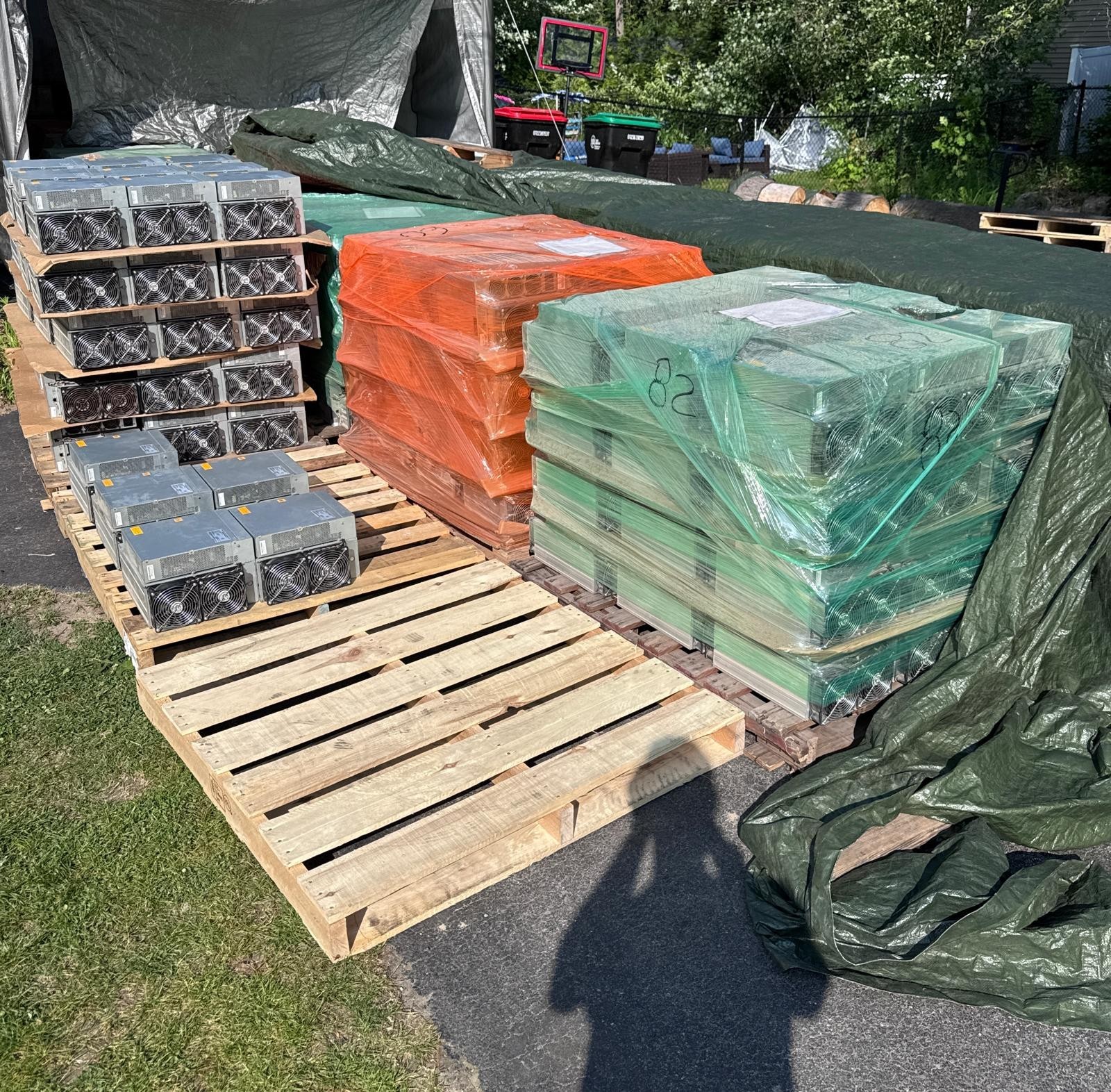
Miners are dense and heavy, they ship palletised rather than parcel, and an LTL quote is priced on gross weight and pallet footprint — not on the bare weight of the machines. Real figures from our own listings, computed from the manufacturers’ published specifications:
- S19 class — 14.2 kg net, 16 kg gross per boxed unit.
- Lot of 10 S19k Pro — about 128.5 kg net, 145 kg gross.
- Lot of 50 S19 — about 710 kg net, 800 kg gross.
- Lot of 300 S19 — roughly 4.3 tonnes net, 4.8 tonnes gross, and about 975 kW of continuous load once it is running.
Pallet, strapping and overpack sit on top of those. Divide the freight quote by the number of working units, not the number shipped — you paid to move the dead ones too.
Two things worth planning before the pallet arrives: have an electrician confirm the supply, because these machines want 200–277 V, and know where four tonnes of freight is going to be unloaded. A delivery you cannot receive becomes a storage bill.
The 48 hours after delivery decide your DOA claim
Freight claim windows are short. A fault found on day two is a conversation; the same fault found on day thirty is an argument you will probably lose. So the receiving process is part of the economics:
- Photograph the pallet before you open it, and keep the packaging.
- Run every unit for 48 hours and log hashrate and wall draw per machine.
- Compare each against the stated pair — not against the model’s factory sheet, against what the listing said these units do.
- Report shortfalls inside the agreed window, in writing, with the logs attached.
That is the acceptance test we ask buyers to run, and it is why we would rather you found a problem in week one.
A worked example: ten S19k Pro
Take the lot of 10 used S19k Pro — 115 TH/s and 2,645 W per unit, tested working, PSUs included, Braiins OS installed. The same machine as a single unit is $379.99 (or the 120 TH/s VNish bin at the same price), which is the ceiling any lot quote has to beat. The per-unit revenue side, at today’s hashprice:
- Gross revenue: 115 × $31.27 ÷ 1,000 = $3.60/unit/day
- Power at 3.5¢/kWh: 2.645 kW × 24 × $0.035 = $2.22 → net $1.38/unit/day
- Power at 5¢/kWh: $3.17 → net $0.42/unit/day
Now the cost side. The following per-unit price and freight figure are assumptions for the illustration, not our quote — put your own in. Assume $320 a unit, $550 total freight, a 5% DOA allowance and 30 minutes of your time per machine at $40/hour:
(320 + 55) ÷ 0.95 + 20 = $414.74 per working unit
Against that: payback is 302 days at 3.5¢/kWh, and 983 days at 5¢/kWh. The same hardware, the same quote, the same freight — and a power rate 1.5 cents apart turns a ten-month payback into a two-and-a-half-year one. That is the single most important sentence on this page.
Note what the $320 assumption did not do: it did not change the 5.7¢ break-even. If your power were 6¢, every line above would be negative regardless of the price you negotiated.
The costs that start after the pallet lands
A fleet is not a machine you plug in. Budget for these from day one rather than discovering them:
- A spares float. Hashboards, fan assemblies, PSUs and control boards are the four things that fail on an S19 fleet. We stock spares and repair hardware — hashboards, control boards, PSUs and chip testers — precisely because fleets need them on the shelf, not on order.
- A repair bench. At fifty units and up, in-house repair stops being optional. A hashboard tester pays for itself the first week.
- Failure as an operating cost. Units will fail over time. That is not a defect in the lot; it is the depreciation schedule, and it should be in your model.
- Noise and heat. A hundred S19s at roughly 75 dB each is an industrial site, not a garage.
- Firmware. Third-party firmware voids any remaining manufacturer warranty, and pushing frequency raises board temperature — which is what actually kills S19 hashboards.
What to get in writing before you send money
Every one of these changes the arithmetic above, and none of them is rude to ask:
- The condition grade, and what that word means on this specific lot.
- The DOA window and the replacement policy.
- Whether PSUs, cords and the plug standard are included — on a large order this alone is a five-figure swing.
- The test duration and the pass criteria used.
- What was replaced or reworked, if the lot is described as refurbished.
- The warranty term on the lot, if any is offered.
- Freight: who books it, what it costs, and what the delivery window is.
We answer all seven in writing before an order, and where a listing states no grade or no warranty term we say so on the page rather than implying one. That is the deal: you are buying used hardware, and what you are really buying is an accurate description of it.
Ready to price one? Send us the quantity, model and your power rate and we will come back with a quote, the grade detail and a freight estimate. The current lots are on the used ASIC miner shelf, and if a machine you already run has fallen the wrong side of its break-even rate, that is a separate decision with its own options.
Frequently Asked Questions
Does buying miners in bulk lower the break-even electricity price?
No. Break-even is hashprice divided by (24 x J/TH), and efficiency is a property of the silicon rather than of the invoice. A volume discount lowers what you pay to acquire capacity; it does not change the electricity price at which that capacity stops earning. An S19k Pro at 23 J/TH breaks even at 5.7 cents per kWh whether you buy one or three hundred.
How do I work out the real cost of a miner in a bulk lot?
Use landed cost per working unit = (P + F/n) / (1 – d) + L, where P is the quoted unit price, F the total freight across n units, d the fraction expected to arrive dead, and L your labour to receive, test and rack one machine. Divide by (1 – d) rather than multiplying by (1 + d): at a 10% failure rate the survivors carry an 11.1% uplift, not 10%.
What DOA rate should I budget for on a used miner lot?
There is no honest blanket figure – it varies by model, by batch and by how the units were pulled and packed, so treat any seller quoting a universal DOA rate with suspicion. Instead make it contractual: agree the DOA window and the replacement terms in writing before the order is placed, and run a 48-hour acceptance test on every unit as soon as the pallet lands, because freight claim windows are short.
What is the difference between tested working, refurbished and as-is?
On this store, tested working means the unit ran on our bench at the stated hashrate – a working-order grade, not a rebuild. Refurbished means it was also cleaned, re-pasted or had parts replaced. As-is means it is sold with no working claim at all and should be priced as parts. The three carry very different failure rates, so they are not interchangeable in a profitability model.
How much does a lot of used miners weigh for freight?
An S19-class machine is 14.2 kg net and 16 kg gross boxed, on Bitmain’s published specification. That makes a lot of 10 S19k Pro about 145 kg gross, a lot of 50 S19 about 800 kg gross, and a lot of 300 roughly 4.8 tonnes gross. They ship palletised rather than parcel, and an LTL quote is priced on gross weight and pallet footprint, with pallet and strapping on top.
More on buying at fleet scale
- Mining Profitability Metrics: What Each Number Means
- How to Calculate Mining Profitability: The Two Formulas
- How Mining Hardware Actually Depreciates
- What Actually Moves Mining Margin: Five Levers, With the Arithmetic
- 7 Effective Ways to Maximize Mining Profit
- 7 Key Mining Profitability Factors Every Miner Must Know
The lots these numbers get run against
Every lot below is priced by quote — tell us the quantity and your power rate:
- Lot of 10 Used Bitmain Antminer S19k Pro 115TH/s Miners – Tested, Braiins OS, PSUs Included
- Lot of 50 Refurbished Bitmain Antminer S19 95TH/s Miners – VNish OS
- Lot of 300 Used Bitmain Antminer S19 95TH/s Miners – Tested and Working
More in Bitcoin miner, or the full ASIC miner inventory. The arithmetic behind all of this — break-even electricity price from J/TH — is set out in our ASIC miner buying guide.