
An ASIC chip is one hash function cast into silicon: a fixed
datapath with no instruction set, no memory hierarchy and nothing it can be
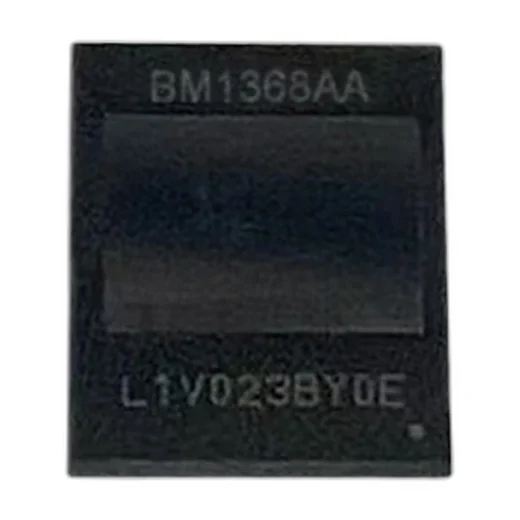
reprogrammed to do. On a Bitmain machine that chip has a part number printed on
it — BM1398BB, BM1366AL, BM1368AA, BM1370 — and that number,
not the model name on the box, decides the efficiency, the resale price and
whether you can get a spare board for it. We buy, test and repair these
by the pallet, so what follows is the ladder as it actually comes across our
bench, with the part numbers off the listings that sell them.
If you want the ASIC-against-GPU argument rather than the silicon, it is
settled and it lives on one page: ASIC vs GPU
mining, and which actually pays. Short version: a current ASIC does
245 TH/s of SHA-256 where a graphics card does of the order of 1 GH/s,
so no electricity price closes the gap. The chip also fixes which algorithm the machine can run at all, which is what a mining algorithm decides when you buy an ASIC.
What an ASIC chip actually is, physically
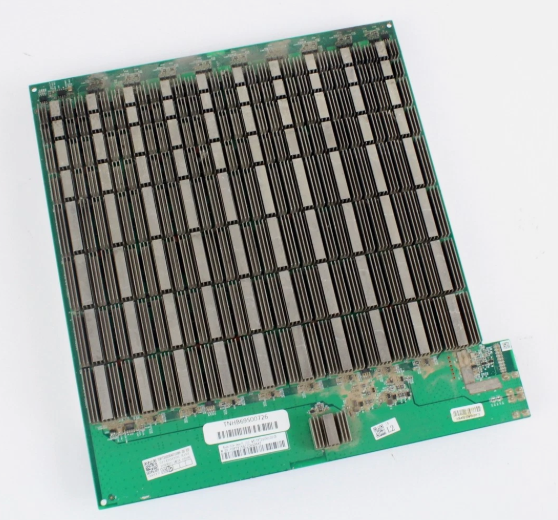
A hashboard — the component that makes a box of steel into mining hardware — is a PCB carrying dozens of identical chips wired in a chain and
fed through a series of voltage domains. Each chip does a small share of the
work, and the machine’s headline hashrate is simply that share multiplied by the
chip count. Three real examples, all from our own listings:
- A used Antminer
S19 95TH/s carries 228 BM1398BB chips on 7 nm silicon
— three boards of 76 — for 95 TH/s at 3,250 W. That is
about 0.42 TH/s and 14.3 W per chip, and where the rest of the watts go is a separate question from the chips. - A refurbished S19
XP 141TH/s carries BM1366AL, 110 chips per hashboard across 11
voltage domains. More chips, each doing less work at lower voltage,
which is where the efficiency gain comes from. - A NerdQAxe++
is four BM1370 chips on a desk, about 4.8 TH/s at 76–80 W
measured. Same silicon generation as the flagship machines, four chips instead
of a few hundred.
That last one is the clearest demonstration of the whole idea. A hobby board
and a production miner using the same chip land at roughly the same joules per
terahash, because efficiency is a property of the silicon and not of the size of
the box around it.
The chip ladder, and what each generation is worth today
Break-even electricity price is hashprice ÷ (24 × J/TH). At a
hashprice of $31.29 per PH per day (16 August 2026,
difficulty 127.48 T, network 902 EH/s, BTC $63,006):
| Chip | Machine it is in | Efficiency | Break-even | Price | $ per TH/s |
|---|---|---|---|---|---|
| BM1398BB (7 nm) | Antminer S19 95T, used | 34.2 J/TH | 3.8¢/kWh | $159.99 | $1.68 |
| BM1366 family | Antminer S19k Pro 115T, used | 23.0 J/TH | 5.7¢/kWh | $379.99 | $3.30 |
| BM1366AL | Antminer S19 XP 141T, refurbished | 21.35 J/TH | 6.1¢/kWh | $699.99 | $4.96 |
| BM1368AA | Antminer S21+ 216T, new | 16.5 J/TH | 7.9¢/kWh | $4,200 | $19.44 |
| BM1370 | Antminer S21 Pro 245T, new | 15.0 J/TH | 8.7¢/kWh | $4,200 | $17.14 |
| BM1370 × 4 | NerdQAxe++ 4.8T, new | 15 J/TH rated | 8.7¢/kWh | $365 | $76.04 |
Two readings of that table are worth more than the rest of this page.
The break-even column is the chip’s real output. Two chip
generations apart is the difference between a machine that needs sub-4¢
power and one that survives to 8.7¢. Nothing you bolt on moves it. The US
residential average is 18.44¢/kWh (EIA, May 2026), and
nothing in that table clears it — which is the honest headline about home
mining and one most hardware sellers leave out. What running one at a domestic rate actually looks like is in ASIC mining at home.
The dollars-per-terahash column does not run in the same
direction. The oldest chip is the cheapest hashrate on the whole used shelf by a factor of ten,
and the NerdQAxe++ is the most expensive on the list by a factor of forty-five,
because what you buy there is a machine that runs off a 12 V brick on a
desk rather than cheap terahash. Capital cost and running cost pull opposite
ways; which one dominates is decided by your electricity price, and that
crossover is worked out in used vs new ASIC
miners.
Read the chip, not the model name
Model names are marketing and they get reused. Chip markings do not. Three
places where this costs buyers real money:
- “110 TH/s” on an S19 is two different machines. An S19 Pro
was built at 110 TH/s. A 95 TH/s S19 running boosted firmware also
advertises about 110. Same number in the title, different silicon, different
efficiency, different resale. How to buy a used ASIC
miner covers that trap in full, and ASIC miner models compared sets the bins side by side. - Firmware moves the operating point, never the chip. VNish
and Braiins OS let you drop chip voltage and frequency — our own S19
listing pulls wall draw from the factory 3,250 W down to about
2,800 W, and J/TH improves when you do it, because hashrate comes down as
well. What firmware cannot do is turn BM1398 silicon into BM1370 silicon. Any
listing quoting an efficiency BM1398 cannot physically reach is quoting a
different machine. - The suffix is part of the part number. BM1366AL, AG, BS, BP
and AH are one family; BM1368AA is a different one. Order the wrong suffix and
it will not work, which is why our five-pack
of BM1368AA chips tells you to read the marking on the board first.
What the chip decides about repair, and what it costs
A dead chip is not a dead machine, but the chip family decides whether that
is true for you. What our own bench uses, by family:
- A BM1366
chip tester — $599.99 gives a straight PASS or ERROR on a single chip.
It covers the AL, AG, BS, BP and AH variants, which is the S19 XP, S19 XP Hydro
and S19k Pro boards. It explicitly does not cover BM1368AA. - A K3L
hashboard tester — $459.99 walks the chip chain on a board outside the
miner and turns “the miner is broken” into “chip 41 in domain 5 is dead”. It
covers S19, S21, T21 and the KS3/KS5 Kaspa boards. - When the diagnosis says the board is gone, a tested
S19 Pro hashboard is $59.99 and an S19
XP Pro board as-is is $24.99. A failed power supply is a $59.99
APW17, not the “$200 to $400” the internet quotes.
Chip-level rework is worth doing when you have isolated one or two dead chips
in a single voltage domain on an otherwise healthy board. It is not worth doing
with multiple failed domains, a burnt or delaminated PCB, water damage or lifted
pads — by then you are at the price of a tested board. And the whole
question only has an answer at all where the chip family has a parts market: the
counter-example is on our own shelf as a $599.99
Antminer E9 test fixture, a diagnostic rig for Ethash machines whose chain
moved to proof of stake in September 2022 and never came back.
What the chip does not decide
Roughly half of what goes wrong with a miner has nothing to do with the
silicon. The power supply, the control board, the fans and the airflow around
the machine are all independent of the chip generation, and they fail more often
than chips do. A control
board is $59.99 and a dual
fan assembly $24.99 — neither touches a headline number, and either
can strand the machine. What’s
inside an ASIC miner lays out how the parts fit together, mining rig parts
maps each part to the number it produces on the listing, and why mining hardware
fails puts them in the order we actually see them break.
Chip families at lot scale
On a single machine the chip family is a spec. On a lot of fifty it is a
logistics decision, because your spares shelf has to cover every family in the
batch. Fifty S19s means BM1398 boards, one tester and one spare board type.
Fifty mixed S19, S19k Pro and S19 XP means BM1398 and BM1366, two
fixtures, and board stock for both.
So the question to put in an enquiry is not “what condition are they” but
“which chip and which board revision, across the whole lot”. Our lots are
quote-only — tell us the count, the chip family you want and the power
price you are working to, and we will price it against what is actually on the
floor. What
the grade words mean and whether a lot pays
for itself cover the rest of that conversation, and what you commit to when you buy
an ASIC is the same argument at the level of the algorithm rather than the
chip.
Frequently Asked Questions
What is an ASIC chip in cryptocurrency mining?
It is an integrated circuit built to compute one hash function and nothing
else — no instruction set, no general-purpose processor, no alternative
use. In a Bitcoin miner, dozens to hundreds of identical chips sit in a chain on
a hashboard: 228 BM1398BB chips in a used Antminer S19, four BM1370 chips in a
NerdQAxe++. The machine’s hashrate is the per-chip figure multiplied by the
count.
How do I find out which chip is in a miner?
Read the marking on the chips themselves, or ask the seller for it in
writing. It is a short code such as BM1398BB, BM1366AL or BM1368AA. Do not infer
it from the model name or the advertised hashrate: a 95 TH/s S19 running boosted
firmware advertises about 110 TH/s, the same figure as a genuine S19 Pro, and
the two are different silicon with different efficiency and different resale
value.
Does firmware change a chip’s efficiency?
It moves the operating point, within limits set by the silicon. Dropping
voltage and frequency with VNish or Braiins OS improves J/TH and reduces
hashrate at the same time — our own S19 listing runs at about 2,800 W
instead of the factory 3,250 W on exactly that trade. What firmware cannot do is
reach an efficiency the chip generation is not capable of, so treat any listing
quoting one as describing a different machine.
Is a dead chip worth repairing?
Yes when one or two chips in a single voltage domain have failed on an
otherwise healthy board, and you have a fixture to prove which ones. No when
there are multiple failed domains, a burnt or delaminated PCB, water damage or
lifted pads — that much rework costs more than a tested board, which is
$59.99 for an S19 Pro on our shelf against $159.99 for a whole working
machine.
More on the silicon
- What’s Inside an ASIC Miner: Hashboards, Control Board and PSU
- What You Commit To When You Buy an ASIC Miner
- Mining Rig Parts: What Each Component Actually Does
- Antminer Parts Compatibility: Order the Right Hashboard, PSU or Fan
The machines these numbers get run against
The machines these numbers actually get run against:
- Bitmain Antminer S21 Pro 234T – Efficient SHA-256 ASIC Miner
- Bitmain Antminer S21 Pro 245T – Efficient Bitcoin Miner
- Lot of 5 Refurbished Bitmain Antminer S19 95TH/s Miners – Braiins OS
More in Bitcoin miner, or the full ASIC miner inventory. The arithmetic behind all of this — break-even electricity price from J/TH — is set out in our ASIC miner buying guide.