
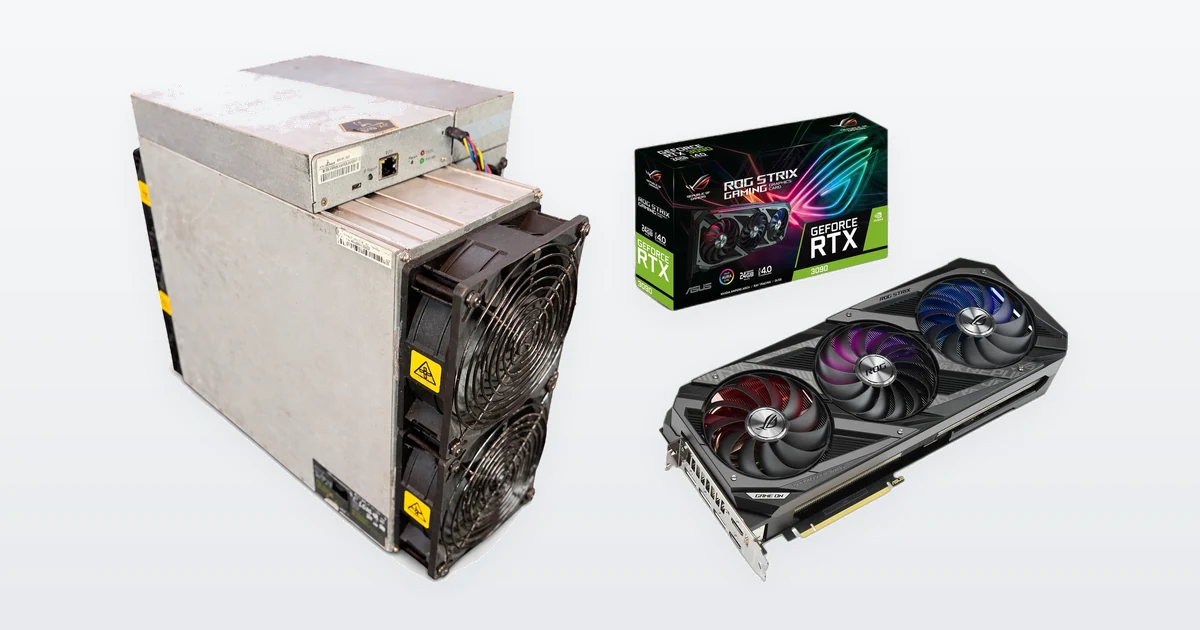
For Bitcoin the ASIC-versus-GPU question is settled and has been since roughly 2013: a graphics card would spend far more on electricity than it could ever earn in block rewards. An ASIC commits all of its silicon to SHA-256; a GPU spends most of its transistor budget on things a miner never uses. The gap is orders of magnitude, not percentages.
The question is not settled everywhere, which is what this page is about. GPUs remain relevant on chains that deliberately design their algorithms to blunt specialised hardware, and that is a genuinely different business with different risks. One thing that changed the landscape permanently: Ethereum moved to proof-of-stake on 15 September 2022 and can no longer be mined on any hardware, which removed the single largest GPU mining market overnight and left a lot of published advice stranded.
For the arithmetic that decides any of this, see our ASIC miner buying guide. For what each profitability input means, see mining profitability metrics.
ASIC against GPU, on the numbers
| ASIC | GPU | |
|---|---|---|
| Bitcoin (SHA-256) | 245 TH/s from an S21 Pro at 15.0 J/TH | of the order of 1 GH/s — roughly one part in 250,000 of the ASIC, at similar wattage |
| Break-even electricity price | 3.9¢–9.0¢/kWh across our catalogue | there is no electricity price at which a GPU mines Bitcoin profitably |
| What it can mine instead | one algorithm, for the life of the machine | whatever is currently GPU-mineable, and it changes |
| What it is worth when mining stops paying | parts — an as-is S19 XP Pro hashboard is $24.99 here | a graphics card, which still has buyers who are not miners |
| Entry price here | $159.99 for a tested used S19 | whatever a card costs — and it will not mine Bitcoin at any of them |
The middle row is the one that ends the argument. There is no electricity price at which a graphics card mines Bitcoin profitably, because the gap is not a matter of margin — it is five orders of magnitude of throughput at comparable wall power. An S21 Pro commits every transistor to SHA-256. A GPU spends most of its die on memory controllers, raster hardware and shader scheduling that a hash function never touches.
What a GPU still does have is optionality. It can mine whatever is currently GPU-mineable, it can stop and be sold to somebody who wants to play a game with it, and it does not become a doorstop when one chain’s economics turn. An ASIC has exactly one job and, when that job stops paying at your power price, its residual value is the parts market — which for the S19 family is deep and real, and for anything rarer is not.
What “profitable” means, precisely
One number decides it: the electricity price at which the machine stops earning. Gross revenue per day divided by kilowatt-hours per day, in dollars per kWh. On 15 August 2026, with Bitcoin’s hashprice at $31.32 per PH per day (difficulty 127.48 T, BTC $63,072), the shortcut is break-even in cents = 130.5 ÷ the machine’s J/TH.
| Machine | J/TH | Gross/day | Break-even | Margin at 6 ¢/kWh |
|---|---|---|---|---|
| Used S19 95T | 34.2 | $2.98 | 3.82 ¢ | −$1.70 |
| Used S19k Pro 120T | 23.0 | $3.76 | 5.67 ¢ | −$0.22 |
| New S21 Pro 245T | 15.0 | $7.67 | 8.70 ¢ | +$2.38 |
| Any GPU, on Bitcoin | — | fractions of a cent | none exists | −(all of it) |
Two readings. First, the older machine is not “less profitable” in a vague way — it is negative at 6 ¢ and positive at 3 ¢, and which side of that line you are on is a property of your building, not of the machine. Second, at the US residential average of 18.44 ¢/kWh (EIA, May 2026) every row of that table is deeply negative, GPU and ASIC alike. Household power does not mine Bitcoin at a profit on any hardware sold anywhere. We would rather say that here than have you find it out.
The full list of what moves this number, ranked by how much each one actually matters, is in the seven profitability factors; the formulas themselves are in the calculation guide.
Where GPUs still make sense, and why we do not sell them
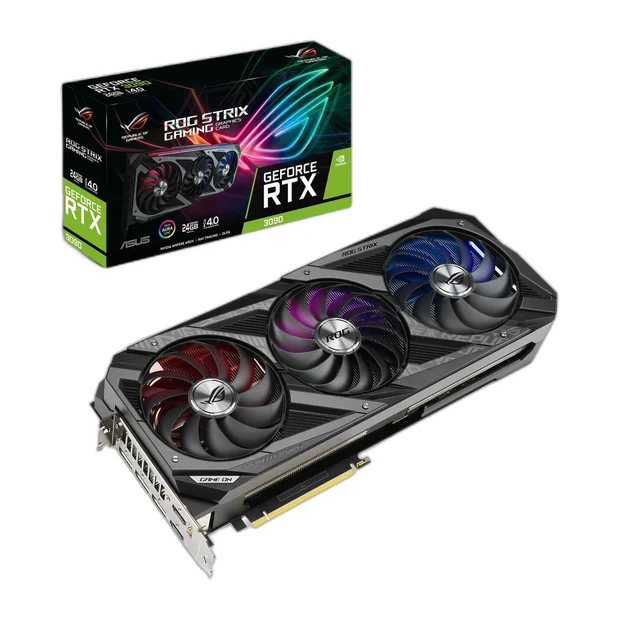
GPU mining is a real business on chains whose algorithms are designed to blunt specialised hardware, and it is a different business from ours. Ethereum Classic on Ethash, Ravencoin on KAWPOW and a rotating cast of smaller chains are genuinely GPU-mined. Monero on RandomX is CPU territory and deliberately hostile to both GPUs and ASICs. The economics there are driven by coin selection and switching rather than by efficiency, because you are not committed to one chain.
Three things a GPU miner is buying that an ASIC buyer is not: the ability to change chains when one turns, a resale market of people who are not miners, and much lower capital per unit. Three things they are giving up: throughput per watt on any chain an ASIC exists for, the ability to plan around a known emission schedule, and the deep parts and firmware ecosystem that makes a fleet of identical ASICs manageable.
We sell ASICs because that is what we buy, test, repair and resell — a fleet of identical machines with a commodity parts supply is a business you can run honestly. Ethereum’s move to proof-of-stake on 15 September 2022 removed the largest GPU mining market that has ever existed, and a lot of GPU mining advice still in circulation was written before that happened. If GPU mining is your plan, take advice from someone who does it. Every ASIC we sell is ranked by the power price it survives in our ASIC miner comparison table.
Depreciation and volatility, in one paragraph each
Depreciation. A miner loses value with efficiency, not with age, and it loses most of it the week a new generation is announced. On our own shelf a 2022 S19 XP at 21.35 J/TH costs $4.96 per terahash while a 2023 S19k Pro at 23.0 J/TH costs $3.17 — the older machine is dearer because it is the more efficient one. The whole curve, with the US tax treatment, is in ASIC depreciation and US tax treatment.
Volatility. Everything above rests on a coin price and a difficulty, and both move. Difficulty is currently 127.48 T, which is 1.7% below where it stood a year ago and 18% off its October 2025 peak, so the usual assumption that difficulty compounds against you has been wrong for twelve months. Do not plan on that continuing either. The discipline is to re-derive your break-even on the day you buy and to size the purchase so that a 30% move in either direction does not end the operation. NBER’s study of listed mining companies is a useful outside check on how much of the industry’s cost base is simply electricity.
Common mistakes new miners should avoid
- Using an online calculator’s default electricity price. Your rate is on your bill, including delivery charges and demand charges, and it is usually higher than the number in the box.
- Comparing machines by hashrate. Hashrate tells you the size of the machine, not whether it earns. Two machines at the same J/TH have the same break-even whatever their hashrate.
- Buying new when the site has power to spare. With cheap power and a capital limit, more used machines beat one efficient one. With constrained power, the reverse. Decide which constraint you actually have.
- Forgetting the circuit. A 3,510 W machine is a continuous load, sized at 125% under the NEC — 18.3 A at 240 V, so a 20 A circuit with nothing spare. Ten of them are not going on a domestic service.
- Ignoring noise. 75–80 dB is a shop vacuum that never stops. It is the single most common reason a home installation gets removed.
- Assuming a GPU is the cheap way in. On Bitcoin it is not a cheaper way in, it is no way in. A tested used S19 at $159.99 is the cheap way in, if your power is under about 3.8 ¢ — the rest of that shelf is in used ASIC miners.
Frequently Asked Questions
Is ASIC or GPU mining more profitable?
For Bitcoin, ASIC, and it is not close — a GPU manages of the order of 1 GH/s of SHA-256 against 245 TH/s from an S21 Pro at comparable wall power, so there is no electricity price at which a GPU mines Bitcoin profitably. For chains built to resist specialised hardware, such as Ethereum Classic on Ethash or Monero on RandomX, GPUs and CPUs remain the correct hardware. The two are not competing for the same job.
What break-even electricity price does a miner need?
Divide 130.5 by the machine’s J/TH at the 15 August 2026 hashprice of $31.32 per PH per day. That gives 3.82 cents per kWh for a used S19 at 34.2 J/TH, 5.67 cents for an S19k Pro at 23.0, and 8.70 cents for an S21 Pro at 15.0. At the US residential average of 18.44 cents per kWh none of them earns anything, which is why home mining on grid power does not pay.
Can I still mine Ethereum with a GPU?
No. Ethereum moved to proof-of-stake on 15 September 2022 and cannot be mined on any hardware. Ethereum Classic still uses Ethash and is GPU-mineable, and a lot of published GPU mining advice predates the merge and has never been updated.
How much does electricity matter compared with everything else?
It is the dominant cost and usually the only one that decides the outcome. A used S19k Pro grosses about $3.76 a day and burns 66.2 kWh; at 6 cents per kWh that is $3.97 of power against $3.76 of revenue, and at 3 cents it is $1.99 against the same $3.76. The same machine, the same day, and the sign of the answer changes with the building it is in.
More on ASIC versus GPU
- What Actually Moves Mining Margin: Five Levers, With the Arithmetic
- Why Your Miner Is Earning Less: Diagnosing ASIC Faults
- Mining 101: A Beginner’s Guide to Cryptocurrency Mining
- Optimal Mining Pool Selection for Crypto Miners: Key Factors
The machines these numbers get run against
The machines these numbers actually get run against:
- Canaan Avalon Q 90T Home Bitcoin Miner – New, 110–240V, 45–65 dB
- Lot of 50 Refurbished Bitmain Antminer S19 95TH/s Miners – VNish OS
- Lot of 300 Used Bitmain Antminer S19 95TH/s Miners – Tested and Working
More in Bitcoin miner, or the full ASIC miner inventory. The arithmetic behind all of this — break-even electricity price from J/TH — is set out in our ASIC miner buying guide.