
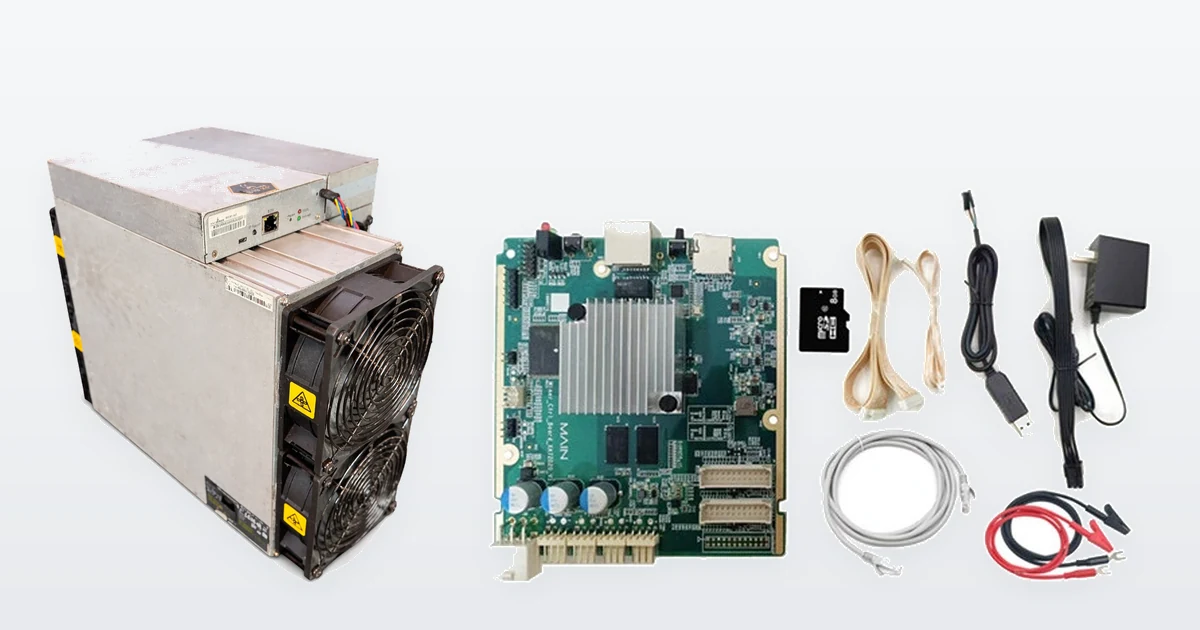
“Mining rig” means two completely different objects, and
which one you are picturing decides almost everything about the purchase. One is
a multi-GPU frame you assemble yourself: an open chassis, a motherboard, risers,
six to twelve graphics cards. The other is a sealed steel appliance that arrives
finished, with the boards, the controller, the power supply and the fans already
inside, and the only assembly is plugging it into a circuit that can carry it.
For Bitcoin it is always the second one. This page is about what
that appliance physically is: what turns up, what it weighs, what it plugs into
and what it does to the room it lands in.
If the question you actually have is which of the two earns more, that is
answered with numbers on one page and the answer has not changed since 2013:
ASIC vs GPU
mining, and which actually pays.
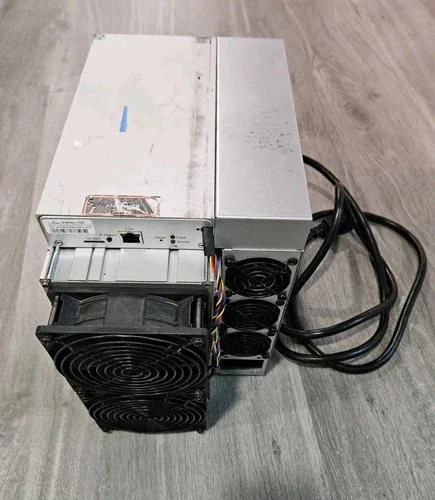
What actually arrives on the pallet
A used Antminer
S19 95TH/s, which is the most common single machine we ship, is
400 × 195.5 × 290 mm bare and 14.2 kg
net — a boxed 570 × 316 × 430 mm and
16 kg gross. A S19k Pro
115TH/s is the same chassis at 13.85 kg net. Two things follow that
catch people out:
- Freight is billed on the gross weight, not the net. On a
single machine that is a couple of kilos. On a pallet of forty it is most of a
line item. - Published dimensions disagree between sources for newer
models. Our own S21
Pro 245T listing says so out loud rather than picking the flattering figure,
and we will confirm in writing what is physically in the crate. If a seller
quotes you a spec to the millimetre for a machine whose manufacturer publishes
two, that is worth noticing.
Inside the case there is no monitor output, no keyboard port and no operating
system you install. It is headless: it boots on its own, takes a DHCP address
over Ethernet, and everything after that happens in a web interface from another
machine on the same network. There is nothing to build — the build question is a buying question, and the machines are in the ASIC miner category. Mining rig parts
maps each internal component to the number it produces on the listing, and what’s
inside an ASIC miner covers the layout.
What it plugs into, and the breaker it needs
This is where a first purchase most often goes wrong, and it is not a
preference — it is an electrical fact printed on the listing. Most Bitcoin
machines are 200–277 V only and will not run on a
North American 120 V outlet under any adapter.
Mining is a continuous load, so a circuit is sized at 125% of the draw. That
gives, per machine:
| Machine | Draw | Input | Amps at that voltage | Circuit at 125% | Heat into the room |
|---|---|---|---|---|---|
| S19 95T (used) | 3,250 W | 200–277 V | 13.5 A at 240 V | 20 A | ~11,100 BTU/hr |
| S19k Pro 115T (used) | 2,645 W | 200–240 V | 11.0 A at 240 V | 20 A | ~9,000 BTU/hr |
| S21 Pro 245T (new) | 3,675 W | 220–277 V | 15.3 A at 240 V, 17.7 A at 208 V | 20 A at 240 V, 30 A at 208 V | ~12,500 BTU/hr |
| Avalon Q 90T (new) | 800 / 1,300 / 1,674 W by mode | 110–240 V | 14.0 A at 120 V in Super mode | 20 A, NEMA 5-20R | ~5,700 BTU/hr |
The Avalon Q is the only machine on that list a house can take, and even it
is not weightless: 1,674 W on a 120 V line is about 14 A, and a
standard 15 A branch circuit is rated for 12 A continuous. In its top
mode it wants a dedicated 20 A circuit with a NEMA 5-20R outlet. That is
what “runs on a normal outlet” honestly means.
The right-hand column is the one people discover in July. A single S19 is an
11,000 BTU/hr electric heater that never switches off — comparable to
a one-tonne air conditioner running in reverse. Plan where that heat goes before
the machine arrives, not after. The full electrical treatment, including what
happens when it is ten machines rather than one, is in the mining
safety checklist.
Noise, which is not a footnote
An Antminer runs at about 75 dB continuously. That is
not a background hum; it is roughly a vacuum cleaner in the room, twenty-four
hours a day, and it is the single most common reason a machine gets moved out of
a house within a fortnight. The Avalon
Q is 45–65 dB depending on power mode, which is a real difference
rather than a marketing one — decibels are logarithmic, so 75 against 65
is roughly twice as loud, not 13% louder. The measured ladder across our whole
catalogue is in ASIC
miner noise: how loud each machine actually is.
What it costs to run, in one division
A rig’s running cost is one number: joules per terahash.
Divide the hashprice by 24 × J/TH and you get the electricity price above
which the machine earns less than it burns. At a hashprice of
$31.29 per PH per day (16 August 2026, difficulty
127.48 T, BTC $63,006):
- Used S19 at 34.2 J/TH — 3.8¢/kWh, $159.99
- Used S19k Pro at 23.0 J/TH — 5.7¢/kWh, $379.99 (the 120TH VNish bin is the same money)
- Avalon Q at 18.6 J/TH — 7.0¢/kWh, $1,999
- New S21 Pro at 15.0 J/TH — 8.7¢/kWh, $4,200
The US residential average is 18.44¢/kWh (EIA, May
2026). None of these clears it, and that is the honest answer to “is a mining rig
profitable at home”: not at a residential rate, on any machine we sell. What
each of those metrics means is in mining
profitability metrics, and the full purchase arithmetic in the ASIC
miner buying guide.
Where a first rig goes wrong
In the order we actually see it, from machines that come back:
- Bought before the circuit existed. The machine lands, there
is nowhere to plug it in, and an electrician quotes more than the miner cost.
Read the power bill and the panel first — that ordering is the whole point
of the power-first
workflow. - Put in a room with no air path. These machines pull cold air
in one end and push hot air out the other. In a closed cupboard they re-breathe
their own exhaust, throttle, and then cook the boards. Heat and dust are what
actually kill them — see why mining hardware
fails. - Bought on hashrate. Hashrate tells you the size of the
machine and nothing about whether it earns. Efficiency and your power price
decide that. - Never tested inside the claim window. A fault found on day
two is a conversation; the same fault on day thirty is an argument. The first
48 hours are set out in acceptance-testing a
miner you just received.
When it is forty rigs and not one
Every line above multiplies, and two of them change character. Forty S19s is
about 640 kg gross on freight and 130 kW of continuous load —
that is no longer a circuit question but a service question, and it is the point
at which most buyers move to hosting or to a commercial building. Our lots are
quote-only: tell us the count, the model and the power price you are working to.
Whether a lot
pays for itself works the arithmetic including freight and a dead-on-arrival
allowance, and how
to buy a used ASIC miner covers what to demand in writing first.
Frequently Asked Questions
What is a mining rig?
For Bitcoin, a sealed appliance rather than something you build: hashboards,
a control board, a power supply and fans in one steel case, about 400 ×
195 × 290 mm and 14 kg, with an Ethernet port and no monitor output. The
multi-GPU frame most images show is a different machine for different
algorithms, and it cannot compete for SHA-256.
Can I build my own Bitcoin mining rig?
Not in any meaningful sense. The hashing is done by application-specific
chips that are only sold soldered to hashboards, so a self-built Bitcoin rig
means buying the same boards and a case to put them in. Assembling from parts is
a real option for GPU-mined algorithms and for hobby boards like the NerdQAxe++,
not for competitive Bitcoin mining.
Can a mining rig run on a normal household outlet?
Most cannot. Antminer-class machines take 200–277 V only and will not
run from a North American 120 V outlet under any adapter. The exception we stock
is the Canaan Avalon Q at 110–240 V, and even that wants a dedicated 20 A
circuit with a NEMA 5-20R outlet in its top power mode, because 1,674 W at 120 V
is about 14 A and a 15 A circuit is only rated for 12 A continuous.
How loud is a mining rig?
About 75 dB for a full-size Antminer, continuously — comparable to a
vacuum cleaner running permanently in the room. The Avalon Q is 45–65 dB
depending on power mode. Decibels are logarithmic, so that gap is roughly a
halving of perceived loudness rather than a small percentage.
More on what a rig costs to run
- What You Need to Start Mining Bitcoin: The Shopping List
- Cloud Mining vs Buying Your Own Miner: An Honest Comparison
- What Actually Moves Mining Margin: Five Levers, With the Arithmetic
- What It Actually Costs to Set Up a Miner: Every Line Item
The machines these numbers get run against
The machines these numbers actually get run against:
- Used Antminer S19 95TH/s – 2,800W Low-Power VNish Tune
- Used Antminer S19k Pro 115TH/s – Tested, Braiins OS
- Canaan Avalon Q 90T Home Bitcoin Miner – New, 110–240V
More in Bitcoin miner, or the full ASIC miner inventory. The arithmetic behind all of this — break-even electricity price from J/TH — is set out in our ASIC miner buying guide.