
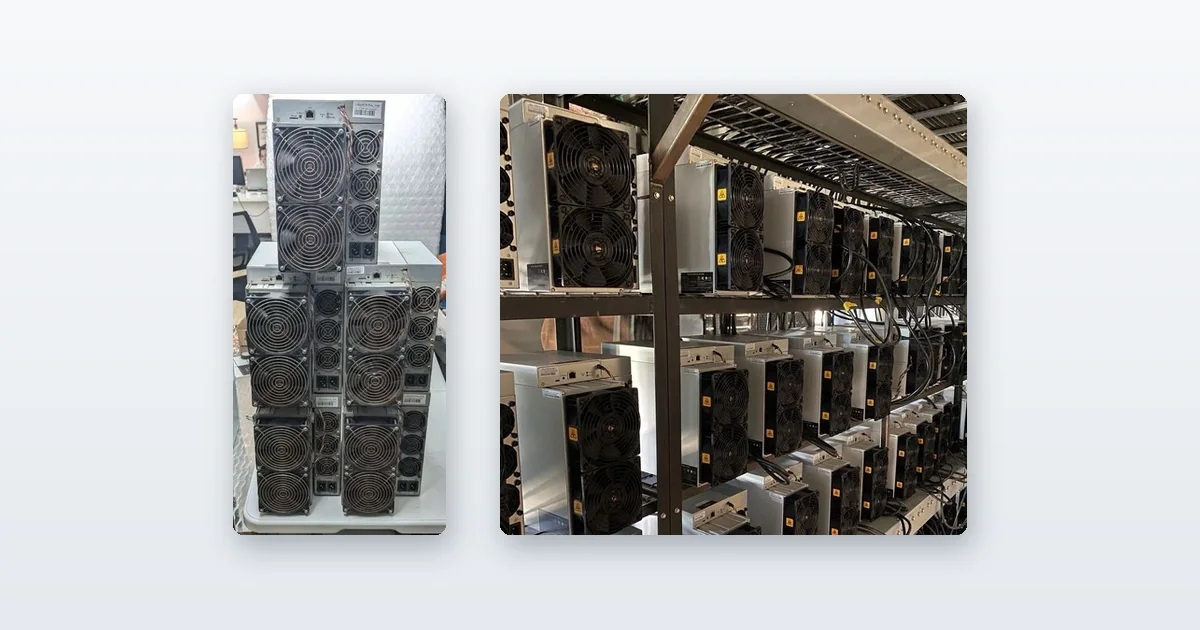
Mining hardware does not depreciate smoothly. The steepest fall happens in the days after a manufacturer announces a new generation, not gradually across the machine’s life – which means the timing of a sale matters more than the age of the unit. This page covers how that value curve behaves and how US tax rules treat it.
This is general information, not tax advice. Depreciation treatment depends on how your operation is structured and on rules that change; confirm anything here with a qualified accountant before filing.
The commercial consequence is the one worth internalising: because resale value falls on a schedule you do not control, a machine sitting near its break-even power rate is worth more sold than run. For what that break-even rate is and how to calculate it, see our ASIC miner buying guide; for how long a machine stays useful in the first place, see physical versus economic lifespan.
Table of Contents
- What our own used shelf says a joule is worth
- Three depreciation methods and which one fits a miner
- What actually accelerates the fall
- U.S. tax treatment and reporting rules
- How to lose less to depreciation
The depreciation and tax position, summarised
Two separate clocks run on a miner and people confuse them. The tax clock is a depreciation schedule you elect — straight-line, declining balance or units of production — and it is a question for your accountant. The economic clock is set by efficiency: a machine stops earning when its break-even electricity price drops below your rate, and that happens years before it stops working. Our own shelf is the evidence. The 2021 flagship S19 95TH still hashes exactly as designed and sells here for $159.99.
What our own used shelf says a joule is worth
Most depreciation writing about mining is theory. We can do something better than theory, because we price used machines for a living and the shelf is public. Here is every used Bitcoin miner we list with a price on it, on 15 August 2026, sorted by efficiency — with what each one costs per terahash and the electricity price at which it stops earning (break-even in cents = 130.5 ÷ J/TH at today’s $31.32/PH/day hashprice).
| Machine | Year | J/TH | Price | $ per TH | Break-even | $/TH per ¢ |
|---|---|---|---|---|---|---|
| Used S19 95T | 2020 | 34.2 | $159.99 | $1.68 | 3.82 ¢ | 0.44 |
| Refurb S19 110T | 2020 | 29.5 | $249.99 | $2.27 | 4.42 ¢ | 0.51 |
| Used S19k Pro 120T | 2023 | 23.0 | $379.99 | $3.17 | 5.67 ¢ | 0.56 |
| Refurb S19 XP 141T | 2022 | 21.35 | $699.99 | $4.96 | 6.11 ¢ | 0.81 |
| New S21 Pro 245T | 2024 | 15.0 | $4,200 | $17.14 | 8.70 ¢ | 1.97 |
Read the last two columns together, because that is where the finding is. Price per terahash tracks efficiency almost perfectly and tracks age not at all. The S19 XP is a 2022 machine and costs more per terahash than the 2023 S19k Pro, because it is the more efficient of the two. A buyer is not paying for youth. A buyer is paying for the number of cents per kWh the machine can survive.
The right-hand column normalises for exactly that: dollars per terahash divided by the break-even cents. Every used machine on the shelf lands between 0.44 and 0.81 — a tight band for hardware spanning four years and a factor of 1.6 in efficiency. The new machine sits at 1.97, roughly three times the price for the same unit of survivability. That gap is the new-machine premium, and it is the number a fleet buyer should be arguing about, not the sticker price.
Two honest caveats. The band is not a valuation formula — it is our own asking prices on one day, and it prices condition, warranty, testing and how many of each we hold. And the same machine in a lot of 100 does not carry the same per-unit price as a single unit; that is what the used shelf and a quote request are for. What the table does establish is the shape: value falls with efficiency, and efficiency is a fixed property of the silicon from the day it ships. Everything else in this article is downstream of that. There is a longer argument about why the naive version of this metric misleads in why price per terahash fails as a valuation.
Three depreciation methods and which one fits a miner
For tax purposes you are choosing how to spread a cost you have already paid. The three that come up are straight-line, declining balance and units of production, and for mining hardware they are not equally sensible.
| Method | Expense Timing | Best Use Case | Tax Advantage |
|---|---|---|---|
| Straight-Line | Even over equipment life | Stable, predictable businesses | Consistent yearly deductions |
| Declining Balance | Front-loaded in early years | Rapidly advancing hardware markets | Larger initial tax write-offs |
| Units of Production | Based on usage hours | Varied workload operations | Matches wear with revenue |
Make it concrete with a machine we actually sell. Take the used S19k Pro at $379.99. On a five-year straight line that is $76 of depreciation a year, or about $6.33 a month — against a machine that grosses roughly $3.76 a day at today’s hashprice and costs $12.21 a day in electricity at 18.44 ¢/kWh, or $3.66 a day at 6 ¢. Straight-line is tidy and it is also fiction: the machine will not lose an equal slice of value each year, it will lose most of it the week a new generation is announced.
Declining balance is the better description of what actually happens to the asset, which is why accelerated recovery is the common election in this industry. Units of production is the one nobody uses and the one that fits mining best in principle — a miner’s wear and its revenue both scale with hours run, and if you host seasonally on curtailed power you are genuinely not consuming the asset in the months it is switched off. It costs bookkeeping to run, which is why it stays a footnote.
The point that matters commercially: none of the three changes the resale price. They change the timing of your deductions. A machine’s market value is set by the table above and by nothing you elect on a form. Schedules and their trade-offs are laid out in more detail by people who do this for a living, and the arithmetic of what actually moves your margin is in What Actually Moves Mining Margin.
What actually accelerates the fall
An announcement, not a shipment. The value of a used fleet steps down when the next generation is announced with a price, not when it arrives. Anyone holding stock to sell should watch manufacturer announcements the way an equity holder watches earnings dates. That single fact is worth more than any depreciation schedule.
Difficulty — but check which way it is moving. Rising difficulty cuts the revenue side and drags every machine’s economics down together. Right now it is doing the opposite: difficulty was 129.70 T in August 2025, peaked at 155.97 T that October and stands at 127.48 T today, 1.7% below a year ago, with the next retarget estimated at −2.98%. A depreciation model built on “difficulty compounds 40% a year” has been wrong for twelve months. It will be right again at some point; the discipline is to re-measure rather than assume.
Your own power price, more than anyone else’s. A machine is worthless to you the day its break-even drops below your metered rate, regardless of what it is worth on the open market. An S19 at 34.2 J/TH is scrap at 6 ¢/kWh and a perfectly good asset at 3 ¢. This is why fleets get sold between operators rather than scrapped — the machine is not dead, it is in the wrong building.
Condition and documentation. A tested unit with a known hashboard history sells; an untested pallet sells for a discount that is usually larger than the cost of testing it would have been. Serial numbers, a bench test result and the original PSU are worth real money at resale, and we grade on exactly those things when we buy fleets in. Why mining hardware fails covers what to look for.
The parts market for that generation. An S19-family board is a commodity and a niche board is not, which puts a floor under S19 residuals that newer or rarer machines do not have. Fitment detail is in the parts compatibility guide.
U.S. tax treatment and reporting rules
Again: general information, not tax advice, and the rules move. Four things are durable enough to plan around.
Mining hardware is normally five-year MACRS property — the same class as computers and servers. That is the default recovery period an accountant will start from for an operation run as a business.
Section 179 and bonus depreciation can pull the deduction forward. Both exist, both have annual dollar limits and eligibility rules, and the bonus percentage in particular has been changed by Congress several times in the last few years. Do not take a percentage from any article, including this one — confirm the figure for the tax year you are filing. IRS Publication 946 is the primary source and it is updated each year.
Mined coin is income when you receive it. The fair market value of the coin on the day it lands in your wallet is ordinary income; that value becomes your basis, and a later sale is a separate capital gain or loss. Two taxable events, not one, and the first happens whether or not you ever sell.
Business versus hobby is the line that decides everything else. Depreciation, electricity and repairs are deductible against mining income when the activity is a trade or business. Run as a hobby, the deductions largely disappear while the income does not. If you are buying a lot of machines with the intention of making money, that distinction is worth an hour with an accountant before the first invoice, not after.
How to lose less to depreciation
- Buy one generation back, deliberately. The steep part of the curve has already happened to a used machine. The table above says a used S19k Pro costs $3.17/TH against $17.14/TH for a new S21 Pro; the S19k Pro’s remaining fall is a fraction of the new machine’s first year.
- Sell on the announcement, not on the anniversary. If a fleet is within a cent or so of your power price, the announcement of a new generation is the moment it is worth most, and it will not come back.
- Match the machine to the site instead of upgrading. Moving an S19 fleet from 8 ¢ power to 4 ¢ power recovers more value than replacing it with an S21 Pro at the old site — and costs freight rather than capital.
- Tune before you replace. An undervolt that trades a few percent of hashrate for a bigger cut in watts moves break-even in the right direction for the price of an afternoon. It is not free — it voids what warranty a used unit has — but it is cheaper than a purchase.
- Keep the paperwork. Serials, purchase invoices, test results and the PSU. It is the difference between selling a tested lot and selling an untested one, and that discount is typically far larger than the cost of the testing.
- Sell in lots. One machine at a time is a retail transaction with retail friction. Fleets move to operators who want twenty or a hundred, which is the market we work in — talk to us before you list units individually.
Frequently Asked Questions
How fast does an ASIC miner actually lose value?
Not on a smooth curve, and not mainly with age. On our own shelf on 15 August 2026 a 2020 S19 95T at 34.2 J/TH is $159.99 ($1.68 per TH) while a 2022 S19 XP at 21.35 J/TH is $699.99 ($4.96 per TH) — the older machine of the two is not the cheaper one because of its year, it is cheaper because it is less efficient. Value tracks the electricity price the machine can survive, and it steps down hardest when a new generation is announced.
What depreciation method should a mining operation use?
Straight-line over a five-year MACRS life is the usual default, and accelerated methods such as declining balance describe what actually happens to the asset more honestly. Units of production fits mining best in principle — wear and revenue both scale with hours run — but costs more bookkeeping than most operations want. Whichever you elect changes the timing of your deductions, not the machine’s resale value. Confirm the choice with an accountant.
Can I write off a mining rig in the year I buy it?
Possibly, through a Section 179 election or bonus depreciation, if the activity is a trade or business rather than a hobby. Both have dollar limits and eligibility rules, and the bonus depreciation percentage has been changed by Congress repeatedly, so take the current-year figure from IRS Publication 946 or your accountant rather than from any article.
Is falling network difficulty good for my hardware’s value?
Yes, and it has been falling. Difficulty stood at 129.70 T in August 2025, peaked at 155.97 T in October 2025 and is 127.48 T on 15 August 2026 — 1.7% below a year ago, with the next retarget estimated at −2.98%. Lower difficulty means every machine earns more per terahash, which lifts break-even prices and puts a floor under used values. It has never stayed in one place, so re-measure rather than extrapolate.
Do I pay tax on coins I mine but never sell?
Yes. The fair market value of mined coin is ordinary income on the day you receive it, and that value becomes your cost basis; selling later is a separate capital gain or loss. Two taxable events, and the first one does not wait for you to sell.
More on depreciation and resale
- Five common mining myths, checked against the numbers
- Mining Hardware Lifespan – How It Impacts Profitability
- Mining Bitcoin Cash With SHA-256 Hardware: What It Pays and When
- Cryptocurrency Mining Tips and High-Performance Hardware
Used and refurbished stock on the floor now
- Used Antminer S19k Pro 115TH/s – Tested, Braiins OS Boost to ~125TH/s
- Used Antminer S19k Pro 120TH Bitcoin Miner – VNish 130TH Tune
- Lot of 20 Refurbished Bitmain Antminer S19 110TH/s Miners
More in Used ASIC miners, or the full ASIC miner inventory. The break-even arithmetic every figure here rests on is in the buying guide.