
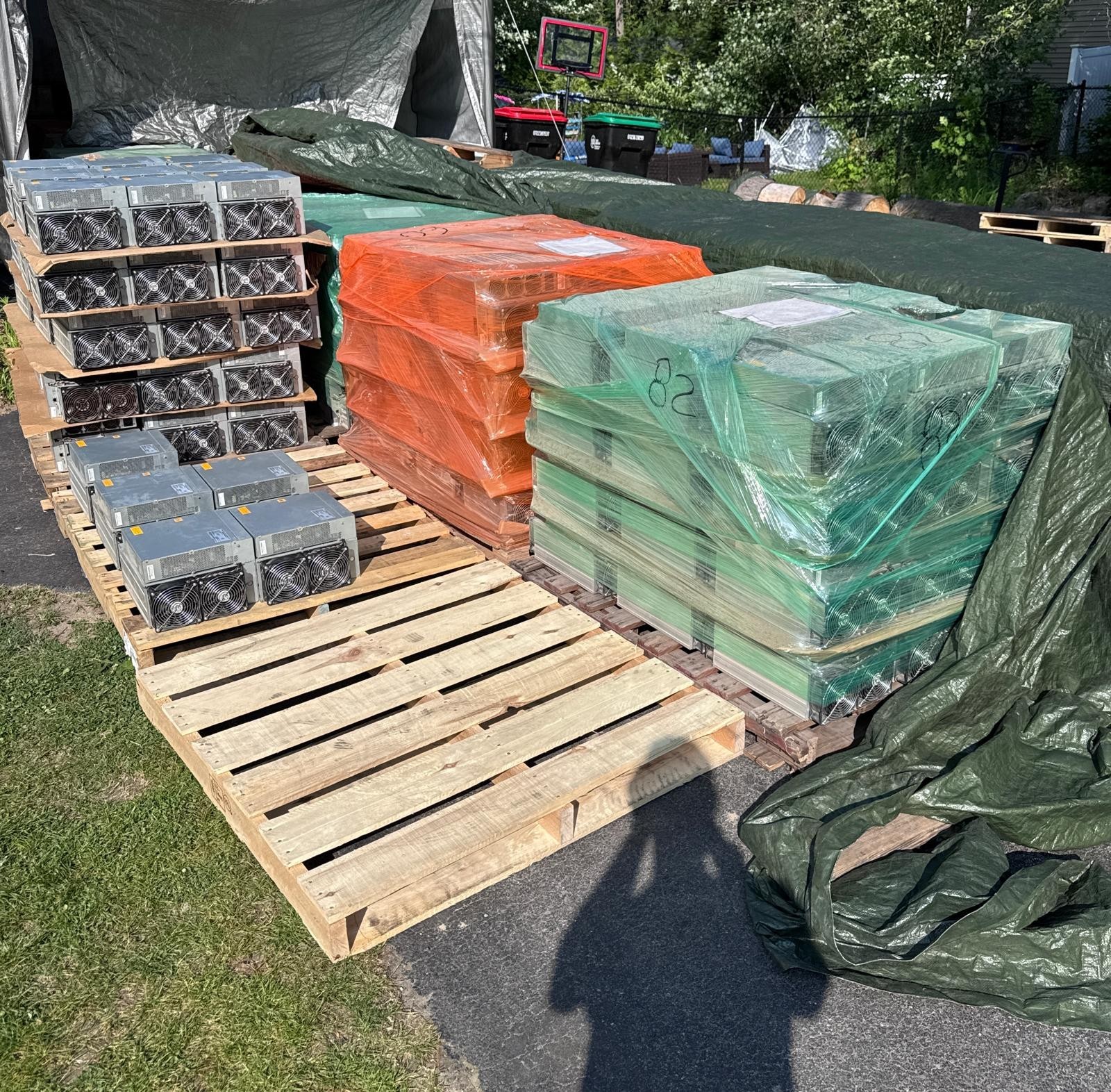
Buying ASIC miners by the pallet is not a shopping decision. It is a power decision and a freight decision, and the lot price is usually the third-largest number in the deal. A hundred Antminer S19s is 325 kW of continuous connected load, roughly 1.6 tonnes of freight on multiple pallets, and about 234 MWh of electricity a month. If you have not sized the service and priced the linehaul, the discount on the machines is meaningless — you will spend it twice over on an electrician and an accessorial charge you did not know existed.
We buy, repair, host and resell this hardware, and we sell fleet lots from five machines to three hundred. This page is the arithmetic and the due diligence, in the order you actually need it. It takes positions, including about our own listings.
This page is the arithmetic. The commercial side — what is in lots on the shelf right now, how a used batch is tested and graded, what happens when a unit in the lot arrives dead, and a quote form that reaches a person — is bulk used ASIC miners. What to do on the day the pallet actually turns up is receiving a used miner lot.
The numbers this page uses, and when they were true
- Hashprice: ~$32.7 per PH/s per day (27 July 2026)
- Network difficulty: 126.23 T; network hashrate ~866 EH/s
- BTC: $65,247; transaction fees ~0.7% of the block reward
- US average residential electricity: 18.44 ¢/kWh (EIA, May 2026)
- US retail hosting: $0.065–$0.09/kWh all-in (published host rate cards, read 16 August 2026)
Every one of these moves daily, and difficulty moves against you between the day you wire the money and the day the machines are energised. Re-run all of it on the day you buy.
Bulk mining hardware starts with the power bill, not the lot price
Work out the connected load before you look at a single listing. It is one multiplication and it disqualifies most buyers on the spot.
A factory Antminer S19 95TH/s draws 3,250 W ±5% at 200–277 V. So:
- 10 machines — 32.5 kW. A serious workshop or barn service. Already beyond a normal house.
- 100 machines — 325 kW continuous, about 234 MWh a month. This is a utility conversation, a transformer and a permit.
- 300 machines — 975 kW. Call it a megawatt. That is the standard container-scale unit for a reason.
Two adjustments people forget. First, continuous load is derated: overcurrent devices are sized so a continuous load sits at 80% of the breaker rating, so divide your connected kW by 0.8 to get the capacity you actually have to buy. 325 kW of miners wants roughly 406 kW of breaker and conductor. Second, that figure is the machines alone — it does not include ventilation, the transformer’s own losses, or anything else in the building.
Per machine at 240 V that is about 13.5 A. It is worth internalising that number, because it is what turns a fleet into a wiring plan: every miner is a dedicated 240 V circuit’s worth of load, and no amount of PDU cleverness changes the total.
The break-even rate decides whether any of this is worth doing
There is one formula, and hashrate cancels out of it entirely:
Break-even electricity rate ($/kWh) = hashprice ($/PH/day) ÷ (24 × J/TH)
At today’s hashprice, for the two machines that make up almost every lot on this site:
- Antminer S19 95TH/s — 34.2 J/TH → break-even at about 4.0 ¢/kWh
- Antminer S19k Pro 115TH/s — 23 J/TH → break-even at about 5.9 ¢/kWh
Run that through a hundred machines and the picture is stark. A hundred S19 95TH units is 9.5 PH/s, which grosses about $311 a day at 27 July 2026 hashprice. The same hundred machines burn 7,800 kWh a day.
- At 3 ¢/kWh the power costs $234/day, leaving roughly $77/day across the whole fleet — about 77 cents per machine per day — before pool fees, hosting margin, freight amortisation and failures.
- At 5 ¢/kWh the same fleet loses about $79/day.
Those figures assume 27 July 2026 hashprice of $32.7/PH/day, difficulty 126.23 T, BTC at $65,247, 100% uptime and factory power draw. They will be wrong tomorrow. The shape of them will not: a used S19 fleet is a sub-4-cent machine, which in practice means flared gas, curtailment, behind-the-meter generation or a stranded hydro contract. If you are buying a hundred S19s to plug into a commercial retail tariff, do not. Buy ten of something efficient instead, or read the buying guide first.
Freight is a real line item, and it is where fleet deals go wrong
An S19 is 14.2 kg bare and 16 kg boxed on Bitmain’s own specification, with its PSU integrated; a bulk repack rather than retail packaging can shift that. Confirm the actual carton weight and dimensions with the seller rather than assuming, because it changes the freight quote materially.
At that weight, a hundred machines is about 1.6 tonnes spread over several pallets. Things that follow from that, all of which we have watched catch buyers:
- LTL versus full truckload. Less-than-truckload is the right call for a few pallets. Past roughly half a trailer the per-unit cost usually flips in favour of a dedicated truck, and you also stop paying for your freight to be handled at three cross-docks. Get both quotes for anything over about twenty machines.
- Carrier liability is set per pound, not per dollar. This is the single most expensive thing people do not know. A standard LTL tariff limits the carrier’s liability by weight and commodity class, and on a 38-pound object worth several hundred dollars that limit is nowhere near the value of the goods. Declare the value, or buy shipper’s-interest cargo insurance separately. Assume nothing.
- Accessorials. Residential delivery, liftgate, limited access, inside delivery, notify-before-arrival — each is a separate charge, and on a small shipment they can rival the linehaul. If the machines are going anywhere without a loading dock, you need a liftgate and someone with a pallet jack standing there when the truck arrives.
- Reweigh and reclass. If the pallet dimensions or weight you declared are wrong, the carrier re-rates the shipment and bills the difference after delivery. Measure the actual pallets.
- Inspect before you sign. Note damage on the delivery receipt at the point of delivery. A clean signature makes a concealed-damage claim very hard to win.
Fold all of it into landed cost per terahash — purchase price plus freight plus PSUs plus cords plus spares plus a failure allowance, divided by the terahash you are actually buying. That is the only number that lets you compare a lot of twenty against a lot of three hundred against buying singles. The method is worked through in detail in how to buy a used ASIC miner. Our own shipping settings still hold a fleet rate card — $3,449.99 on a lot of 100, which works out at $34.50 a machine against $49.99 to ship a single unit, and freight is the one line where buying by the pallet genuinely is cheaper per machine. Since 11 August 2026 no checkout can apply it, because every lot listing here is quoted rather than sold through the cart, so treat those rates as the shape of the saving and get the actual number written on the quote. Anything crossing a border at pallet scale is a freight quote and not a web-form rate; ask before you order. Rates on shipping and delivery. Do not treat freight as settled until it is in writing for the specific lot: the rate card attaches to a shipping class, not every lot listing carries one, and no lot on this store currently reaches a cart at all.
Why lots trade below unit price — and what you are absorbing
A fleet discount is not generosity and it is not a fire sale. It is a transfer of work and risk from the seller to the buyer, and it is worth being precise about what transfers:
- Selling effort. One conversation instead of three hundred. No per-unit photography, no per-unit listing, no three hundred separate shipping labels.
- Testing and grading depth. Individually listed machines get individually tested and described. Lots are sampled. That is normal industry practice and it is also exactly why you must ask what the sampling rate was.
- The repair tail. Every used lot has one. Some units arrive dead, some die in the first month, some have a hashboard down and still hash at two-thirds rate. Budget for it as a percentage, not as a surprise. Our repair parts and spares category exists because this is the normal condition of used fleet hardware, not an exception.
- Time. The seller converts inventory into cash today; you convert cash into machines that need racking, sorting and possibly reselling over months.
If a lot is cheap and none of those four things is true, be suspicious rather than pleased.
That first bullet is worth pricing rather than assuming, because taking it on is part of what you are being paid for. Selling the same machines individually recovers less of the discount than most buyers expect: a lot of eight S19s completed at $1,080 on 6 June 2026 — $135 a machine — against a $150 median for that model sold one at a time. A per-unit penalty of 8.3%, far smaller than the folklore, and eBay’s fee structure hands $2.80 of it straight back on the lot. Four rows from three sellers, so read it as a reading and not a law — current-generation S21 lots in the same pull showed no lot discount at all. The per-unit and fee arithmetic is set out in selling ASIC miners in lots versus singles.
That 8.3% is only the price side of it. The rest of the spread is work — unpacking, testing, photographing, writing and answering questions on eight machines instead of one, then carrying the ones that do not sell — and it is the part first-time lot buyers forget to cost. If the lot you are pricing is one of ours, what transfers to you when you re-list our machines is written out in full: the grade word, the firmware, the sampling rate, and what you are allowed to claim about any of them.
Per-unit price is not a clean volume curve — check ours too
Here is a specific instruction: divide the lot price by the machine count on every listing before you compare anything, including on this site. Fleet pricing does not fall smoothly as lot size rises. Lots get priced against the condition of the specific batch, what firmware is on it, whether PSUs are included, and how long it has been sitting — not against a volume table. On our own listings the per-unit figure does not decrease monotonically with lot size, and on at least one pair a smaller lot works out cheaper per machine than a larger one.
We would rather tell you that than have you assume the 300-unit lot must be the best deal because it is the biggest. Do the division. If the answer surprises you, ask us why — there is usually a real reason involving grade, firmware or PSU inclusion, and if there is not, that is worth knowing too.
The nine things to demand before you wire money for a fleet
For a single machine, “refurbished, tested” is a reasonable amount of information. For forty machines it is not. This is the list we would want if we were the buyer:
- The grade, in writing, and what it means. “Tested and working” and “refurbished” are not standardised terms. Ask what test was run, for how long, and at what ambient temperature. A five-minute bench pass is not a burn-in.
- Measured wall draw at the profile the machines will actually ship on — not the factory datasheet number. On tuned or overclocked units this is the difference between your service being adequate and your breakers tripping.
- Hashboard and control board revision. This determines whether parts exist for the machines in two years. It is the single best predictor of long-term fleet cost and almost nobody asks.
- PSU: included or not, and which one. Lots frequently ship without power supplies. An APW12 and an APW17 are not interchangeable for every configuration, and buying a hundred PSUs after the fact is a large unbudgeted line.
- Firmware state and whether it is locked. See below — this is the trap.
- The DOA rate the seller stands behind, and the remedy. A percentage, a window, and what actually happens: replacement, refund, credit, or parts. Get the remedy, not just the promise.
- Serial-level documentation, or at least the sampling rate. If it is a sample, what percentage, and were the tested units chosen at random or by the seller?
- Freight terms and who owns the risk in transit. Who books it, who insures it, whose problem is a pallet that arrives crushed.
- Payment terms and escrow. On a five-figure wire to a counterparty you have not met, escrow is normal, not an insult. Anyone who refuses to discuss it has told you something.
Ask us all nine. If we cannot answer one of them about a specific lot, we will say we do not know rather than guess — there are listings on this site where the grade genuinely is not established, and we say so on the page.
Firmware is the trap on used S19 lots
Most large S19 lots on the secondary market — including most of ours — are running third-party firmware rather than stock Bitmain. That is usually a feature, and occasionally a liability. Know which before you buy.
Braiins OS+ is the mature option. It gives roughly +10–13% hashrate at stock power, or 8–12% lower power at stock hashrate — you pick which. It carries a 2–2.5% development fee, waived when you mine on Braiins Pool. On a hundred machines that fee is a real operating cost and it belongs in your model. It is a known, documented, reversible piece of software.
VNish is the other firmware you will meet on S19 lots, usually on the machines advertised at 110 TH/s. Understand what that number is: a factory S19 is 95 TH/s. 110 TH/s is an overclock, and it draws meaningfully more than the 3,250 W on the datasheet. Size your service off the measured figure, not the factory one — someone provisioning power for a hundred units off the stock number will trip breakers on day one.
The questions that matter on any third-party firmware, at fleet scale:
- Is there a development fee, and at what rate?
- Is the firmware licensed or locked to the seller’s account, pool or wallet? Some builds are.
- Is there a documented path back to stock firmware, and does taking it brick anything?
- Does the tune survive a factory reset, or does the machine come back at a profile your power plan does not support?
Get the answers before the wire, not after the pallets land.
What we actually stock in fleet quantity
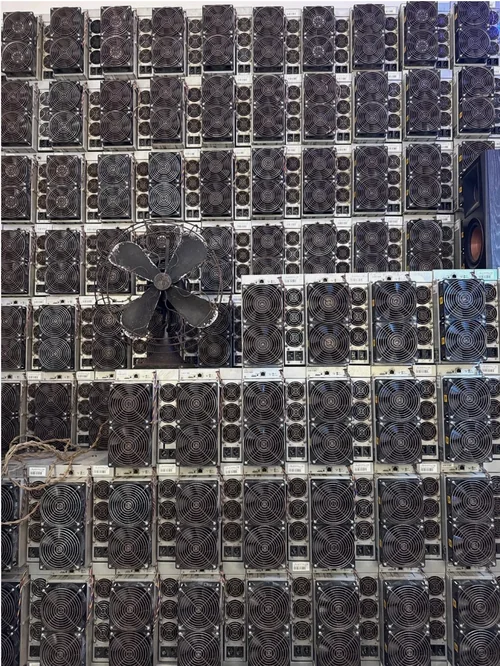
Eleven fleet listings, from five machines to three hundred. They are all Antminer S19-family SHA-256 machines, because that is what genuinely trades in volume on the secondary market right now. Grades and firmware differ between them, so read the individual pages — they are not interchangeable.
Antminer S19 95TH/s — Braiins OS, refurbished
- Lot of 5 — the smallest step above buying singles
- Lot of 10 — 32.5 kW, the largest fleet most private sites can actually power
- Lot of 100 — 325 kW, a utility conversation
Antminer S19 95TH/s — VNish OS and tested stock
- Lot of 40 — note that the grade on this listing is not stated; ask us before you buy it
- Lot of 50 — VNish OS, refurbished
- Lot of 300 — tested and working — just under a megawatt of connected load — and what a megawatt of used machines actually costs and mines
Antminer S19 110TH/s — overclocked, refurbished
- Lot of 5 · Lot of 10 · Lot of 100 — Braiins OS
- Lot of 20 — VNish OS
Antminer S19k Pro 115TH/s — the efficient option
- Lot of 10, Braiins OS, PSU included — 23 J/TH against the 95TH’s 34.2, so it breaks even at roughly 5.9 ¢/kWh instead of 4.0. If your power is between those two numbers, this is the only lot on the list that works.
Everything above is also visible in used ASIC miners and across the full miner inventory.
When a fleet lot is the wrong buy
Three cases, stated plainly because we would rather not sell you the wrong thing:
- Your power is above about 5 ¢/kWh. An S19 fleet does not work. Neither does an S19k Pro fleet much above 6. Buy fewer, newer, more efficient machines, or host them somewhere cheap, or do not buy.
- You have no repair capability and no appetite to acquire one. A fleet of used machines generates a steady trickle of faults. If you cannot swap a fan, reseat a hashboard or read an error log, every fault becomes a shipping event. Ten machines is a hobby; a hundred is an operation.
- You are buying on the sticker price rather than $/TH landed. If you have not costed freight, PSUs, cords, spares and a failure allowance, you do not yet know what the lot costs. Do that arithmetic first — it sometimes says buy the smaller lot.
If any of that changes the plan, tell us what you are trying to build and we will tell you whether we have the right hardware for it, including when we do not.
The reverse trade is the same phone call. If the fleet you are replacing is coming out as the new one goes in, we buy used miners — outright for the whole batch, or on consignment at 60/40 — so a fleet upgrade is one conversation rather than two.
Fleet arithmetic is per-unit arithmetic multiplied by a number large enough to make an assumption expensive: a 200 W error in the wall draw you budgeted is 20 kW across a hundred machines, which is the difference between a service that carries the site and one that does not. The machine-by-machine comparison table publishes the wall-draw and J/TH figures this page’s power maths runs on, for every model we stock, so you can size the transformer against the exact model in the lot rather than against the generic S19 in your head.
Frequently Asked Questions
How much power does a lot of 100 Antminer S19s need?
About 325 kW of continuous connected load at the factory 3,250 W per machine, which is roughly 234 MWh per month. Because it is a continuous load, size the breakers and conductors at about 406 kW — divide connected load by 0.8. That excludes ventilation and transformer losses. A 300-machine lot is roughly 975 kW, which is why a megawatt is the standard unit at container scale.
What electricity rate does a used S19 fleet need to be profitable?
Roughly 4.0 ¢/kWh or below for the 95TH/s model, using break-even = hashprice ÷ (24 × J/TH) at 27 July 2026 hashprice of $32.7/PH/day and the S19’s 34.2 J/TH. The S19k Pro 115TH at 23 J/TH breaks even nearer 5.9 ¢/kWh. Both figures move every day with difficulty and BTC price, and difficulty moves against you between order and energisation, so re-run the arithmetic on the day you buy.
Do bulk mining hardware lots always work out cheaper per machine?
No. Per-unit price does not fall smoothly with lot size, on this site or anywhere else, because lots are priced against the condition of the specific batch, the firmware, whether PSUs are included and how long the stock has been held. Divide the lot price by the machine count on every listing before comparing, and add freight, PSUs, cords, spares and a failure allowance to get landed cost per terahash.
How are ASIC miners shipped in bulk?
Palletised, as freight rather than parcels. An S19 is 14.2 kg bare and 16 kg boxed on Bitmain’s own specification, so a hundred machines is about 1.6 tonnes across several pallets. Use LTL for a few pallets and get a full-truckload quote for anything over about twenty machines. Confirm carton weight and dimensions with the seller before quoting, or the carrier will re-rate the shipment after delivery.
Is freight insurance included when I buy a lot of miners?
Assume it is not. Standard LTL carrier liability is limited by weight and commodity class under the carrier’s tariff, not by what the goods are worth, and that limit is far below the value of a pallet of miners. Declare the value or buy shipper’s-interest cargo insurance, and agree in advance who books the freight and who carries the risk in transit.
What firmware do used S19 lots ship with, and does it matter?
Usually Braiins OS+ or VNish rather than stock Bitmain. Braiins OS+ gives about +10–13% hashrate at stock power or 8–12% lower power at stock hashrate, with a 2–2.5% development fee that is waived on Braiins Pool. VNish is what most 110 TH/s S19 listings are running — that is an overclock of a 95 TH/s machine and it draws more than the 3,250 W datasheet figure, so size your electrical service off the measured draw. Ask whether the firmware is locked to the seller’s pool or wallet and whether there is a documented path back to stock.
What should I ask for before paying for a fleet of used miners?
The grade in writing and what test produced it, measured wall draw at the shipping profile, hashboard and control board revision, whether PSUs are included and which model, the firmware state and any lock, the DOA rate the seller stands behind and the specific remedy, serial-level documentation or the sampling rate, freight terms and who carries transit risk, and payment terms including escrow. On a five-figure wire, escrow is normal.
How many used miners is a realistic first fleet?
Ten is usually the honest answer for a first purchase at a private site: 32.5 kW is at the top of what most non-industrial services can carry, it is enough machines to learn the failure modes, and the loss if the economics turn out worse than modelled is survivable. Scale to fifty or a hundred once you have measured your real uptime, your real repair rate and your real delivered power cost rather than the modelled ones. What five, ten, fifty and a hundred machines each prove about the seller, your site and your own economics is what each lot size actually proves.