
Almost nothing that goes wrong with a mining machine at home is the machine’s fault. It is the circuit it is plugged into, the connector carrying 13 amps continuously for two years, and the dust that turns a heatsink into a blanket. An ASIC is a space heater that happens to earn money, and it runs at full load every hour of every day, which is a duty cycle almost nothing else in a house comes close to.
So this checklist is mostly electrical, and it is built from the actual rated wattages on the machines we sell rather than from generic advice. Work through it before the pallet arrives, not after.
The one calculation everything else depends on
Watts divided by volts gives you amps. Then, because mining is a continuous load — anything running three hours or more — the breaker has to be sized so the load sits at or below 80% of its rating. In practice: divide the machine’s wattage by the supply voltage, then divide by 0.8, and round up to the next real breaker.
| Machine | Rated draw | Amps at 240 V | Minimum breaker |
| Antminer S19 95T | 3,250 W | 13.5 A | 20 A |
| Antminer S19k Pro 115T | 2,645 W | 11.0 A | 15 A |
| Antminer S21 Pro 245T | 3,675 W | 15.3 A | 20 A |
| Antminer L9 17G | 3,570 W | 14.9 A | 20 A |
| Avalon Q 90T | 1,674 W | 7.0 A | 15 A |
The S21 Pro is the one to look at twice. At 15.3 A it needs 19.1 A of headroom, which just fits a 20 A circuit and leaves nothing — so that circuit carries the miner and nothing else, ever.
Why a normal household outlet will not run a full-size miner
Run the same machines at 120 V and the current doubles. An S19 draws 27.1 A at 120 V and would need a 40 A circuit; a standard 15 A outlet delivers 12 A continuous, or about 1,440 W. The machine wants more than twice that.
This is the single most common dangerous mistake in home mining: an extension lead, a 15 A outlet, and a 3.25 kW load. It does not trip immediately, which is the problem — it warms the weakest connection in the chain until something melts.
Two legitimate ways out. Run a proper 240 V circuit, which is what the machines are designed for (our S19 listing specifies a 200–277 V AC input). Or run the machine deliberately underpowered on 120 V with a 240 V to 110 V conversion kit and a low-power firmware tune, accepting the lower hashrate — that is exactly what these kits are for, and there is an X19-series version too. What you cannot do is plug the stock machine into a wall socket and hope.
Here is what standard circuits actually carry, continuously:
| Circuit | Continuous capacity | Full-size S19s it will run |
| 15 A / 120 V general outlet | 1,440 W | none |
| 20 A / 120 V | 1,920 W | none |
| 20 A / 240 V | 3,840 W | 1 |
| 30 A / 240 V (dryer-style) | 5,760 W | 1 |
| 50 A / 240 V (range-style) | 9,600 W | 2 |
| 100 A subpanel | 19,200 W | 5 |
Note the 30 A row. It looks like it should take two S19s at 27 A of draw, and it will not: 24 A is the continuous limit, so it carries one machine and a margin.
Where a lot of ten stops being a domestic question
This is the number to run before you buy a pallet. Ten used S19s is 32.5 kW. At 240 V that is 135 A drawn continuously, needing about 169 A of breaker capacity.
A 200 A residential service supports 160 A continuous for the entire property — heating, cooking, everything. Ten machines alone want roughly 85% of that. Which means a ten-unit lot is not a garage project; it is a service upgrade, a subpanel, and an electrician, or it is a hosting contract.
We would rather say that before you buy than after. If the power side is the constraint, the honest options are fewer machines, more efficient machines (an S19k Pro at 2,645 W buys you meaningfully more per circuit than an S19 at 3,250 W), or hosted capacity. What the whole install costs once the electrical work is included is itemised in what it actually costs to set up a miner, and the order to make these decisions in is in power first, then machine.
One more thing about a lot of ten, and it catches people who sized the service correctly: the machines still have to be brought up, and inrush is not the continuous figure you just planned around. do not close one breaker on the whole pallet — bring them up in groups — is the step-by-step version, along with what should already be on the shelf on the day the truck arrives.
The connector is where fires actually start
Breakers protect wiring against a short. They do not protect against a loose or corroded connection carrying 13 A for two years, which warms, oxidises, and warms faster. Every real burn mark we have seen on returned hardware has been at a joint: a PSU inlet, a spade terminal on a hashboard, or a cheap extension.
What that means in practice:
- Use the cable that belongs to the machine. A correct APW9/APW12 supply cable is $16.50 and is not the place to improvise.
- Hand-tighten every screw terminal on install, then check them again after a week of thermal cycling.
- Give the machine its own circuit and no extension lead. If the plug or cable is warm to the touch, that is a fault, not a characteristic.
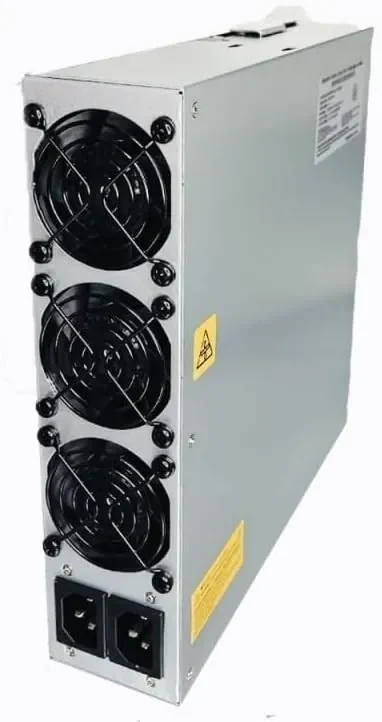
- If you are running tuned firmware above factory draw, size the supply for it — that is what a 5,600 W APW12-format unit exists for. A supply run permanently near its ceiling is the component that fails first.
Heat, using the numbers on the listing instead of a rule of thumb
Our S19 listing gives an operating range of 5 to 40 °C ambient. That is the specification to design to, and it is about the intake air, not the room average — a machine breathing its own exhaust is outside spec in a room that feels fine.
A 3,250 W miner puts essentially all of that 3,250 W into the room as heat, which is more than most domestic heaters. Two consequences people underestimate: the room will climb well past 40 °C without deliberate extraction, and in summer the machine effectively fights your air conditioning, paying twice for the same watt.
Get the airflow direction right (cold in one end, hot out of the building, never recirculating), filter the intake, and check that hot air genuinely leaves rather than pooling near the ceiling above the intake. Where density makes air impossible, the answer is hydro or immersion rather than a bigger fan. What heat costs you in efficiency terms is quantified in the seven variables that decide whether an ASIC makes money.
Dust is a fire load and a warranty question
Dust does three things, in order of how much they cost you: it insulates heatsinks so the machine throttles, it jams fan bearings so a fan stops and the miner shuts down, and it accumulates on hot surfaces as a genuine fire load. A filtered intake and a scheduled clean fix all three, and the fan itself is a $24.99 assembly when it does seize.
Clean with the machine off and unplugged, use compressed air rather than a vacuum against the boards, and never wash a board you intend to run. The full maintenance schedule is in ASIC miner maintenance, and fault-by-symptom diagnosis is in diagnosing ASIC faults by symptom.
Noise is a safety item once it is a permanent fixture
Our S19 listing publishes approximately 75 dB from four fans. That is not a background noise; it is a permanent installation-level noise, and it is the reason a machine that is electrically perfect can still be the wrong purchase for a house. Machines vary enormously — the published figures across our catalogue run from the low thirties to the mid seventies — and the Avalon Q at 45–65 dB exists precisely because of it. What each level means in a home is in ASIC miner noise explained.
The parts of this that are not a checklist
Everything above is arithmetic you can do yourself and decisions you can make yourself. Installing the circuit is not. Breaker sizing interacts with wire gauge, run length, panel capacity and local code, and the failure mode is a house fire rather than a bad quarter — so the circuit, the subpanel and the service assessment are a licensed electrician’s job, and in most places a permitted one.
Take them the number from the first table: the machine’s continuous draw, the voltage, and how many units you intend to run. That is the entire brief, and it is a fifteen-minute conversation rather than a survey. Security and access control, which is a different kind of risk, is covered in ASIC mining security, and acceptance-testing a machine when it lands is in acceptance-testing a miner you just received.
Frequently Asked Questions
What size breaker does an ASIC miner need?
Divide the machine’s wattage by the supply voltage, then divide by 0.8 because mining is a continuous load, and round up. A 3,250 W Antminer S19 at 240 V draws 13.5 A and needs a 20 A circuit; a 3,675 W S21 Pro draws 15.3 A and needs 19.1 A of headroom, which fills a 20 A circuit completely.
Can I run a Bitcoin miner on a normal household outlet?
Not a full-size one at stock power. An Antminer S19 draws 27.1 A at 120 V and would need a 40 A circuit, while a standard 15 A outlet supplies about 1,440 W continuously. The options are a proper 240 V circuit, or a 240 V to 110 V conversion kit with a low-power firmware tune that runs the machine deliberately underpowered.
How much electrical capacity does a lot of ten used miners need?
Ten S19s at 3,250 W each is 32.5 kW, which is 135 A drawn continuously at 240 V and about 169 A of breaker capacity. A 200 A residential service allows 160 A continuous for the whole property, so ten machines alone want roughly 85% of it. At that scale you are looking at a service upgrade and a subpanel, or hosting.
What temperature can an ASIC miner run at?
Our Antminer S19 listing specifies a 5 to 40 degrees C ambient operating range, measured at the intake rather than as a room average. A machine breathing its own exhaust can be out of specification in a room that feels comfortable, so airflow direction matters more than the thermostat reading.
Where do mining fires actually start?
At connections, not in the machine. A breaker protects wiring against a short but not against a loose or corroded joint carrying 13 A continuously for years, which heats, oxidises and heats faster. Use the correct supply cable, no extension leads, give each machine its own circuit, and treat a warm plug as a fault.
Do I need an electrician to install a mining circuit?
For the circuit itself, yes. Breaker sizing interacts with wire gauge, run length, panel capacity and local code, and in most places the work is permitted. The arithmetic in this article is what you take to them: continuous draw per machine, the voltage, and how many units you plan to run.
More on running a miner safely
- Cryptocurrency Mining Security Basics for New Miners
- What Actually Moves Mining Margin: Five Levers, With the Arithmetic
- 7 Essential ASIC Miner Maintenance Tips for Reliability
- 7 Essential Steps for Testing ASIC Miners Effectively
Power supplies, converters and cabling in stock
The power-side hardware this comes down to, all of it in stock:
- Loki Kit Power Converter for Bitmain X19 Miners – New
- Loki Kit 240V to 110V Converter for Antminer S19 S21 | APW12 Compatible
- New Antminer Power Supply Cable for S17 S19 T17 | APW9 APW12 Compatible
More in Need Parts, or the full ASIC miner inventory.