
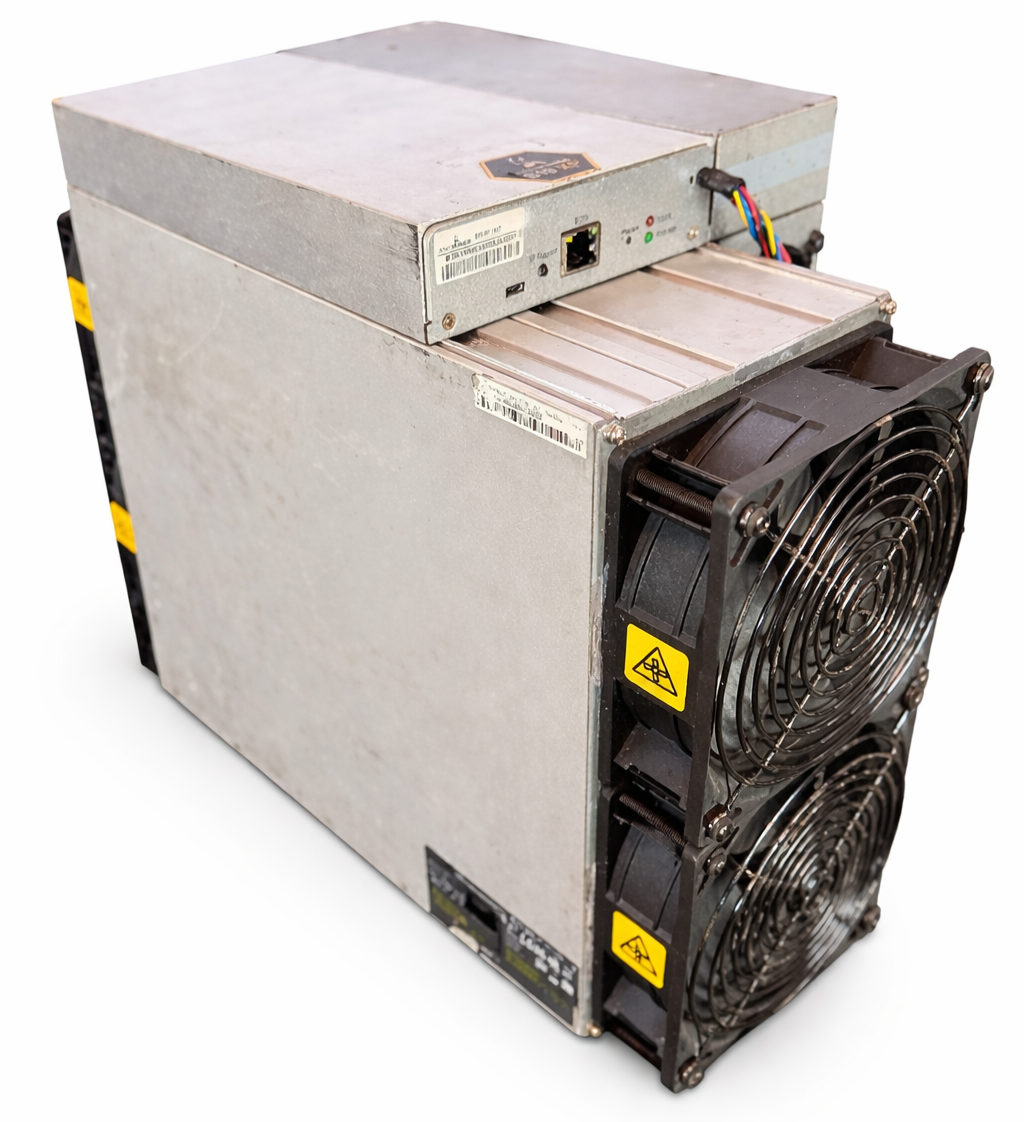
Used wins when your electricity is cheap enough that an old machine still clears its own power bill — and nowhere else. That is the whole answer, and it is a much narrower window than the price gap suggests. A refurbished Antminer S19 on our floor costs roughly one seventh per terahash of a new S21 Pro and burns more than twice the electricity per terahash to do the same work. Which of those two facts wins is decided entirely by what you pay per kWh. This is the used vs new ASIC miner decision worked out with real numbers: our own shelf prices, our own spares ledger, and the two pieces of arithmetic that settle it.
Scope, so you land in the right place. This page is about which one to buy. If you have already decided on used and want the process — grading, what to demand in writing, how to inspect a lot — that is how to buy a used ASIC miner. If you want the specs decoded from scratch, that is the ASIC miner buying guide. If a machine you already own is dead and you need the right part, that is Antminer parts compatibility.
Used vs new ASIC miner: two gates, in order — and most buyers only run the second
The used-or-new question is usually argued as if it were one comparison. It is two, and they run in sequence:
- Does the machine clear your power bill at all? Every ASIC has an electricity price above which it loses money on every hash it produces, forever, regardless of what you paid for it. Capital cost does not enter this calculation. If a machine fails this gate, it does not matter that it was cheap.
- If both machines pass gate one, which one is ahead, and for how long? The used machine starts ahead because you did not spend the capital. It falls behind at a predictable rate because it burns more power. There is a date on which they cross.
Nearly every bad used-miner purchase we see is someone who ran gate two and skipped gate one. They compared a few hundred dollars against four thousand, decided that was obviously the deal, and bought a machine that was never going to earn at their rate.
Every number below is a snapshot, and snapshots go stale. The network inputs were read off the chain at block 961,927 on 10 August 2026:
- Hashprice $32.09 per PH/s per day, before pool fees — derived here rather than copied off a dashboard: 144 blocks at the 3.125 BTC subsidy, plus the fees actually paid over the last 144 blocks (0.84% of subsidy), divided by network hashrate
- Network difficulty 127.48 T; network hashrate ~904 EH/s; BTC $63,961; next retarget estimated +0.07%
- US average residential electricity 18.44¢/kWh (EIA Table 5.3, May 2026 — the most recent month published); US retail hosting 6–9¢/kWh all-in
- Store prices are ours as of 10 August 2026, rounded to the nearest dollar — check the listing for the current figure
Those inputs move, so the rates below move with them. Our S19-versus-S19k-Pro comparison was derived the same morning at a Bitcoin price $1,270 higher and lands on 3.9¢ and 5.9¢ where this page lands on 3.9¢ and 5.8¢. Neither is an error in the other. That gap — two tenths of a cent from ten hours of Bitcoin price — is the shelf life of this whole exercise, and it is the reason every rate here is published with the block height it came from.
Difficulty retargets roughly every two weeks and Bitcoin moves every second, so hashprice changes daily. The formulas are here in full so you can re-run them with today’s inputs on the day you buy. Nothing here is a forecast; it is arithmetic on a dated input.
Gate one: the electricity price above which the machine is scrap
One division does this, and hashrate cancels out of it completely:
Break-even electricity rate ($/kWh) = hashprice ($/PH/day) ÷ (24 × the machine’s J/TH)
Run it across the SHA-256 hardware we actually stock, at 10 August hashprice:
| Machine | Condition | J/TH | Break-even power |
|---|---|---|---|
| Antminer S19 95 TH/s | used | 34.2 | 3.9¢/kWh |
| Antminer S19k Pro 115T (stock) | used | 23.0 | 5.8¢/kWh |
| Antminer S19 XP 141T | used | 21.4 | 6.3¢/kWh |
| Avalon Q 90T | new | 18.6 | 7.2¢/kWh |
| Antminer S21+ 216T | new | 16.5 | 8.1¢/kWh |
| Antminer S21 Pro 234T | new | 15.0 | 8.9¢/kWh |
| SealMiner A2 Pro Air 255T | new | 14.9 | 9.0¢/kWh |
Read the top and bottom rows together, because that is the entire used-vs-new argument in two lines. A used S19 needs power under 3.9¢/kWh. A new S21 Pro survives to 8.9¢. The gap between those two numbers is where every real decision lives.
Now put the US average residential rate of 18.44¢ next to the column. Nothing in the table clears it. Not the used machines, not the new ones, not the best current-generation hardware Bitmain and Bitdeer sell. At today’s hashprice, mining Bitcoin on ordinary US household electricity loses money on every machine on this page, and a cheap used miner loses it more than twice as fast as an expensive new one. That is an unhelpful thing for a hardware dealer to publish and it is the truth, so it is published.
Retail hosting at 6–9¢ changes the picture: it puts the new machines above water and leaves the used S19 fleet well below it. Sub-4¢ power is a real thing, but it is a specific thing — flared gas, curtailed wind or solar, behind-the-meter hydro, stranded generation, a demand-response contract, or heat you were going to buy anyway. If that describes you, keep reading, because the used fleet was built for you. If you are quoting a residential tariff, gate one has already answered the question and gate two is a distraction.
Gate two: the crossover, and why it needs no Bitcoin price
Assume both machines clear gate one. The used one is ahead on day one by the capital you did not spend, and it loses ground every day on power. Set the two cumulative positions equal and something useful happens — revenue cancels out. Both machines are paid the same hashprice per terahash, so hashprice, difficulty and the price of Bitcoin all drop out of the comparison entirely:
Days the used machine stays ahead = (new $/TH − used $/TH) ÷ (0.024 × (used J/TH − new J/TH) × your $/kWh)
The 0.024 is just 24 hours divided by 1,000 — it turns watts per terahash into kWh per terahash per day. This is the one number in the whole decision you can calculate without guessing where Bitcoin goes next, which is why we lead with it rather than with a profitability figure.
First you need capital per terahash. That is the only way to compare a $250 machine with a $4,200 one honestly:
| Listing | Price | Per machine | Capital per TH |
|---|---|---|---|
| Lot of 100 · S19 95 TH/s | Quoted† | $100† | $1.05† |
| Lot of 10 · S19 95 TH/s | Quoted† | $150† | $1.58† |
| Single refurbished S19 95 TH/s | $250 | $250 | $2.63 |
| Used S19k Pro 115T | $380 | $380 | $3.30 |
| Used S19 XP 141T | $700 | $700 | $4.96 |
| New SealMiner A2 Pro Air 255T | $4,200 | $4,200 | $16.47 |
| New S21 Pro 245T | $4,200 | $4,200 | $17.14 |
| New S21 Pro 234T | $4,200 | $4,200 | $17.95 |
| New S21+ 216T | $4,200 | $4,200 | $19.44 |
| New Avalon Q 90T | $2,000 | $2,000 | $22.22 |
† The two lot rows are what those lots were listed at until 11 August 2026. Neither carries a price today. Every lot on this shelf is now quoted rather than sold through the cart, so there is no current per-machine number we can honestly print. The rows stay because what follows is an argument about what fleet pricing does to capital per terahash, not an offer you can accept — your figure is whatever comes back on the quote. Every single-machine row is a live price, re-checked 16 August 2026, rounded to the nearest dollar — $250 is a $249.99 listing and $2,000 is a $1,999.00 one.
Four machines on this shelf carry the same $4,200 and they are not the same machine. That one price buys $16.47 per terahash on the SealMiner A2 Pro Air 255T, $17.14 on the S21 Pro 245T, $17.95 on the S21 Pro 234T and $19.44 on the S21+ 216T — an 18% spread for identical money. The two S21 Pros are both 15.0 J/TH, so between those the larger bin is simply more machine. The S21+ 216T is a different line at 16.5 J/TH by its own spec table, which is why it comes last on capital and on break-even alike. If you are spending $4,200 on this floor, there is no argument for the 216T over the 245T.
The Avalon Q is the most expensive terahash in the building and it is still the right machine for some people, because it is the only one here that runs on 110–240 V at 45–65 dB. You are not buying terahash with that premium, you are buying the ability to site the machine somewhere a 75 dB, 240 V-only industrial box cannot go. Priced per terahash it looks bad; priced per problem solved it can be the only option, and the Avalon Q versus S19k Pro comparison is where that trade-off is worked through properly.
The headline pair, worked out
Refurbished S19 95 TH/s at $2.63/TH and 34.2 J/TH, against a new S21 Pro 234T at $17.95/TH and 15.0 J/TH. The capital gap is $15.32 per terahash and the efficiency gap is 19.2 W/TH:
| Your power | Used S19 stays ahead for | S19 pays back in | S21 Pro pays back in |
|---|---|---|---|
| 2¢/kWh | 1,662 days (4.6 yr) | 168 days | 721 days |
| 3¢/kWh | 1,108 days (3.0 yr) | 352 days | 843 days |
| 4¢/kWh | 831 days (2.3 yr) | never | 1,015 days |
| 5¢/kWh | 665 days (1.8 yr) | never | 1,274 days |
| 7¢/kWh | 475 days (1.3 yr) | never | 2,605 days |
| 9¢/kWh | 369 days (1.0 yr) | never | never |
Look at the 4¢ row, because it is the trap. The used S19 is still “ahead” of the new S21 Pro for 831 days — and it never pays back. Both statements are true at once. Being ahead of the alternative is not the same as making money; at 4¢ the S19 is simply losing more slowly than a machine that has to earn back $4,200 first. This is exactly why gate one runs before gate two, and why a crossover table on its own is a dangerous thing to shop with.
At 2¢ and 3¢ the case for used is overwhelming and needs no qualification: five and a half to twelve months to payback against roughly two years for the new machine, and three to four and a half years before the efficiency gap eats the advantage. On genuinely stranded power, buy the old machines.
One row moved since we last re-derived this page a fortnight ago, and it is worth naming because it moved the wrong way. At 27 July hashprice the new S21 Pro still crawled to payback at 9¢/kWh — barely, over a span long enough that we called it “never in practice”. At today’s hashprice it does not get there at all: its break-even is 8.9¢, so at 9¢ it is under water like everything else in the table. Nothing we sell, new or used, pays for itself at 9¢/kWh today. Two weeks of difficulty and a lower Bitcoin price did that, and it will keep happening in that direction.
Haggling the used price is not how you win this
Buy at fleet pricing instead of single-unit pricing and capital per terahash falls from $2.63 to about $1.05 — a 60% cut. That is what our hundred-unit lot worked out at while it carried a listed price; today the number comes back on a quote. Here is what a cut that size actually buys:
- Payback improves by 60%. At 3¢, a lot-of-100 machine pays back in about 141 days instead of 352. Payback scales directly with what you paid.
- The crossover against a new S21 Pro improves by about 10% — 1,222 days instead of 1,108 at 3¢.
The crossover barely moves because it is driven by the difference in capital per terahash, and $17.95 dominates that difference no matter what you do at the cheap end. The new machine’s price per terahash is what sets the crossover date. Negotiating the used price shortens your own payback and hardly touches the comparison. Useful to know before you spend a week arguing over a lot price: spend it checking the power contract instead. Fleet economics, freight and per-unit testing are covered in buying ASIC miners by the pallet.
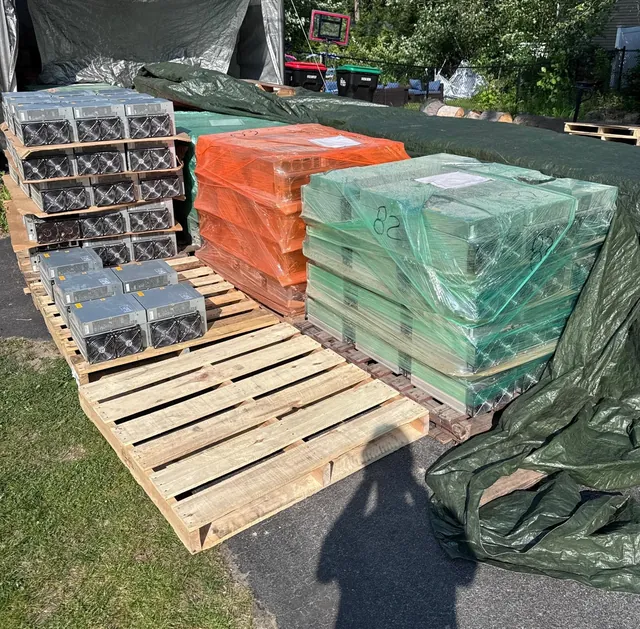
Per-unit price does not descend with quantity, and our own price book proves it
Read the date on this table before you read the numbers. The assumption underneath “buy in bulk and save” is that there is a volume curve. On used hardware there is not, and rather than assert that, we published our own book. Every row is the same machine — a 95 TH/s Antminer S19 — and every figure is what that lot was listed at up to 11 August 2026, the day the whole bulk shelf moved to quote-only. None of these lots carries a price today; all eleven route to a quote. They are printed because a dealer’s own price book is the only honest evidence for what follows, and because we are not going to make the argument and hide the receipts:
| Lot | Condition as listed | Lot price, to 11 Aug 2026 | Per machine, to 11 Aug 2026 |
|---|---|---|---|
| Lot of 5 | Refurbished, Braiins OS | $854 | $171 |
| Lot of 10 | Refurbished, Braiins OS | $1,500 | $150 |
| Lot of 40 | Used — no grade stated | $8,400 | $210 |
| Lot of 50 | Refurbished, VNish OS | $7,000 | $140 |
| Lot of 100 | Refurbished, Braiins OS | $10,000 | $100 |
| Lot of 300 | Tested and working | $50,000 | $167 |
The forty cost more per machine than the ten. The three hundred cost more per machine than the fifty. That was not a pricing mistake and it was not a negotiating position — each lot is priced against what we paid for that specific batch and what we had to put into it, so the per-unit number tracks condition and purchase history, not quantity. The cheapest per machine in that book was the hundred-lot; the dearest was the forty-lot at more than twice the price, and that was also the one lot on the list whose condition grade is not stated, which is exactly the sort of thing you should be pricing rather than assuming.
It went the other way too, and this is the one that catches fleet buyers. A used S19k Pro bought singly is $380 — a live price today. The ten-machine lot of the same model was listed at $400 a machine — more, not less, for buying ten at once, and both figures were live on this site at the same time. So do not assume the lot is the cheaper way in: on any given week it may not be, and now that lots are quoted rather than listed, asking is the only way to find out at all. Volume terms, freight and payment on a five-figure order are set out on bulk used ASIC miners, and there is no tier table there either, for the same reason there is none here.
What actually fails, and what we charge to put it right
A dealer’s honest failure-rate data is the spares shelf. You stock what runs out. Of the thirty-nine listings in our parts and repair category, eighteen are diagnostic tools and sixteen of those are testers or bench fixtures — nobody carries sixteen testers for a part that rarely fails.
In rough order of how often they take a machine down on our bench: the power supply, a fan that stopped and let a board cook, a dead or corrupted control board, and only then a genuine hashboard or chip failure. Hashboards are the failure everyone plans for and they are fourth on that list. Of the machines that arrive here described as having a dead hashboard, roughly half have a healthy board and a sick PSU, control board or ribbon cable — which is the most expensive assumption in used mining, because by the time the machine ships the buyer has usually already paid for the board.
Here is the ladder, cheapest first, with what it costs on our shelf, re-checked against the live shelf on 16 August 2026:
| What fails | How it presents | The part | Ours, approx. |
|---|---|---|---|
| PSU cable | Intermittent chain, or a machine that looks like a dead power supply | APW9/APW12 cable, S17 · S19 · T17 | $17 |
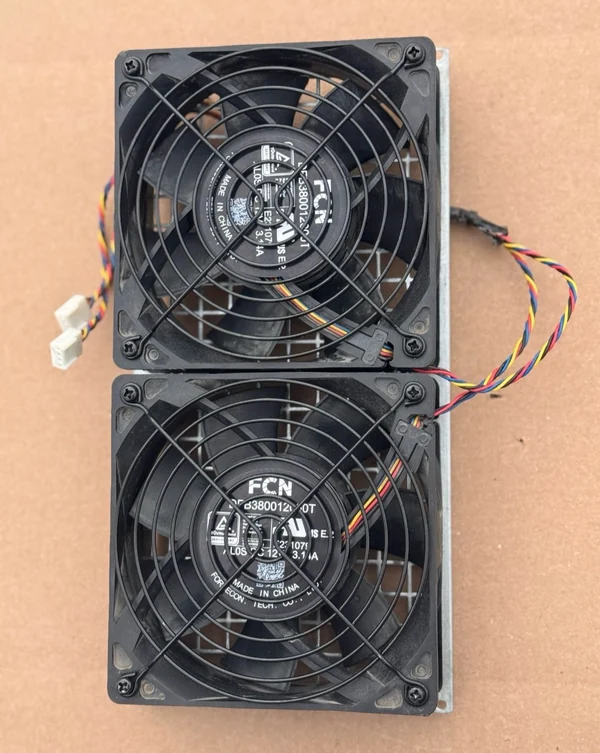
| Fans | Fan-speed alarm, or silent thermal throttling if an underrated fan was fitted | S19/S20/S21 dual fan assembly with backplate | $25 |
| Hashboard (donor) | Not a repair — a source of chips and components for one | S19 XP Pro 141 TH/s board, sold AS-IS | $25 |
| ASIC chips | Dead chip position found by a fixture; a bench job, not a swap | BM1368AA, five for S21 · T21 · S21 Hyd | $55 (~$11 each) |
| Control board | No web interface, won’t boot, or all boards missing at once | Bitmain ctrl_C55, tested working | $60 |
| Hashboard | One chain missing; hashrate down by a third | S19 Pro 95 TH/s board, tested working | $60 |
| Hashboards (full set) | Two or three chains down on one machine | S19 Pro 110 TH/s board set | $170 |
| Power supply | Dead machine, no lights, or shutdown under sustained load | APW12-class 5,600 W supply | $350 |
Two things about that table matter more than any individual figure.
The whole ladder for an S19 sits under $180. Fans, cable, control board, one hashboard — every failure that puts a used S19 out of service is cheaper than the machine. That is not an accident, it is the reason a six-year-old chip family still has a market: Bitmain shipped enough S19s that the spares channel stayed open long after the machines stopped being worth much. It is simultaneously the best and the worst thing about buying used. Cheap parts are why the fleet is repairable; the reason parts are cheap is that the machines are nearly worthless.
Diagnosis is a separate cost from repair. You cannot tell a dead hashboard from a dead control board, a dead rail or a bad ribbon cable by looking. A universal Antminer test fixture is about $200, plus around $60 for the test-file card. On one machine that never pays for itself — buy the machine tested, or buy a tested replacement board and skip the diagnosis. Fixtures start earning at fleet scale; the parts compatibility guide has the arithmetic for exactly when, and the EEPROM warning you need before you sweep a board. Everything we sell goes through the six-step bench procedure before it ships, which is the same cost, absorbed by us instead of you.
Order by the code on the board, not the name on the lid. The $60 board above is a 95 TH/s S19 board carrying 76 BM1398BB chips. It is not an S19j Pro board (BM1362, BHB426xx codes), it is not an S19 XP or S19j XP board (BM1366, BHB428xx), and it is not an S19k Pro board (BHB568xx and BHB569xx). Different chip, different control platform, different voltage-domain layout — they are not freely interchangeable inside what is nominally one family. Read the BHB silkscreen off your own board before you order; the parts compatibility guide works through it, and ordering by model name is the single most common mistake we see.
Chip-level work has a clean go/no-go, and it is worth knowing before you buy a project machine. One or two dead chips in a single voltage domain on an otherwise healthy board is worth chasing. Multiple failed domains, a burnt or delaminated PCB, water damage, or a lifted pad under a chip is not — by the time you have paid for that much rework you are at the price of a tested board with no guarantee at the end of it. Neither case can be told from the other by looking, which is the whole argument for a fixture: it names the domain and the chip position before you commit any bench time.
The one-line rule for when not to repair
A hashboard restores one third of a three-board machine. A whole working machine restores all three. So the board is only worth buying when it costs less than a third of what the equivalent working machine costs:
Repair the board if: board price < (price of a whole working machine ÷ 3)
At a $60 board, that threshold is a machine price of $180. Run it against our own stock and the answer flips inside the same model:
| Machine you own | What it costs to replace | A third of that | Verdict on a $60 board |
|---|---|---|---|
| New S21 Pro 234T | $4,200 | $1,400 | Repair. Every part on the ladder is a rounding error |
| Single used S19 95 TH/s | $250 | $83 | Repair — comfortably |
| Used S19 you paid $150 for, at fleet pricing | $150 | $50 | Do not repair. Buy another machine |
| Used S19 you paid $100 for, at fleet pricing | $100 | $33 | Part it out. The board is worth more than the miner |
That is the position, stated plainly: below roughly $180 a machine, hashboard repair is economically dead and you should be harvesting, not fixing. Strip the good boards, the PSU, the control board and the fans, and the carcass becomes spares for the rest of the fleet. Two dead boards in a $250 single unit is already marginal once you count your own time. Three dead boards is never worth it at any used price.
The rule inverts completely on new hardware, and that is a genuine argument for buying new that rarely gets made: on a $4,200 machine, every failure on the ladder is worth repairing, so the machine has a long serviceable life ahead of it. On a $100 machine, almost none of them are. What you are buying with the extra capital is not only efficiency — it is the fact that the machine stays worth fixing.
Two caveats before you use the rule. It assumes the rest of the machine is sound, so check the PSU and control board before you commit to a board. And a fault you have not diagnosed is not a hashboard fault yet — all three chains missing at once is far more often a control board, a rail or a ribbon cable than three simultaneous board deaths.
A repair has to clear gate one too
The one-third rule is a capital test, and on its own it is incomplete. There is a second test almost nobody runs, and at the wrong power price it vetoes the repair however cheap the board is.
Fitting a hashboard is not a rescue, it is a small purchase of hashrate. On a 95 TH/s S19 you are buying back about 32 TH/s, and that restored third burns power at the machine’s own 34.2 J/TH — so it faces gate one exactly the way a whole machine does. At a $60 board and 10 August hashprice:
| Your power | The restored third earns | It costs to run | Net per day | The board pays for itself in |
|---|---|---|---|---|
| 1¢/kWh | $1.02 | $0.26 | $0.76 | 79 days |
| 2¢/kWh | $1.02 | $0.52 | $0.50 | 121 days |
| 3¢/kWh | $1.02 | $0.78 | $0.24 | 254 days |
| 3.5¢/kWh | $1.02 | $0.91 | $0.11 | 564 days |
| 3.91¢/kWh (break-even) | $1.02 | $1.02 | nothing | never |
The repair breaks even at the same 3.9¢/kWh the whole machine does, and that is not a coincidence — the third you restore has the machine’s efficiency, so it inherits the machine’s break-even rate. Above 3.9¢ a hashboard is not worth fitting to an S19 even if somebody gives you the board, because the hashrate it hands back cannot pay for the electricity it burns. Below 3.9¢ the part is cheap and the payback is quick, and at 1–2¢ it is one of the better returns available anywhere in mining: three to four months on a $60 part.
So the complete rule is two halves and a repair has to pass both: the part must cost less than a third of a working machine, and your power must be below that machine’s break-even rate. Run the capital test on its own and it will cheerfully tell you to fix a $250 S19 at 5¢/kWh — and the machine you get back loses money slightly faster than the broken one did.
The same arithmetic scales to whatever you are fixing, and it scales in favour of better silicon. Restoring one board of four on an S19 XP buys back about 35 TH/s at 21.4 J/TH, which clears its own power bill out to 6.3¢ rather than 3.9¢. An efficient machine is worth repairing at power prices where an inefficient one is not — the same reason it was worth buying.
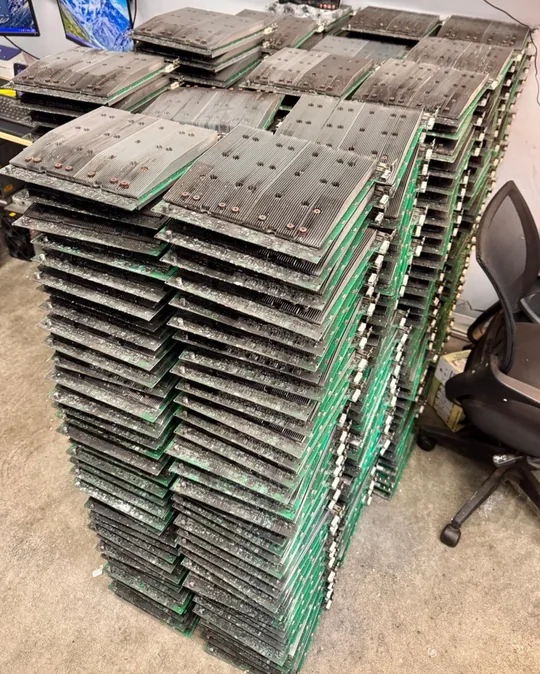
The corollary is worth saying plainly: a machine that fails gate one at your power price has not failed it at everybody’s. If it is not worth repairing where you are, sell it rather than scrap it — we buy used miners outright, dead ones included, and the boards in the photograph above arrived exactly that way.
The spares channel is the third gate
Gate one asks whether the machine earns. Gate two asks how long the discount lasts. There is a third question only a dealer with a parts shelf can answer honestly, and on the wrong machine it outranks both: when this thing fails, will a part exist?
Across a whole fleet the question has a price rather than an answer: what to put on the shelf before a hundred used machines arrive, and what that costs per machine, is costed in used ASIC miner fleet economics.
Our parts and repair shelf, counted today: 39 listings — 14 components you bolt into a machine, 18 diagnostic tools, and 7 power or cooling accessories. Sorted by what those 14 spares actually fit, they are not evenly spread, and the shape of it is the finding:
| Machine family | Spares we can ship you | Can we diagnose it? | What a first failure means |
|---|---|---|---|
| Antminer S19 (BM1398) | Tested hashboard, control board, fan assembly, PSU cable, supplies from APW12 to APW17 | Yes — fixtures, PSU tester, fan tester | A repair. Every rung of the ladder is in stock |
| Antminer S19 XP · S19k Pro (BM1366) | An AS-IS donor board. No tested board, no loose chips | Yes — K3L fixture, BM1366 chip tester | We can name the dead chip and cannot sell you a board |
| Antminer S21 · T21 (BM1368) | Loose chips, APW17 supplies. No board | Yes — K3L fixture | Component-level rework, or the factory warranty |
| Avalon | One genuine 1166 Pro control board | Partly — multi-model testers | Control board yes, hashboard no |
| Whatsminer M20 · M30 | None | Yes — M20/M30 fixture | A diagnosis with nothing to buy afterwards |
| IceRiver KS (Kaspa) | None | Yes — KS-series fixture | Same |
That is not a verdict on those manufacturers. It is a map of the aftermarket, and the aftermarket is what you are really buying into when you buy used. A board for a machine Bitmain shipped by the hundred thousand costs $60 six years later. A board for a machine that sold in the tens of thousands does not exist at any price, and the machine being good does not change that.
Which produces a shape nobody warns a first-time buyer about. Hardware is repairable when it is new and again when it is old, and there is a valley in between. A new machine is covered by the manufacturer — Bitmain and Bitdeer both publish 365 days from shipment, to the original direct purchaser. An old machine is covered by the aftermarket, because enough of them were built and scrapped that boards, controllers and supplies circulate freely. In between sits hardware that is out of warranty and not yet common enough to have a spares channel, and that is the worst place on the curve to own a miner.
Our own shelf is the evidence, and it is inconvenient for us. The S19 is 2020 hardware and we could rebuild one out of the parts page. The S19 XP and S19k Pro are 2022–23 hardware, and for those we stock a fixture and a chip tester and not one tested board or loose chip to fit them. The S21 generation is current, so the chips have started to appear and the boards have not. The machine we name at the end of this page as the best-value used buy on our floor is sitting in the deepest part of that valley. Both things are true, and the second is not a reason to avoid it — it is a reason to buy it differently.
What that means in practice:
- On a valley-generation machine, plan for replacement rather than repair. Buy it tested, get the return window in writing, and price it as a unit rather than as three boards you can swap out one at a time. At $380 a used S19k Pro is cheap enough that “if it dies, part it out and buy another” is a rational plan. It is not a rational plan on a $4,200 machine, which is exactly why the warranty matters up there and barely matters down here.
- If repairability is what you are buying, the plain S19 is the machine. It is the only used unit we sell where the whole ladder — cable, fans, control board, tested hashboard, supply — is on the shelf at the same time. That is not nostalgia for old silicon; it is the reason we keep buying them.
- On anything that is not an Antminer, ask before you buy rather than after. We stock a Whatsminer fixture and an IceRiver KS fixture because those boards are worth diagnosing; we stock no parts for either, because there are none to stock. A used KS5 Pro on our own shelf is a different risk class from an S19 standing beside it at a comparable price — not a worse machine, a thinner channel behind it.
- It is also the argument for buying new that almost never gets made. For the first year the manufacturer is the parts channel. On a $4,200 machine that is worth real money, because a fault you cannot source a part for costs you the whole machine — and the whole machine is what you paid for.
When used is the better buy
- Your power is genuinely under about 4¢/kWh. Flared gas, curtailment, behind-the-meter generation, demand response. This is the buyer the used fleet exists for, and at 2–3¢ the used S19 pays back in five to eleven months against roughly two years for a new S21 Pro.
- You are heating something you would have heated anyway. If the waste heat has a job, your effective power cost is your electricity rate minus the fuel you did not burn, and that can put a 34 J/TH machine back above water when the meter reading alone says it is dead.
- You are buying learning, not hashrate. One used machine is the cheapest honest way to find out what 75 dB, 3,250 W and a 240 V circuit actually mean in your building — before that becomes ten of the same problem.
- Your capital is the binding constraint and your horizon is short. Under about a year, capital dominates and used wins at almost any power price that clears gate one.
- The machine has an open spares channel. An S19 is six years old and that is a point in its favour, not against it: enough were built that a tested hashboard, a control board, fans and a supply are all on a shelf today. Used hardware with no aftermarket behind it is a different purchase, and the table above is how to tell which one you are looking at.
- You can absorb variance. Used machines arrive with unknown history. At fleet scale a dead-on-arrival percentage is a line item you plan for; on a single machine it is your entire purchase.
When new is the better buy
- Your power is between about 4¢ and 9¢. This is the band where new hardware earns and used hardware does not. It covers most retail hosting contracts, which is to say most people reading this.
- You are holding the machine more than about three years. Past the crossover the efficiency gap compounds and never comes back.
- You need the machine to survive the next difficulty rise. Difficulty only pushes break-even rates downward over time. The machine closest to its break-even is the first one you switch off, and the used fleet is already there.
- Siting is the constraint, not price. Household voltage and 45–65 dB is a specification no used industrial S19 can meet at any discount.
- The used machine you were going to buy is in the repairability valley. Out of warranty, and not yet common enough for parts to circulate — 2022–23 silicon sits squarely in that gap. If you cannot absorb the machine being a write-off on its first serious fault, new hardware puts a manufacturer behind it for a year instead.
- You want a manufacturer behind the unit. Bitmain and Bitdeer both publish 365 days from shipment, to the original direct purchaser. On resold hardware that falls to the reseller, which is a real difference and not a small one — see what an ASIC warranty actually covers.
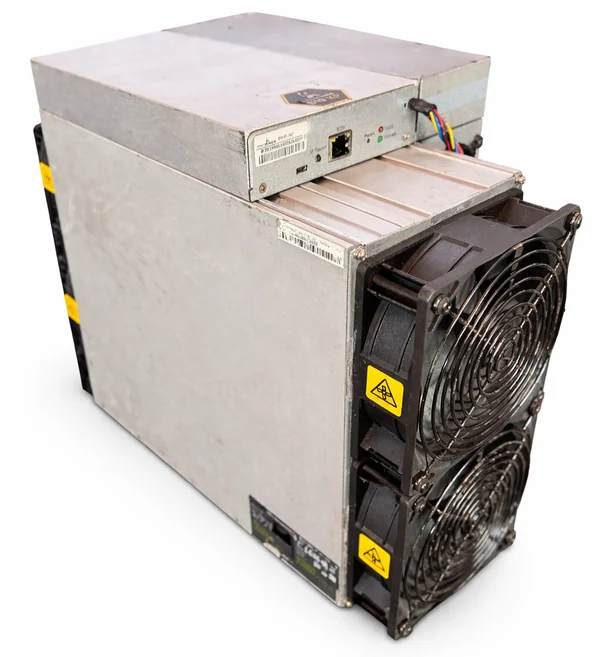
The used machine we would actually buy today
Not the cheapest one, and not the most expensive one either. Run the payback arithmetic across the whole used shelf instead of across a convenient pair and the answer comes out three bands wide:
| Your power | S19 95 TH/s · $250 · 34.2 J/TH | S19k Pro 115T · $380 · 23.0 J/TH | S19 XP 141T · $700 · 21.4 J/TH |
|---|---|---|---|
| 2¢/kWh | 168 days | 157 days | 227 days |
| 3¢/kWh | 352 days | 213 days | 297 days |
| 4¢/kWh | never | 330 days | 428 days |
| 5¢/kWh | never | 736 days | 767 days |
| 6¢/kWh | never | never | 3,688 days |
| 6.3¢/kWh | never | never | never |
The middle band is where almost every buyer actually sits, and the machine that wins it is the one in the middle of the price list. The S19k Pro 115T at $380 pays back faster than the cheap S19 at every rate above 1.7¢/kWh, and faster than the XP at every rate below 5.1¢/kWh. That span covers essentially everyone on sub-retail power, which is why the k Pro — neither the cheapest machine on the floor nor the most efficient — is the single used unit we would buy today. The 120 TH/s version of the same machine sells at the same price and is a shade better again per terahash; ask which one is on the shelf when you call. The two machines at the top and middle of that table are worked through against each other in S19 versus S19k Pro, which is the same decision at one more level of detail: the cheaper machine costs more to own, and the electricity gap between them is 816 kWh a month.
Two machines on our used shelf are missing from that table on purpose
A payback table is only honest if it says what it left out, because a reader who scrolls the shop will find the gaps and be entitled to wonder. Two used machines we sell are not in it.
The cheapest single S19 on our floor is $160, and we will not put a number on it. It is a used S19 running a low-power VNish tune at roughly 2,800 W at the wall. Its factory reference is the same as every other S19 here — 95 TH/s at 3,250 W, 34.2 J/TH — but a low-power tune brings the hashrate down along with the power, and how far down depends on the chip bin and the ambient temperature of the room it ends up in. We do not publish the tuned pair because we have not metered that specific unit, and a hashrate we made up would be the one number on this page capable of costing you real money. Its own listing refuses in the same terms. That leaves it out of every table here: without a tuned hashrate there is no honest capital per terahash and no honest J/TH, so there is nothing to rank. Do the division yourself before you pay — at 2,800 W that machine only matches factory efficiency if it still hashes 81.8 TH/s. If it does, $160 buys you terahash at about $1.96 — the cheapest on this floor one machine at a time, comfortably under the $2.63 the plain S19 costs, though still nowhere near the $1.05 a hundred-unit lot worked out at while those lots carried listed prices. Ask us and we will meter it and send you the pair. That is the whole transaction: we will do the work, we will not do the guessing.
The used KS5 Pro is not in the table either, and that one is simpler: it mines Kaspa on kHeavyHash, so it is not paid the SHA-256 hashprice every figure on this page is built on. Comparing it here would be arithmetic on the wrong revenue. It is a real machine and a reasonable buy for a Kaspa miner — it is just not in this comparison, and the spares table above is the risk to read before buying one.
One qualification on the k Pro, and it comes off the spares shelf rather than the spreadsheet. The k Pro is BM1366-generation hardware, which is the valley described above: we can diagnose a k Pro board and we cannot currently sell you one. That does not move the payback ranking by a day, and it does change how to buy — take the tested unit, get the return window in writing, and treat the machine as a unit rather than as something you will keep alive board by board. If you would rather own the machine you can definitely repair, buy the $250 S19 and accept the slower payback above 1.7¢. That is a real trade, and it is yours to make rather than ours.
Both ends still have their case. Below 1.7¢ the $250 S19 pays back soonest, because at that rate electricity is almost free and only capital per terahash matters. Above 5.1¢ the k Pro is running out of room — it stops earning at 5.8¢ — and the S19 XP at $700 becomes the last used machine on our floor that pays back at all, out to 6.3¢. Above 6.3¢, nothing used here pays back at any price, and gate one told you that before you got to this table.
Headroom and payback are different questions, and it is worth being explicit about which one you are buying. At 5¢/kWh four used listings on our floor still earn — both S19k Pro singles, the ten-machine lot of them, and the S19 XP. The XP is not the only survivor; it is the one with the most margin left before the next difficulty rise takes it. If you are buying the machine you expect to still be running in two years, that margin is the thing worth paying for. If you are buying the machine that returns your capital soonest at the rate you actually pay today, it is the k Pro below 5.1¢, and it is not close. Those two machines now have a page of their own: S19k Pro against S19 XP works the choice through per terahash rather than per machine, which is the version of it that does not move with the Bitcoin price — and it re-derives that 5.1¢ crossover on a later snapshot, where it comes out at 4.9¢.
Fleet pricing moves the line again, and it moves it down. At the ten-unit pricing our own book carried the S19 undercuts the k Pro below 3.0¢; at hundred-unit pricing it undercuts it below 3.4¢. Those two thresholds move with whatever a quote comes back at, and they are the reason to ask for one rather than to assume a discount. So if your power is genuinely industrial and your constraint is capital, buying S19s by the pallet still beats buying better silicon one box at a time — right up to 3.9¢, where the S19 stops earning and the whole pallet is worth what the parts are worth, whatever you paid for it.
Three things that will not change the answer, and are sold as if they do:
- Firmware boosts. A “110 TH/s” boosted base S19 is not a factory S19 Pro — the Pro carries 114 chips per board where the base carries 76, and firmware cannot add chips. Overclocking raises power faster than hashrate, so a boosted machine is worse in J/TH than a stock one, not better. You are buying hashrate at a worse break-even rate, which is precisely the wrong direction on this page.
- Cosmetics. A deep-cleaned chassis tells you about the seller’s process, not the silicon. Ask what was measured, not what was wiped.
- Grade letters with no method behind them. A grade is only worth what the testing behind it is worth — what A, B and C grades actually mean covers what to ask for.
One more number belongs beside our shelf prices: what these machines actually resell for. Over the 90 days to 14 August 2026 the eBay medians were $150 for a used S19 across 29 sales, $300 for an S19k Pro across 16, and $331 for an S19 XP across 45 — published with the method and the sample size on our used ASIC sold-price index. Our $250 S19 sits above that median; the $380 k Pro and the $700 XP both sit inside the middle half of their own buckets. We price above the market on purpose, because a machine off our bench carries a metered result and a return window and most eBay ones carry neither. Know both numbers and decide for yourself which one you are buying.
If the reason you are weighing used against new is that you mean to resell them rather than run them, the comparison changes shape: you are buying work, and the spread is the wage. Reselling used ASIC miners covers what you inherit from our description when you re-list one, and why the freight bill per machine goes up rather than down once you split the pallet.
Whatever you buy, ask for the metered wall draw and the measured hashrate of the specific unit, in writing, before you pay. Every figure above is a factory rating or our shelf price; the only number that decides your outcome is what your machine actually does on your circuit. Ask us and we will meter the unit and send you the pair.
Frequently Asked Questions
Is a used ASIC miner worth it in 2026?
Only below about 3.9 cents per kWh. At 10 August 2026 hashprice a used Antminer S19 at 34.2 J/TH breaks even at roughly 3.9 cents, and a new S21 Pro at 15.0 J/TH survives to about 8.9 cents. If your power is inside that band, new hardware earns and used hardware does not, and the price difference is irrelevant. Below 3.9 cents the used fleet is excellent: at 3 cents a refurbished S19 pays back in around twelve months against roughly two years for the new machine. Re-run the division on the day you buy, because hashprice moves daily.
How do I calculate whether used or new is cheaper for me?
Two steps. First, break-even electricity rate equals hashprice in dollars per PH per day divided by 24 times the machine’s J/TH — do that for both machines and discard any that your power price already beats. Second, if both survive, the used machine stays ahead for a number of days equal to the difference in capital per terahash divided by 0.024 times the efficiency difference in W/TH times your dollars per kWh. Revenue cancels out of that second calculation entirely, so it needs no Bitcoin price and no difficulty forecast.
What fails most often on a used Antminer?
Not the hashboard, which is what most buyers expect and budget for. In rough order of how often they take a machine down on our bench: the power supply, a fan that stopped and let a board overheat, a dead or corrupted control board, and only then a genuine hashboard or chip failure. Of the machines that reach us described as having a dead hashboard, roughly half have a healthy board and a sick PSU, control board or ribbon cable. The cost runs the same way: a PSU cable is about $17 on our shelf, a dual fan assembly about $25, a tested control board or a tested S19 hashboard about $60 each, a full board set about $170, and a 5,600 W supply about $350. Diagnose before you buy anything, because all three chains missing at once is far more often a control board, a power rail or a ribbon cable than three simultaneous hashboard failures.
How much does it cost to replace an Antminer hashboard?
A tested-working Antminer S19 Pro 95 TH/s hashboard is around $60 on our shelf as of July 2026, and a full S19 Pro 110 TH/s board set is around $170. Boards sold AS-IS for parts run about $25 and are donors, not repairs. Add the diagnosis if you do not already own a fixture: a universal Antminer test fixture is about $200 plus roughly $60 for the test-file card, which only makes sense across a fleet rather than for one machine.
When is an ASIC miner not worth repairing?
Two tests, and it fails if it fails either one. The capital test: a hashboard restores one third of a three-board miner, so buy the board only when it costs less than a third of a whole working machine — at a $60 board that cut-off is a machine price of about $180. A single refurbished S19 at $250 passes it; the same machine bought at $150 at fleet pricing does not, and at $100 a machine the board is worth more than the miner. The power test, which almost nobody runs: the third of the machine you restore burns power at the machine’s own efficiency, so it inherits the machine’s own break-even rate. Above about 3.9 cents per kWh a hashboard is not worth fitting to an S19 even if the board is free, because the hashrate it gives back cannot pay for the electricity it burns.
Does buying a used miner in bulk change the used-versus-new answer?
It changes your payback far more than it changes the comparison. Moving from single-unit to lot-of-100 pricing cuts capital per terahash from about $2.63 to about $1.05, which cuts payback by roughly 60 percent — but it extends the crossover against a new S21 Pro by only about 10 percent, because that crossover is dominated by the new machine’s capital per terahash. Negotiate the lot price to shorten your own payback, not to win the argument against new hardware. And do not assume a bigger lot is cheaper per machine: while our lots still carried listed prices, the forty-unit S19 lot worked out dearer per machine than the ten-unit lot and the three-hundred dearer than the fifty, and a ten-pack of S19k Pros cost more per machine than buying them singly. Every lot on this shelf is quoted rather than listed as of 11 August 2026, which makes the same point by other means: there is no ladder to read off.
Will a firmware boost make a used miner competitive with a new one?
No, and it moves the wrong way. Overclocking raises power consumption faster than it raises hashrate, so a boosted machine has a worse J/TH than a stock one and therefore a lower break-even electricity rate. A base S19 driven to 110 TH/s is not a factory S19 Pro either — the Pro reaches that hashrate on 114 chips per hashboard where the base has 76, and firmware cannot add chips. Boosting buys hashrate at the cost of the exact specification that decides whether the machine earns at all.
Which used miner has the best value right now?
Between about 1.7 and 5.1 cents per kWh it is the Antminer S19k Pro 115T at around $380, which pays back sooner than both the cheaper S19 95 TH/s and the more expensive S19 XP across that entire range — at 3 cents it repays its capital in about 213 days against 352 for the S19 and 297 for the XP. Below 1.7 cents the $250 S19 pays back soonest, because at that rate only capital per terahash matters. Above 5.1 cents the k Pro is close to its 5.8 cent break-even and the S19 XP at $700 takes over, earning out to about 6.3 cents. Above 6.3 cents no used machine we stock pays back at all. Fleet lots shift the answer lower again: at the hundred-unit pricing our own book carried, a plain S19 repays sooner than the k Pro below 3.4 cents. Lot pricing is quoted rather than listed now, so that threshold moves with the quote.
Can you still get spare parts for a used ASIC miner?
It depends entirely on the generation, and it is the question to ask before you buy rather than after. Antminer S19 hardware from 2020 has a wide open aftermarket — we stock tested hashboards, control boards, fan assemblies, PSU cables and supplies for it. The 2022 to 2023 machines are the awkward ones: for the S19 XP and S19k Pro we stock a test fixture and a BM1366 chip tester, and not one tested board or loose chip to fit them. For Whatsminer and IceRiver machines we stock diagnostic fixtures and no parts at all. Hardware is repairable when it is new, because the manufacturer warranty covers it, and again when it is old, because the aftermarket has filled in. Between the two there is a valley, and a machine sitting in it is a replacement rather than a repair.