
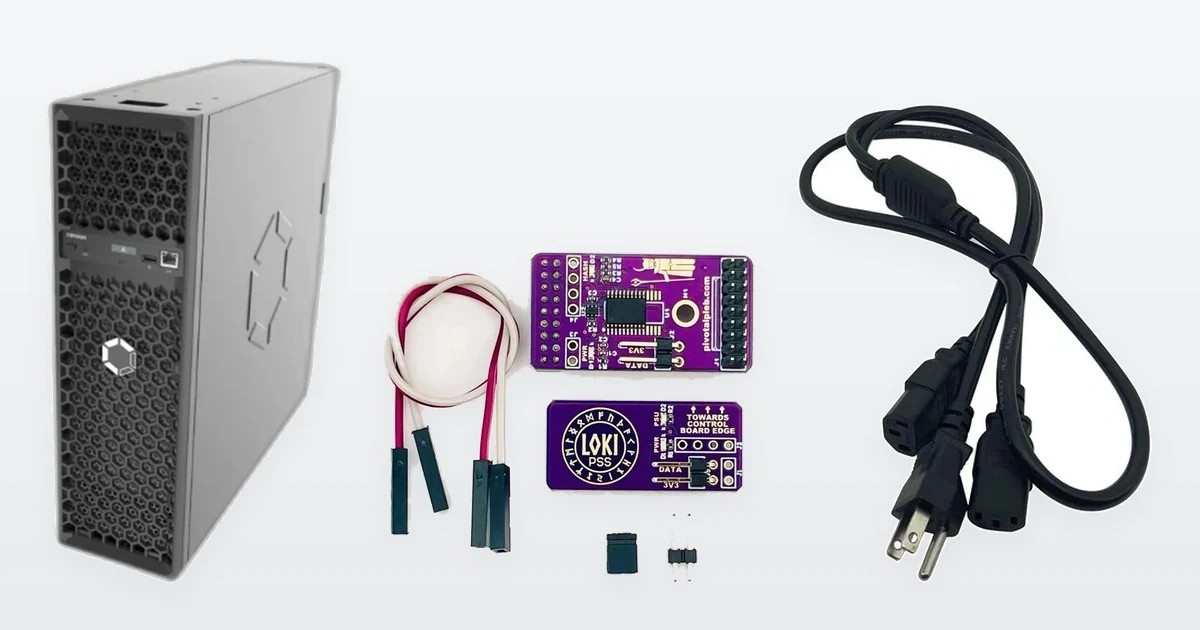
The machine is rarely the biggest surprise. Electrical work is: a dedicated 240 V circuit run to where the miner will sit is the line item most first-time buyers have not budgeted, and it is the one that has to happen before anything can be plugged in. After that come the parts nobody mentions — a PDU with the right receptacle, cabling of the correct gauge, ventilation or ducting, and freight on a 15 kg machine in a bulky carton.
This page is the capital cost of getting one machine hashing. The running cost, and whether the thing earns once it is running, is what to do if you are below break-even — a separate question with a separate answer.
The bill for one machine, itemised
Here is the whole capital cost of putting one miner on a circuit, using three machines
we actually have on the floor. Prices are ours, read off the listings; freight is our
published rate card rather than a quote.
| Line item | Used S19 95TH, low-power tune | Used S19k Pro 115TH | New S21 Pro 245T |
|---|---|---|---|
| The machine | $159.99 | $379.99 | $4,200.00 |
| US freight, UPS Ground, per unit | $49.99 | $49.99 | $49.99 |
| Power supply | confirm before ordering — not every used listing includes one | included | included |
| Power cord / PSU cable if you need one | $16.50 | $16.50 | C20-to-P13 4-pin, not a drawer part |
| Massachusetts sales tax at 6.25%, MA buyers only | $10.00 | $23.75 | $262.50 |
| Landed, shipped anywhere else in the US | $209.98 | $429.98 | $4,249.99 |
| Dedicated 240 V circuit | quoted by your electrician — see below. This is the line we cannot price for you and it is routinely the second-largest one | ||
Freight is charged per unit, not per order. Three machines to the same
address is $149.97, not $49.99, and outside the US it is $250.00 per unit — so three
abroad is $750.00. Fleet quantities are configured as freight instead — the hundred-machine class
is $3,449.99, or $34.50 a machine — but since 11 August 2026 no checkout can
apply it, because every lot listing here is quoted rather than sold through the cart,
so freight on a lot comes back on the quote with the machines. The full rate card is on the
shipping and delivery page.
We charge one sales tax rate, 6.25% Massachusetts, because ING Mining LLC is in Hanson,
MA. Orders shipping outside Massachusetts are not charged sales tax at checkout; whether
you owe use tax in your own state is between you and your state.
The electrical work is the line we cannot quote you
None of these machines runs on a North American 120 V outlet. They want 200–240 V,
and a dedicated circuit, and that is a job for a licensed electrician whose price depends on
your panel, your distance from it and your local code. We are not going to invent a number
for it. What we can give you is exactly what to ask for:
- S19k Pro, 2,645 W: about 11.0 A at 240 V. The continuous-load rule sizes
the breaker at 125% of that — 13.8 A — so a 20 A circuit is right
and has real headroom. - S21 Pro, 3,675 W: about 15.3 A, which is 19.1 A after the same rule. That
technically fits a 20 A breaker with 4% left, which is not enough. Ask for
30 A. - The receptacle matters as much as the amperage. Tell the electrician the
plug you need before they finish, not after — a NEMA 6-20 and an L6-30 are not
interchangeable and neither is free to change later.
There is one exception worth knowing about and one caveat that goes with it. A
Loki kit at $99.99 lets an X19-series Antminer run from a 120 V
outlet. It does not raise hashrate and it does not improve efficiency — every
conversion stage loses a little to heat — and you will run the machine derated to fit
the circuit. It solves the problem of having the miner but not the circuit. It does not
solve the problem of wanting full output. Requirements machine by machine are on the
ASIC miner power requirements page.
What it costs every month, which dwarfs all of it
Capital is the small number. Here is the electricity bill for one machine at 730 hours a
month, machine only, before PSU losses and before anything you spend moving the heat.
| Your power price | S19 95TH (2,800 W tune) | S19k Pro (2,645 W) | S21 Pro (3,675 W) |
|---|---|---|---|
| 3¢/kWh | $61 | $58 | $80 |
| 5¢/kWh | $102 | $97 | $134 |
| 7¢/kWh (typical hosting) | $143 | $135 | $188 |
| 12¢/kWh (cheap US residential) | $245 | $232 | $322 |
| 18.44¢/kWh (US residential average, EIA, May 2026) | $377 | $356 | $495 |
Read the bottom row against the top row of the first table. At the US residential
average, the S19k Pro burns most of its own purchase price in electricity every five
weeks. That is the whole reason this industry sits where power is cheap, and it is
why the first question we ask anyone buying more than one machine is what their rate
actually is. Whether any of them earns more than that bill is the
break-even calculation — across our catalogue it lands between
about 3.9¢ and 9.0¢/kWh.
The line items people forget
- Repairs, on used stock. Budget for them explicitly rather than hoping. What fails, what a replacement board or fan actually costs and when a machine is not worth repairing is set out in used vs new ASIC miners.
- The power supply, on used stock. Some used listings include one and some
do not, and ours say which. A replacement is a real cost: an
APW17-1215c for the current S21 generation is $59.99 here. Confirm the
PSU, its rating, the cord and the plug standard in writing before you order. - The firmware dev fee. A machine that ships on Braiins OS or VNish carries
a dev fee collected in hashing power — Braiins publishes 2 to 2.5%, offset against the
pool fee on Braiins Pool and not offset anywhere else. On a pre-flashed used machine that is
a running cost you inherit. Ask which firmware and which fee setting is on the actual
unit. - The warranty you assumed. Third-party firmware voids any remaining
manufacturer cover. We state condition and warranty per listing rather than across the
catalogue, so read the listing rather than the store. - Heat and noise. Every watt in the table above comes back out as heat in
the room, and these machines run at about 75 dB. Ducting, a different room or a different
building is a cost even when nobody invoices it. What each cooling type actually makes you
build is set out in ASIC miner cooling. - A spare. A dead PSU takes a whole machine offline and is a five-minute
fix with a screwdriver if the part is on your shelf and a week’s downtime if it is not.
A realistic first-machine budget
For one used S19k Pro shipped outside Massachusetts: $429.98 landed, plus
an electrician’s quote for a 20 A 240 V circuit, plus $135 a month at 7-cent power or $356 a
month at the US residential average. The machine is 21% of the first year’s outlay at
7¢ and under 10% of it at residential rates.
That ratio is the single most useful thing on this page, and it is why
buying used is a smaller decision than it looks and why your
electricity rate is a bigger one. If you want the machines ranked by the power price they
break even at, that is the comparison table; the tested secondhand
stock is on the used ASIC miner shelf.
Frequently Asked Questions
What does it actually cost to set up one ASIC miner?
Landed cost for one tested used Antminer S19k Pro from us is $429.98 — $379.99 for the machine plus $49.99 US freight, with the PSU included. Add 6.25% sales tax if you are in Massachusetts. On top of that sits an electrician’s quote for a dedicated 240 V circuit, and then about $135 a month in electricity at 7-cent power or $356 a month at the 18.44¢/kWh US residential average.
What is the biggest hidden cost of mining?
Electricity, by a wide margin, and it is not really hidden — it is just usually left out of the purchase decision. A $379.99 machine burns most of its own price in power every five weeks at the US residential average. The second biggest is the electrical work: a dedicated 240 V circuit has to exist before anything can be plugged in, and it is priced by your electrician, not by us.
Do I need a 240 V circuit to mine Bitcoin at home?
For an Antminer S19 or S21 class machine, yes. They take 200–240 V and no adapter converts a North American 120 V outlet into that. The one exception is a Loki kit at $99.99, which lets an X19-series machine run from 120 V — derated, with no gain in hashrate or efficiency. Size the breaker at 125% of the machine’s draw: 20 A for an S19k Pro, 30 A for an S21 Pro.
How much is freight on a miner, and is it per order?
Per unit, not per order. $49.99 by UPS Ground anywhere in the US and $250.00 per unit outside it, so three machines abroad is $750.00. Fleet quantities are configured as freight instead — the hundred-machine class is $3,449.99, or $34.50 a machine, which is the one place where buying by the pallet is genuinely cheaper per unit. Since 11 August 2026 no checkout can apply it: every lot listing here is quoted, so freight on a lot comes back on the quote with the machines.
More on what a setup costs
- How to Start Crypto Mining for Reliable Home Profits
- 7 Mining Setup Essentials Every New Miner Must Know
- the five checks to run before you buy
- How to Calculate Mining Profitability: The Two Formulas
Power supplies, converters and cabling in stock
The power-side hardware this comes down to, all of it in stock:
- Alpha Miner APW12 Overclocking PSU 5600W ASIC Compatible A B C D E F G
- Antminer Hashboard Repair Tool Kit New Version Full Set 2024
- Antminer S19 / Pro / S19j Pro / SE / XP / T19 – AMLOGIC Control Board Unlock Kit
More in Need Parts, or the full ASIC miner inventory.