
ASIC Mining Hardware and Repair Parts
An ASIC miner is a machine built to run one hashing algorithm and nothing else. That is the whole trade: it will out-hash any GPU on its algorithm by orders of magnitude, and it is worthless the day that algorithm stops paying. This is the widest view of our catalogue: every miner we stock plus the parts that keep them running — Bitcoin SHA-256 machines, Scrypt units for Litecoin and Dogecoin, the smaller altcoin ASICs new and used, and the PSUs, hashboards, testers and cooling hardware behind them.
-
-
Add to WishlistAdd to Wishlist
-
Add to WishlistAdd to Wishlist
-
Add to WishlistAdd to Wishlist
-
Add to WishlistAdd to Wishlist
-
Add to WishlistAdd to Wishlist
-
Add to WishlistAdd to Wishlist
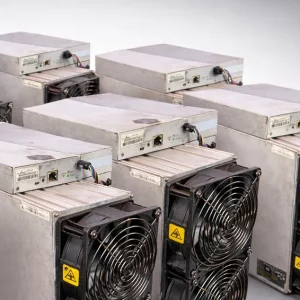
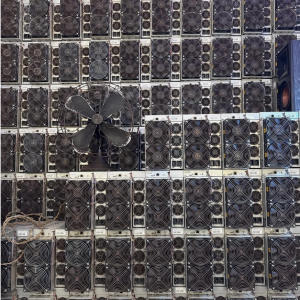
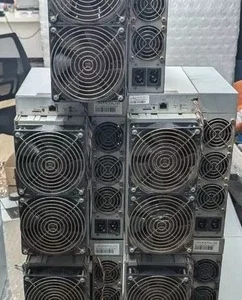
Three numbers decide the purchase, in this order
Efficiency (J/TH) comes first. It is the only spec that determines whether a miner survives the next difficulty rise. Today’s air-cooled flagships sit around 13–15 J/TH; an S21 XP is 13.5 J/TH and an S21 Pro is 15 J/TH. The 2020-generation S19 class runs 30–35 J/TH, and the S19k Pro splits the difference at 23 J/TH. A machine at 34 J/TH burns roughly two and a half times the power per terahash that a 13.5 J/TH machine does. That gap is the entire argument.
Then your power price. Efficiency only matters relative to what you pay per kWh. Cheap power keeps old hardware alive far longer than the spec sheet suggests, which is exactly why our used and refurbished stock still sells to people who know their numbers. Expensive power means you cannot afford anything but current-generation efficiency.
Hashrate comes last. It sets your revenue share, but it is the easiest number to buy more of. Two efficient machines beat one inefficient one at the same total draw.
Cooling decides where the machine can actually live
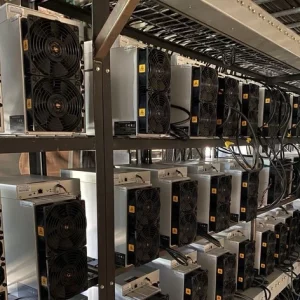
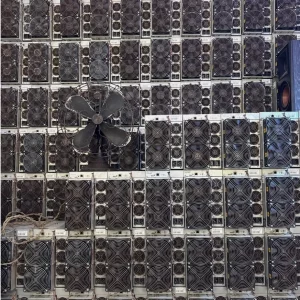
Cooling sorts this catalogue three ways and the three shelves are siblings under this one. Air-cooled machines are the ones that need nothing built first, across every manufacturer we carry: self-contained and loud — expect around 75 dB, which is a shop-vac running permanently — and wanting a 200–240V circuit and real airflow. Hydro-cooled and immersion models are quieter and denser but are not plug-in hardware: they need a loop, a dry cooler or a tank before they will run at all. Do not buy hydro until the loop exists.
Efficiency means a different unit on each shelf here
This is the one page on the site where machines that share nothing but a manufacturing process sit next to each other, and their spec sheets are not comparable. Bitcoin machines are rated in joules per terahash. The Scrypt machines for Litecoin and Dogecoin are rated in joules per gigahash. The Kaspa, Aleo, Dash and CKB machines are rated against whatever their own algorithm counts in. A figure is not better for being smaller: the most efficient Bitcoin miner we ship sits at 13.4 J/TH and the most efficient Scrypt miner at 165 J/GH, and neither number tells you anything whatsoever about the other.
So compare efficiency only inside one algorithm. Between algorithms the only common currency is money — what a day of that machine’s output is worth in the coin it actually mines, against what a day of its power costs you. That is the arithmetic we will run with you for anything on this page, and it is why our comparison table sorts machines onto separate shelves by algorithm rather than ranking everything against everything: an honest league table of this catalogue cannot be one list.
What one machine does to a power bill
A current air-cooled Bitcoin miner draws around 3,500 W and draws it continuously. That is roughly 84 kWh a day and about 2,550 kWh a month from one box — for most buyers, more than the rest of the building put together. It also decides the circuit before it decides anything else: 3,500 W at 240 V is about 14.6 A, and a load that runs continuously is allowed only 80 per cent of a breaker’s rating, so it wants a 20 A circuit to itself rather than a share of one.
Whether any of that pays comes down to a single division: break-even rate = hashprice ÷ (24 × the machine’s J/TH). Hashprice is what one PH/s of mining is paid over twenty-four hours; on 9 August 2026 it was $32.18/PH/day, worked out from the last 144 blocks — 452.11 BTC paid to miners, of which 0.47 per cent was fees — at a Bitcoin price of $64,959, difficulty 127.48 T and a network of about 912 EH/s. It moves every day, and every figure below moves with it.
Across this catalogue that division runs from about 10.0¢/kWh for the most efficient Bitcoin machine on the shelf down to 3.9¢/kWh for a factory-spec S19 — and that bottom figure is the whole reason used hardware is cheap, not a bargain hiding in plain sight. Band-by-band numbers are on the new and used pages, where they belong to a specific shelf.
Which part of this catalogue you actually want
This is the widest view of the store, which makes it a good place to start and a poor place to finish. Pick the line below that matches what you are doing.
Mining Bitcoin, one machine, in a house. Canaan Avalon and Fluminer home miners — the quiet, low-draw end of SHA-256. Everything else in here is a 3 kW appliance at around 75 dB and does not belong indoors.
Mining Bitcoin, one or two machines, in a garage or shop. Air-cooled miners, on a 240 V circuit with real airflow — that shelf carries every manufacturer we stock, not only Bitmain.
Mining Bitcoin at scale, with power you already pay little for. Used and refurbished miners and the fleet lots. Cheap power is what keeps older hardware earning, and it is the only thing that does.
Mining Bitcoin on a new build, hosted or financed. New ASIC miners — sealed, warranty intact, no run hours behind it.
Mining Litecoin and Dogecoin. Scrypt miners for LTC and DOGE. Scrypt machines mine both at once; they are not Bitcoin hardware and cannot be repointed at it.
Mining Kaspa, Aleo, Dash or CKB. Kaspa, Aleo, Dash and CKB machines. Each of these machines mines exactly one chain, and none of them mine Bitcoin — that is the whole risk of buying one.
You already have a loop or a tank. Hydro and immersion, which reach efficiency air cooling cannot. Build the infrastructure first.
Fixing what you already own. Repair parts and test fixtures — testers, supplies, control boards, fans and chips, with a symptom-by-symptom guide to which one you need.
Browse everything in all miners, or ask us before you buy — we run this hardware ourselves, and we will tell you when a machine is wrong for your site.
If you want the arithmetic rather than the sales pitch, our ASIC miner buying guide covers what every spec on the sheet means, what a miner costs to run each month, and the total cost of ownership once power and hosting are counted.
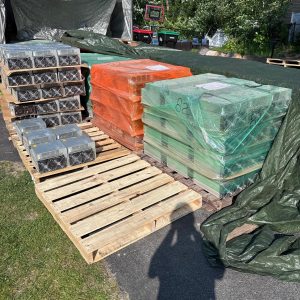
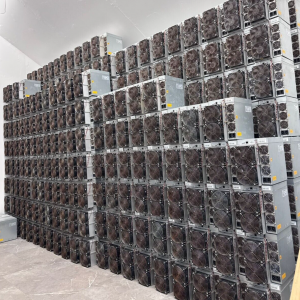
Three machines cover most of what people come to this category for. The Antminer S21 Pro 245T is the current-generation air-cooled benchmark at 15 J/TH. The Avalon Q 90T draws about 1,674 W and runs near 45 dB, which is what makes it liveable in a house rather than an outbuilding. And a lot of fifty used S19s is where the arithmetic lands if you already have industrial power at a few cents a kilowatt-hour.
Every machine on this page is also in one table with the rest of the catalogue: compare ASIC miners by hashrate, wall power and J/TH, with the daily electricity cost worked out at your own rate.
Browse by manufacturer
The 94 machines on this page come from eleven manufacturers, and nine of them have a shelf of their own: Bitmain Antminer (52 machines), MicroBT WhatsMiner (13), Canaan Avalon (6), Bitdeer SealMiner (5), IceRiver (4), ElphaPex (4), Fluminer (3), Goldshell (3) and VolcMiner (2). The other two machines — a Bitaxe NerdQaxe++ and a Pinecone INI Box — are the only ones we stock from their makers, so they have no shelf and sit on the algorithm pages instead.
Manufacturer is worth browsing by for one practical reason: parts, firmware and repair expertise follow the maker, not the coin. The other 39 listings on this page are repair parts, and which machines our own bench can actually cover is set out on ASIC miner repair parts.