
Bitdeer SealMiner Bitcoin Miners
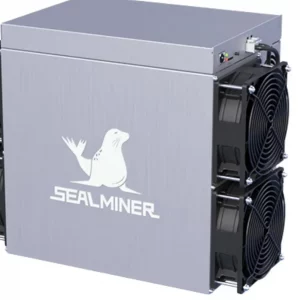
Bitdeer SealMiner Bitcoin miners — the air-cooled A2 Pro and the hydro-cooled A2 Pro Hyd range. Bitdeer designs its own silicon and mines with it at scale before selling it, which is a meaningfully different position from a pure hardware vendor: the company is a customer of its own product.
-
Add to WishlistAdd to Wishlist

-
Add to WishlistAdd to Wishlist
Where the SealMiner A2 Pro sits
The air-cooled A2 Pro is rated 255 TH/s at 3,790 W, which is 14.9 J/TH ±5%, at around 75 dB. That puts it directly against the Antminer S21 Pro class on efficiency and slightly ahead of it on raw hashrate per box. If you are comparing against Antminer or Whatsminer, this is a real alternative rather than a budget substitute.
The A2 Pro Hyd models run from roughly 506 to 518 TH/s in a hydro chassis. Same silicon family, water instead of air, higher density — and the same hard prerequisite as every hydro machine: a loop and heat rejection have to exist before the miner does anything at all. See hydro cooling.
How to choose
Air or hydro is an infrastructure decision, not a performance one. If you do not have a facility, buy the air unit. There is no version of this where hydro hardware earns you money while the plumbing is still on a quote.
Check batch dates. SealMiner stock is often sold by production batch. A batch month is a delivery window, and difficulty at delivery will not be difficulty today. Ask us for the current lead time before you commit.
Weigh the support question honestly. Bitmain’s advantage is not efficiency, it is that spare parts, firmware and repair expertise for Antminers are everywhere. Bitdeer hardware is newer, so the parts market is thinner. For a hosted deployment that rarely matters; for a self-maintained site, factor it in.
The efficiency gap to Bitmain is smaller than the rounding
The page above puts the SealMiner A2 Pro against the S21 Pro class. Here is that comparison as a number, because it is smaller than most people expect. The air-cooled A2 Pro Air is 3,790 W for 255 TH/s, or 14.9 J/TH. The Antminer S21 Pro 245T is 3,675 W for 245 TH/s, or 15.0. Run both through break-even rate = hashprice ÷ (24 × J/TH), at $32.18/PH/day derived on 9 August 2026, and the SealMiner stops earning at 9.0¢/kWh and the Antminer at 8.9¢ — about six hundredths of a cent apart. Across the roughly 33,000 kWh a machine of this draw uses in a year, that is not a difference you can act on.
So efficiency does not decide this purchase, and any comparison that leads with it is wasting your time. What decides it is parts, repair, lead time and what the machine is worth in two years.
What our own repair shelf says about this manufacturer
The support caveat further up this page is usually where a vendor gets vague. We can measure it instead, because we run the repair shelf: of the 39 listings in our parts and repair category, not one is a Bitdeer or SealMiner part. Twenty-two name a Bitmain machine and nothing else — hashboards, APW12 supplies, S19 and T17 test fixtures, EEPROM kits — and the remaining seventeen are multi-brand tools, like the K9 tester that covers 70-plus models across Bitmain, MicroBT, Canaan and Innosilicon, or the control-chip tester that does not care whose board it is on.
Read that precisely. The generic diagnostic layer covers a SealMiner perfectly well; the model-specific spares do not exist on our shelf, and to our knowledge there is not yet an aftermarket to buy them from. Bitdeer publishes 365 days from the shipment date, with the buyer paying freight in and Bitdeer paying the return leg, and coverage voided if settings are changed without consent. Inside that year you have a warranty. Outside it, an Antminer of the same class has a bench behind it and this machine has an RMA. That is not a reason to avoid the hardware — it is a reason to buy it hosted, or to buy it knowing a hashboard fault is a shipment rather than an afternoon.
One thing this shelf has that the Bitmain hydro range does not — but not the one this page used to claim. Correction, 14 August 2026: until today this paragraph said all three A2 Pro Hyd bins were rated 200–240 V and that a single-phase 240 V service could energise them. That was wrong. Bitdeer publishes the A2 Pro Hyd at AC 380–480 V three-phase, each listing now says so, and no single-phase 240 V circuit runs one at any breaker size. If you sized a service off the old wording, tell us and we will work it through with you.
The real difference is at the top of the range rather than the bottom. All three bins — 506/508T, 510/512/514T and 516/518T — accept up to 480 V, while the non-preorder hydro Antminers are rated 380–415 V. A 277/480 V three-phase service is ordinary in North American commercial and industrial buildings, and on one of those the Bitdeer units take the supply as it comes while the Bitmain hydro range needs a transformer in front of it. If your building is already 480 V, that is a genuine advantage and worth more than a tenth of a cent of break-even. If your building is single-phase 240 V, neither shelf is open to you — see hydro cooling for what that whole category actually requires.
Who this suits
Operators who want current-generation efficiency without adding to their Bitmain concentration, and buyers sizing a hydro build who want an alternative to the S21 Hyd range.
Full catalogue: all miners.
Weighing a SealMiner against its Bitmain equivalent? Read Antminer S21 Pro vs Bitdeer SealMiner A2 Pro Air – the efficiency gap is under 1%, so the decision turns on parts, repair and resale instead.
The SealMiner A2 Pro Air is the one we physically stock, and at 14.9 J/TH it sits in the same efficiency band as an S21 Pro. The A2 Pro Hyd 506/508T and the A2 Pro Hyd 516/518T are the hydro versions of the same silicon — roughly double the hashrate per box, and they do not run at all without a water loop. Read the parts-availability section on the air model before you commit to either; it is the real risk with this manufacturer, not the hardware.