
ElphaPex DG Scrypt Miners for Litecoin and Dogecoin
ElphaPex builds Scrypt ASICs for merged Litecoin and Dogecoin mining, and nothing else. No machine on this shelf mines Bitcoin. The company’s whole DG range is built around a single efficiency target that it hits at four different sizes, which makes choosing inside it unusually simple — and makes the one machine that breaks the pattern worth reading about carefully before you buy it.
-
Add to WishlistAdd to Wishlist
-
Add to WishlistAdd to Wishlist
-
Add to WishlistAdd to Wishlist
What ElphaPex makes, and for which coins
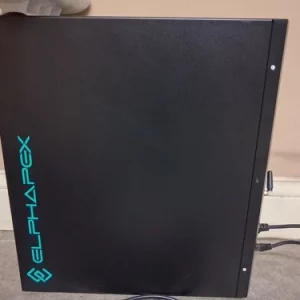
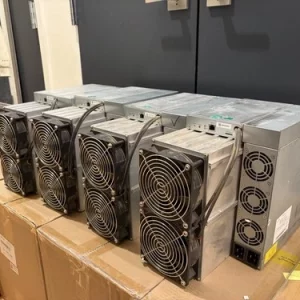
Four machines, one algorithm. The DG1+ 14G is 14 GH/s at about 3,920 W and the DG1+ 13G is 13 GH/s at 3,640 W. The DG Home1 2.1G is 2.1 GH/s at 630 W. The DG Hydro1 20G is 20 GH/s and is the exception in every sense — see below.
Scrypt hardware is quoted in J/GH or J/MH, never J/TH. An ElphaPex at 0.28 J/MH is 280 J/GH, and putting that next to a Bitcoin miner’s 15 J/TH is arithmetic with no meaning attached to it. Merged mining is why these machines exist at all: the same Scrypt work is submitted to both the Litecoin and Dogecoin chains, so one machine earns on two networks. Merged mining vs auto-switching explains what that does and does not guarantee.
One efficiency bin, three sizes
The DG1+ line is binned at a single efficiency and the wattage is scaled to the hashrate. 3,640 W over 13 GH/s is 280 J/GH. 3,920 W over 14 GH/s is 280 J/GH. Not close — identical.
So the 14G is not a better machine than the 13G, it is a bigger one, and the decision between them is how much power you have and how many boxes you want, not which is more efficient. That is a genuinely different way to buy from the Bitmain range, where each new bin usually moves the efficiency as well as the hashrate.
The DG Home1 is the deliberate exception: 630 W over 2.1 GH/s is 300 J/GH, about seven per cent worse than the DG1+ bin. You are paying that seven per cent for a machine that runs at 170–300 V and around 50 dB, quiet enough to live somewhere a 75 dB machine cannot. That is a fair trade if the machine has to share a building with people, and a bad one if it does not.
The hydro machine is the uncertain one
We will not pretend this is settled. The DG Hydro1 20G’s listing carries 5,200 W; ElphaPex’s distributors publish 6,200 W for the same model, and ElphaPex publishes no consumer spec page to settle it. At 20 GH/s that is the difference between 260 J/GH and 310 J/GH — a 19% swing in running cost, and we are not going to quietly quote the flattering one.
Read the second number carefully, because it inverts the usual assumption. If the distributors are right, the hydro machine is less efficient per GH than the air-cooled DG1+ at 280. Hydro cooling buys density and quiet and a place to put the heat; on this range it does not obviously buy efficiency. Ask us and we will read the rating label off the actual unit before you size a circuit or a coolant loop.
The other hard prerequisite is the supply. This is three-phase 380–480 V plant and there is no single-phase 240 V circuit that runs it at any breaker size, and it does not ship with its cooling system. ASIC miner cooling sets out what the loop and the heat rejection actually involve before the miner does anything at all.
Where this sits against an Antminer L11
Bitmain leads this algorithm on efficiency and we would rather say so. The Antminer L11 20G is 184 J/GH. A DG1+ at 280 J/GH needs about 52% more power for the same work. Over a machine running continuously that is not a rounding difference, and no amount of build quality argues it away.
ElphaPex’s case is availability, price and the fact that the DG range is shipping now in sizes Bitmain does not always have on the shelf. That can be the right trade — a machine you can buy today at a workable price beats a more efficient one you are waiting on — but make it deliberately, with the 52% in front of you. Every Scrypt row we stock is on the ASIC comparison table.
How to choose
Decide air or hydro before you decide hashrate. If you do not have three-phase service and somewhere for the heat to go, the DG Hydro1 is not a machine you can buy, whatever it costs. That is an infrastructure question and it has a yes-or-no answer.
Then pick a size, not an efficiency. Inside the DG1+ bin the 13G and the 14G run at the same J/GH, so the question is how many kilowatts you have per unit and how many units you want to manage.
Put the Home1 where a person can hear it. At about 50 dB and 170–300 V it is the one ElphaPex that belongs in a utility room. It is rated 0–35 °C, a narrower band than the 5–45 °C of the DG1+ line, so a hot loft in August is outside its spec and inside theirs.
Get the power figure in writing on the hydro unit. A 19% uncertainty on 5–6 kW is a real number in a real bill, and it also changes the breaker. Ask before you buy, not after.
Who this suits
Operators who have chosen Scrypt and want current hardware in a size that is actually available — the DG1+ pair for a shed, a garage or a hosted rack on 200–240 V, the DG Home1 for one machine somewhere quiet, and the DG Hydro1 only for a site that already has three-phase power and a coolant loop. If you are weighing Scrypt against Kaspa before choosing a maker, Kaspa miner vs Litecoin miner compares them on the same terms.
All four are new single units. We hold no used ElphaPex stock and no ElphaPex lots, so nothing on this shelf is priced by volume; our multi-unit inventory is SHA-256 hardware on bulk used ASIC miners. For quantities, ask for a quote and we will tell you what we can source and when.
Full catalogue: all miners. Related shelves: Litecoin and Dogecoin Scrypt miners and hydro cooling.