
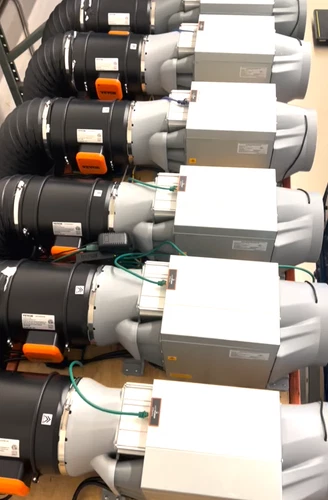
Buy the S19k Pro. We have both machines on the floor — a used Antminer S19k Pro 115TH/s at $379.99 and a refurbished Antminer S19 XP 141TH/s at $699.99 — and for most people reading this, the cheaper one is the better machine. It is not close: the k Pro delivers about 50% more hashrate per dollar, and the XP’s efficiency advantage over it is only 7%. Seven per cent does not buy back an 84% price difference at any electricity rate where either machine is still worth switching on.
There are exactly two situations where the S19 XP is the right buy, and both of them are about your site rather than your spreadsheet. The first is when you have run out of machine positions rather than money — the XP puts 141 TH/s on the same 20 A, 240 V circuit that carries 115 TH/s of k Pro. The second is if you are buying for the far side of the halving on power between about 2.8 and 3.0¢/kWh, which is the narrow band where the halving kills one fleet and not the other. Everything below is the arithmetic behind those two sentences, run on our own shelf prices and a network snapshot taken this morning.
Antminer S19k Pro vs S19 XP: what the two machines actually are
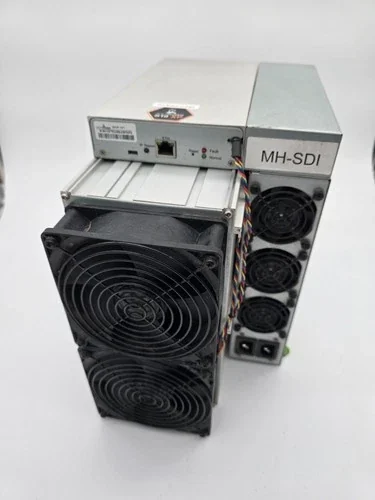
Both figures below are factory ratings, because that is the only pair of numbers with a manufacturer behind it. Neither machine is new, both are 200–240 V industrial hardware at roughly 75 dB, and both arrived here with Braiins OS on them.
| Antminer S19k Pro | Antminer S19 XP | |
|---|---|---|
| Our price | $379.99 | $699.99 |
| Condition | Used, tested working on our bench | Professionally refurbished, tested |
| Hashrate | 115 TH/s | 141 TH/s |
| Wall power | 2,645 W | 3,010 W |
| Efficiency | 23.0 J/TH | 21.35 J/TH |
| Capital per TH/s | $3.30 | $4.96 |
| Break-even power price | 5.6¢/kWh | 6.1¢/kWh |
| Draw at 240 V | 11.0 A (13.8 A at NEC 125%) | 12.5 A (15.7 A at NEC 125%) |
| Circuit needed | One 20 A / 240 V | One 20 A / 240 V |
| Silicon | BM1366, BHB568xx/569xx boards | BM1366AL, BHB428xx boards, 110 chips × 4 |
| In the box | Miner, PSU, Braiins OS | Miner and Braiins OS — no PSU named |
| Buyable as a lot? | Yes, ten units, priced on quote | No — single-unit line only |
Two rows there deserve more than a table cell. The “no PSU named” one is not us being coy: the k Pro listing states a power supply is included and the XP listing does not name one, and our standing rule on every listing is that nothing is in the crate unless the listing says it is. Before you pay for the XP, call us on +1 (781) 577-0377 and we will confirm in writing what physically ships. An APW12 is a couple of hundred dollars, which is most of the way to being a third machine, so it is not a detail.
The other is the circuit. Both machines want their own 20 A, 240 V feed — the XP’s 12.5 A becomes 15.7 A once you size a continuous load at 125% under the NEC, and that still fits a 20 A breaker. You cannot put two of either on one circuit. That single fact is what most of the rest of this article is about.
What $320 actually buys: 26 TH/s for 365 watts
Stop comparing the two machines for a moment and price only the difference between them. Going from the k Pro to the XP buys 26 TH/s more for 365 W more. Divide one into the other and those extra terahashes arrive at 14.0 J/TH — better than either machine’s own average, and squarely in current-generation territory. The step up costs $12.31 per extra TH/s and the extra hashrate pays for its own electricity all the way up to 9.2¢/kWh.
That is the strongest thing anyone can honestly say for the XP, and it is worth saying clearly before the arithmetic turns against it. What it means in practice: if the machine slot already exists and is already paid for, the marginal terahash you get by filling it with an XP instead of a k Pro is efficient terahash. The trouble starts when you notice you could have spent that $320 on most of another whole machine instead.
Payback today, and why we would rather you did not shop on it
Here is the conventional comparison, run the same way our used versus new analysis runs it — purchase price only, gross hashprice, no firmware dev fee and no freight, so the rows line up with that page. Network inputs were read off the chain at block 962,444 on 14 August 2026: hashprice $31.05 per PH/s per day, Bitcoin at $62,547, difficulty 127,479,855,693,691, with fees running 0.65% of the block reward.
| Your power | S19k Pro pays back in | S19 XP pays back in |
|---|---|---|
| 2¢/kWh | 165 days | 239 days |
| 3¢/kWh | 228 days | 317 days |
| 4¢/kWh | 369 days | 470 days |
| 5¢/kWh | 959 days | 914 days |
| 5.5¢/kWh | 4,819 days (13 years) | 1,732 days (4.7 years) |
| 5.6¢/kWh | never in any useful sense — this is its break-even | 2,204 days |
| 6.1¢/kWh | never | never — this is its break-even |
Read the 5¢ row before the 4¢ one. The ranking flips between them: on this morning’s numbers the crossover sits at 4.9¢/kWh. Below it, buy the k Pro; above it, the XP repays sooner because the k Pro is close enough to its own break-even that its payback is running away to infinity.
Now the part that matters more than the number. That crossover was 5.1¢ when we published the same arithmetic four days ago, and it moved because Bitcoin fell about 4%. Difficulty has not changed at all since — it is the same epoch, the same 127.5 T. A 10% move in hashprice in either direction puts the crossover anywhere between 4.6¢ and 5.6¢. Payback is a hyperbola near break-even, and shopping for a $700 machine on a figure that swings that far in four days is not analysis, it is a coin toss with extra steps.
The version of this comparison Bitcoin’s price cannot move
There is a way to compare these two that does not move with the market at all, and for anyone buying more than one machine it is the right one. Stop asking “which machine” and ask “how do I buy 5,000 TH/s”. At equal hashrate, both fleets earn exactly the same revenue — the same terahash is paid the same hashprice regardless of what is generating it. Revenue cancels out of the comparison completely, and with it goes the price of Bitcoin, the difficulty, the fee market and every forecast anyone has ever sold you. What is left is two numbers:
- The XP costs $1.66 more per TH/s to buy ($4.96 against $3.30).
- The XP saves 1.21 kWh per TH/s per month at 730 running hours, because it is 1.65 J/TH more efficient.
So the whole decision is: does a kilowatt-hour saved every month, forever, justify $1.66 spent once? Divide one by the other at your own power price and you get the answer in months.
| Your power | Months for the XP premium to come back | Verdict |
|---|---|---|
| 2¢/kWh | 69 months (5.7 years) | No |
| 3¢/kWh | 46 months (3.8 years) | No |
| 4¢/kWh | 34 months (2.9 years) | Marginal |
| 5¢/kWh | 28 months (2.3 years) | Marginal |
| 5.6¢/kWh and up | 25 months | Irrelevant — the k Pro is already scrap here |
The last row is the trap, and it is worth being explicit about it because a naive efficiency argument walks straight into it. Yes, the more efficient machine repays its premium faster as electricity gets dearer — at 7¢/kWh the premium comes back in under 20 months. But at 7¢/kWh neither of these machines covers its own electricity, so the payback is on a fleet that is losing money on every terahash. To repay the premium within two years you would need power above 5.7¢/kWh, and the k Pro dies at 5.6¢. The window where the XP’s efficiency pays for itself in a sensible timeframe and the machines are worth running does not exist. Inside the band where these two actually earn, the premium takes three to six years to come back on efficiency alone.
Note what does not appear anywhere in that paragraph: the price of Bitcoin. Because revenue cancels, this conclusion holds at $30,000 and at $150,000, before the halving and after it. It is the only part of this comparison with a shelf life longer than a fortnight, which is exactly why we lead with it rather than with the payback table.
When the S19 XP is the machine to buy
Everything above prices watts. The case for the XP is built on things that cost you per machine, and those do not appear in a J/TH figure at all: a rack position, a PDU port, an IP address, the labour to hang and commission a unit, a hosting contract billed per box, and freight. Our own US ground rate is $49.99 per machine — the flat rate multiplies by quantity — so ten machines is ten times it whichever model you pick. Per terahash landed, that is $3.74 for the k Pro against $5.32 for the XP; the flat fee actually narrows the gap slightly, because $49.99 is a bigger surcharge on a cheaper machine.
Here is the same decision on a site where positions are the scarce thing. Take a 40-slot container, filled either way:
| 40 positions filled with | Total hashrate | Draw | Capital | Freight |
|---|---|---|---|---|
| S19k Pro | 4,600 TH/s | 105.8 kW | $15,199.60 | $1,999.60 |
| S19 XP | 5,640 TH/s | 120.4 kW | $27,999.60 | $1,999.60 |
The XP fills that container with 22.6% more hashrate for $12,800 more capital and 14.6 kW more load, and the freight bill is identical because you shipped forty boxes either way. At 3¢/kWh that extra hashrate nets $21.78 a day, so the $12,800 comes back in 588 days — about three weeks inside the halving, which lands roughly 608 days from now at block 1,050,000. At 4¢ it takes 701 days and the halving arrives first, which means it does not come back on that path at all. This is a genuinely close call and it turns entirely on how cheap your power is and how firmly your slot count is fixed.
Invert the constraint and the answer inverts with it. On a power-limited site — a fixed megawatt, slots to spare — you can hang 378 k Pros for 43,470 TH/s and $143,636, or 332 XPs for 46,812 TH/s and $232,397. That is 7.7% more hashrate for 62% more capital. If what you are short of is watts rather than positions, the XP is a bad trade, and it is a bad trade by a wide enough margin that no plausible power price rescues it. Our fleet cost-per-megawatt breakdown runs that division across the rest of the shelf.
The last case for the XP is the halving, and it is the one we would actually act on. Break-even scales with the subsidy, so in roughly 608 days both figures halve: the k Pro’s falls to about 2.8¢/kWh and the XP’s to about 3.0¢. If your power sits between those two numbers — call it 2.9¢ — then on the morning after the halving your k Pro fleet is scrap and your XP fleet is still earning. It is a narrow band, but if you are in it and you are buying hardware you intend to still be running in 2028, that is worth more than every payback figure on this page.
Four things the spec sheets will not tell you
You can buy the k Pro as a lot. You cannot buy the XP as one. There is a ten-machine S19k Pro lot on the floor; there is no XP lot, so ten XPs is ten single units and ten separate freight charges. Every lot on this site is priced on quote now rather than listed — on condition, quantity and freight to your address — which is the honest way to sell used hardware in quantity but does mean you have to ask for the number rather than read it. Per-unit price does not automatically descend with quantity, and we would rather say that than imply a discount that is not there.
Same chip, different boards, and we stock a tested spare for neither. Both machines run BM1366 silicon, which sounds like a shared spares pool and is not one: XP boards are the BHB428xx family and k Pro boards are BHB568xx/569xx, and they do not substitute for each other. The BM1366 chip tester we sell covers both generations of board, and we have an as-is XP donor board at $24.99 for a repair bench, but a tested working replacement board for either machine is something we cannot reliably source — the tested boards on our parts shelf are BM1398 stock for the older S19. Read the full board compatibility rules before you order any part for either machine, and order by the BHB code on the board rather than the name on the lid.
Grades mean what we say they mean. The k Pro is used, tested working: it ran on our bench at 115 TH/s and carries cosmetic wear from service. The XP is professionally refurbished and tested, which additionally means cleaned, re-pasted or with parts replaced. Neither carries a manufacturer warranty — the S19 XP first shipped in July 2022 and a “not found” result on Bitmain’s warranty check is the normal outcome for a secondhand unit. Whatever you buy, run the 48-hour acceptance test the day the pallet lands, because freight claim windows are short.
Neither of these is a machine for a house. Both are roughly 75 dB and both are 200–240 V only. Neither will run from a North American 120 V outlet under any adapter, and at the US residential average of 18.44¢/kWh (EIA, May 2026) both lose money by a wide margin — $356 a month of electricity for the k Pro and $405 for the XP, against far less than that in mined Bitcoin. These are hardware for cheap, stranded or behind-the-meter power in a building nobody sleeps in.
Which one suits which buyer
- Buying one or two machines on cheap power, capital is the constraint: the S19k Pro at $379.99. It is 50% more hashrate per dollar and pays back in 228 days at 3¢/kWh. This is most people.
- Building out a fleet on a megawatt you already have: the k Pro, and it is not close — 62% more capital for 7.7% more hashrate is the worst trade on this page.
- Filling a fixed number of positions — a container, a rented rack, per-box hosting: the S19 XP at $699.99. 22.6% more hashrate per slot, and at 3¢/kWh the premium repays just inside the halving.
- Power between about 2.8 and 3.0¢/kWh and buying for 2028: the XP. The halving takes the k Pro below its break-even and leaves the XP above it.
- Power above 5.6¢/kWh: neither. The k Pro stops covering its electricity there and the XP follows at 6.1¢. If that is your rate, the buying guide shows which efficiency class you actually need, and it is not this one.
- Under $300 and willing to trade efficiency for entry price: neither — look at the $249.99 refurbished S19, which we compared against this same k Pro in S19 vs S19k Pro.
If you want the XP measured against new hardware rather than against its stablemate, that is S19 XP vs S21 Pro. If you are still deciding between used and new at all, start with what fails and what repairs cost. The full efficiency and running-cost table for everything we stock is on compare ASIC miners, and the rest of the second-hand floor is in used ASIC miners.
Questions buyers ask about these two
Which is the better buy, the Antminer S19k Pro or the S19 XP?
The S19k Pro, at $379.99 against $699.99. It gives you 0.303 TH/s per dollar against the XP’s 0.201 — about 50% more hashrate for the same money — and the XP’s efficiency edge is only 7%, which is too small to close a gap that size at any electricity price where either machine still earns. Buy the XP when machine positions rather than dollars are what you have run out of.
What does the extra $320 for the S19 XP actually buy?
26 TH/s for 365 W. Divide one by the other and the terahash you are buying with that $320 arrives at 14.0 J/TH, which is current-generation efficiency — better than either machine’s own average. That is the honest case for the XP, and it is why the machine wins whenever the thing you are short of is slots rather than capital.
At what electricity price does the S19 XP pay back sooner?
Today, 4.9¢/kWh. Below that the S19k Pro pays its purchase price back sooner; above it the XP does. But that number was 5.1¢ four days ago and it moved because Bitcoin fell 4%. Near break-even, payback periods swing wildly on small changes, so we would rather you did not buy on that figure at all.
Is the S19 XP’s better efficiency worth the higher price?
Not really. At equal hashrate the XP costs $1.66 more per TH/s up front and saves 1.21 kWh per TH/s per month. At 3¢/kWh that premium takes 46 months to come back, and at 5¢ it takes 28. To repay inside two years you would need power above 5.7¢/kWh — and above 5.6¢ the S19k Pro does not cover its own electricity, so nobody should be buying either machine there.
Can I run either of these at home?
Both mine at a loss on ordinary US household power. The S19k Pro stops covering its electricity at 5.6¢/kWh and the S19 XP at 6.1¢, against a US residential average of 18.44¢/kWh (EIA, May 2026). These are 240 V industrial machines for cheap or stranded power, and we would rather say so than sell you one.
What happens to both machines at the halving?
Both break-evens halve with the subsidy: about 2.8¢/kWh for the S19k Pro and 3.0¢ for the XP, roughly 608 days from now. If your power sits between those two figures, the halving kills a k Pro fleet and leaves an XP fleet earning. That is the strongest reason to pay the premium, and it applies to a narrow band of sites.
Can I buy either of these in bulk?
The S19k Pro, in a ten-machine lot. There is no S19 XP lot on the floor — it is a single-unit line, so ten of them is ten separate units at $699.99 and ten lots of $49.99 freight. Lot pricing is quoted rather than listed, on condition, quantity and freight to your address.
The numbers, and their shelf life
Network inputs were read off the chain on 14 August 2026 at block 962,444: difficulty 127,479,855,693,691, Bitcoin $62,547 (median of three exchanges), and a measured reward of 452.94 BTC over the last 144 blocks including fees, giving a hashprice of $31.05 per PH/s per day before pool fees. Break-even rate is hashprice ÷ (24 × J/TH); payback is purchase price ÷ daily net, with no firmware dev fee and no freight, which is the convention our other comparison pages use. The equal-hashrate arithmetic in the middle of this article uses no network inputs at all, which is the point of it.
Difficulty retargets roughly fortnightly and Bitcoin moves every second. Every payback figure here is stale the moment it is published — the formulas are in our specs and running-costs guide and on the break-even page so you can re-run them with the numbers on the day you buy. We do not publish profitability forecasts. Prices are ours as at 14 August 2026 and exclude the $49.99 per-machine US ground freight, which is quoted separately. Ask us anything on +1 (781) 577-0377 or ns@ingmining.com — including for a meter reading on either machine, which we will take on request.
Resale is the other half of the price, and it does not favour the XP either. Over the 90 days to 14 August 2026 a used S19k Pro sold on eBay for a median of $300 across 16 sales and an S19 XP for $331 across 45 — a $31 gap between two machines we sell $320 apart. The XP has also fallen further and faster: its monthly median was $1,080 in September 2025 and $308 this month. The figures, the method and the sample size behind them are on our used ASIC sold-price index. If you expect to sell the machine on rather than run it to scrap, that is the number to weigh against the $320.