
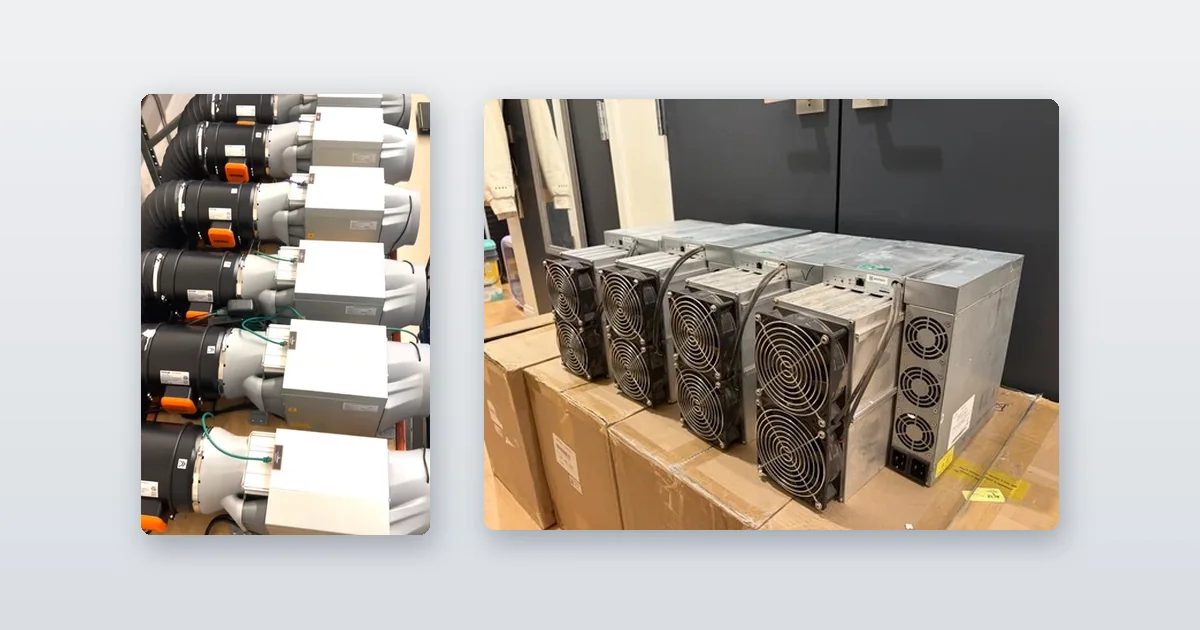
The machine is the same wherever you buy it. What changes between channels is everything around it: whether anyone powered it on before it shipped, whether a dead unit is your problem or theirs, whether parts exist a year from now, and who pays the freight when a pallet arrives short.
So sourcing is not a hunt for the lowest unit price. It is choosing which of those risks you are willing to hold. Here are the five channels used ASIC hardware actually comes through, what each one is genuinely good at, and what each one quietly hands you.
The five channels, and what each one hands you
| Channel | Good at | What you absorb |
| Manufacturer direct / preorder | New silicon, full warranty, current efficiency | Money out months before hardware in; price risk over the wait |
| Fleet liquidation (site exits) | Lowest cost per terahash, real volume | Mixed condition, unknown history, freight on a full pallet |
| Tested reseller | Powered-on before shipping, condition stated, parts supply | A margin over liquidation price — that margin is the testing |
| Open marketplaces | Single units, price discovery | Grading you cannot verify, freight surprises, weak recourse |
| Operator direct | Provenance you can actually ask about | No recourse at all, and payment risk on both sides |
Notice that none of these is wrong. A 500-unit buyer with an electrician, a bench and spare boards should be buying liquidation stock, because they can absorb condition risk more cheaply than anyone can sell it to them. A first-time buyer with one circuit should not, for exactly the same reason.
Manufacturer direct and preorder: paying now for hardware later
Buying a current-generation machine from the manufacturer, or on preorder against a future batch, gets you the best efficiency available and a real warranty. We list preorder stock ourselves — the S23 318T and S23 Hyd 580T are batch allocations rather than boxes on a shelf.
The honest cost is the gap between paying and receiving. Over a wait, difficulty rises, hashprice moves, and the machine you are buying at a fixed price is being valued by a market that has not stood still. That is a real position, not a technicality — and it is why we quote preorder rather than pretending it is stock. If you want the machine in the building this month, preorder is the wrong channel regardless of price.
Fleet liquidation: the cheapest terahash, and the most work
Most genuinely cheap used hardware comes from sites closing, upgrading or losing a power contract. It is sold as-is, by the pallet, and priced accordingly.
What you are absorbing is the part nobody itemises: some machines will not power on, some will hash below nameplate, some will have had boards swapped between them, and the firmware may be locked or tuned by whoever ran them last. On a large enough lot that is fine — it is arithmetic, and a dead unit is a spare-parts donor rather than a disaster. On ten machines it is not fine, because one dead unit is 10% of the purchase.
The break-even question comes first anyway. A used S19 at 34.2 J/TH needs power under about 3.8¢/kWh to earn anything at today’s hashprice, so a liquidation lot is only cheap if your power is genuinely cheap. That arithmetic, and the freight and palletising that go with a fleet purchase, is worked through in how to buy ASIC miners by the pallet.
Tested resellers: what the margin actually buys
This is what we do, so read the next paragraph with that in mind.
A tested reseller charges more per unit than a liquidator. What that difference pays for is specific and checkable: the machine was powered on and hashed before it shipped, the condition is written on the listing rather than implied, and there is somebody to call when it arrives dead. Our used S19 at $159.99 states its own hashrate, wattage, firmware tune and condition; our KS5 Pro says “tested” and means powered on.
The test of any reseller, including us, is whether the condition language is specific enough to be wrong. “Tested working” means something. “Excellent condition” means nothing, and a grade with no definition behind it is marketing — what the letter grades do and do not mean is set out in ASIC grading explained.
Open marketplaces: fine for one machine, hard for ten
Marketplaces are good at price discovery and bad at everything that matters on a fleet purchase. The listing photograph is usually of a machine, not necessarily the machine; the grade is whatever the seller decided it means; and freight on a 14.5 kg miner is frequently an afterthought that arrives as a surprise.
They are still a legitimate channel for a single unit if you insist on the same evidence you would demand anywhere else: the serial of the actual unit, a screenshot of that machine’s own status page rather than a stock photo, the condition in writing, and a payment method that can be reversed. The full vetting sequence — and how to ask for it without being fobbed off — is in how to vet an ASIC seller.
Parts availability is a sourcing decision, not an afterthought
The question that separates a good used purchase from a bad one is not what the machine costs. It is whether you can still buy a hashboard for it in a year.
This is the actual reason we keep buying S19s rather than more exotic bargains: the parts supply is wide open. A tested S19 hashboard is $59.99, a control board $59.99, a fan assembly $24.99, and there are 39 parts and test-gear listings in stock behind them. A machine from a manufacturer who has left the market can be a superb deal until the first board fails, at which point it is scrap with a good spec sheet.
Before you buy any used model in quantity, price its hashboard, its control board and its PSU. If you cannot find all three from anyone, that is the answer. Which parts to order and how to identify them is in the Antminer parts compatibility guide.
Sourcing a lot: what to put in the enquiry
Our fleet stock is quoted rather than priced on the shelf, because the per-unit number depends on quantity, condition mix, firmware and where it is going. That is true of every honest lot seller, and a published “bulk price” that never changes is usually a retail price with a discount sticker.
An enquiry that gets a straight answer contains four things: how many units, what your power price is, where it is shipping, and what you will do with a dead unit. The last one matters most and is the one people leave out — a buyer with a bench and a hashboard tester wants different stock, at a different price, from a buyer who needs every unit to work on arrival.
Lots we hold run from five machines up to three hundred, in tested and refurbished condition mixes, and every one of them is an enquiry rather than an add-to-cart. Single machines are on the used ASIC miner shelf, and the whole catalogue is at ASIC miner inventory.
The sequence, whichever channel you use
Sourcing goes wrong in the same order every time, so run it in this one:
- Power price first. It sets which machines are even eligible — see the seven variables that decide whether an ASIC makes money.
- Then efficiency, not price. The J/TH you buy is the electricity rate you can survive, permanently.
- Then parts supply for that specific model, priced, from a real listing.
- Then the seller — serial, status page, condition in writing, reversible payment.
- Then freight, agreed before money moves rather than after.
Whether used is the right call at all, against buying new, is argued with the failure and repair numbers in used versus new ASIC miners, and the full buyer’s walkthrough is how to buy a used ASIC miner without getting burned.
Frequently Asked Questions
Where does used ASIC mining hardware actually come from?
Mostly from sites closing, upgrading, or losing a power contract, which sells as-is by the pallet; from tested resellers who buy that stock, power it on and grade it; from open marketplaces for single units; and occasionally direct from another operator. Manufacturer direct and preorder is a separate channel for new hardware.
Is it cheaper to buy a liquidation lot than from a tested reseller?
Per unit, yes. The difference pays for testing, stated condition and someone to call when a machine arrives dead. That trade only favours the lot buyer if they can absorb condition risk cheaply – a bench, spare boards and enough units that a dead machine is a parts donor rather than 10% of the purchase.
What should I check before buying a used miner model in quantity?
Price its hashboard, control board and PSU from a real listing before you commit. A model whose parts you cannot source becomes scrap at the first board failure. For the Antminer S19 a tested hashboard is $59.99, a control board $59.99 and a fan assembly $24.99, which is why that model stays viable years after launch.
Why are bulk miner lots quoted instead of priced?
Because the per-unit number genuinely depends on quantity, condition mix, firmware and destination. A published bulk price that never moves is usually a retail price with a discount applied. Send quantity, your power price, the shipping destination and what you will do with a dead unit, and you get a real number back.
Is buying miners on a marketplace safe?
It is workable for a single unit if you demand the same evidence you would anywhere: the serial of the actual machine, a screenshot of that machine’s own status page rather than a stock photo, condition in writing, and a reversible payment method. For fleet quantities the weak recourse and unverifiable grading make it an expensive channel.
What is the risk with preorder mining hardware?
The gap between paying and receiving. Over the wait, difficulty and hashprice move while your purchase price is fixed, so you are holding a market position as well as buying a machine. If you need hardware running this month, preorder is the wrong channel whatever the price looks like.
More on sourcing hardware
- What Actually Moves Mining Margin: Five Levers, With the Arithmetic
- Why Your Miner Is Earning Less: Diagnosing ASIC Faults
- Mining 101: A Beginner’s Guide to Cryptocurrency Mining
- Antminer S19 miners for sale
Fleet lots, quoted by enquiry
The lot sizes we hold, each quoted rather than priced on the shelf:
- Lot of 5 Refurbished Bitmain Antminer S19 95TH/s Miners – Braiins OS
- Lot of 40 Used Bitmain Antminer S19 95TH/s Miners
- Lot of 300 Used Bitmain Antminer S19 95TH/s Miners – Tested and Working
More in Used ASIC miners, or the full ASIC miner inventory.