
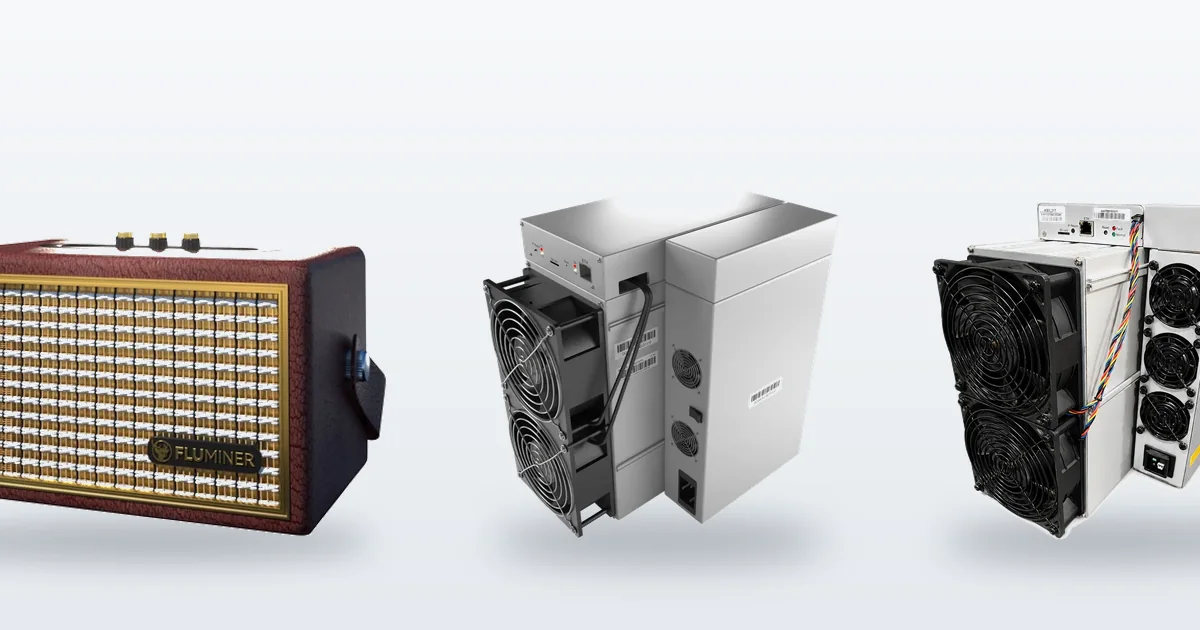
Every altcoin ASIC is a bet on two things at once: that the hardware works, and that the coin still has a market when you plug it in. Bitcoin miners only carry the first risk. That is the whole difference, and it is why non-Bitcoin mining hardware needs a different buying rule — buy the machine whose coin has the longest boring track record, not the one with the best current payout screenshot. Below is the cryptocurrency mining hardware worth considering outside SHA-256, what each one actually mines, and the specific way each can go wrong.
We buy, repair, host and resell this hardware. This page ranks machines, not shops, and links only to our own stock.
The rule that governs all non-Bitcoin mining hardware
For Bitcoin the arithmetic is settled: break-even electricity rate = hashprice ÷ (24 × J/TH), the network is enormous, and hashprice moves slowly enough to plan against. We work that through in the ASIC miner buying guide.
Altcoin ASICs break that model in three specific ways, and all three are about the coin rather than the hardware:
- The network is small, so your own purchase moves it. When a batch of new machines ships, difficulty on a small chain can step up sharply. The payout you calculated in the shopping cart is not the payout you get in month two.
- Liquidity is thin. Mining a coin is easy; selling meaningful quantities of it without moving the price is not. Check the actual daily traded volume before you check the mining calculator.
- The hardware is worthless if the algorithm changes or the coin dies. A SHA-256 machine will always mine Bitcoin. A single-algorithm altcoin ASIC has no fallback. There is no resale market for a machine whose only chain has stopped.
So the practical rule: weight the coin’s age and boringness far above the machine’s headline numbers. A five-year track record beats a 40% better payout estimate every time, because the estimate is a forecast and the track record is evidence.
Scrypt: Litecoin and Dogecoin, the one altcoin case with a long record
Litecoin and Dogecoin are merged-mined — the same Scrypt work earns both simultaneously, at no extra power. Both chains have existed for over a decade with continuous ASIC support and functioning markets. If you are going to own one non-Bitcoin machine, this is the least speculative category available.
We stock two bins of the same machine:
- Antminer L9 16G — 16 GH/s at 3,360 W
- Antminer L9 17G — 17 GH/s at 3,570 W
Both land at roughly 0.21 J/MH, so they are the same efficiency and the same silicon — they are hashrate bins, not different products. Buy whichever is cheaper per GH/s on the day, not the higher number. The 17G is not a better machine; it is a slightly better-binned one that also draws more power, and if it is priced at more than a 6% premium over the 16G it is the worse purchase.
The previous generation, the Antminer L7 at 9.05 GH/s and 3,260 W (~0.36 J/MH), is roughly 70% less efficient. It only makes sense at power prices that are cheap even by mining standards. The whole range sits in Scrypt miners for LTC, DOGE and BEL.
kHeavyHash: Kaspa
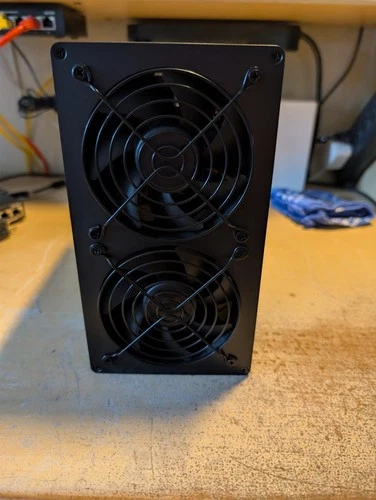
The Antminer KS5 Pro at 21 TH/s mines Kaspa, which has real exchange listings and a working ecosystem — a materially better position than most single-coin ASICs are in. It is a tested used unit; ask us for the measured wall draw rather than working from a datasheet, because on a used machine the tune matters more than the badge.
The honest risk statement: Kaspa is a young chain relative to Litecoin, and KS-series hardware supply has been expanding. Model your return with difficulty rising, not flat. If the machine only works at today’s difficulty, it does not work.
Aleo and the very new chains
The IceRiver AE3 is a 2 GH/s, 3,400 W, 100–240 V machine for Aleo. The Pinecone INI Box 850M is a much smaller 480 W, 220 V machine for InitVerse.
Both are early-chain hardware, and we will say the quiet part: this is the highest-risk category on the site. The upside case is that you are early on a chain that works out. The downside case is not “lower returns” — it is a machine with no chain to mine and no resale market, in a market where hardware for new chains depreciates faster than almost any other asset you can buy. Our own listing title for the AE3 called it a “Top 10 Most Profitable Miner” until 10 August 2026 — a marketplace phrase we inherited with the listing, which depended entirely on the day it was written. We took it out of the title rather than leave a profitability claim on a $7,999.99 machine, and you should not buy any single-chain ASIC on the strength of a phrase like it.
Buy in this category with money you can lose, not with money you are relying on. Everything in it is under XTM, ALEO, KAS, DASH and CKB miners.
What we would not recommend, and why
- Buying an altcoin ASIC on a profitability calculator screenshot. Those figures assume today’s difficulty and today’s coin price, and both move fastest on exactly the small chains where the machines are sold this way. Ask for J/MH or J/TH and the measured wall draw, then model the coin conservatively.
- Buying an altcoin ASIC before you can sell the coin. Check the exchange listings and the real daily volume for the coin you intend to mine before you buy hardware for it. Mining something you cannot convert is a hobby with a power bill.
- Treating an altcoin machine as a hedge on Bitcoin. It is not a hedge; it is a second, more concentrated bet. If what you want is exposure to mining with the least chain risk, the answer is SHA-256 hardware — ranked by break-even rate in best ASIC miners 2026.
The parts question nobody asks until it is urgent
Bitcoin ASICs have an enormous third-party repair economy: hashboards, control boards, chips, test fixtures, PSUs. Altcoin machines mostly do not, and the smaller the chain the thinner the supply. That is a real ownership cost, and it is why our parts and test-fixture stock is overwhelmingly Antminer-shaped — it follows the installed base.
Before buying any altcoin ASIC, ask what happens when a hashboard fails. If the honest answer is “you buy another machine”, that is the true cost of the machine and it belongs in your model.
Everything we stock is in the full miner inventory. If you tell us which coin you are actually trying to mine and what you pay for power, we will tell you whether the hardware makes sense — including when it does not.
Frequently Asked Questions
What is the best cryptocurrency mining hardware that is not for Bitcoin?
The Antminer L9, at 16 or 17 GH/s and roughly 0.21 J/MH, because it merge-mines Litecoin and Dogecoin — two chains with over a decade of continuous operation, real markets and ongoing ASIC support. Every other altcoin ASIC carries more chain risk. Choose between the L9 16G and 17G on price per GH/s, since they share the same efficiency and are simply different hashrate bins of one machine. Our 16G vs 17G comparison works that through, including the breaker limit that settles it more often than the price does.
Is altcoin mining more profitable than Bitcoin mining?
Sometimes on paper and rarely in practice, because the calculation is far less stable. Small networks reprice sharply when new hardware ships, so difficulty can rise steeply within weeks of your machine arriving, and thin exchange liquidity means selling what you mine can move the price against you. Bitcoin’s arithmetic is dull and predictable; altcoin arithmetic has a wider distribution in both directions.
What happens to an altcoin ASIC if the coin fails?
It becomes scrap. A single-algorithm ASIC has no fallback chain and effectively no resale market once its coin stops trading. A SHA-256 machine can always mine Bitcoin, which puts a floor under its value. This asymmetry, not efficiency, is the main reason to weight a coin’s track record above its current payout when buying non-Bitcoin hardware.
What is merged mining and why does it matter for Litecoin and Dogecoin?
Merged mining lets the same Scrypt work secure two chains simultaneously, so an Antminer L9 earns both Litecoin and Dogecoin from one unit of electricity. It matters because it effectively doubles the revenue sources for a single power cost, and because it ties two long-established chains together — making Scrypt the least speculative non-Bitcoin category available.
Should I buy an Antminer L9 16G or 17G?
Whichever is cheaper per GH/s on the day you buy. Both run at roughly 0.21 J/MH, so they are the same silicon at different hashrate bins: 16 GH/s at 3,360 W versus 17 GH/s at 3,570 W. The 17G is not more efficient, just better binned and higher-draw, so a premium above about 6% over the 16G makes it the worse purchase.
Are Kaspa and Aleo miners worth buying in 2026?
They carry materially more risk than Scrypt or SHA-256 hardware. Kaspa has real exchange listings and a working ecosystem but is a young chain with expanding hardware supply, so model it with difficulty rising rather than flat. Aleo and InitVerse hardware is early-chain equipment where the downside is not lower returns but a machine with nothing to mine. Buy in this category only with money you can afford to lose.
Can altcoin ASICs be repaired?
Far less easily than Bitcoin ASICs. Antminer hashboards, control boards, chips and test fixtures have a deep third-party supply chain that follows the enormous installed base; altcoin machines generally do not, and the smaller the chain the thinner it gets. Before buying, ask what happens when a hashboard fails — if the answer is that you replace the whole machine, that is part of the machine’s real cost.
Update: this page deliberately declined to publish earnings figures for the KS5 Pro, because no verified wall-power figure was available when it was written. There is one now, so the arithmetic has been done: Kaspa miner vs Litecoin miner works both the Scrypt and the kHeavyHash cases from live difficulty and coin prices, and lands on a break-even of about 9.2 ¢/kWh for the Antminer L9 against 5.3 ¢ for the KS5 Pro.