
Receiving a used miner lot: the day forty miners arrive
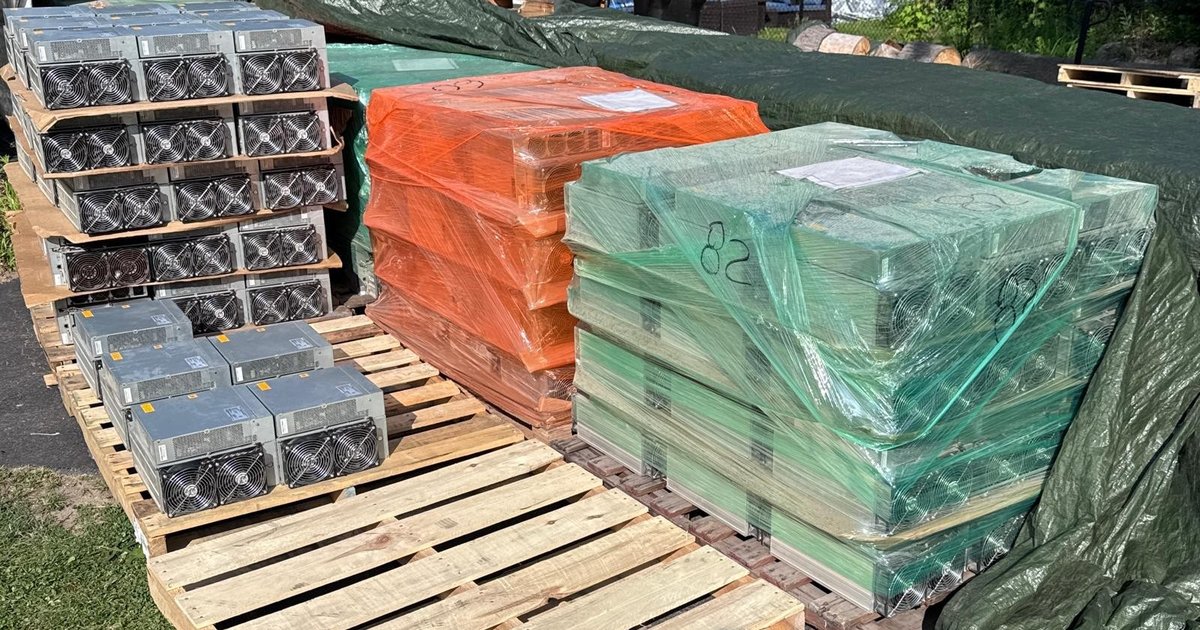
A pallet of used miners has been delivered and the driver is waiting for a signature. For one machine the answer is already written down: photograph the box, keep the packaging, and run the acceptance test — that is the three-line list on shipping and delivery and the full bench procedure in acceptance-testing a miner you just received. Receiving a used miner lot is a different job, and four things break at scale: you are signing a freight receipt rather than taking a parcel, you have a count and a serial list to reconcile, you cannot close one breaker on forty machines, and you have forty IP addresses to find that all arrived asking for DHCP at once. If the size of the delivery is still an open question, settle how many machines a first order should be before any of this page applies.
This page is the lot-scale version, in the order the day actually happens. It does not repeat the per-machine test procedure, the circuit design, or the grading policy — those live at the first-48-hours bench procedure, ASIC miner power requirements and bulk used ASIC miners, and each is named where it belongs below.
Before the truck arrives: what has to already exist
Everything on this list has to be finished before delivery day, because none of it can be done with machines on the floor and a claim window running. The circuits, sized and inspected — every S19 in the lots below is a 200–277 V AC machine and no adapter makes it a 110 V one, which is its own page. Somewhere to put the heat, because a lot rejects effectively all the power it draws and that is a ventilation problem, not a fan problem (cooling). A network with a DHCP range you control. A pallet jack, or a plan for the weight in the last column. And a bench — a table, power, a network drop — for the machines that do not come up, because on a used lot there will be some.
Used Antminer S19 lots listed at ING Mining, read from the listings on 14 August 2026. Figures without a dagger are printed on that listing itself.
| Units | Machine | Condition, as the listing states it | Connected load | Hardware weight, boxed (gross) |
|---|---|---|---|---|
| 5 | Antminer S19 95TH/s | Refurbished, Braiins OS | 5 × 3,250 W = 16.3 kW † | 5 × 16 kg gross = 80 kg † |
| 5 | Antminer S19 110TH/s, boosted | Refurbished, Braiins OS | 5 × 3,250 W = 16.3 kW at the factory rating — boosted, so size above it † | 5 × 16 kg gross = 80 kg † |
| 10 | Antminer S19 95TH/s | Refurbished, Braiins OS | 32.5 kW stock, at least 35.9 kW tuned | about 160 kg gross |
| 10 | Antminer S19 110TH/s, boosted | Refurbished, Braiins OS | at least 37.6 kW | about 160 kg gross |
| 10 | Antminer S19k Pro 115TH/s | Used, tested working, Braiins OS, PSUs included | about 26.5 kW | not published on the listing — ask |
| 20 | Antminer S19 110TH/s, boosted | Refurbished, VNish OS | 20 × 3,250 W = 65 kW at the factory rating — boosted, so size above it † | 20 × 16 kg gross = 320 kg † |
| 40 | Antminer S19 95TH/s | Used — no grade stated, ask | about 130 kW | about 640 kg gross |
| 50 | Antminer S19 95TH/s | Refurbished, VNish OS | about 163 kW | about 800 kg gross |
| 100 | Antminer S19 95TH/s | Refurbished, Braiins OS | 325 kW | about 1,600 kg gross |
| 100 | Antminer S19 110TH/s, boosted | Refurbished, Braiins OS | at least 376.3 kW | about 1,600 kg gross |
| 300 | Antminer S19 95TH/s | Used, tested and working | about 975 kW | about 4.8 tonnes gross |
† the listing does not print a lot-level figure, so this cell is that listing’s own per-unit number multiplied by the count, with the arithmetic shown. Every lot is quoted rather than sold through the cart, so the price, the freight and the delivery window come back together on the bulk used miners page.
Two numbers on that table are worth reading before you agree a delivery date rather than after. The connected load is what your electrician needs, and on every boosted 110 TH/s lot it is higher than Bitmain’s published figure, because those machines reach 110 TH/s on firmware from a base S19 — an install specified from 3,250 W a machine comes up short across the lot. The weight is what decides whether this is a liftgate delivery or a dock: 640 kg of hardware is not a two-person unload, and 4.8 tonnes is several pallets and a forklift. If you have neither, say so before the freight is booked, not when the truck is outside.
Signing for it: the ninety seconds that decide who pays for a broken pallet
This is the part with a clock on it, and it is over before most buyers realise it started. The driver wants a signature on a delivery receipt. That signature is the carrier’s evidence that the freight arrived in the condition described — and a clean one, with no exceptions written on it, makes a later damage claim dramatically harder to win.
- Count the pieces against the receipt before you sign. Pallets, not machines — the machine count comes later. A shortage noted at delivery is a different conversation from a shortage discovered on Tuesday.
- Write specific exceptions, not “subject to inspection”. “Pallet 2 leaning, outer wrap torn, three chassis fan grilles crushed” is a claim. “Subject to inspection” is routinely treated as no exception at all.
- Photograph the pallet before you cut the wrap. This is already the store’s advice on shipping and delivery and it is the single highest-value ninety seconds of the day: a freight damage claim without a photograph of the packaging as delivered is a much weaker claim.
- Keep the packaging until every machine in the lot has run a clean 48 hours.
Damage that only appears once the wrap is off is concealed damage, and it has its own deadline. Most carrier rules tariffs require written notice within about five business days of discovery, which is a notification requirement rather than the claim itself; cargo claims against a US motor carrier are separately filed within nine months of delivery under the Carmack Amendment. Read the tariff named on your bill of lading — those windows are the carrier’s, not ours, and they vary. Then tell us the same day on +1 (781) 577-0377, while the claim window is still open. A fault found on day two is a conversation; a fault found in week three is an argument.
Count it, then reconcile the serial numbers
A lot of forty is forty serial numbers, and they are the only thing that ties a specific chassis to what was quoted, to a warranty claim, and later to which unit it was that failed. Photograph the label on each machine as it comes off the pallet. It takes about a minute per ten machines and it is the record you will want in eight weeks when one board dies and nobody can remember which position it was in.
Number the machines physically while you are doing it — a paint pen or a label with the rack position, and later the last octet of its IP address. From that point every conversation about the lot, internally or with us, is about machine 17 rather than about “one of the S19s”. If you want the serials before the lot ships rather than after, ask for them in writing when you request the quote; that is a normal request on a used batch and it is answerable.
Check the count against what you actually bought, too. Two of the lots above are quoted with power supplies stated and most used stock can move bare — can I get PSUs with the lot is a five-figure question across a hundred machines and is answered on the bulk page, in writing, per lot.
Count the power supplies as their own line while you are at it, because the listing may never have committed to them: on this store’s own shelf, counted on 14 August 2026, only 7 of our own 19 used listings say whether power supplies are included. On a forty-machine lot that is a four-figure question, and it belongs in writing before the truck is booked rather than on the receiving dock.
Powering up multiple ASIC miners: do not close one breaker on forty
Here is the failure this page exists for, because nothing else on this site says it and the machines themselves give you no warning. A switch-mode power supply draws a large, brief current at the instant it is switched on, while its input capacitors charge. It is over in a fraction of a second and it is much larger than the machine’s running current. One miner: unremarkable. Forty supplies closing onto the same feeder at the same moment present that transient all at once, and an upstream breaker can trip on an inrush that the steady-state load would never have troubled.
The practice is the obvious one: bring the lot up in groups, let each group reach steady state and settle before adding the next, and watch the panel while you do it. It costs you an hour on delivery day and it removes an entire class of problem — including the one where a tripped main takes down the group that was running and you learn nothing about which machine caused it.
What we will not do is give you a group size, an inrush multiple or a breaker curve. Those depend on your service, your feeder, the breaker’s trip characteristic and the supplies in front of you, and they are the call of the electrician who sized the panel. What we can tell you is the steady-state number to give them, which is the connected load in the table above, and the continuous-load derating rule that applies to it — that is worked through on ASIC miner power requirements, which is also where the “how many miners will my panel take” arithmetic lives.
Finding the IP address of every miner in the lot
Antminers come up asking for DHCP. For one machine the IP Reporter button on the chassis is the fastest route and the whole walkthrough is at how to set up a Bitmain Antminer. Forty is a different job, and the answer is to stop hunting machines and start reading the network.
- Give the lot a DHCP range of its own before anything is plugged in, so the leases you are about to see cannot be confused with anything else on the site.
- Read the lease table as each group powers up, not once at the end. This is the second reason to stagger: four new leases you can walk to beats forty that all appeared together.
- Write the last octet on the machine next to the number you already painted on it. That is the map between the thing on the shelf and the thing in the dashboard, and without it you will be pulling network cables to find out which box is which.
- Keep them off the open internet. Changing the default password is a step on the single-machine walkthrough for a reason, and forty machines is forty of the same default.
If the switch is the missing piece, we keep a 24-port managed gigabit switch on the parts shelf; twenty-four ports is one lot of twenty with room, and two of them covers a forty.
Check the firmware before you check the hashrate
A used miner arrives on whatever the previous owner left on it. Our lot listings name it — Braiins OS or VNish, installed — and on any used purchase from anyone that is a question to get answered in writing before the money moves, not discovered on the bench. Three things to establish on the first machine out of each group, before you look at the hashrate at all:
- Which firmware it is running, and whether that matches what you bought. Tuned firmware changes what the machine draws at the wall, which is why the boosted lots in the table above carry a higher connected load than Bitmain’s sheet.
- What pool it points at when it boots. A used machine should come up pointed at your pool and nobody else’s.
- What it costs you. Most third-party firmware takes a developer fee off the top and no spec sheet mentions it — the arithmetic is on how to buy a used ASIC miner and on the used miner shelf.
If you want a machine back on stock firmware, that is a card and a reflash rather than a repair — we stock the Braiins OS+ microSD card for the S19 and S21 families. What we will not tell you is that a reflash fixes a bad board; the parts guide covers which faults are firmware and which are silicon.
The first clean 48 hours, run in groups
The per-machine procedure is written and this page will not re-derive it: physical inspection, PSU check, network and firmware, hashrate against the listing, temperatures, then an extended load run (the full first-48-hours procedure). What changes on a lot is that you cannot bench forty machines, so the burn-in runs in the same groups you energised in, and the output you want at the end is not a pass or a fail — it is three piles.
- Hashing to the listed rate and stable. Leave them alone. Record the serial and the position and move on.
- Hashing, but low, hot or dropping a board. These are the ones worth bench time; they are usually a fan, a paste refresh or one hashboard, and why mining hardware fails is the triage order.
- Not hashing at all. This is the pile with a clock on it. Photograph it, note the serial, and tell us the same day — the freight claim window and any DOA allowance on your order both run from delivery, not from when you got round to it.
Keep the packaging until every machine has run its clean 48 hours, and do not stack the empty pallets outside in the rain in the meantime. If a claim goes in, the packaging is evidence.
What to have on the shelf before the pallet lands
We will not hand you a spares ratio, because we do not publish a failure rate we have not measured and an invented one would be worth less to you than this: on used S19-class hardware the things that fail are power supplies, fans and hashboards, roughly in that order of nuisance, and a lot arriving with none of them on site means the first fault costs you a week rather than an afternoon. Budget for a float and a bench rather than for a zero.
- K8 ASIC multifunctional tester or the universal hashboard tester — so “this one does not work” becomes “board 2 is dead and the other two are fine”.
- APW12 PSU tester — the S19 lots above all run integrated APW12 supplies.
- A tested S19 Pro hashboard, a control board and PSU cables — the parts that turn one dead machine into one afternoon.
- The rest of the shelf is at miner parts, and the machines we sell knowing they need work are at need parts.
What we do, and what is yours
We palletise, wrap, count and book the freight, and we would rather organise crating on a lot that warrants it than have a first pallet turn up shrink-wrapped to a broken skid. Freight rates for single machines and the smaller lots are published on shipping and delivery; pallet quantities are quoted with the freight and a delivery window rather than sold through the cart, which is why every row in the table above goes to a quote.
What we need in order to quote is four things: the model, the quantity, where it is going and roughly when you need it. Everything else can be unknown — most enquiries arrive that way. What comes back is a price, the condition of the specific machines, the freight and a delivery window, in writing, from somebody who has had these machines apart. Start at bulk used ASIC miners, or call +1 (781) 577-0377.
Two things that are yours and cannot be ours: the electrical design, which belongs to a licensed electrician working from the connected load above, and the receiving process on your dock. We can tell you what is in the crate and what it draws. We cannot sign the delivery receipt for you, and that signature is the one that decides who pays if the pallet arrives on its side.
Questions people ask after a lot lands
Can I power up a whole lot of ASIC miners at once?
No, and this is the single most common way a first pallet goes wrong. A switch-mode power supply draws a large, brief current at the instant it is switched on while its input capacitors charge, and that transient is much larger than the machine’s running current. One miner is unremarkable. Forty supplies closing together present that transient to the same feeder at the same moment, and an upstream breaker can open on an inrush the running load would never have troubled. Bring the lot up in groups, let each group settle at steady state before you add the next, and have the electrician who sized the panel tell you the group size and the breaker curve — that is their call, not a number any seller should hand you.
What should I do if a pallet of miners arrives damaged?
Write it on the delivery receipt before you sign, and be specific: “pallet 2 leaning, outer wrap torn, three chassis fan grilles crushed” beats “subject to inspection”, which carriers routinely treat as no exception at all. Photograph the pallet before you cut the wrap and keep the packaging. A clean signature makes a later claim dramatically harder to win. If the damage only shows up once the wrap is off, most carrier rules tariffs require written notice of concealed damage within about five business days of discovery — read the tariff named on your bill of lading, because it is the carrier’s tariff and not a universal rule. Then call us the same day on +1 (781) 577-0377.
How do I find the IP addresses of a whole lot of Antminers?
Antminers come up asking for DHCP, so the fastest route on a lot is to give them a DHCP range of their own and read the lease table on the router or switch as each group powers up. Scanning the subnet works too, but the lease table tells you the MAC as well, which is what lets you tie an address to a physical machine. Do it group by group as you energise, not in one pass at the end — forty unknown leases that all appeared at once is a much worse problem than four leases you can walk to. For a single machine the IP Reporter button on the chassis is quicker.
What firmware do used Antminer S19s arrive on?
Whatever the previous owner left on them, unless the seller says otherwise. Our lot listings state it — Braiins OS or VNish, installed and named on the listing — and that is a question worth asking of any used seller in writing before the money moves. Check it before you check the hashrate, because tuned firmware changes what the machine draws at the wall and most third-party firmware takes a developer fee off the top that no spec sheet mentions. Also check what pool the machine points at when it boots: a used miner should be pointed at your pool and nobody else’s.
How many spare parts should I keep for a lot of used miners?
We will not give you a ratio, because we do not publish a failure rate we have not measured and a made-up number would be worth less to you than the honest answer. What we can say is what fails: power supplies, fans and hashboards, roughly in that order of nuisance. Budget for a spares float and a bench rather than for a zero, and settle the DOA allowance for your specific lot in writing before the order goes in.
Do you publish a DOA rate on used miner lots?
No. We have not measured one we would defend in writing, so we do not quote one. What we will do is agree the DOA window and the replacement policy for your lot in writing before the order goes in, which is worth more than a percentage on a web page — at a hundred units the difference between a five-unit and a fifteen-unit allowance is real money, and it is a ten-minute conversation before the invoice and a dispute after it.
More on buying and running used machines at scale: bulk used ASIC miners · how to buy ASIC miners by the pallet · the mining hardware shipping guide · power requirements · compare ASIC miners · support: what we test and what to do when something is wrong · every machine we stock.