
Used ASIC miner fleet economics: buy the megawatt, not the machine
A fleet is not a quantity of machines. It is a quantity of power you have already paid for, and the only question the hardware answers is how much hashrate comes out of it. Size the buy against your service and your power price and the used-versus-new argument stops being a matter of taste. It becomes a division you can do in a minute, and it lands differently depending on which of the two things you are actually short of: capital, or megawatts.
This page prices a used ASIC miner fleet per megawatt rather than per machine, on our own inventory, at the specs our own listings publish – and it is unflattering about some of it. If you want the shelf, the grade definitions and the quote form instead, they are on the bulk used miner page.
The numbers this page runs on, and the day they were read
All of them move. These were derived at block 961,911 on 10 August 2026 rather than copied off a dashboard: network hashrate about 908 EH/s, difficulty 127.48 T, BTC at $63,999, a block subsidy of 3.125 BTC, and transaction fees running at 0.65% of that subsidy across the last 144 blocks. Multiply it out and the hashprice is $31.91 per PH/s per day, or $0.0319 per TH/s per day, which is what every revenue line below is multiplied by. Re-derive it against your own rate on the day you buy – the method is in our used-miner buying guide. Re-read from the chain at block 962,378 on 14 August 2026, the day this page was published, the hashprice was $32.01 per PH/s per day – 0.3% above the figure every line below runs on. That moves each payback by well under a day and each break-even by less than a hundredth of a cent, so the figures are left as derived rather than nudged, and the point stands: they are a snapshot, not a specification.
Two warnings before you use any of it. First, everything below is gross mined: no pool fee, no firmware developer fee, no freight, no power supplies, no spares, no racking labour, no downtime and no tax. Those are real and they are yours. Second, a payback figure longer than about 612 days crosses the next halving at block 1,050,000, which cuts the subsidy in half – so read a long payback as a number that gets worse on a date already in the calendar, not as one that merely takes a while. The per-machine version of this arithmetic, with the developer fee applied, is in our S19 against S19k Pro comparison, which was written the same week at a different BTC price and therefore lands a few hundredths of a cent away from this page. That gap is not an error in either of them. It is the shelf life of the whole exercise.
Buy the megawatt, not the machine
One megawatt of connected load, filled five ways, at the hashrate and wall draw each listing on this store publishes for the machine in question. The used prices are the per-unit figures those lots were listed at up to 11 August 2026, the day this store’s whole bulk shelf moved to quote-only: $100.00 a machine on the 100-unit 95 TH/s lot at $9,999.99, $150.00 on the 20-unit boosted lot at $3,000.00, and $400.00 on the 10-unit S19k Pro lot at $3,999.99. Not one of the eleven lots carries a listed price today; every one of them routes to a quote instead. Read the used capital column below as the shape of the decision rather than as a number you can accept — yours comes back on the quote, and if it comes back higher the argument moves with it. The new prices are live listed prices, re-checked 14 August 2026: the S21 Pro 245T and the SealMiner A2 Pro Air 255T.
| Fill 1 MW with | Machines | Fleet hashrate | Fleet J/TH | Capital | Capital per PH/s | Mined per day |
|---|---|---|---|---|---|---|
| Used Antminer S19, 95 TH/s | 307 | 29.16 PH/s | 34.2 | $30,700 | $1,053 | $931 |
| Used Antminer S19 boosted to 110 TH/s | 265 | 29.15 PH/s | 34.2 | $39,750 | $1,364 | $930 |
| Used Antminer S19k Pro, 115 TH/s | 378 | 43.47 PH/s | 23.0 | $151,200 | $3,478 | $1,387 |
| New Antminer S21 Pro 245T | 272 | 66.64 PH/s | 15.0 | $1,142,400 | $17,143 | $2,126 |
| New SealMiner A2 Pro Air 255T | 263 | 67.06 PH/s | 14.9 | $1,104,600 | $16,471 | $2,140 |
Read the last two columns together, because that is the whole decision. The same megawatt produces 29.16 PH/s or 67.06 PH/s depending on what you put in it – a factor of about 2.3 on an identical electricity bill – and it costs $30,700 or $1,104,600 to buy, a factor of about 36. Used hardware is not cheaper hashrate. It is far cheaper capital per unit of hashrate, bought at the price of much worse efficiency, and whether that trade is a good one depends entirely on what your power costs.
The practical consequence is the one most first-time fleet buyers get backwards. If power is what you are short of – a fixed service, a fixed hosting allocation, a landlord who will not give you another transformer – then efficiency is the only thing that raises your revenue, and a used S19 is the wrong buy at almost any price. If capital is what you are short of and you have cheap power going spare, the used machine returns its money several times faster and you should not be looking at new silicon at all. Most people buying their first fleet have the second problem and shop as though they had the first.
Why boosting a used S19 to 110 TH/s buys you nothing at fixed power
Look at the first two rows of that table again. A megawatt of stock 95 TH/s S19s and a megawatt of the same machines boosted to 110 TH/s produce 29.16 PH/s and 29.15 PH/s. That is the same number, and it is not our arithmetic being lazy.
A firmware boost cannot add hashboards. Reaching 110 TH/s on a base S19 means driving the same 228 chips harder, which takes 3,250 W multiplied by 110 over 95 – about 3,763 W – so you fit fewer machines into the same service by exactly the proportion each one hashes faster. The terahashes cancel. And 3,763 W is a floor, not a figure: power climbs faster than hashrate on the voltage-frequency curve of every ASIC ever built, so the real boosted fleet comes out slightly behind the stock one rather than level with it. Nobody has published a metered draw for these units at 110 TH/s, including us; ask before you order and we will put a clamp on one and send you the reading.
Which leaves capital as the only column still in play, and it does not favour the boost either. Filling a megawatt from the boosted lot costs $39,750 against $30,700 from the stock one – about $9,050 more for the same hashrate on the same power bill. We list both lots and we would rather say this than let the larger number in the title do the arguing.
When the boost is worth paying for: when machine slots are your constraint rather than watts. Racks, floor space, network drops, a hosting contract billed per unit instead of per kilowatt – in every one of those cases 110 TH/s in one box beats 95 and you should buy it. That case is real and it is not the common one. Note also that a boosted base S19 is not the same machine as a factory S19 Pro, which reaches 110 TH/s with 114 chips per board rather than 76 and does it without the voltage – the S19 trap covers why two machines advertised at the same hashrate are not the same purchase.
A megawatt is one way to have your hand forced; a fixed cheque is the other, and it gives a different answer. One new S21 Pro against nine used S19k Pros spends $4,200 both ways rather than a megawatt both ways — freight turns eleven used machines into nine, and the window where the new machine wins on money turns out to be 0.55 cents per kilowatt-hour wide.
Total fleet J/TH decides everything, and it is on no listing
Break-even electricity price is hashprice divided by twenty-four hours of the machine’s own draw, which means efficiency is the only spec that decides whether a fleet survives – hashrate cancels out of the division entirely. At $31.91 per PH/s per day the fleets above break even at 3.89, 5.78, 8.86 and 8.94 cents per kilowatt-hour respectively. Whatever you pay above your own fleet’s number is money you are converting into heat for nothing.
The catch is that a real fleet does not have one J/TH. It has a blended one, and you compute it the same way every time: total watts at the wall divided by total terahash at the pool. Not the average of the listings. Three things move it away from the spec sheet and all three move it the same way:
- Mixed fleets blend by terahash, and averaging the listings gets it wrong in the direction that flatters you. Put 100 of the 95 TH/s machines beside 20 S19k Pros and the average of the two efficiency figures says 28.6 J/TH. The fleet is actually 32.0 – 377.9 kW producing 11,800 TH/s – because the inefficient machines are also most of your hashrate. That is the difference between a break-even rate of 4.65 cents and one of 4.15 cents, which is the difference between signing a power contract and not.
- A machine with a dead hashboard is the worst unit you own. An S19 has three boards. Lose one and it still boots, still appears on the dashboard and hashes at roughly two thirds – but its power does not fall by a third, because the fans, the control board and the supply overhead do not care how many boards are working. We are not going to publish a watt figure for that state that we have not metered on your machines, but the direction is certain: every partially dead unit drags the blended number while looking healthy on a hashrate report. Meter it, or pull it.
- Age, dust and ambient all cost watts. A rated figure assumes a healthy machine at a specified ambient temperature. A six-year-old machine in a warm room draws more, and the number that lands on your electricity bill is the one at your wall.
So the acceptance question on a fleet is not does it hash. It is what is the clamp reading and what is the pool reading, on the same machines at the same time. Those two give you the only J/TH that will ever appear on a bill. The bench procedure a machine goes through here before it gets a grade is published at how we test mining hardware, and the five measurements it records are exactly the ones this paragraph is asking you to repeat on arrival.
When used beats new on payback, and when it does not
The same five fleets, the same megawatt, at three electricity prices. Payback here is capital divided by what the fleet clears in a day after power and nothing else – before every cost listed at the top of this page, and at one day’s hashprice, which changes daily and falls as difficulty rises.
| Fill 1 MW with | Break-even power price | Payback at 3¢ | Payback at 5¢ | Payback at 7¢ |
|---|---|---|---|---|
| Used Antminer S19, 95 TH/s | 3.89¢/kWh | 145 days | never | never |
| Used Antminer S19 boosted to 110 TH/s | 3.89¢/kWh | 187 days | never | never |
| Used Antminer S19k Pro, 115 TH/s | 5.78¢/kWh | 227 days | 808 days | never |
| New Antminer S21 Pro 245T | 8.86¢/kWh | 812 days | 1,233 days | 2,556 days |
| New SealMiner A2 Pro Air 255T | 8.94¢/kWh | 777 days | 1,171 days | 2,374 days |
Three readings, and together they are the argument in full:
- Below about four cents, used S19s win and it is not close. At three cents the stock 95 TH/s fleet returns its $30,700 in 145 days, while the SealMiner fleet takes 777 days to return $1,104,600. One of those is inside the current halving epoch and the other is not, which is a difference in kind rather than degree.
- Above your fleet’s break-even rate the payback column stops existing. There is no slow payback on a machine that loses money every hour – it is negative, and no purchase price fixes it. That is why a used S19 fleet is a behind-the-meter, curtailed-power or flare-gas machine, and not a hosting machine.
- New silicon wins on revenue per megawatt at every rate either machine survives. At five cents the SealMiner fleet clears $944 a day out of that megawatt and the S19 fleet clears nothing at all. If you are buying cash flow out of a fixed service rather than terahash out of a fixed budget, buy the efficiency and stop reading price tags.
The middle of that range is where the S19k Pro sits, and it is the one used lot on our shelf that answers it. At 23.0 J/TH it breaks even near 5.78 cents rather than 3.89, which in practice is the difference between a machine that only works behind your own meter and one that survives a real hosting contract – and a megawatt of them costs $151,200 rather than $1,104,600. If your power sits between those two break-even numbers, it is the only used machine here that works, and we would rather point you at it than at the cheaper row.
What actually arrives, and why your bench is the bottleneck
What a lot from us commits us to – what tested means, what refurbished means, what was actually replaced, and which listings carry no warranty term at all – is defined once and used the same way on every listing, on the bulk page. Why letter grades are worth nothing without the method behind them is written up separately, and what a warranty on this class of hardware does and does not cover is in the warranty fine print. This section is only the part that changes at fleet scale, and it is the part that costs people money.
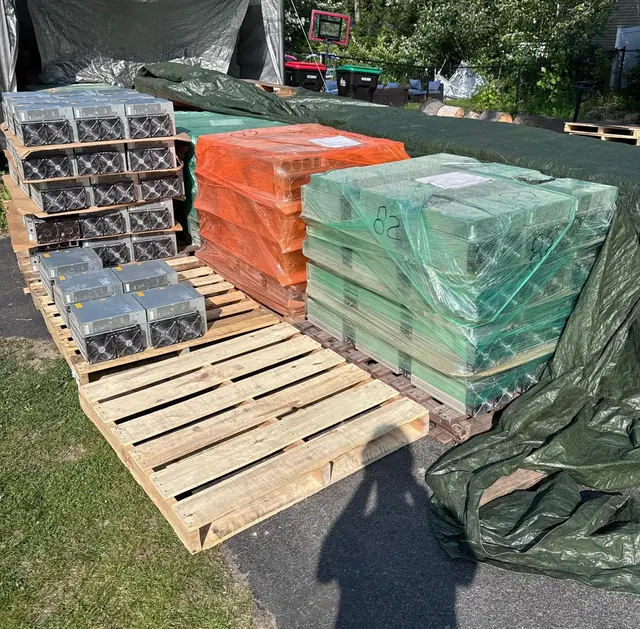
You cannot bench a pallet as fast as a pallet arrives, and the freight claim window does not wait for you. Acceptance testing a fleet is rate-limited by the power you can energise at once, not by how many machines you own. Take delivery of three hundred S19s into a 200 kW service and you can run about sixty at a time, so a full acceptance pass is a queue several days long while the carrier’s window for concealed damage runs on a calendar. Plan the two against each other before the truck is booked, not after it is unloaded.
What that means in practice, none of it expensive:
- Photograph every pallet before the wrap comes off. A damage claim without a photograph of the packaging as delivered is a much weaker claim, and this is thirty seconds a pallet.
- Sample across the stack, not off the top. Pull your first test units from different layers and different pallets. Machines that travelled at the bottom of a stack and machines that travelled on top have had different journeys.
- Power-on and pool-check everything before you burn in anything. A short does-it-hash pass across the whole lot finds the dead ones inside the claim window; the long stability runs can queue behind your service at whatever rate it allows. The full first-48-hours procedure is at acceptance-testing a miner you just received.
- Tell the seller the same day. A fault found on day two is a conversation and the same fault on day thirty is an argument. That is true of us and it is true of everybody.
We do not publish a dead-on-arrival percentage – not here and not anywhere else on this site – because we have not measured one across enough lots to defend it in writing, and a flattering number would be worth less to you than this sentence is. Settle the DOA window and the remedy in writing before the order goes in instead. At a hundred units the gap between a five-unit and a fifteen-unit allowance is real money, and it takes ten minutes to agree beforehand and weeks to argue afterwards. Anyone who quotes you a failure rate to two decimal places has measured nothing.
What fails first on a used S19, and what our own shelf charges to fix it
In the order these take a machine down, cheapest fix first. The order is a judgement from working on this hardware rather than a published statistic; the prices are what those parts are listed at on this store today, which is the only repair-cost claim we can make that you are able to check for yourself.
- Cabling and connectors, $16.50 for an APW9 or APW12 supply cable. Cheap, and the first thing to rule out, because a bad cable imitates a dead power supply convincingly enough to get a working machine scrapped.
- Fans, $24.99 for a dual assembly with backplate. Bearings wear, the machine throttles or refuses to hash, and it gets diagnosed as a hashboard fault. Two assemblies cover the four fans on an S19. Treat them as a consumable and buy them with the machines rather than after one dies.
- The power supply. The most-worn part in the box – it has run at full load, hot, for years – and the one line here we cannot price off our own shelf, because we do not currently list a like-for-like replacement APW12 for an air-cooled S19. What we do list is the APW12 tester at $299.99, which settles in minutes whether the supply is the fault at all. Budget a spare from your own channel and put it in the plan rather than discovering it on a Tuesday.
- The control board, $59.99 for a tested unit. The won’t-boot, no-IP-address case, and a straightforward swap once you have established it is the board and not your network.
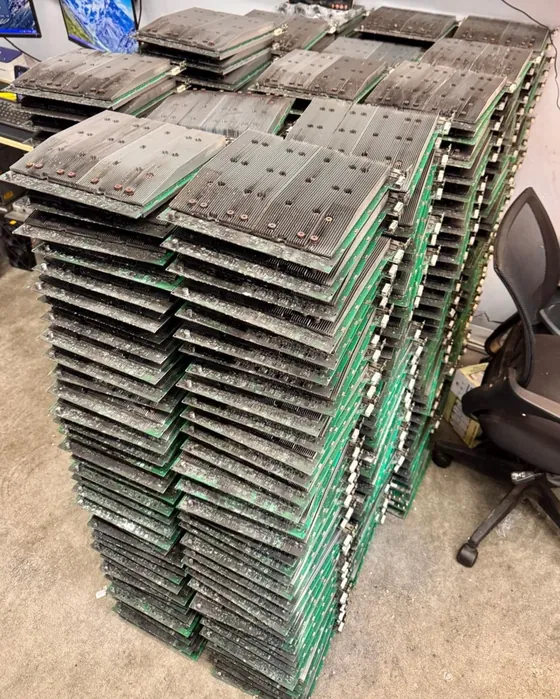
- Hashboards, $59.99 for a tested working S19 board and $24.99 for an as-is donor. The expensive failure and the one you cannot diagnose by looking: a board with dead chips drops the machine to two thirds or one third of its hashrate while it carries on looking alive on every dashboard you own.
The full range, including the fixtures we use ourselves, is in repair parts and testers, and which board actually fits which machine is the subject of the parts compatibility guide – read the silkscreen, never the model name. Whether a given repair is worth doing at all is a different question again, and it turns on your power price rather than the part price: on a machine you cannot afford to run, the correct repair spend is zero and the correct move is to part it out. Why hardware fails in the first place, and what shortens its life, is in heat, dust, PSUs and repair costs.
The spares float, costed
Every used fleet has a repair tail. Budget it as an operating cost rather than as an insult, and buy the shelf before the pallet lands – a machine idle for a week waiting on a $24.99 fan assembly has already cost you more than the fan. Here is what we would put on a shelf for a hundred used S19s, at what those items are listed at here today.
| On the shelf | Qty | Each | Line |
|---|---|---|---|
| dual fan assembly with backplate | 4 | $24.99 | $99.96 |
| tested working S19 hashboard | 4 | $59.99 | $239.96 |
| tested control board | 2 | $59.99 | $119.98 |
| APW9/APW12 power supply cable | 4 | $16.50 | $66.00 |
| S19/T19 test fixture on an SD card | 1 | $59.99 | $59.99 |
| Total, for a hundred machines | $585.89 |
$585.89 across a hundred machines is $5.86 each, against the $10,000 those hundred machines were listed at before the lot shelf went quote-only – and that ratio is the point. The quantities in that table are our judgement, not a measured failure rate, and we are not going to dress them up as one. What they genuinely depend on is three things: how long your replacement lead time is, whether you have a bench and somebody who can use it, and how hard the fleet is tuned. The third is under your control and it is the one that decides how many boards you cook.
Two things that table deliberately leaves out. It carries no spare power supply, for the reason in the section above, and on a used fleet that is the omission most likely to bite – price one in from wherever you can source it. And it carries no diagnostic beyond the $59.99 SD-card test fixture, which is the cheap end of a ladder that runs a long way up. It runs $199.99 for the fan tester, $299.99 for the PSU tester, $459.99 for the K3L hashboard tester and $1,399.99 for the twenty-piece repair kit at the top.
At what fleet size does the expensive end pay? The honest form of the question is a ratio rather than a machine count – a fixture pays for itself after roughly twice as many wrong diagnoses as its price is a multiple of the part price, and the one-line version of that arithmetic is on the parts guide. Put a hundred machines through the $459.99 tester and it is $4.60 a machine. Put one machine through it and you should not own it.
The float above is sized for this argument. If you want the underlying list rather than the selection, the whole repair shelf, priced, and split into what a machine consumes and what the bench buys once is published as a dated census: 39 SKUs, 17 of them replacement parts from $16.50 to $849.99 and 17 of them bench and test equipment from $59.99 to $1,399.99. It is a purchasing record and not a failure rate — it says what we hold, not what proportion of machines consume it.
Before you wire five figures
The hardware questions to put to any seller – grade and what test produced it, measured wall draw at the profile the machines will ship on, board revision, power supplies, firmware and whether it is locked, the DOA remedy, the sampling rate, freight risk and payment terms – are set out as the nine things to demand before you wire money for a fleet, and how to check the seller rather than the machines is a guide of its own. Run both. Run them on us. The size of the wire is a decision of its own — sizing a first order by what it settles is the page for that.
The three this page adds are the ones specific to buying a megawatt rather than a machine, and they belong in the written quote rather than in a phone call:
- The measured wall draw of the lot at the firmware it ships on, not the factory datasheet figure. A 200 W error per machine is 20 kW across a hundred, which is the difference between a service that carries the site and one that trips. If the answer is that nobody has metered it, that is an acceptable answer and it should be written down as one.
- Whether power supplies are included, in writing, per lot. On a hundred-unit order this one question is a five-figure swing. On this store it is stated in the title on one lot and silent on the others, which means you have to ask rather than infer – and ask about cords and the plug standard in the same sentence.
- The DOA window, the remedy, and who pays return freight, as three separate answers rather than one word. Replacement, refund, credit and parts are four different outcomes and only one of them is the one you are picturing.
On payment: this website’s checkout cannot currently take card payment. That is a limitation of the store rather than a policy, and it is why a bulk order here runs as a quote and an invoice with terms agreed in writing first – which on an order this size is the right route anyway. Escrow is a reasonable request from a buyer who has never met the seller, and we would rather answer it than have you sit on the question. Our own public trading record sits on four third-party surfaces – eBay, Amazon, a Google Business Profile and Trustpilot – and all four are readable without asking us; we list them with their figures, including the one that is not five stars, because a seller who only shows you the flattering surface has told you which surfaces exist. Freight, palletising and what happens when a pallet arrives damaged are covered in shipping and delivery.
Tell us the megawatts, not the machine count
Send us a quantity and we will quote a quantity. Send us your connected load, your power price and what you are trying to build, and we can tell you which of the machines above actually fits it – including when the answer is that none of them do, that you should buy fewer newer units than you planned, or that at your electricity rate the honest advice is not to buy mining hardware at all. The quote form and the current shelf are on the bulk used miner page; single machines out of the same stock are on the used and refurbished shelf; everything we sell is in one place; and the circuits, breakers and receptacles any of it needs are in the power requirements page.
Questions operators ask before buying a used fleet
How many used Antminer S19s fit in one megawatt?
About 307 machines. A stock 95 TH/s S19 draws 3,250 W, so a megawatt of connected load holds 307 of them and produces 29.16 PH/s at a fleet efficiency of 34.2 J/TH. Size on measured draw with margin rather than on the datasheet figure: a six-year-old machine in a warm room draws more than its rating, and the error multiplies by the machine count.
Does a firmware boost to 110 TH/s make a used S19 fleet more profitable?
Not if power is your constraint. Reaching 110 TH/s on a base S19 means driving the same 228 chips harder, which takes about 3,763 W, so a megawatt holds 265 machines instead of 307 and the fleet produces 29.15 PH/s against 29.16 PH/s. That is the same hashrate for more capital. The boost is worth buying when machine slots, rack space or a per-unit hosting contract are what you are short of rather than watts.
How do I work out the blended J/TH of a mixed used fleet?
Total watts measured at the wall divided by total terahash measured at the pool, across the whole fleet at once – never the average of the J/TH figures on the listings. 100 of our 95 TH/s S19s beside 20 S19k Pros averages to 28.6 J/TH and is really 32.0, because the inefficient machines are also most of the hashrate. Watch too for a unit running on two of its three hashboards: it looks healthy on a hashrate report while quietly making the blended number worse.
Is it cheaper to buy used S19s or new miners for the same power service?
Cheaper to buy, far more expensive to run. Filling a megawatt from our used 95 TH/s lots cost about $30,700 at the per-unit price those lots carried to 11 August 2026 – they are quoted rather than listed now – and produces 29.16 PH/s; filling the same megawatt with new SealMiner A2 Pro Air units costs about $1,104,600 and produces 67.06 PH/s on an identical electricity bill. Below roughly 3.89 cents per kilowatt-hour the used fleet returns its money several times faster; above it the used fleet does not return its money at all.
What spare parts should I have on the shelf before a used lot arrives?
For a hundred used S19s we would stock four dual fan assemblies, four tested hashboards, two control boards, four supply cables and a test fixture, which is $585.89 at our listed prices, or $5.86 a machine. Those quantities are a judgement from running this hardware, not a measured failure rate. Add a spare power supply from your own source, because we do not currently list a like-for-like replacement APW12 for an air-cooled S19.
At what fleet size does a hashboard test fixture stop being optional?
As soon as every diagnosis is a purchase decision rather than a hobby. The test is a ratio and not a machine count: a fixture pays for itself after roughly twice as many wrong diagnoses as its price is a multiple of the part price. Across a hundred machines the $459.99 K3L tester works out at $4.60 each, and without one you cannot tell a worn fan from a dead hashboard, which is two orders of magnitude of difference in what the fix costs.
Can I acceptance-test a whole pallet before the freight claim window closes?
Only as fast as you can energise it. Your testing rate is set by your electrical service, not by how many machines you own, so three hundred machines arriving into a 200 kW service is a queue several days long while the carrier’s window runs on a calendar. Photograph every pallet before the wrap comes off, run a short does-it-hash pass across the whole lot first, and queue the long stability runs behind it.
Do you sell replacement power supplies for a used S19?
Not a like-for-like APW12 for an air-cooled S19 at the moment. We list the $299.99 APW12 tester, the $16.50 supply cable, higher-output APW12-class units built for immersion, and an overclocking supply – none of which is a drop-in spare for a standard air machine. Ask before you assume either way, and price a spare into any fleet purchase from whatever channel can actually supply one.