
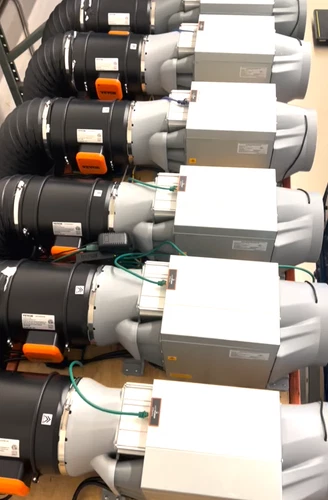
Buy the nine used machines if your power is under about 5.1¢ per kilowatt-hour, and the one new machine if it is not. We have both on the floor: a new Antminer S21 Pro 245T at $4,200 and a used Antminer S19k Pro 115TH/s at $379.99. Once you count freight, the same money buys one of the first or nine of the second, and the nine deliver 1,035 TH/s against 245 — four times the hashrate for the same landed cost. That sounds like the end of the argument. It is not, because those nine machines also burn 23.8 kW against 3.7 kW, and electricity is the one cost that scales with the number of boxes you own.
Run both baskets against the same chain snapshot and they cross at 5.12¢/kWh. What makes this comparison worth writing is where that crossover sits: 0.55¢ below the price at which a used S19k Pro stops covering its own electricity at all. The window in which the new machine is genuinely the better buy — where it nets more money and both baskets still work — is barely half a cent wide. Above it you are not choosing the S21 Pro over the used fleet; you are choosing it because the used fleet has stopped being a machine and started being a heater.
Everything below is that arithmetic, run on our own shelf prices, our own freight rate and a snapshot read off the chain this morning. Where a number depends on Bitcoin, we say so and give you the sensitivity. One section deliberately does not depend on Bitcoin at all, and it is the one worth remembering.
Antminer S21 Pro vs S19k Pro: the two machines, and the one price three of ours share
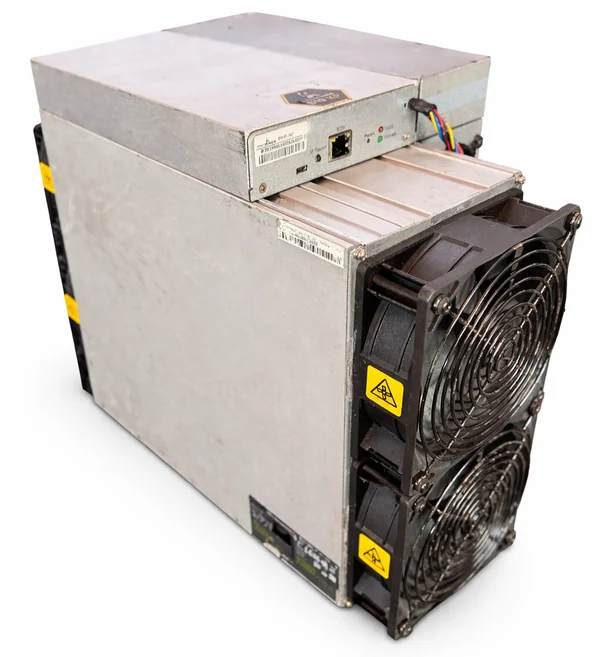
Both columns are factory ratings taken from our own listings. Neither number has been improved. The S21 Pro is new stock; the S19k Pro is second-hand and tested working on our bench, which is a different claim from refurbished and we keep them separate on purpose.
| Antminer S21 Pro 245T | Used Antminer S19k Pro | |
|---|---|---|
| Our price | $4,200.00 | $379.99 |
| Condition | New stock | Used, tested working on our bench |
| Hashrate | 245 TH/s ±3% | 115 TH/s |
| Wall power | 3,675 W ±5% | 2,645 W ±5% |
| Efficiency | 15.0 J/TH | 23.0 J/TH |
| Silicon | Bitmain BM1370 | BM1366 series |
| Capital per TH/s | $17.14 | $3.30 |
| Landed per TH/s, with freight | $17.35 | $3.74 |
| Break-even power price | 8.70¢/kWh | 5.67¢/kWh |
| Input voltage | 220–277 V — not 208 V, not 120 V | 200–240 V only |
| Draw at 240 V | 15.3 A (19.1 A at the NEC’s 125%) | 11.0 A (13.8 A at 125%) |
| Circuit needed | One 20 A / 240 V | One 20 A / 240 V |
| Power supply | Built into the chassis | Separate PSU, included |
| Noise | Roughly 75–76 dB | 75 dB |
| Warranty | Bitmain publishes 365 days to the original direct purchaser — ask us in writing what we cover on a resold unit | None claimed. Tested working is the claim |
| Buyable in quantity? | Single unit | Ten-machine lot, priced on quote |
One thing about that $4,200 needs saying before you spend it, because it is our shelf and not a secret. The top of our catalogue is priced flat. The S21 Pro 245T, the S21 Pro 234T and the S21+ 216T all carry the same $4,200, and so does the SealMiner A2 Pro Air 255T. The two S21 Pros share an identical 15.0 J/TH — the larger bin runs more silicon harder, it is not more efficient per terahash — so at one price the 245T is simply more machine than the 234T. The S21+ 216T is a different line and it is not a 15 J/TH machine: its own spec table says ~3,564 W for ~216 TH/s, which is 16.5 J/TH, and on this page’s hashprice it stops covering its own power at 7.90¢/kWh against the S21 Pro’s 8.70¢. At one price it is both the smallest and the least efficient of the three. That is why this page uses the 245T, and it is why there is no reason to take the 216T at that price. The SealMiner is more machine again on paper, at 255 TH/s and 14.9 J/TH; we put those two head to head in our S21 Pro and SealMiner comparison.
What $4,200 actually buys, once freight is in the box
Divide $4,200 by $379.99 and you get eleven used machines with $20.11 left over. That is the number every comparison like this one publishes, and it is wrong, because freight is charged per machine and hashrate is not. Our US ground rate is $49.99 a unit — the same $49.99 whether the pallet carries one machine or eleven — so the honest basket is the one that matches landed cost.
| One S21 Pro 245T | Nine used S19k Pros | Eleven, if you ignore freight | |
|---|---|---|---|
| Machines | 1 | 9 | 11 |
| Goods | $4,200.00 | $3,419.91 | $4,179.89 |
| Freight at $49.99 a unit | $49.99 | $449.91 | $549.89 |
| Landed | $4,249.99 | $3,869.82 | $4,729.78 |
| Freight as a share of landed | 1.2% | 11.6% | 11.6% |
| Hashrate | 245 TH/s | 1,035 TH/s | 1,265 TH/s |
| Wall power | 3.7 kW | 23.8 kW | 29.1 kW |
| Electricity a month | 2,683 kWh | 17,378 kWh | 21,239 kWh |
| Landed cost per TH/s | $17.35 | $3.74 | $3.74 |
Freight eats two machines. Eleven units at the sticker price become nine once the pallet is paid for, and the used basket’s real capital cost is $3.74 per terahash rather than the $3.30 on the price tag — a 13% difference that no spec sheet shows you. On the single new machine freight is a rounding error at 1.2%. This is the most reliable way we know to tell whether somebody has actually bought used hardware in quantity or has only read about it: ask them what freight did to their unit count. Our published shipping and delivery terms are the same $49.99 per machine for anyone; a palletised multi-unit order is quoted separately and will not match nine times a single-unit rate, which is one of several reasons the lot listings are quote-only.
Even after that correction, the used basket wins the capital column by 4.6 to one. Nine machines, four times the hashrate, $380 cheaper to land. If capital per terahash were the whole question this page would stop here, and the same reasoning worked out per megawatt rather than per dollar is in our fleet economics page.
The crossover is 5.12¢, and the used machines die at 5.67¢
Capital is not the whole question because the nine machines have to be fed. Here is what each basket nets per day and per month at a range of electricity prices, gross mining revenue minus electricity, on a hashprice of $31.30 per PH/s per day read this morning. No firmware dev fee, no pool fee, no hosting margin — the same convention our other comparison pages use, so the numbers are directly comparable.
| Your power | One S21 Pro, per day | Nine S19k Pros, per day | S21 Pro, per month | Nine, per month |
|---|---|---|---|---|
| 2¢ | $5.91 | $20.97 | $179.63 | $637.95 |
| 3¢ | $5.02 | $15.26 | $152.80 | $464.17 |
| 4¢ | $4.14 | $9.55 | $125.97 | $290.39 |
| 5¢ | $3.26 | $3.83 | $99.15 | $116.62 |
| 5.12¢ | $3.15 | $3.15 | $95.96 | $95.96 |
| 5.5¢ | $2.82 | $0.98 | $85.73 | $29.73 |
| 5.67¢ | $2.67 | $0.00 | $81.14 | $0.00 |
| 6¢ | $2.38 | −$1.88 | $72.32 | −$57.16 |
| 7¢ | $1.50 | −$7.59 | $45.49 | −$230.94 |
| 8.70¢ | $0.00 | −$17.28 | $0.00 | −$525.60 |
Read that table as four bands rather than as a single answer.
Under 5.12¢ the used fleet wins on every measure that matters. At 3¢ it nets three times the money and pays its landed cost back in 254 days against 846. If you have behind-the-meter gas, curtailed renewables, flare capture or a hydro contract, this is not a close decision and no efficiency argument rescues the new machine.
Between 5.12¢ and 5.67¢ the single new machine nets more while both baskets still earn. This is the only band on the page where the S21 Pro wins on money alone, and it is 0.55¢ wide.
Between 5.67¢ and 8.70¢ the used machines cost more in electricity than they generate — at 7¢ the nine of them lose $231 a month, every month, and the S21 Pro clears $45. That is not the new machine winning a comparison. It is the used option ceasing to exist. Note where retail hosting sits: roughly 5.5–8.5¢/kWh all-in on our 2026 survey, published on the Avalon Q comparison. If you are buying either of these to put in somebody else’s facility at a retail rate, the used fleet is at or past its own break-even before the first invoice.
Above 8.70¢ neither machine covers its power. The US residential average was 18.44¢/kWh in May 2026 (EIA), which is more than twice the better machine’s break-even. Nobody should be buying either of these to plug into a house, and we would rather write that down than sell you one.
The part Bitcoin cannot move: the window is always the top tenth
Every figure in the last section is stale already. Our fleet economics page read the S19k Pro’s break-even at 5.78¢ this morning on a hashprice of $31.91; this page reads 5.67¢ on $31.30, taken from the same chain a few hours later. Same formula, same machine, 1.9% apart inside a day — which is why the S19k Pro and S19 XP comparison publishes it to one decimal place. Anyone shopping on a payback figure to two decimals is shopping on noise.
So here is the version that cannot move. Divide the crossover by the used machine’s own break-even rate and hashprice cancels out of both sides:
5.12¢ ÷ 5.67¢ = 0.903
That ratio is pure hardware. It is built from two hashrates, two wall-power figures and two prices, and there is no Bitcoin price, no difficulty and no fee market anywhere in it. Whatever the market does, the window where one new S21 Pro beats nine used S19k Pros on money is always the top 9.7% of the used machine’s operating range. Move hashprice 10% either way and every number slides together:
| Hashprice, $/PH/day | Crossover | Used S19k Pro dies at | S21 Pro dies at | Ratio |
|---|---|---|---|---|
| $28.17 — hashprice down 10% | 4.61¢ | 5.10¢ | 7.83¢ | 0.903 |
| $31.30 — this morning | 5.12¢ | 5.67¢ | 8.70¢ | 0.903 |
| $34.43 — hashprice up 10% | 5.63¢ | 6.24¢ | 9.57¢ | 0.903 |
This is the only thing on the page we would put in front of a buyer six months from now without re-running it. The practical form: work out your own all-in power rate, work out the used machine’s break-even on the day, and if you are inside the top tenth of that range the new machine is the better buy. The one-line formula is in our buying guide, and the break-even page walks through it with worked examples. The same trick — find the framing where the volatile inputs cancel — is what makes the S19 XP and S21 Pro comparison worth reading a month after it was written.
Nine machines is nine of everything
The tables above price electricity and nothing else, which quietly flatters the used basket. Here is what the ninth machine actually brings with it, and none of it appears in a payback calculation.
| One S21 Pro 245T | Nine used S19k Pros | |
|---|---|---|
| Dedicated 20 A / 240 V circuits | 1 | 9 |
| Terahash per circuit | 245 TH/s | 115 TH/s |
| Hashboards in service | 3, new | 27, used |
| Power supplies | 1, built in | 9, separate |
| Heat to reject | 3.7 kW | 23.8 kW |
| Combined noise | 75–76 dB | 84.5 dB |
| Network drops, IPs, pool workers | 1 | 9 |
| Units to unpack, test and rack | 1 | 9 |
The circuit row is the one that decides real installations. Both machines want their own 20 A, 240 V feed — the S21 Pro’s 15.3 A becomes 19.1 A once you size a continuous load at 125% under the NEC, which still fits a 20 A breaker, and the S19k Pro’s 11.0 A becomes 13.8 A. The same breaker carries 245 TH/s or 115 TH/s and nothing else changes. If what you have run out of is circuits, panel space or rack positions rather than money, the new machine is 2.1 times the terahash per slot and the comparison is over before electricity is mentioned.
Two footnotes with teeth. The S21 Pro wants 220–277 V, which means a 208 V three-phase leg — the most common supply in a small commercial building — is below its rated input, not merely inconvenient; we wrote up what 208 V does to this machine family when it caught us out. And nine machines at 75 dB is not 75 dB: sound power adds logarithmically, so nine of them make about 84.5 dB, which is a different conversation with a neighbour and a different hearing-protection policy for whoever walks the aisle.
The spares channel is shared everywhere except where it matters
Twenty-seven used hashboards against three new ones is the risk you are being paid to take, and we are not going to quote you a DOA rate, because we have not measured one across enough S19k Pro lots to publish it. What we can do is show you our own parts shelf, which is a more honest failure-rate signal than any percentage — you stock what runs out.
For the used S19k Pro, the cheap failures are shared with the entire S19 chassis family and they are on the shelf today: a dual fan assembly at $24.99, a tested ctrl_C55 control board at $59.99, a PSU cable at $16.50 and an S19-series test fixture at $59.99. One of each is $161.47, and across nine machines that is $17.94 a machine. The same four items on a hundred-machine shelf work out at $3.46 each. You cannot buy a fifth of a control board, so a small used fleet pays about five times as much per unit for the same protection — the worst spares economics of any fleet size, and one more thing the per-terahash tables never show. The costed hundred-machine version is on the megawatt page, where the quantities are our judgement rather than a measured failure rate; we say so there too.
Now the part that argues against our own used shelf. There is no S19k Pro hashboard in our catalogue today. We carry a tested S19 Pro 95 TH/s board at $59.99 and a BM1366-series chip tester, and the k Pro is BM1366 silicon, so the diagnostic path exists — but an S19 Pro board is not a k Pro board and we will not pretend otherwise. If a hashboard dies on one of your nine, today the realistic options are the open market or cannibalising another unit from the same batch. That is a genuine argument for buying more of them than you need, and it is a genuine argument for the new machine, which carries a manufacturer warranty for its first year. Bitmain publishes 365 days from shipment, running to the original direct purchaser; on a resold machine that support is the reseller’s responsibility, so ask us on +1 (781) 577-0377 what we will cover and get it in writing before you order. What fails and what it costs to put right is written up in full, and the day the pallet lands is covered in our acceptance-testing procedure — run it inside the freight claim window, not in week four.
What the halving does to both baskets
Block 1,050,000 is 87,490 blocks away, roughly 608 days at ten minutes a block. The subsidy halves there, and break-even scales with the subsidy, so every rate on this page halves with it — holding difficulty, price and the fee market where they are today, which is a convention rather than a forecast.
| Today | After the halving | |
|---|---|---|
| Used S19k Pro stops earning | 5.67¢/kWh | 2.84¢/kWh |
| S21 Pro stops earning | 8.70¢/kWh | 4.35¢/kWh |
| Crossover between the two baskets | 5.12¢/kWh | 2.56¢/kWh |
| Band where only the new machine earns | 5.67–8.70¢ | 2.84–4.35¢ |
The band gets narrower in cents and much wider in sites. Power under 2.84¢ is genuinely rare; power under 4.35¢ is ordinary for anyone with an industrial contract or a hosting deal. A site paying 3.5¢ owns a working S21 Pro and a pallet of scrap S19k Pros the morning after the halving. If the machine you are buying today is meant to still be running in two years, that is the argument for paying for efficiency, and it is the only one on this page that gets stronger rather than staler with time. If it is meant to pay for itself in eighteen months on 3¢ power, it does not apply to you at all.
Which one suits which buyer
Plainly, and with the reason attached to each.
Cheap or stranded power, under about 4¢/kWh — buy the used S19k Pros. Three times the monthly net, payback in a third of the time, four times the hashrate for the same landed cost. Nothing about the new machine competes down here. Start with the tested Braiins unit or the VNish one at the same price, and if you want more than a handful, ask for the ten-machine quote.
Hosted, or any rate from about 5.1¢ upward — buy the S21 Pro. Above the crossover the single new machine nets more, and above 5.67¢ it is the only one of the two earning anything at all. Most US retail hosting sits in exactly that range, and hosting billed per machine rather than per kilowatt makes nine boxes nine invoices.
Short of circuits, rack positions or floor space — buy the S21 Pro. Same breaker, 2.1 times the terahash. This is the constraint that overrides the arithmetic most often, and it is the one buyers discover after the pallet arrives rather than before.
Buying your first machine, or testing a site — buy one used S19k Pro. $379.99 is a far better way to find out whether your power, your cooling and your tolerance for noise are what you think they are. $4,200 is an expensive way to learn that a 20 A circuit was never available.
Buying for the far side of the halving on 2.8–4.3¢ power — buy the S21 Pro. That band kills one fleet and not the other, and 608 days is inside the service life of both.
Paying an ordinary retail electricity rate — buy neither. Both machines lose money on 18¢ power and no firmware, tune or duct changes that. Our used-buying guide starts with the same test, and the whole shelf is on the comparison table if you want to check a machine we have not written up yet.
Questions buyers ask about these two
Is one new Antminer S21 Pro better than nine used S19k Pros?
Below about 5.1¢/kWh, nine used ones — and it is not close. At 3¢ the nine used S19k Pros net roughly $464 a month against the single S21 Pro’s $153, and they pay their landed cost back in 254 days against 846. Above 5.67¢ the used machines stop covering their own electricity and the new machine is the only one of the two still earning. Between those two figures there is a window 0.55¢ wide where the S21 Pro nets more money while both baskets still work, and that window is where most hosted sites actually sit.
How many used S19k Pros can I buy for the price of an S21 Pro?
Eleven at the sticker price, nine once you pay to get them here. Our US ground rate is $49.99 per machine, so eleven machines carry $549.89 of freight and one machine carries $49.99. Matching the landed cost of a $4,200 S21 Pro — $4,249.99 with freight — buys nine used S19k Pros landed at $3,869.82. Freight eats two machines, and it is 11.6% of the used basket against 1.2% of the new one.
At what electricity price does the new S21 Pro actually win?
Above 5.12¢/kWh on today’s numbers. That is where one S21 Pro and nine used S19k Pros net the same dollars per day; above it the single new machine nets more, because the used basket burns 23.8 kW to the S21 Pro’s 3.7 kW and electricity is the only cost that scales with the number of machines you own. Retail US hosting runs roughly 5.5–8.5¢/kWh all-in, so if you are buying these for a third-party facility rather than for your own cheap power, the new machine is usually the right answer.
Why does freight matter so much when you buy used miners in quantity?
Because freight is charged per machine and hashrate is not. One S21 Pro pays $49.99 to arrive with 245 TH/s. Nine S19k Pros pay $449.91 to arrive with 1,035 TH/s — the same $49.99 nine times. That is most of a tenth machine, and it is the single most under-counted number in used fleet buying. It also means the used basket’s real capital cost is $3.74 per TH/s rather than the $3.30 the price tag implies.
What can go wrong with nine used miners that cannot go wrong with one new one?
Twenty-seven used hashboards instead of three new ones, nine power supplies instead of one, and nine of every failure mode a machine has. We publish what actually fails and what our shelf charges to fix it rather than quoting a DOA rate we have not measured. The honest asymmetry is that the S19k Pro shares its fans, control board and PSU cable with the whole S19 chassis family and those parts are cheap and on our shelf today — but there is no S19k Pro hashboard on that shelf, and a hashboard is the failure that costs you a machine.
Can I actually buy nine Antminer S19k Pros from you?
Not as nine clicks, no. Both S19k Pro listings are single-unit lines and we do not manage a stock count on them, so we will not tell you nine are on the floor until we have looked. There is a ten-machine S19k Pro lot on the site and it is quoted rather than listed — on condition, quantity and freight to your address. Ask for the quote before you assume the arithmetic on this page is buyable at that price.
What does the halving do to this comparison?
It moves the whole picture down and does not change its shape. In about 608 days the block subsidy halves, and every break-even rate on this page halves with it: the used S19k Pro falls from 5.67¢ to about 2.84¢, the S21 Pro from 8.70¢ to about 4.35¢, and the crossover from 5.12¢ to about 2.56¢. The band where only the new machine earns narrows from 3.02¢ to 1.51¢ in absolute terms while covering far more real sites, because 2.84¢/kWh power is rare and 4.35¢ is not. That is the strongest argument for paying for efficiency, and it is the only one on this page that gets stronger with time.
The numbers, and their shelf life
Network inputs were read off the chain on 15 August 2026 at 02:38 UTC, block 962,510: difficulty 127,479,855,693,691, Bitcoin $63,051 as the median of three exchanges, and a measured reward of 453.07 BTC over the last 144 blocks including fees, of which fees were 0.68%. That gives a hashprice of $31.30 per PH/s per day before pool fees, against an implied network hashrate of 912.5 EH/s. Break-even rate is hashprice ÷ (24 × J/TH). Net is gross revenue minus electricity, with no dev fee and no pool fee. Payback is landed cost ÷ daily net — landed, because the entire point of this page is that the number of machines changes the freight bill, which is a departure from our other comparison pages and the reason the figures here will not line up with theirs to the cent.
Difficulty retargets roughly fortnightly and Bitcoin moves every second, so every payback figure above is stale the moment it publishes — the ratio in the fourth section is the part with a shelf life. Prices are ours as at 15 August 2026 and freight is the $49.99 per-machine US ground rate the cart charges today; a palletised order is quoted separately. We do not publish profitability forecasts. If you want a metered wall reading on either machine rather than a rated one, or a quote on quantity, ask a person on +1 (781) 577-0377 or ns@ingmining.com — and there is more of this arithmetic on the bulk used landing page, our lot-level freight and repair data, what actually happens the day a lot arrives, the S19 against the S19k Pro, the used miner shelf and the full catalogue.