
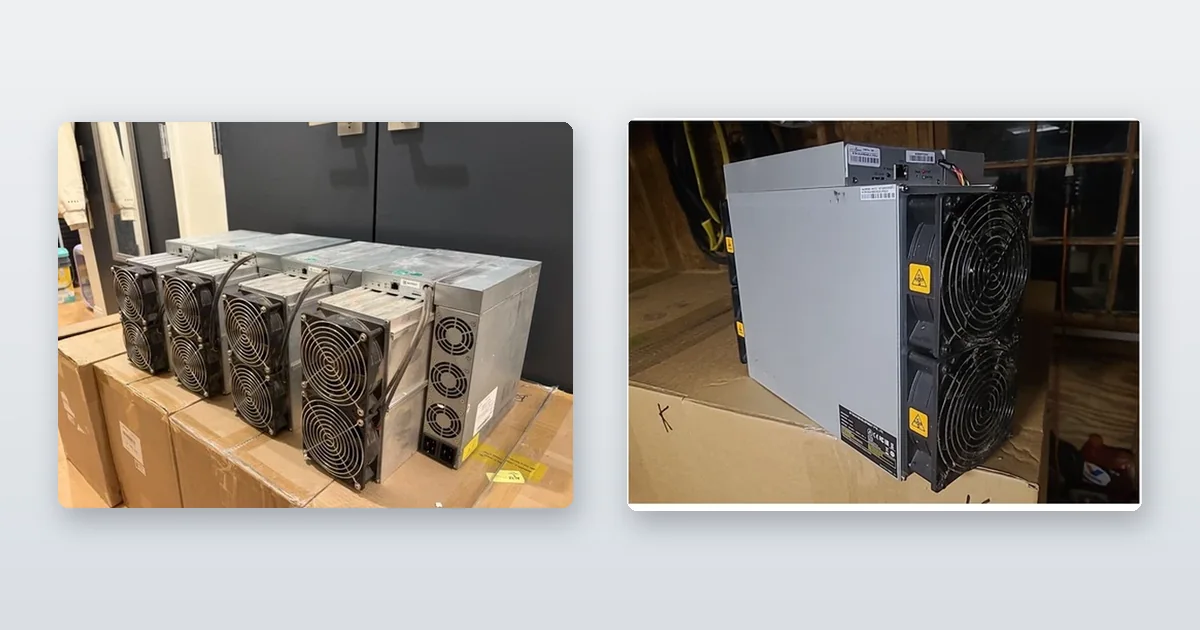
Four numbers decide whether a mining machine makes money: its hashrate, its efficiency in J/TH, your all-in electricity rate, and today’s hashprice. Everything else — pool choice, firmware, resale value — moves the answer at the margins. If those four say no, nothing else rescues it.
What follows is the arithmetic, worked end to end on machines we actually stock, with every input dated. Two formulas do all of it. Learn them and you stop needing a calculator site — which matters, because most of them quietly assume today’s difficulty holds forever, and it does not.
The numbers this guide uses, and when they were true
- Hashprice: ~$31.90 per PH/s per day — derived on 7 August 2026 from the last 144 blocks (453.73 BTC paid to miners, of which 3.73 BTC was transaction fees) at a BTC price of $64,856.
- Network difficulty 126.23 T, network hashrate ~922 EH/s.
- Fees were 0.82% of miner revenue over those 144 blocks. Fees are not currently a meaningful part of what a machine earns, whatever a fee-spike headline suggests.
- US average residential electricity: 18.44¢/kWh (EIA, May 2026). US retail hosting runs $0.065–$0.09/kWh all-in (published host rate cards, read 16 August 2026).
Sources: block reward and network hashrate from mempool.space, BTC price from blockchain.info, both read on 7 August 2026. Every one of these moves daily. Hashprice moves for two independent reasons — the Bitcoin price and the total network hashrate — which is why a BTC rally that arrives with a bigger difficulty rise behind it can leave your machine earning less than it did before the rally. Re-run this on the day you buy, not the day you research.
The two lines of arithmetic that do all the work
Daily revenue ($) = hashrate in PH/s × hashprice in $/PH/day. A 245 TH/s machine is 0.245 PH/s, so at $31.90 it grosses $7.82 a day.
Daily power cost ($) = watts ÷ 1,000 × 24 × your all-in $/kWh. A 3,675 W machine burns 88.2 kWh a day, whatever it is mining.
Margin is what is left: revenue × (1 − pool fee) × uptime − power cost. Two of those four terms are conservative corrections most spreadsheets skip, and they are the difference between a plan and a forecast.
All-in is the important word in the second formula. Take the total at the bottom of your electricity bill and divide it by the kWh on the same bill — supply, delivery, demand charges and taxes included. Using the supply rate alone is the single most common way a spreadsheet says yes to a machine that loses money, because delivery can be a third of the real number.
Worked example: an Antminer S21 Pro 245T at four power prices
The Antminer S21 Pro 245T is 245 TH/s at 3,675 W, which is 15.0 J/TH — the specification on our own listing, not a rounded-up one. Gross revenue is 0.245 × $31.90 = $7.82 a day. Apply a 1% pool fee and a realistic 98% uptime and you are working with $7.58 a day before you have paid for a single kilowatt-hour.
| All-in electricity rate | Power cost/day | Margin/day | Margin/year |
|---|---|---|---|
| 6.0¢/kWh (good hosting) | $5.29 | +$2.29 | +$836 |
| 9.0¢/kWh | $7.94 | −$0.36 | −$131 |
| 12.0¢/kWh | $10.58 | −$3.00 | −$1,095 |
| 18.44¢/kWh (US residential average) | $16.26 | −$8.68 | −$3,168 |
The machine is not profitable or unprofitable. It is profitable below roughly 8.9¢/kWh and it is an expensive space heater above it, and the same hardware sits on both sides of that line depending on nothing but your postcode. That is the whole reason we ask what you pay for power before we recommend anything.
These figures assume the machine runs at its rated numbers. They do not include what it cost to get it to you or wire it in — see below.
Skip the whole calculation with one division
If you only want to know whether a machine can survive your electricity price, you do not need the revenue line at all:
Break-even electricity rate ($/kWh) = hashprice ($/PH/day) ÷ (24 × J/TH)
Hashrate cancels out of it completely, which is why efficiency — not size — is the specification that decides this. At the 7 August 2026 hashprice above:
| Machine | Efficiency | Break-even rate |
|---|---|---|
| Antminer S21 Pro 245T | 15.0 J/TH | $0.089/kWh |
| Antminer S19k Pro 115T (stock firmware) | 23 J/TH | $0.058/kWh |
| Antminer S19 95T | 34.2 J/TH | $0.039/kWh |
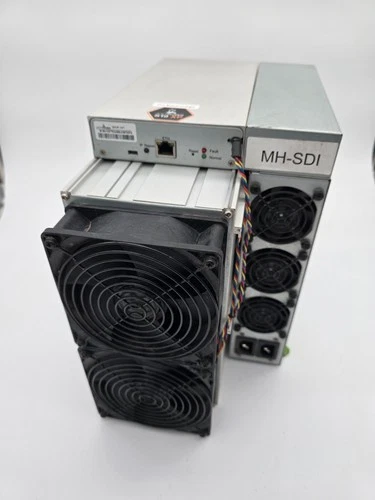
A used S19 needs power under about 3.9¢/kWh to break even today. That is not a household rate anywhere in North America — it is a hosted rate, a stranded-gas rate or a curtailment deal. This is exactly why used S19s are cheap, and buying one without that kind of power is the most common expensive mistake we see. The second question — how long a machine takes to pay back what you paid for it — is worked through in what to do about a miner that is below it, and the specifications behind both are explained in the ASIC miner buying guide.
What the calculator sites leave out
- Difficulty between order and delivery. Bitcoin retargets every 2,016 blocks, roughly every two weeks. A pallet ordered today arrives into a network that is not today’s, and the drift has been upward for years. Assume the machine earns a little less on arrival than the calculator promised on the day you ordered.
- Your pool’s fee and payout scheme. FPPS pools typically charge 2–3% and pay a smooth daily figure; PPLNS charges less and pays lumpier. The 1% used above is deliberately optimistic — put your own pool’s published number in.
- Uptime. 98% is a good year, not a guaranteed one. Heat derates a machine before it trips it, firmware needs restarts, and a shared breaker will find you eventually.
- Landed cost, not sticker price. Freight on a 15 kg machine is real money and a pallet is more; so is the electrician who fits the circuit. Our ASIC miner power requirements page has the voltage and breaker side, and shipping and delivery covers how the freight itself works.
- What you can sell it for afterwards. A machine that clears its power bill but loses 60% of its capital value in a year has still cost you money. ASIC depreciation and physical vs economic lifespan take that apart.
When the answer flips
Four things move the result enough to change a decision, and only one of them is under your control:
- Network hashrate. If the network doubles at the same BTC price, hashprice halves. Nothing about your machine changed; its revenue did.
- The BTC price. The other half of hashprice, and the half everyone watches.
- The halving. The block subsidy is 3.125 BTC today. The next halving cuts it again, and the fee share above — 0.82% — is nowhere near large enough to absorb that.
- Your J/TH. Undervolting and tuned firmware genuinely move efficiency, and this is the only lever on the list you own. It is also the one that voids warranties, so read what a miner warranty covers before you flash anything.
Frequently asked questions
How do I calculate mining profitability without a calculator site?
Multiply your hashrate in PH/s by today’s hashprice in dollars per PH/s per day to get gross revenue, then subtract your machine’s kilowatts times 24 times your all-in electricity rate. Apply your pool fee and a realistic uptime figure to the revenue side. Two lines of arithmetic, and unlike a calculator site you can see every assumption you just made.
What is hashprice, and where do I get today’s number?
Hashprice is what one unit of hashrate earns per day — here quoted in dollars per PH/s per day. It is published daily by several mining data services, and you can derive it yourself: take the BTC paid to miners over the last 144 blocks, multiply by the BTC price, and divide by the network hashrate in PH/s. That is exactly how the $31.90 figure on this page was produced on 7 August 2026.
What electricity rate should I put in the calculation?
The all-in rate: your total bill divided by the kilowatt-hours on that bill, including delivery, demand charges and taxes. Using the supply rate alone understates the real cost by a third in many US markets, and that is usually the difference between a machine that pays and one that does not.
Does a higher hashrate machine always earn more?
It always earns more revenue, and it does not always make more money. Revenue scales with hashrate but so does power draw, and the break-even formula shows hashrate cancelling out entirely. A 245 TH/s machine at 15 J/TH and a 95 TH/s machine at 34.2 J/TH survive at completely different electricity prices, and the smaller one is the one that dies first.
How often should I re-run this?
Before you buy, when the difficulty retargets if you are close to the line, and any time your electricity tariff changes. The method on this page does not go stale. The numbers in it go stale in about a day.
Related reading
- Below Break-Even: What to Do With a Miner That Stops Paying
- Best ASIC Miners 2026: Ranked by the Power Price They Break Even At
- Mining Profitability Metrics: What Each Number Means
- What Actually Moves Mining Margin: Five Levers, With the Arithmetic
The machines these numbers get run against
The machines these numbers actually get run against:
- Lot of 40 Used Bitmain Antminer S19 95TH/s Miners
- Lot of 20 Refurbished Bitmain Antminer S19 110TH/s Miners – Boosted, VNish OS
- Bitdeer SealMiner A2 Pro Air 255TH/s Bitcoin Miner – 14.9 J/TH, January Batch
More in Bitcoin miner, or the full ASIC miner inventory. The arithmetic behind all of this — break-even electricity price from J/TH — is set out in our ASIC miner buying guide.