
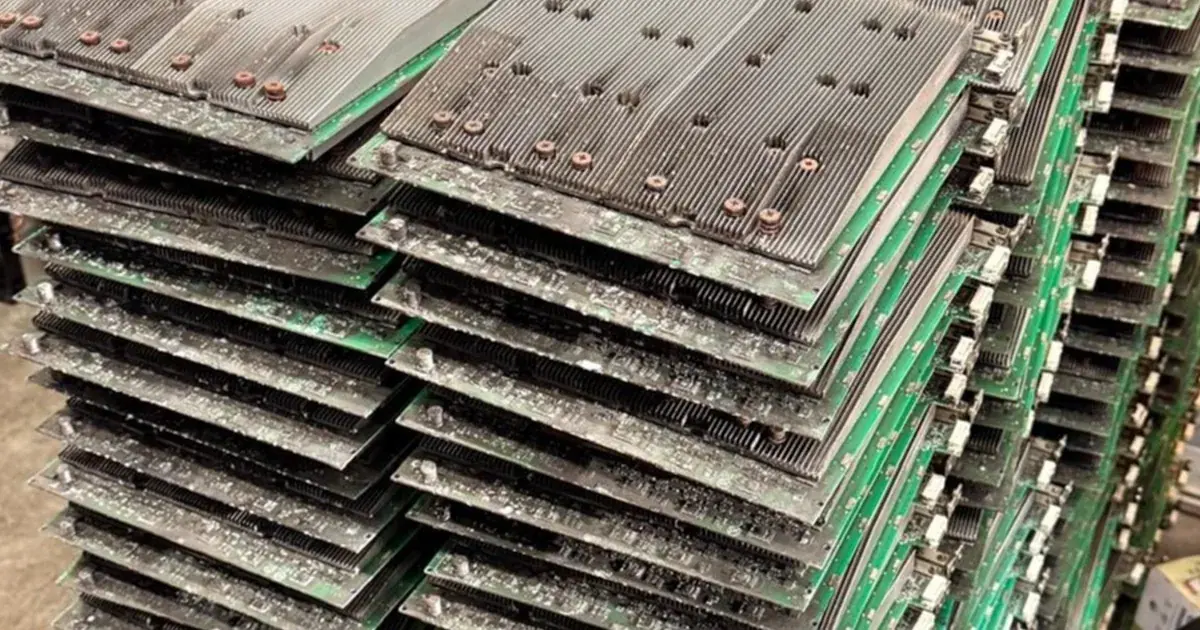
Many cryptocurrency miners assume their mining rigs will continue generating profits for years with little change in performance. In reality, mining hardware efficiency declines faster than most people expect. ASIC miners may still operate for several years, but their competitiveness drops quickly as newer, more efficient hardware enters the market.
Misunderstandings about electricity costs, cloud mining services, and network difficulty adjustments also lead many miners to overestimate profitability. These misconceptions can cost operators thousands of dollars in lost revenue or poor hardware investments. This article breaks down some of the most common cryptocurrency mining myths using practical data and real-world considerations relevant to miners in the United States.
Each myth, and the number that settles it
Five claims that cost people money, each answered with a figure off our own shelf or off
the chain. Everything here was measured on 10 August 2026: hashprice
$32.29 per PH/s per day, difficulty 127.48 T, network
909 EH/s, BTC $65,032, US average residential electricity
18.44¢/kWh (EIA, May 2026). They move daily. Re-run them.
| The myth | What the number says |
|---|---|
| Mining hardware holds its value | The 2021 flagship S19 95TH is $159.99 here. The same machine by the three hundred is quoted, not listed. A current S21 Pro is $4,200. |
| Electricity costs are overblown | At 18.44¢/kWh an S19k Pro costs $356 a month to run and mines less than that. Every machine we sell loses money at the US residential average. |
| Cloud mining is safer than owning | A contract cannot tell you the machine model, its J/TH or the electricity rate behind it. Owning answers all three on the label. |
| Home mining can never work | It works below about 9.0¢/kWh on the most efficient machine we stock. Above that it does not, and no amount of tuning changes it. |
| Difficulty only goes up | The retarget before this one was +0.99%; the one before 30 July was −0.74%. It moves both ways. |
Myth 1: mining hardware doesn’t depreciate quickly
The Antminer S19 95TH/s was flagship equipment in the 2021 build-out and cost thousands of
dollars a unit. Nothing is wrong with the ones we sell — they hash exactly as designed.
A tested one on a low-power tune is $159.99. Buy them three hundred at a time and the per-machine figure is quoted rather than listed, which is its own comment on what the hardware is worth.
That is the entire myth, priced. The machine did not break. It was overtaken, because a
newer machine does the same work on less electricity, and in an industry where electricity is
the whole cost structure that is the only thing that matters. An S19 needs power under about
3.9¢/kWh to break even. An S21 Pro 245T at 15.0
J/TH needs under about 9.0¢. Nothing physical separates them except
joules per terahash, and that gap is worth $4,040 on our own price list.
The practical consequence is that an ASIC is a depreciating consumable, not an
asset. Budget for that on the day you buy, and read
what an ASIC actually depreciates to before you model a resale value
into your payback.
Myth 2: electricity costs are overblown
Electricity is not one of the costs. It is the cost, and it is larger than the
machine within weeks. Here is one used S19k Pro, 2,645 W, at 730 hours a month:
| Your rate | Monthly power bill | What that is |
|---|---|---|
| 3¢/kWh | $58 | behind-the-meter generation or curtailed renewables |
| 5¢/kWh | $97 | a good industrial contract |
| 7¢/kWh | $135 | typical hosting |
| 12¢/kWh | $232 | cheap US residential |
| 18.44¢/kWh | $356 | the US residential average (EIA, May 2026) |
The machine costs $379.99. At the US residential average it burns
most of its own purchase price in electricity every five weeks, and it does
not mine enough to cover that at any point.
The old version of this page said profitability “becomes much harder” above
roughly $0.10 per kWh. That was too generous and we are correcting it: across our whole
catalogue the break-even band is 3.9¢ to 9.0¢/kWh. Ten cents is
already past the end of it. The formula is one division — hashprice ÷ (24 ×
J/TH) — and it is worked in full in the ASIC miner buying
guide.
Myth 3: cloud mining is safer than owning hardware
Three questions decide whether any mining position makes money: which machine, at what
efficiency, on what electricity rate. A cloud contract typically answers none of them, and a
contract that will not name the hardware cannot be checked against the arithmetic above.
Owning the machine answers all three off the label.
That is not an argument that every cloud operator is dishonest. It is an argument that you
cannot audit one, which is a different and worse problem, because the failure mode is silent:
the payout simply drifts below what the same money in hardware would have produced, and no
line item explains why. We wrote the full version of this up in
cloud mining explained.
Myth 4: home mining can never be profitable
It can, and the condition is precise: your all-in electricity rate has to sit under the
machine’s break-even, which for the most efficient machine we can ship today is about
9.6¢/kWh, and about 13.7¢ for the hydro-cooled S23 we list on preorder. Plenty of American households are nowhere near that and some
are well under it. What decides it is your bill, not your enthusiasm.
Two things that are true of home mining regardless of the rate, and that the myth-busting
usually skips: an S19- or S21-class machine runs at about 75 dB, and it needs
200–240 V on a dedicated circuit, so no adapter puts one on a North
American 120 V outlet. Both are capital costs before they are lifestyle problems — the
full itemised bill is in what it actually costs to set up a miner.
Myth 5: difficulty only goes up
Network difficulty retargets roughly every two weeks to hold block production near ten
minutes, and it falls whenever hashrate leaves the network. Read on 10 August 2026: difficulty
127.48 T, the previous retarget +0.99%, the next estimated at
about +3.1%. The retarget before 30 July was −0.74%.
This matters in a direction most people get backwards. Falling difficulty raises everyone’s
revenue per terahash, which means a machine that is marginal today can be viable next quarter
without your power bill changing at all — and the reverse. It is also why a single-day
snapshot is a bad basis for a purchase. Use an average, state the date, and re-run it on the
day you buy.
Which of these applies to you
- Under about 4¢/kWh: almost anything works, including six-year-old
hardware. Buy on capital per terahash and accept the efficiency — a
$159.99 S19 is the cheapest way onto the network. - 4¢ to 9¢/kWh: efficiency is the whole decision. Buy the best
J/TH you can afford; the comparison table ranks our stock by exactly
that. - Above about 9¢/kWh: no machine we sell earns more than it costs to
run. That is not a sales position we enjoy publishing, and it is the truth. - Limited capital: tested used hardware on the
used ASIC miner shelf puts less money at risk per terahash — but it
buys the worst efficiency, so it is a bet on cheap power, not a bet on the machine.
Most mining myths survive because nobody publishes the number. We publish ours: a break-even band of about 3.9¢ to 9.0¢/kWh across our own catalogue, against the 18.44¢/kWh US residential average (EIA, May 2026). Check any claim on this page against the comparison table, and the one about hardware holding its value against what an ASIC actually depreciates to.
Frequently asked questions
When should I replace my mining hardware?
When your electricity rate rises above the machine’s break-even, or when the machine’s break-even falls below your rate — the two are the same event seen from different sides. Break-even is hashprice divided by 24 times the machine’s J/TH. On our catalogue that runs from about 3.9¢/kWh on a six-year-old S19 to about 9.0¢/kWh on an S21 Pro. Replacing is worth it when the newer machine’s break-even exceeds your rate by enough to pay for itself before the next halving.
How do electricity rates vary across the US, and why does it matter?
The US average residential rate was 18.44¢/kWh in May 2026 (EIA), with states running from about 12.35¢ to over 50¢. Every machine we sell loses money at the national average. Mining is viable between roughly 3.9¢ and 9.0¢/kWh depending on the machine, which is why the industry sits where power is cheap rather than where people are.
How does mining difficulty affect my daily earnings?
Directly and both ways. Difficulty retargets about every two weeks; on 10 August 2026 it read 127.48 T after a +0.99% adjustment, with the next estimated at about +3.1%, and the retarget before 30 July was −0.74%. When difficulty falls, every terahash earns more without you doing anything. That is why a purchase decision should use an averaged figure with its date stated, not a single-day snapshot.
More on the numbers behind the claims
- why mining hardware fails
- Altcoin Mining Explained: Profitability and Pitfalls
- Mining Profitability Explained: Key Metrics and Pitfalls
- Cryptocurrency Mining Profitability Explained
The machines these numbers get run against
The machines these numbers actually get run against:
- Lot of 300 Used Bitmain Antminer S19 95TH/s Miners – Tested and Working
- Lot of 40 Used Bitmain Antminer S19 95TH/s Miners
- Lot of 20 Refurbished Bitmain Antminer S19 110TH/s Miners – Boosted, VNish OS
More in Bitcoin miner, or the full ASIC miner inventory. The arithmetic behind all of this — break-even electricity price from J/TH — is set out in our ASIC miner buying guide.