
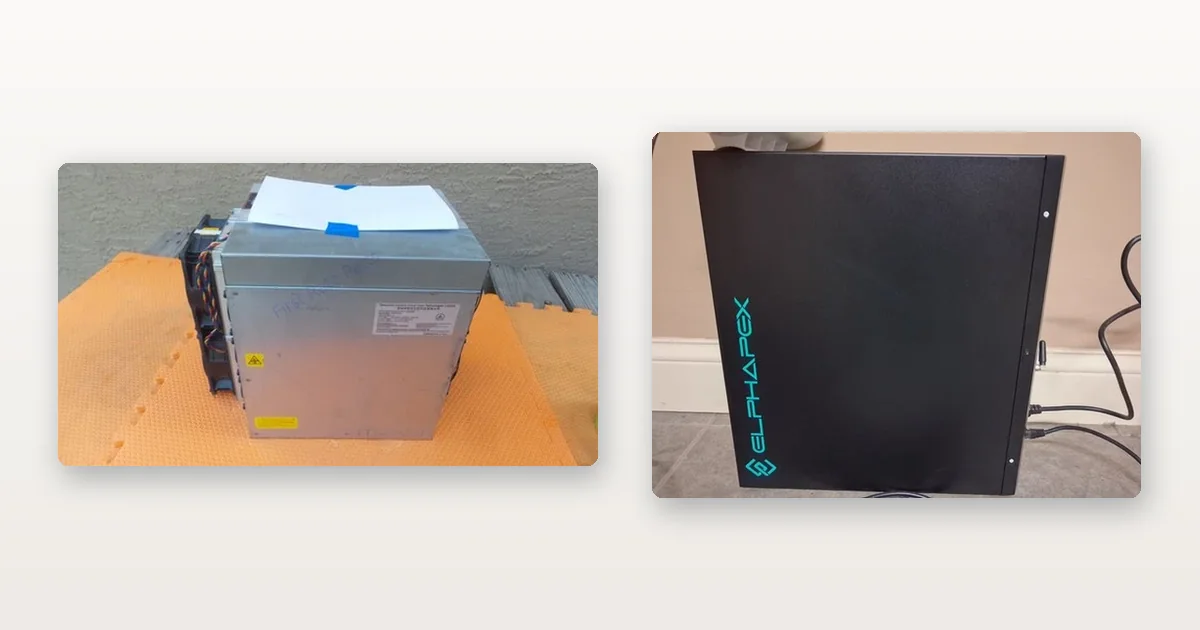
Mining a smaller chain carries one risk Bitcoin does not: the chain can change the rules your hardware depends on. An ASIC is built for a single algorithm. If a project forks to a new one – which several have done specifically to remove ASICs from their network – the machine you bought becomes scrap for that chain overnight, with no recourse and no resale market.
That is the risk worth pricing before any altcoin mining purchase, and it sits alongside three others: thin liquidity, so the coins you mine may be hard to sell at the quoted price; chains that simply stop being worth securing; and the fact that Ethereum’s move to proof-of-stake in September 2022 showed a major network can end mining entirely. This page covers those risks and the economics around them.
For which hardware suits which non-Bitcoin chain, see non-Bitcoin mining hardware and chain risk. For the break-even arithmetic that applies to every machine, see our ASIC miner buying guide.
Altcoin mining: the hardware question is settled before the coin is
Altcoin mining is proof-of-work validation on a chain that is not Bitcoin, and the decision that matters is made at the checkout, not at the pool: the machine commits you to an algorithm, and the algorithm decides which coins you can ever mine. A Scrypt machine like the Antminer L9 mines Litecoin and Dogecoin; a kHeavyHash machine mines Kaspa; neither can be re-pointed at the other, resold into the other’s market, or rescued by the other’s price rally. We priced that trade-off on our own shelf in Kaspa miner vs Litecoin miner, where two comparable-priced machines on two different algorithms earn $7.84 and $4.02 a day at the same moment.
The myth that needs killing first is that mining a smaller coin is a guaranteed profit stream because there is “less competition”. Revenue on any proof-of-work chain is set by the same four inputs — your electricity price, the coin’s market price, the network’s difficulty, and your machine’s efficiency — and on a small chain two of those inputs move faster and further than they do on Bitcoin. Difficulty on a minor chain can double when one industrial operator points a container of machines at it, and the coin’s price can halve on one exchange delisting. Neither of those risks appears on a spec sheet.
Scrypt, kHeavyHash and SHA-256 each need their own silicon
Efficiency is the only spec that sets your break-even electricity price, and efficiency is a property of algorithm-specific silicon — the arithmetic is in our ASIC miner buying guide. What each class of hardware actually mines today:
- Scrypt ASICs — Litecoin and Dogecoin, and the two pay at once through merged mining. The L9 family runs 210 J/GH across every hashrate bin.
- kHeavyHash ASICs — Kaspa. Single chain, no merge partner, and an emission schedule that steps the block reward down every month.
- SHA-256 ASICs — Bitcoin first, Bitcoin Cash as the only meaningful altcoin alternative, plus Namecoin and RSK as merged-mining passengers.
- GPUs — the flexible option: KawPow (Ravencoin) and most of the small proof-of-work tail. Flexibility is the product; on any single algorithm a GPU loses to the ASIC built for it.
- CPUs — RandomX, which Monero designed specifically so that ordinary processors stay competitive. The lowest barrier to entry and the smallest absolute return.
An ASIC buys maximum efficiency and takes on maximum chain risk: it is the best possible machine for exactly one job, and worthless for every other. A GPU rig inverts that trade. That inversion — not raw hashrate — is the honest reason both still exist.
Not every additional coin needs an additional machine. Dogecoin is merge-mined on the same Scrypt work as Litecoin, so a single unit of hashing can earn on both chains at once — our guide to multi-coin mining explains where that is genuinely free and where an auto-switching pool simply adds variance.
What the algorithm decides about the machine you end up owning
The algorithm on the box decides three things the spec sheet never mentions. It decides your resale market: a Scrypt machine can only be sold to someone who wants to mine Scrypt, so its second-hand value tracks two coins’ fortunes rather than a broad market. It decides whether merged mining is available: Scrypt carries Dogecoin free alongside Litecoin, while a Kaspa machine earns one coin or nothing. And it decides your exposure to a fork: history’s clearest examples are Monero, which changed its proof-of-work repeatedly through 2018 and 2019 precisely to brick the ASICs built for it before settling on CPU-friendly RandomX, and Ravencoin, which moved to KawPow in May 2020 for the same reason. Every machine those forks orphaned was working perfectly the day it became scrap.
Difficulty adjustment is the other mechanism worth understanding before buying for a small chain, because it is the machinery that transmits other people’s decisions to your payout. Bitcoin re-targets every 2,016 blocks, roughly two weeks; Bitcoin Cash re-targets every block (ASERT, since November 2020); Kaspa adjusts per block as well. The faster the adjustment, the faster an influx of industrial hashrate dilutes everyone already there — on a per-block chain there is no two-week window in which early miners enjoy the old difficulty. On a chain a fraction of Bitcoin’s size, one operator’s container of machines is the difficulty chart.
What an altcoin machine costs to run, and the risks a small chain adds
The cost structure is the same as Bitcoin mining — the machine, the power, the cooling, the repairs — and electricity dominates it. The arithmetic off our own shelf: an Antminer L9 17G draws 3,570 W, which is 85.68 kWh a day — $15.80 every day at the 18.44¢/kWh US residential average (EIA, May 2026), before the machine has earned anything. That figure, not the hardware price, is what decides whether an altcoin machine makes sense at your wall socket, and it is why the break-even electricity price in our profitability metrics guide is the first number to compute.
What a small chain adds on top of the ordinary costs:
- Liquidity risk. Mining pays you in the coin, not in dollars. On a thin market, selling a month of rewards moves the price against you, and the quoted price you planned around is not the price you get filled at.
- Delisting risk. A small coin’s market can shrink to one or two exchanges. Each delisting widens the spread on everything you mine afterwards.
- Chain-death risk. If the price falls far enough that securing the chain stops paying anyone, hashrate leaves, blocks slow, and the coins you already hold get harder to move. The machine’s resale value dies with the chain.
- Emission-schedule risk. Some chains cut the block reward on a published schedule — Kaspa steps down monthly, halving the reward every twelve months — so revenue falls even if price and difficulty hold still. Price it before you buy, not after.
Buying for a coin instead of for an algorithm, and four other ways to lose money
Buying for a coin instead of for an algorithm is the expensive one. The purchase that goes wrong is almost never “the machine was slower than advertised”; it is “the chain this machine mines stopped rewarding it” — by fork, by price, or by schedule. Evaluate the machine against the algorithm’s whole future, not one coin’s chart. Four more, each of which we see in trade-ins:
- Underestimating the electrical work. An L9-class machine needs 220–277 V on its own circuit. If your building cannot supply it, the machine’s price is only the deposit on the real cost.
- Ignoring the pool landscape. A small chain may have two or three viable pools. Check their fees, payout minimums and uptime history before buying the hardware, because you will be living with them.
- Skipping the emission schedule. A machine priced fairly against today’s reward can be priced badly against the reward twelve months out. Kaspa buyers in particular should read the schedule before the spec sheet.
- Counting on resale value. A used Bitcoin ASIC has a deep market at every price point. A single-purpose altcoin machine has a market exactly as deep as its chain’s future. Assume the exit door is narrower than the entrance.
The risk that actually kills an altcoin mining position is that the machine can only ever mine that algorithm. A Scrypt miner cannot be pointed at SHA-256, so if the coin dies the hardware dies with it. That is why we compare machines by break-even electricity price rather than by coin — the comparison table does it for everything we stock.
Frequently Asked Questions
What is altcoin mining?
Altcoin mining is proof-of-work validation on a chain other than Bitcoin. The hardware is algorithm-specific: a Scrypt machine mines Litecoin and Dogecoin, a kHeavyHash machine mines Kaspa, and no machine can be re-pointed at an algorithm it was not built for.
How does hardware selection impact altcoin mining profitability?
The choice of hardware — GPU, CPU or ASIC — is fixed by the algorithm you intend to mine, and an ASIC cannot be moved onto a different one after purchase. Each type has unique strengths and weaknesses, and the right selection can significantly affect returns.
What are the key factors that influence the profitability of altcoin mining?
Four inputs set revenue on any proof-of-work chain: your electricity price, the coin’s market price, network difficulty, and the machine’s efficiency. Small chains add two more that Bitcoin miners can ignore — the coin’s liquidity when you sell, and its emission schedule, which can cut the block reward on a published timetable.
What common mistakes should I avoid when starting altcoin mining?
The expensive mistakes are buying a machine for one coin’s chart rather than for its algorithm’s future, underestimating the electrical work a 3,000-watt-class machine needs, ignoring how few pools a small chain has, skipping the emission schedule, and counting on a resale market that is only as deep as the chain itself.
More on altcoin mining risk
- Mining Profitability Metrics: What Each Number Means
- ASIC vs GPU Mining: Which Actually Pays
- 7 Key Mining Profitability Factors Every Miner Must Know
- cuándo vale la pena minar altcoins
The machines these numbers get run against
The machines these numbers actually get run against:
- Bitdeer SealMiner A2 Pro Air 255TH/s Bitcoin Miner – 14.9 J/TH, January Batch
- Pinecone INI Box 850M – 850 MH/s InitVerse Miner, 480W, No PSU
- Bitmain Antminer S19K Pro 120T – Efficient Bitcoin Miner
More in Bitcoin miner, or the full ASIC miner inventory. The arithmetic behind all of this — break-even electricity price from J/TH — is set out in our ASIC miner buying guide.
For a worked example of the risk this page describes, Kaspa miner vs Litecoin miner compares two altcoin machines we actually stock and finds that the deciding factor is neither spec sheet. Kaspa’s block reward halves every twelve months by design, in monthly steps, while Dogecoin’s has been fixed since 2015 — so one machine faces a scheduled, certain cut to its output and the other does not. That is an emission-schedule risk, and almost nobody prices it.