
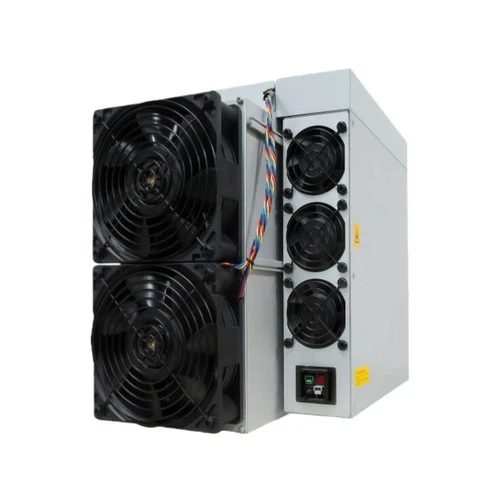
Buy the L9 17G. That is the short answer to the Kaspa miner vs Litecoin miner question as our own shelf actually poses it — a used Antminer KS5 Pro 21 TH/s mining Kaspa against a new Antminer L9 17G mining Scrypt. On 30 July 2026 the L9 earns $7.84 a day against the KS5 Pro’s $4.02, it keeps earning up to 9.15 ¢/kWh where the Kaspa machine dies at 5.32 ¢, and it returns its purchase price faster even though it costs about 2.6 times as much.
There is no electricity rate at which the KS5 Pro out-earns it. The two machines’ daily margins cross at 37.94 ¢/kWh, which is about four times the rate at which both of them have already stopped being profitable — so the crossover, the number that decides most head-to-heads, is useless here.
The KS5 Pro has exactly one honest case and it is not an earnings case: it is roughly two-fifths of the capital. If you have industrial power under about 4.12 ¢/kWh that you have actually metered, and you specifically want Kaspa exposure through hardware, then a small bet on a fast-decaying chain is a defensible thing to make. Above 4.12 ¢/kWh you would finish the year holding more KAS by simply buying KAS and never plugging anything in. And if you pay a normal residential rate, buy neither: at the US average of 18.44 ¢/kWh the KS5 Pro loses about $302 a month and the L9 about $242.
One correction before the tables, because it is the fact most likely to change your mind. You probably arrived here calling the L9 a Litecoin miner. On today’s difficulty and prices 86.8% of an L9’s revenue is Dogecoin and only 13.2% is Litecoin. You are not choosing between Kaspa and Litecoin. You are choosing between Kaspa and Dogecoin, with Litecoin as the junior partner, and the risk you are taking is not the one printed on the box.
The numbers this post is built on
Everything below is derived from block rewards, difficulty and coin price. None of it is copied from a calculator, and all of it moves daily. Re-run it on the day you buy — the method is in our ASIC miner buying guide.
| Input | Value | Source, 30 July 2026 |
|---|---|---|
| Litecoin difficulty | 93,821,903.06 | Blockchair block 3,150,974 and CoinWarz block 3,150,979, in agreement |
| Litecoin price | $45.29 | Blockchair; CoinGecko $45.31 |
| Litecoin block reward | 6.25 LTC | derived from 24h issuance ÷ 513 blocks; next halving at block 3,360,000 |
| Dogecoin difficulty | 35,400,000 (daily average) | CoinWarz. Snapshots the same hour read 53,430,000 and 72,130,000 — see below |
| Dogecoin price | $0.070513 | Blockchair; CoinGecko $0.070434 |
| Dogecoin block reward | 10,000 DOGE | fixed since 2015, no halving schedule |
| Kaspa block reward | 2.44997148 KAS | api.kaspa.org; Woolypooly shows 2.449 |
| Kaspa blocks per second | 10 | measured: the virtual DAA score advanced 873 in 90.1 seconds |
| Kaspa price | $0.02759381 | api.kaspa.org; CoinGecko $0.02756317 |
| Kaspa network hashrate | 305,145 TH/s | api.kaspa.org; independent estimates span 267,905–325,400 TH/s |
| US residential electricity | 18.44 ¢/kWh | EIA Electric Power Monthly, May 2026 preliminary |
For Scrypt, expected revenue for a machine of h GH/s on a chain is 86400 × reward × price × 109 ÷ (difficulty × 232) per GH per day. Block time cancels out of that expression, so it needs no network-hashrate estimate at all:
- Litecoin: $0.06069 per GH per day. 3,600 LTC issued daily at target.
- Dogecoin: $0.40070 per GH per day. 14.4 million DOGE issued daily at target.
- Combined: $0.46139 per GH per day — 13.2% Litecoin, 86.8% Dogecoin.
For Kaspa we use issuance instead, because Kaspa’s published difficulty carries a factor-of-two convention and the chain runs at ten blocks a second, so the difficulty route needs two conventions to be right where issuance needs one measured number. The whole network pays out 2.44997148 × 10 × 86400 = 2,116,775 KAS a day, worth $58,410, spread across 305,145 TH/s of hardware. That is $0.19142 per TH per day, and a 21 TH/s machine is one part in 14,531 of the network.
The mistake that would have made this whole page wrong by a factor of two
Dogecoin retargets its difficulty every block, not every two weeks, so its instantaneous difficulty swings violently inside a single day. Two reputable explorers, sampled minutes apart at the same block height, gave us 72,130,000 and 53,430,000. The daily average was 35,400,000. Since Dogecoin is 86.8% of the L9’s revenue, taking either snapshot would have understated the machine’s income by roughly half and put its break-even near five cents instead of nine — which would have reversed the recommendation on this page.
The check that catches it is arithmetic you can repeat. Litecoin and Dogecoin are secured by the same Scrypt work, so drive Dogecoin’s difficulty with Litecoin’s measured hashrate and see whether you predict the number of blocks the chain actually produced. At the daily average you predict 1,363 blocks against 1,368 observed. At the snapshots you predict about 900 and 670. Two of those three numbers are not describing the network that exists.
Three further controls, all of which have to hold before any of this gets published: the Scrypt figure derived from difficulty agrees with the same figure derived from the coins actually issued in the last 24 hours to within 1%; Kaspa’s issuance rate implies 1,115,422,844 KAS still to be mined under an annual halving, against the 1,096,519,319 the node reports, which is agreement to 1.7%; and the Bitcoin hashprice this method produces, $31.96 per PH per day, matches what we published three days ago.
Why J/TH cannot compare a Kaspa miner with a Litecoin miner
The KS5 Pro is rated 150 J/TH. The L9 17G is rated 210 J/GH. Those units look like they belong on the same axis and they do not, because a Kaspa terahash and a Scrypt gigahash are units of completely different work paid completely different amounts by completely different networks. Dividing one by the other produces a number with no meaning. Efficiency ranks machines within an algorithm; it says nothing across algorithms.
There is exactly one figure that does compare, and it is the one this page is built on: the electricity rate at which the machine stops making money. Revenue per day divided by kilowatt-hours per day, in dollars per kWh. It is algorithm-blind because it is denominated in dollars and kilowatt-hours on both sides, and it is the only cross-algorithm comparison we will publish.
Run it and the intuition inverts. The machine with the worse-looking number per unit of hash — 210 J/GH against 150 J/TH — is the one that survives the higher electricity price, by nearly two cents to one.
What the two spec sheets say
| Antminer KS5 Pro | Antminer L9 17G | |
|---|---|---|
| Algorithm | kHeavyHash — Kaspa (KAS) | Scrypt — Litecoin and merge-mined Dogecoin |
| Rated hashrate | 21 TH/s | 17 GH/s ±5% |
| Rated power | 3,150 W | 3,570 W |
| Efficiency | 150 J/TH (3,150 ÷ 21 exactly) | 210 J/GH (3,570 ÷ 17 exactly) |
| Condition | tested used unit, in service since 2024 | new |
| Warranty | none stated on the listing, so we claim none | the listing states a 6-month term |
| Input voltage | sources disagree: 220–240 V or 220–277 V. Not a 110 V machine either way | 200–277 V |
| Noise | ~75–76 dB, 4 fans | published figures range 75–80 dB |
| Size and weight | 430 × 195 × 290 mm, 15.8 kg | disputed — 400 × 195 × 290 or 370 × 195.5 × 290 mm; 13.5, 14.2 or 16 kg depending on the sheet |
| Heat rejected | 10,748 BTU/h | 12,181 BTU/h |
Two of those rows are disagreements rather than facts and we are not going to resolve them by picking the flattering figure. We have not metered either unit on a bench, so where the published sheets differ, the page says so. What matters is that the three numbers driving every calculation below — hashrate, wall power and therefore efficiency — are consistent across every source we checked, and each divides exactly into the other two.
If it is the L9 bins you are choosing between rather than the algorithm, that is a separate and much shorter question, and we answered it in Antminer L9 16G vs 17G: the whole line runs at the same 210 J/GH, so at one price the bigger bin wins. This page uses the 17G for that reason. The 16G changes none of the conclusions here — its break-even is the same 9.15 ¢/kWh, because sharing an efficiency means sharing a break-even.
The break-even rates, and the payback table
| KS5 Pro (Kaspa) | L9 17G (Scrypt) | |
|---|---|---|
| Revenue | $4.02/day | $7.84/day |
| Electricity used | 75.6 kWh/day | 85.7 kWh/day |
| Break-even | 5.32 ¢/kWh | 9.15 ¢/kWh |
| Share of its own network | 1 in 14,531 | 1 in 141,093 of Litecoin |
| Capital | 1× | about 2.6× |
The KS5 Pro break-even carries a wider error bar than the L9’s, and it is honest to say why. Kaspa’s revenue per terahash depends on an estimate of network hashrate, and the published estimates differ by about ten percent either way. Take the range and the KS5 Pro breaks even somewhere between 4.99 and 6.06 ¢/kWh. The L9 figure needs no such estimate, because block time cancels out of the Scrypt formula.
Break-even tells you where a machine dies. Payback tells you whether it was worth buying, and that is capital divided by daily margin. We do not print our prices in articles, because prices move and an article does not — what you need is the shape, and the shape is that the L9 costs about 2.6 times as much and still returns its money faster at every rate where the Kaspa machine is alive at all.
| Your power rate | KS5 Pro margin/day | KS5 Pro payback | L9 17G margin/day | L9 17G payback |
|---|---|---|---|---|
| 3.00 ¢ | $1.75 | 188 days | $5.27 | 163 days |
| 4.00 ¢ | $1.00 | 331 days | $4.42 | 195 days |
| 5.00 ¢ | $0.24 | 1,376 days | $3.56 | 242 days |
| 6.41 ¢ | −$0.83 | never | $2.35 | 366 days |
| 7.00 ¢ | −$1.27 | never | $1.85 | 466 days |
| 9.15 ¢ | −$2.90 | never | $0.00 | over 20 years |
| 10.00 ¢ | −$3.54 | never | −$0.72 | never |
| 18.44 ¢ | −$9.92 | never | −$7.96 | never |
Read the payback columns and the decision falls out. At genuinely cheap industrial power the L9 is ahead but not dramatically — 163 days against 188 days at 3.00 ¢. By 5.00 ¢ the KS5 Pro takes almost four years and the L9 takes eight months. Past its 5.32 ¢ break-even the Kaspa machine never returns its capital at all, while the L9 still has another 3.84 cents of headroom in hand. And at the US residential average both are simply space heaters that cost money.
The crossover is 37.94 ¢/kWh, which is the same as saying there is not one
The standard move in a two-machine comparison is to find the electricity rate where their daily margins cross: below it one machine wins, above it the other. Here that rate is 37.94 ¢/kWh, roughly four times the higher of the two break-evens and twice the US residential average. It is real arithmetic and it is useless, because by the time you reach it both machines have been losing money for a long time.
A crossover above both break-evens is not a shrug, it is a finding: it means the ordering never changes inside the range where the decision is live. The L9 17G earns more per day than the KS5 Pro at every electricity rate at which either machine earns anything at all. No power price you can plausibly be paying reverses that, so the argument for the Kaspa machine has to be made on something other than income — capital at risk, or the coin itself.
The real difference is the emission schedule, not the machine
Physically these two are near-interchangeable: both are grey steel boxes around 3.2 to 3.6 kW, both in the high-70s dB, both needing a 220 V-class circuit and a building where that is normal. Almost nothing about the hardware decides this purchase. What decides it is a property of the chains, and it is the single most useful thing on this page.
Kaspa’s block reward halves every year, in monthly steps. The emission falls by a factor of one-half to the power of one-twelfth each month — about 5.6% per step — which compounds to an exact halving every twelve months. It is not a rumour and you do not have to trust us: the current issuance of 2,116,775 KAS a day, multiplied by a year and divided by the natural log of two, comes to 1,115,422,844 KAS, and the node says 1,096,519,319 KAS remain to be mined. Those agree to 1.7%, which is the signature of an annual halving and of nothing else.
Hold the KAS price and the network hashrate still, and the consequence is arithmetic: twelve months from now the same KS5 Pro earns half as much and breaks even near 2.66 ¢/kWh instead of 5.32. That is worse than a used Antminer S19. Next month’s step alone takes 5.6% off the revenue. For the machine to stand still, KAS has to double.
Now the other side. 86.8% of the L9’s revenue is Dogecoin, and Dogecoin’s block reward has been fixed at 10,000 coins since 2015 with no halving schedule at all. It does not decay. The remaining 13.2% is Litecoin, which halves once every four years, and the next one is about 209,021 blocks away — on the current block rate roughly 407 days. When it lands it takes the L9’s break-even from 9.15 to about 8.55 ¢/kWh, because it only halves an eighth of the income. That is a haircut. The Kaspa machine takes one of those every twelve months, forever.
None of that makes Dogecoin a safe asset. A fixed reward on a chain whose price can halve in a week is still a bet, and a fixed reward means a fixed number of coins competing for whatever demand exists. What it does mean is that the two machines carry different kinds of risk. The L9’s risk is price. The KS5 Pro’s risk is price and a scheduled, certain, compounding cut to the coins it produces. Only one of those two you can look up in advance, and the machine subject to it is the one that already earns less.
Mining the coin versus just buying it
Anyone buying an altcoin ASIC is really taking a position on a coin, so the test nobody applies is worth applying: for the same money, would you have finished the year with more coin by just buying it? Set one year of net mining margin against spending the identical sum on the coin on day one. The coin price cancels out — both sides are denominated in the same coin — which is what makes the test fair rather than a forecast.
- KS5 Pro: 4.12 ¢/kWh. Below that, a year of mining nets more KAS than buying KAS. Above it, buying wins — with no freight, no breaker, no fan bearings and no machine to resell.
- L9 17G: 6.41 ¢/kWh. Half again as much headroom, for the same reason it wins everywhere else.
Those thresholds are lower than most people expect, and they are the reason we will not sell either machine to a buyer who has not read their own electricity bill. At 7.00 ¢/kWh — a good commercial rate in much of the US, and well under the residential average — buying the coin beats mining it on both machines. The hardware only wins on genuinely cheap industrial power. That is not a sales pitch. It is, however, what the arithmetic says, and you would find it out for yourself inside a year.
Your breaker: 208 V is where these two separate
The one place the hardware, not the chain, makes the decision. Under the NEC a continuous load is sized at 125% of its rating, and a miner is the textbook continuous load, so the arithmetic is draw ÷ volts × 1.25:
| KS5 Pro (3,150 W) | L9 17G (3,570 W) | |
|---|---|---|
| At 240 V | 13.1 A, sized 16.4 A → 20 A circuit | 14.9 A, sized 18.6 A → 20 A circuit, with almost nothing spare |
| At 208 V | 15.1 A, sized 18.9 A → 20 A circuit | 17.2 A, sized 21.5 A → needs a 30 A circuit |
208 V is what a great many US commercial three-phase supplies actually deliver, and it is where an install goes wrong after the hardware has shipped. On a 208 V 20 A circuit the KS5 Pro fits and the L9 17G does not; the L9 16G does not either, at 20.2 A sized. If 208 V is your supply and 20 A is your circuit, that single fact may outrank everything else on this page — though note the KS5 Pro’s own sources disagree about whether 208 V is inside its rated range at all, so ask us to read the label off the actual unit before you plan around it.
How these two compare with the Bitcoin machines on the same shelf
Break-even rate is algorithm-blind, so it is the one number that lets an altcoin machine be lined up honestly against a Bitcoin one. At a hashprice of $31.96 per PH per day:
| Machine | Algorithm | Break-even |
|---|---|---|
| Antminer S21 XP 270T | SHA-256 | 9.86 ¢/kWh |
| Antminer L9 17G | Scrypt | 9.15 ¢/kWh |
| Antminer S21 Pro 234T | SHA-256 | 8.88 ¢/kWh |
| Antminer KS5 Pro | kHeavyHash | 5.32 ¢/kWh |
| Antminer S19 95T, used | SHA-256 | 3.89 ¢/kWh |
The L9 sits between the two current Bitcoin flagships, which is a genuine selling point and one that rests almost entirely on the Dogecoin price. The KS5 Pro sits below both of them and above a used S19 — and on next year’s emission it drops below the used S19 too. Notice also that not one machine in that table clears the 18.44 ¢/kWh US residential average. Nothing we sell does, and we would rather say so here than let you find out. The full shelf, ranked, is in our ASIC miner comparison table, and the Bitcoin-side version of this argument is Antminer S19 XP vs S21 Pro.
Repair, resale, and what happens if the chain moves
Both machines are single-algorithm silicon. Neither can be repointed at Bitcoin, and neither has any use beyond its own algorithm, so when a chain stops paying, the machine is worth what the next person will pay to mine that same chain. This is the risk our own KS5 Pro listing leads with rather than burying, and it is covered generally in altcoin mining risks.
The asymmetry is in the repair shelf, and it does not fall the way you would guess. We stock a fixture that covers KS3 and KS5 hashboards and an IceRiver KS-series fixture, so a Kaspa board can be diagnosed properly here rather than guessed at. But diagnosis is the easy half: replacement Kaspa hashboards are genuinely scarce, because the installed base is small. There is a deep secondhand market in S19 boards and a reasonable one in Scrypt parts; there is nothing like it for KS boards. A repairable diagnosis you cannot source a part for is still a dead machine. Our parts and fitment guide has the arithmetic on when a repair is worth doing at all.
On the other side of the ledger, the L9 is new with a stated six-month term and the KS5 Pro is a used unit whose listing states no warranty, so we do not imply one. That is a real difference in what you are buying, and if you are weighing used against new generally, that is its own guide. Whichever you buy, run the 48-hour acceptance test the day it lands, because freight claim windows are short.
So which one should you buy?
Buy the L9 17G if your all-in power rate is under about 7.00 ¢/kWh and you can fund the larger purchase. It earns nearly twice as much per day, it returns its capital faster despite costing about 2.6 times as much, it has roughly twice the electricity-rate headroom, it is new with a stated warranty term, and 86.8% of its income sits on a chain whose block reward has not moved in eleven years. Check your breaker first if you are on 208 V.
Buy the KS5 Pro only if all three of these are true: your metered power is under about 4.12 ¢/kWh, you specifically want Kaspa exposure through hardware rather than through the coin, and you want the amount at risk to be small. It is the cheaper mistake by a wide margin, and for some buyers that is the whole point. Go in knowing that this year’s revenue is next year’s double, and that if you simply want KAS, buying it beats mining it above 4.12 ¢/kWh.
Buy neither if you pay a residential rate. At 18.44 ¢/kWh the KS5 Pro burns about $424 of electricity a month to produce about $122 of coin, and the L9 about $481 to produce $239. Those are losses of roughly $302 and $242 a month and no firmware tune closes a gap that size. If that is your situation, the honest options are hosting or nothing, and both are covered in the buying guide.
Both machines live in Kaspa, Aleo, Dash and CKB miners and LTC, DOGE and BEL miners respectively. If you want the wider view of non-Bitcoin hardware before choosing an algorithm at all, that is mining hardware beyond Bitcoin, and the mechanics of getting paid on two chains at once are in multi-coin and merged mining.
What we found on our own listings while writing this
Two things, both disclosed because you can check them.
- The L9 photograph is not ours. All three of our L9 listings share one identical supplier photograph, and it carries another company’s watermark across the machine’s top face with a sheet of paper resting on it. The hero image above is cropped from it, below the paper. We have logged it as needing a real photograph of the actual unit in our own workshop, which is what the listing should have had in the first place.
- Our media library holds a KS5 Pro photograph whose control-board label reads
KS3_21T. The 21T matches the KS5 Pro’s rated hashrate exactly and the KS3 part does not match its name, so rather than guess which machine it shows we have kept it off every live listing and flagged it for someone to read the label off the physical unit. The KS5 Pro page you can buy from uses a different photograph.
Neither of those changes a number on this page. Both are the sort of thing a buyer spending four figures is entitled to be told, and the KS5 Pro listing already offers to read its rating plate on request for the same reason.
Frequently asked questions
Is a Kaspa miner or a Litecoin miner the better buy right now?
On 30 July 2026 numbers the Antminer L9 17G is the better buy at every electricity rate where either machine earns anything. It produces $7.84 a day against the KS5 Pro’s $4.02, and it keeps earning up to 9.15 cents per kWh where the KS5 Pro stops at 5.32 cents. The KS5 Pro’s advantage is capital, not income: it is roughly two-fifths of the price, so being wrong costs less. Both figures move daily with difficulty and coin price.
Can I compare 150 J/TH against 210 J/GH to decide?
No, and it is the most common mistake on this decision. Joules per terahash only compares machines running the same algorithm, because a Kaspa terahash and a Scrypt gigahash are paid completely different amounts by completely different networks. The number that does compare across algorithms is the break-even electricity rate: revenue per day divided by kilowatt-hours per day. On that measure the L9 17G reaches 9.15 cents per kWh and the KS5 Pro 5.32 cents, and the machine with the worse-looking J-per-unit figure is the one that survives the higher power price.
How much of an Antminer L9’s revenue is actually Litecoin?
About 13.2% of it. On 30 July 2026 the split was $0.06069 per GH per day from Litecoin and $0.40070 from Dogecoin, so 86.8% of the machine’s income is Dogecoin. Both chains are mined with the same Scrypt work through AuxPoW merged mining and you are paid on both at once, but Dogecoin issues 14.4 million coins a day against Litecoin’s 3,600. Anyone selling you an L9 purely as a Litecoin miner is describing an eighth of the machine.
What electricity rate does an Antminer KS5 Pro break even at?
About 5.32 cents per kWh on 30 July 2026 numbers, and the honest error bar is 4.99 to 6.06 cents because independent estimates of Kaspa’s network hashrate differ by around ten percent. That figure is gross, before pool fees, and it falls by design: Kaspa’s block reward drops about 5.6% every month, so twelve months from now the same machine on the same network breaks even nearer 2.66 cents.
Does Kaspa’s block reward really halve every year?
Yes, and it does it in monthly steps rather than one event. Kaspa’s emission falls by a factor of one-half to the power of one-twelfth each month, about 5.6% per step, which compounds to an exact halving every twelve months. You can check the schedule against the supply: at the current rate the network issues 2,116,775 KAS a day, and one year of that divided by the natural log of two comes to 1,115,422,844 KAS, against 1,096,519,319 KAS left to be mined. Those agree to within a few percent, which is what an annual halving looks like.
Will either of these run on a household outlet?
Neither. Both need a dedicated 220 V-class circuit and a room where the noise is nobody’s problem, and both are in the 75 to 80 dB range. The KS5 Pro draws 3,150 W and the L9 17G 3,570 W. Where they separate is 208 V: under the NEC’s 125% continuous-load rule the KS5 Pro wants 18.9 A of breaker at 208 V and fits a 20 A circuit, while the L9 17G wants 21.5 A and needs a 30 A one. Published sources also disagree about whether the KS5 Pro is rated for 208 V at all, so ask us to read the rating label off the actual unit.
Is it better to mine Kaspa or just buy KAS?
Below about 4.12 cents per kWh, a year of mining a KS5 Pro nets you more KAS than spending the same money on KAS on day one. Above it, buying the coin wins and involves no freight, no breaker and no machine that can fail. The coin price cancels out of that comparison because both sides are denominated in KAS, which is what makes it a fair test. The same threshold for the L9 17G against LTC and DOGE is about 6.41 cents.
What happens to one of these machines if its chain stops paying?
Both are single-algorithm machines and neither can be repointed at Bitcoin, so the answer is that the hardware is worth what someone else will pay to mine the same chain. That risk is not symmetrical. The L9’s income is dominated by Dogecoin, whose block reward has been fixed at 10,000 coins since 2015 and is merge-mined onto Litecoin, so two chains have to fail together. The KS5 Pro is one chain with a reward that halves annually by design. There is also a repair asymmetry: we stock fixtures that cover KS3 and KS5 boards, but replacement Kaspa hashboards are genuinely scarce, where Scrypt and SHA-256 boards are not.