
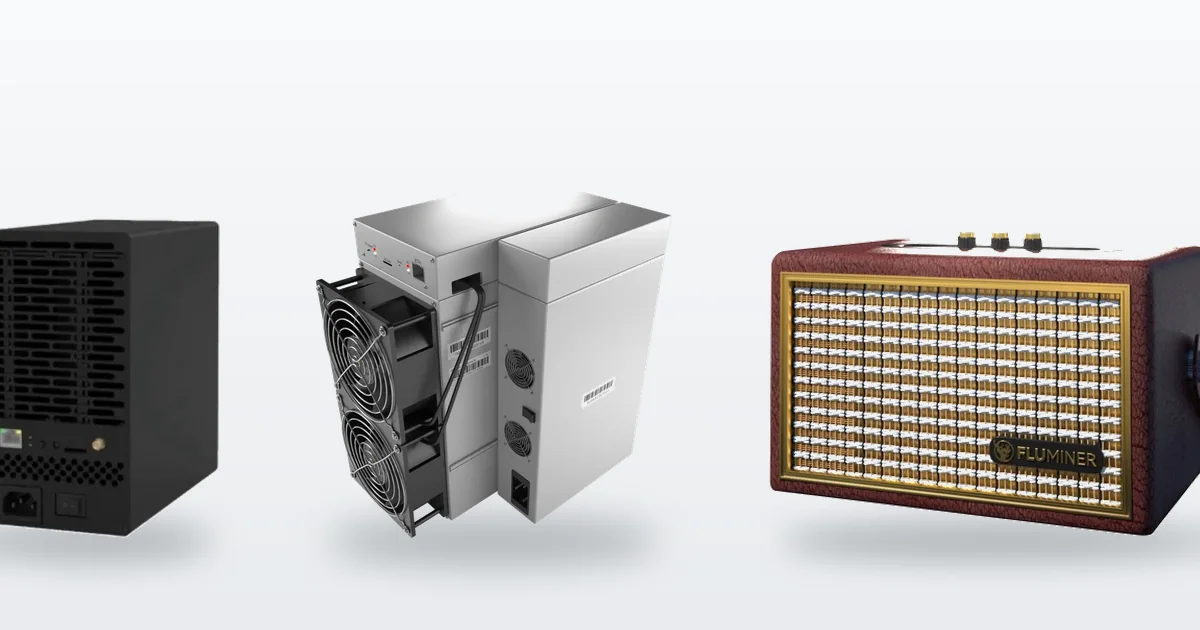
One machine, two chains, the same watts. That is the whole promise of
multi-coin mining, and on the right hardware it is not marketing: on
30 July 2026 about 87% of an Antminer L9’s revenue was the
Dogecoin half of the merged Litecoin–Dogecoin pair — the
machine is sold as a Litecoin miner and Litecoin is the smaller share of what it
earns. There are two ways to be paid by more than one chain, and they are not
interchangeable: merged mining, which pays the same hash twice
and costs nothing to enable, and auto-switching pools, which
chase whichever coin tops today’s table and mostly make sense on hardware
this store does not sell. This page covers which your machine supports, how the
double payment actually works, and how to pick a pool that passes the second
coin through instead of keeping it.
Table of Contents
- What merged mining does, and what it does not
- The two methods, and which your hardware supports
- How AuxPoW pays the same hash twice
- Auto-switching pools: mostly a GPU story
- What the hardware decides
- Choosing the pool: the payout dashboard is the test
- Enable it, measure it, and do not chase the table
- Frequently asked questions
What merged mining does, and what it does not
Merged mining lets one machine secure two chains that share an algorithm and be paid by both — Litecoin and Dogecoin on Scrypt being the case that matters commercially. What it does not do is change any of the arithmetic underneath: the machine draws the same watts, breaks even at the same electricity price, and carries the same J/TH whether one chain is paying it or two. The second payout is upside on a fixed cost, not a different cost structure.
The two methods, and which your hardware supports
Merged mining works when two chains share a proof-of-work
algorithm. One acts as the parent, the other as an auxiliary chain, and the
mechanism — Auxiliary Proof of Work, or AuxPoW — lets a single valid
proof mine two blockchains simultaneously.
No extra hashes, no extra watts. A Scrypt ASIC such as the Antminer L9 mines
Litecoin and Dogecoin (Bitmain’s own spec sheet adds BEL) at its one rated
draw — 3,570 W for the 17G bin. A SHA-256 machine like an S19 or S21
can carry Namecoin or RSK the same way.
Multipool auto-switching is a different animal. The pool
watches profitability across many coins and algorithms and points your hardware
at whichever pays most right now. That only works if the hardware can change
algorithm — which a GPU can and an ASIC, by definition, cannot. An L9 is
Scrypt silicon; an S19 is SHA-256 silicon. The only switching available to an
ASIC is between coins on its own algorithm, and for coins that merge-mine you do
not have to choose at all.
Dual mining is a third, GPU-specific term you will meet:
splitting one card’s resources across two unrelated algorithms at once. It
is not merged mining — it divides the hardware rather than reusing the
proof — and it has no ASIC equivalent.
So the decision tree is short. If you run ASICs, multi-coin mining means
merged mining, and the question is whether your pool passes the auxiliary coin
through. If you run GPUs, auto-switching is available, and the question is
whether the gain survives the fees and the variance — the
altcoin mining risks
page is the honest place to start on that, and
mining security basics
covers keeping a multi-coin setup from leaking keys or hashrate.
How AuxPoW pays the same hash twice
Merged mining uses Auxiliary Proof of Work to make one solution count on two
chains. The miner does no extra hashing; the pool embeds a commitment to the
auxiliary block in the work it hands out, and sorts the results. In practice:
- You point your Scrypt ASIC at a pool that supports merged mining — a
Litecoin pool that also mines Dogecoin. - The machine works on the Litecoin (parent) block as normal.
- Every share it returns is checked against both targets. Dogecoin’s
difficulty is far below Litecoin’s, so many proofs that miss the Litecoin
block still make a valid Litecoin block solution
at Dogecoin’s threshold — the pool submits those to the Dogecoin
network. - You are paid on both chains in proportion to your hashrate.
Dogecoin has accepted the same proof-of-work
as Litecoin since September 2014 (AuxPoW activated at block 371,337), and the
two chains’ parameters are why the auxiliary side is worth so much: Dogecoin
pays a fixed 10,000 DOGE per one-minute block, against Litecoin’s
6.25 LTC per 2.5-minute block. Which half earns more on a given day is a
price question — on 30 July 2026 it was the Dogecoin half, by a wide
margin, on our own measurement linked at the end of this page.
Two things merged mining does not do. It does not raise your electricity
bill: the hashing workload is identical, so
power consumption in mining
stays exactly where the machine’s tune puts it. And it does not wear the
machine faster — the extra bookkeeping happens at the pool. What it also
does not do is rescue a weak unit:
testing mining hardware
matters just as much here, because a machine that hashes below spec is paid
below spec by both chains at once.
One genuine catch: some pools mine the auxiliary coins and keep them unless
you opt in. Before assuming your pool pays them out, read its payout dashboard
— the section below covers what to look for.
Auto-switching pools: mostly a GPU story
Auto-switching multipools monitor exchange rates, network difficulty and
block rewards across dozens of coins, and redirect your hashrate whenever
another coin crosses a profitability threshold. NiceHash is the best-known
version of the model: it rents your hashrate to the highest bidder and pays you
in Bitcoin regardless of what was mined.
The trade-offs are real and they compound:
- Share disruption. Every switch abandons partial work in
flight. Pools call the resulting payout drag a “luck penalty”, and
switching often enough can erase the edge you were chasing. Set the switch
threshold well above zero — if a coin is not
sustainably more profitable
after fees, the switch was noise. - Fees on both ends. The multipool takes its cut, and paying
out in one settlement coin adds conversion spread on top. - Variance. A profitability table is a snapshot. A coin that
tops it for six hours and then retraces pays you for the spike only if the
pool’s accounting window catches it.
For an ASIC operator the honest summary is shorter: your machine cannot
change algorithm, so an auto-switching pool can only ever move it between coins
on the algorithm it was built for — and on Scrypt, the two coins that
matter pay simultaneously through merged mining, no switching required. Enable
the merge and the choice disappears. If you are weighing the financial side of
switching strategies anyway,
mining risk management
gives the framework, and
profitable mining practices
covers what actually moves the net number.
What the hardware decides
Your silicon fixes your options.
ASIC miners for merged mining
cannot switch algorithms, so the multi-coin question is settled the day you buy
the machine. What that looks like on our own shelf, specs read off the listings
on 17 August 2026:
- The Antminer L9 17G — $859.99, in stock — does
17 GH/s ±5% of Scrypt at 3,570 W, which is 210 J/GH. Point
it at a merged pool and it earns LTC and DOGE together at that one draw. - The L9 16G Oct — also $859.99 — is the same
silicon binned at 16 GH/s and 3,360 W: identical 210 J/GH, so it
breaks even at the same electricity price and simply earns less, slower, on a
smaller circuit. - Both need 220–277 V single-phase — a
standard 120 V household outlet is not in Bitmain’s input range
— and both publish 75 dBA at maximum fan, which is
too loud for an occupied room. The merge does not change the wiring or the
noise; the machine does.
Operationally, merged mining adds one failure cost worth naming: a machine
that goes down loses both reward streams at once. The maintenance that protects
the Litecoin income — clean intakes, fan replacement before bearings fail,
hashboard checks — is protecting the Dogecoin income too. Do not tune the
machine harder because a second coin is paying it; the tune sets watts and
J/GH, the merge just decides how many chains pay for them. For how hardware
generations move these numbers, see the
future of mining hardware,
and if the room itself is the constraint,
mining cooling solutions
covers moving the heat somewhere it is welcome.
Choosing the pool: the payout dashboard is the test
For merged mining the one question that matters is whether the pool
pays out the auxiliary chains, not merely mines them. Some pools credit
DOGE automatically; some hold auxiliary rewards until you enable them; a few
keep them. The pool’s payout documentation answers this in five minutes and
no ranking table does —
the pools running merged Scrypt at scale
(ViaBTC, Antpool, EMCD, Luxor among them) all document which coins land in your
balance and which need opting in. Read that page before you point a
$859.99 machine at it.
After the payout question, the criteria are the ordinary ones:
- Fee model. PPS (pay per share) buys predictable income;
PPLNS (pay per last N shares) pays loyalty and punishes pool-hopping; FPPS folds
transaction fees into the payout. On a merged pool, check the model
per coin — some pools pay the parent FPPS and the auxiliary
coins PPS. - Payout thresholds. Mining three coins means three balances
crawling toward three minimums. Low thresholds matter more in merged mining
than anywhere else. - Latency. A far-away server means stale work and rejected
shares, and a rejected share is rejected on every chain it would have paid. - Uptime history. Community track record beats an advertised
fee discount; a pool outage stops all your coins at once.
Enable it, measure it, and do not chase the table
Merged mining on a compatible ASIC is the rare free lunch in this business:
zero marginal watts, zero extra wear, and on the L9 it is most of the revenue,
not a rounding error. Enable it, confirm on the payout dashboard that the
auxiliary coin is actually landing in your balance, and measure the increase
over 30 days against the same machine’s parent-chain-only baseline.
Auto-switching deserves more scepticism. The gains are real in the table and
smaller in the wallet — share disruption, fees and conversion spread all
bill against them — and on single-algorithm hardware the strategy barely
applies. A stable pool, a machine running at its rated hashrate and a clear view
of your electricity cost will out-earn an aggressive switching setup run
casually. Complexity is a cost; pay it only where the measured return covers
it.
Merged mining adds coins, not hashrate: the machine draws the same watts and breaks even at the same electricity price whether one chain or two is paying it. Judge it on J/TH like everything else — the comparison table lists ours, ASIC vs GPU mining covers which silicon can mine what, mining hardware beyond Bitcoin covers the altcoin machines, and the used ASIC miner shelf is where the cheap ones are.
Frequently asked questions
Does multi-coin mining increase electricity consumption?
Merged mining earns rewards from multiple coins using the same computational effort, so it does not increase electricity consumption. The proof of work is submitted to both chains at once, so the same hashes and the same watts are paid twice.
Can all ASIC miners perform multi-coin mining?
ASIC miners designed for a specific algorithm can perform merged mining if their pool supports it, but they generally cannot switch algorithms for multipool mining. ASICs for merged mining cannot handle algorithm switches, so multi-coin mining for ASICs mainly means merged mining.
Which coins are commonly merged mined together?
Popular merged mining pairs include Litecoin and Dogecoin using the Scrypt algorithm, and Bitcoin with Namecoin or RSK using SHA-256. These common merged mining pairs are widely supported by major pools.
What mining pools support merged mining?
Pools such as ViaBTC, Antpool, EMCD, and Luxor support merged mining with multi-coin payouts. Check the pool’s own documentation for which auxiliary coins are paid automatically and which need opting in.
Is auto-switching multipool mining better than merged mining?
Auto-switching multipool mining can maximize short-term profits but adds complexity and may increase variance and fees compared to stable merged mining. Set a switching threshold high enough that fees and variance do not eat the gain, and prefer a stable pool over whichever tops today’s table.
Scrypt hardware for LTC and DOGE
The 16G, 16.5G and 17G are one machine sorted into hashrate bins, all at 210 J/GH. Antminer L9 16G vs 17G covers what actually decides between them, starting with the circuit you have.
The Scrypt hardware we stock for merged LTC and DOGE:
- Bitmain Antminer L9 17G Scrypt ASIC Miner for Litecoin & Dogecoin
- Bitmain Antminer L9 16G Oct | Litecoin and Dogecoin Scrypt Miner
- Bitmain Antminer L9 16G – High-Power Scrypt ASIC
More in LTC+Doge+Bel Miner, or the full ASIC miner inventory.
Merged mining is worth more than it sounds on this hardware, and Kaspa miner vs Litecoin miner puts a number on it: on 30 July 2026 about 87% of an Antminer L9’s revenue came from the Dogecoin half of the merged pair, not the Litecoin the machine is usually sold as. The same page compares that two-chain income against a single-chain Kaspa miner, which is the closest thing to a controlled test of whether merged mining actually matters.