
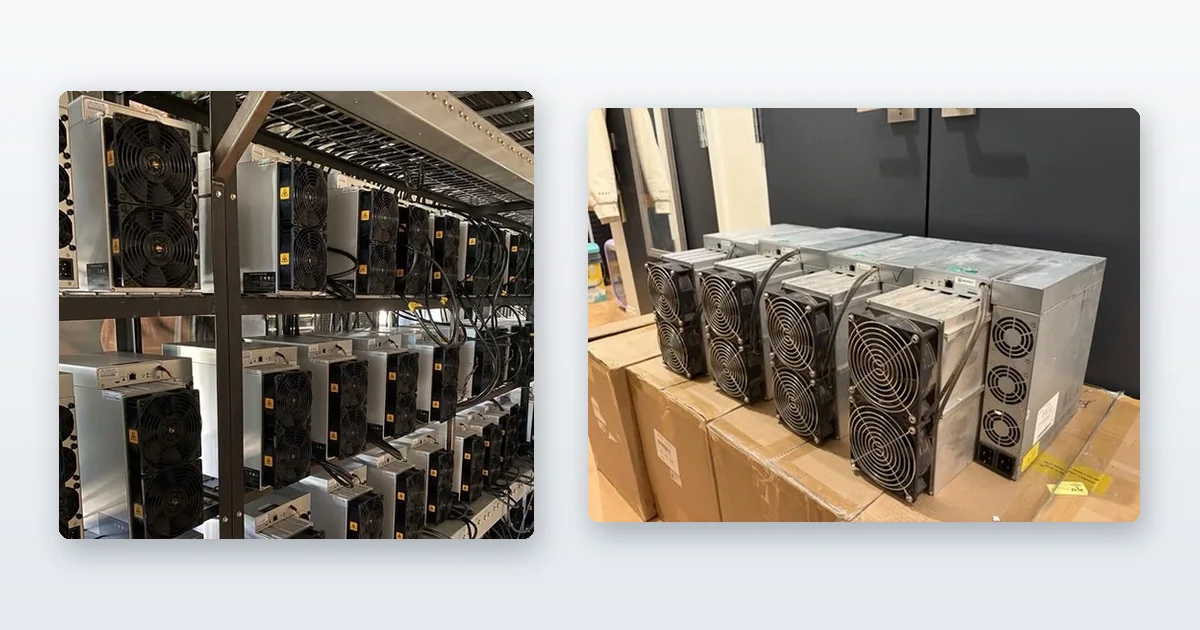
TL;DR: The types of mining farms differ by who owns the power problem, not by size. Home and small-scale setups cost nothing to enter and stop at whatever your panel can carry. Hosting hands the power, cooling and uptime to someone else at a published per-kWh rate, and is the only step most people take. Containerised, industrial and behind-the-meter farms only make sense once you control a power contract — the hardware is the cheap part of all three.
What separates one type of mining farm from another is not scale. It is who owns the power problem. A single miner in a spare room and a 40 MW industrial site run the same silicon against the same network; what differs is who negotiates the electricity, who gets rid of the heat, and who is liable when a breaker trips at three in the morning.
Sort the options that way and the choice gets much simpler, because it is decided by the power you can actually get rather than by how big you would like to be. Each type below is covered with what it costs to enter, what it costs to run, and the failure mode that ends it.
Whichever of these you land on, the hardware question underneath it is the same one: what a machine costs to run at your power rate. That is the ASIC miner buying guide.
Table of Contents
- 1. Key criteria for evaluating different mining farm types
- 2. Self-operated home or small-scale farms
- 3. Hosted mining farms
- 4. Cloud mining operations
- 5. Industrial-scale mining farms
- 6. Modular and containerized mining farms
- 7. Behind-the-meter and stranded power farms
- 8. Comparative analysis of mining farm types
- 9. Practical recommendations for selecting and setting up your farm
- What I’ve learned about picking the right farm setup
- Hardware that fits each of these builds
- FAQ
1. Key criteria for evaluating different mining farm types
Before you compare specific mining farm configurations, you need a framework for evaluation. Hardware alone does not determine profitability. Energy cost and hardware efficiency are the dominant factors in 2026, and operators who underestimate infrastructure complexity often end up choosing managed services just to maintain uptime.
Here are the core factors worth examining for any farm type you consider:
- Electricity cost and access: your rate in dollars per kilowatt-hour decides the whole thing, and the threshold is per machine rather than industry-wide. Break-even $/kWh is hashprice ÷ (24 × J/TH): today that is about 8.7¢ for a new S21 Pro at 15.0 J/TH and 3.8¢ for a used S19 at 34.2 J/TH. Capacity matters as much as price — a good rate you cannot get 500 kW of is not a site.
- Hardware efficiency (J/TH): The ratio of power consumed per unit of hash rate produced. Lower is better. Amortization and J/TH metrics matter more than raw hash rate when projecting long-term margins.
- Cooling method: Air cooling works for small setups. Hydro-cooling and immersion become necessary at higher machine densities because heat accumulation directly shortens hardware lifespan.
- Operational complexity: Self-operated farms require hands-on maintenance, network management, and noise and heat mitigation. Hosted and cloud options reduce this burden at a cost.
- Ownership model: You can own hardware outright, place it with a hosting provider, or purchase a hashrate contract. Each model distributes financial risk differently.
- Location and regulatory environment: Location selection influences energy costs, climate conditions, and long-term regulatory compliance. Iceland’s geothermal power and Sichuan’s hydropower are two well-known examples of favorable location choices.
Before you commit to any farm type, calculate your all-in cost per kilowatt-hour, including infrastructure buildout and maintenance, not just the utility rate. This number tells you far more than your hardware spec sheet.
2. Self-operated home or small-scale farms
This is where most individual miners start. A home or small-scale farm typically consists of one to ten ASIC miners running in a basement, garage, or dedicated room. The appeal is direct ownership, full control over hardware, and no hosting fees.
The practical constraints are real, though. A single Antminer S21 Pro draws 3,675 W at the wall. Run three of those units and you are pulling over 11 kilowatts continuously. Most residential electrical panels are not wired for that load without upgrades. Heat and noise become immediate issues in enclosed spaces, and standard air conditioning is rarely sufficient for dense setups.
This model works best for operators with favorable residential power rates, technical comfort with electrical work and firmware configuration, and a tolerance for ongoing hands-on management. The benefits of home-scale mining are real when conditions align, but they depend heavily on your local electricity rate and how well you manage thermals.
3. Hosted mining farms
In a hosted farm arrangement, you purchase the mining hardware and ship it to a third-party facility. The hosting provider supplies power, cooling, rack space, network connectivity, and basic maintenance. You receive the mined rewards minus hosting fees.
Hosting providers typically charge a 15 to 20 percent revenue share plus monthly service fees, though structures vary widely. Some providers bundle electricity costs into a flat rate per kilowatt. Others bill separately. Policies on customer-owned hardware, repair guarantees, and minimum contract lengths differ significantly between operators.
The primary advantage is offloading infrastructure complexity without giving up hardware ownership. You still bear the risk of hardware depreciation and market volatility, but you sidestep the day-to-day operational demands. Industrial hosting providers commonly bundle electricity, cooling, monitoring, and repair into transparent fee structures, which makes cost forecasting more predictable than running your own site.
This model suits entrepreneurs who want direct hardware ownership without building or managing physical infrastructure from the ground up.
4. Cloud mining operations
Cloud mining removes physical hardware from the equation entirely. You purchase a hashrate contract from a provider, and they allocate a portion of their mining output to your account based on the contract terms. You never touch, see, or maintain any physical equipment.
The appeal is obvious: no capital expenditure on hardware, no electrical infrastructure, no maintenance. The problem is that cloud mining contracts are frequently poor value, and some providers have operated fraudulently. Contract terms often lock you into fixed rates that become unprofitable when network difficulty rises or coin prices shift.
Cloud mining is best understood as a low-barrier entry point for learning about mining economics rather than a scalable business model. If your primary goal is profitability, owning and operating physical hardware through a hosted or self-operated setup gives you far more control over outcomes.
5. Industrial-scale mining farms
Industrial farms represent the highest tier of cryptocurrency mining facilities. These operations run hundreds to thousands of ASIC miners across purpose-built or converted structures with dedicated power infrastructure, advanced cooling systems, and full-time on-site staff.
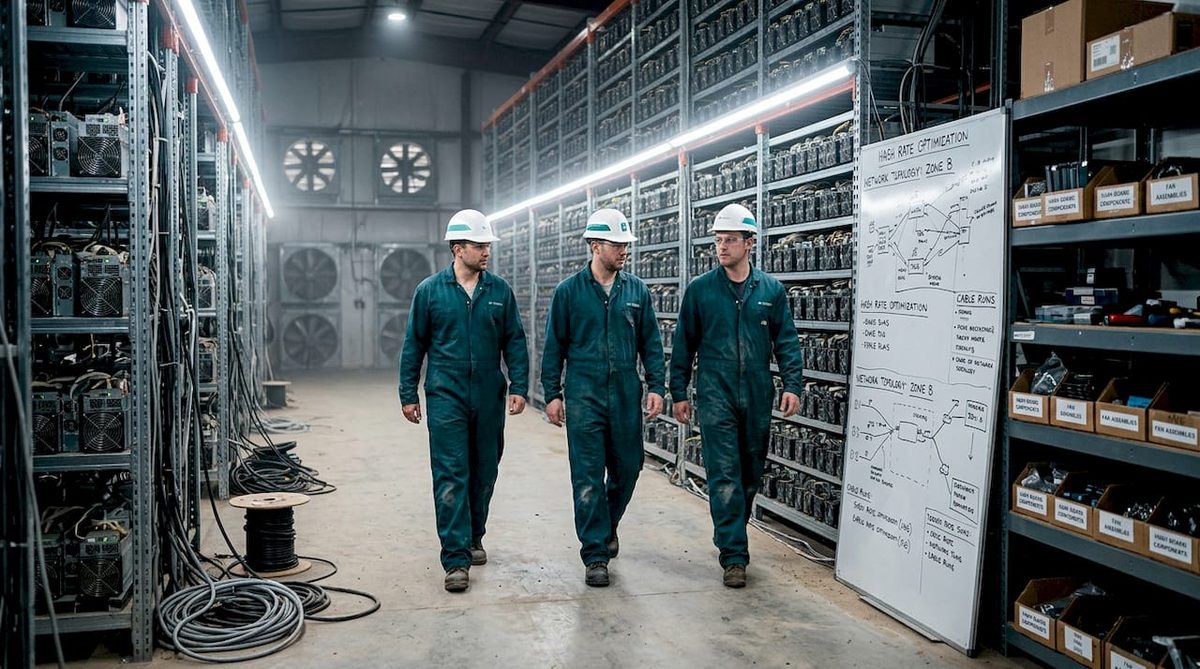
Hydro-cooled ASICs enable higher output per square foot and reduce equipment failure from heat and dust compared to air-cooled configurations. At industrial scale, thermal density management using immersion or hydro-cooling becomes a prerequisite rather than an option. The manifold and coolant distribution unit infrastructure required for these systems cannot be replicated in a home or small facility.
Capital expenditure at this scale is substantial. Electrical buildout, cooling plant, site preparation, and hardware procurement can run into the millions before the first block is mined. The return on that investment depends heavily on locking in favorable long-term power contracts and maintaining high uptime through professional maintenance programs.
6. Modular and containerized mining farms
A containerized farm places mining equipment inside a modified shipping container or prefabricated enclosure that includes integrated cooling, power distribution, and network infrastructure. The container ships as a complete unit and can be deployed at virtually any location with adequate power access.
This model has grown because it dramatically reduces site preparation time. You are not retrofitting a building. The thermal management, cable management, and rack layout are pre-engineered for the hardware load. Modular equipment racks with reliable power and seasonal dust and humidity management are hallmarks of well-designed modular setups.
Containerized setups are particularly useful for operators who want to scale incrementally, deploying additional containers as capital allows, or who need to relocate if power rates or regulatory conditions change.
7. Behind-the-meter and stranded power farms
This is one of the most strategically interesting farm types available today, and it is still underutilized by smaller operators. A behind-the-meter operation places mining hardware at or near a power generation source, consuming electricity before it enters the grid. This sidesteps transmission costs and often accesses power rates that retail customers never see.
Bolivia’s repurposing of a 127 MW gas plant as a Bitcoin mining operation running on USD-denominated contracts is a compelling real-world example. Stranded power assets, like remote gas flares, underutilized hydropower stations, or curtailed solar and wind generation, provide an opportunity to mine at marginal electricity costs that make otherwise borderline hardware profitable.
Curtailed solar is the clearest version of this, because the alternative use of the energy is nothing at all. If you are sizing that the other way round — starting from generation you already have and asking how much hardware it will carry — the array and battery each machine needs gives the figure per machine for everything we stock.
This model requires significant coordination: land rights, generator agreements, regulatory approvals, and the technical capability to deploy and maintain equipment at remote sites. It is not a beginner setup. But for operators with access to the right power assets, it represents a genuine structural cost advantage over competitors paying retail rates.
8. Comparative analysis of mining farm types
| Farm type | Who owns the power problem | Entry cost | Ongoing burden | The failure mode that ends it |
|---|---|---|---|---|
| Home / small-scale | You, at retail rates | One machine | Hands-on: noise, heat, breakers | Your panel, or your household |
| Hosted | The provider, at a published rate | Hardware + deposit | Low — you own hardware, not uptime | Fee structure changes, or the host fails |
| Cloud | Nobody you can audit | A contract | None | Contract terms outlive their profitability |
| Industrial | You, via a negotiated contract | Millions | Full-time staff and cooling plant | Power contract expiry; uptime |
| Containerised | You, but pre-engineered | Container + power drop | Moderate, and relocatable | Site access and the power drop |
| Behind-the-meter | You own the generation | Land, rights, agreements | High, and often remote | Regulatory approval; generator downtime |
A few observations from this comparison. Cloud mining scores well on ease but poorly on control and long-term economics. Hosted mining is the practical middle ground for most operators entering the space with capital to spend on hardware but not on facility buildout. Industrial and behind-the-meter farms deliver the best economics at scale, but only when power contracts, cooling infrastructure, and staffing are properly funded.
When evaluating hosted vs. self-operated setups, calculate the cost of hosting fees over a 24-month period and compare it against the cost of building equivalent power and cooling infrastructure yourself. The hosted option is often cheaper in the short term even when the monthly fees look steep.
Whichever model you land on, the hardware decision narrows quickly. Hosted and containerised sites are usually filled with used and refurbished machines bought by the pallet, because the economics there run on cheap terahash rather than the newest silicon. Industrial builds with real cooling infrastructure are where hydro-cooled hardware earns its extra plumbing and complexity. Small self-operated setups are usually better served from the new machine range, where the manufacturer warranty is still worth something.
9. Practical recommendations for selecting and setting up your farm
Getting the farm type right comes down to honest self-assessment. Here is a structured approach:
-
Audit your power first. Before purchasing a single miner, confirm your available capacity in kilowatts and your actual all-in rate. Residential rates above $0.10/kWh make most ASIC mining marginal. You can dig into power consumption specifics to model this accurately before committing.
-
Match cooling to your machine count. One to three machines can run on supplemental air conditioning and good airflow. Beyond that, you need dedicated exhaust, positive pressure management, or you risk thermal throttling and shortened hardware life.
-
Choose your ownership model based on experience, not aspiration. If you have never managed mining hardware before, starting with hosted mining reduces the risk of a costly learning curve on infrastructure you are not yet equipped to manage.
-
Evaluate hardware for efficiency, not just hash rate. A miner with a lower J/TH rating generates more profit per unit of electricity consumed. When comparing machines, the hardware efficiency comparison matters over the headline hash rate figure.
-
Plan for maintenance from day one. Build a maintenance schedule into your operating plan. Hash boards fail. Fans wear out. Power supplies degrade. Operations that ignore this run into costly unplanned downtime that erodes margins faster than most operators expect.
-
Verify legal and regulatory compliance for your location. Zoning rules, noise ordinances, and utility interconnection agreements vary by jurisdiction. Industrial and behind-the-meter setups in particular require thorough legal review before buildout begins.
Buy tested, verified hardware rather than units sold “as-is.” The cost difference between inspected and uninspected refurbished ASIC miners is often small. The difference in operational reliability is significant.
What I’ve learned about picking the right farm setup
I’ve worked with operators across the full spectrum of mining farm configurations, from someone running two miners in a garage to groups deploying containerized farms at remote power sites. The single biggest mistake I see is people treating the hardware decision as the main decision.
The hardware matters. But the infrastructure around it, power delivery, thermal management, physical security, and network reliability, is what actually determines whether a farm runs profitably for two years or collapses after six months of operational headaches.
Cooling is where this is most stark. I’ve seen setups where identical hardware produced completely different failure rates purely because one site had proper airflow management and the other didn’t. Hydro-cooling and immersion are genuinely superior for high-density deployments. They are not marketing upgrades. They extend hardware life and allow tighter machine packing that changes the economics at scale.
My honest take on hosted mining: for most people entering this space, it is the smarter starting point. Not because self-operation is impossible, but because the infrastructure learning curve is steep and the cost of mistakes is high. Starting hosted, learning the operational patterns, and then building your own site with that experience is a more disciplined path than doing it the other way around.
Energy sourcing is the long-term variable that separates sustainable operations from those that break even at best. Behind-the-meter access to cheap, stable power is a structural advantage that compounds over time. If you have any path to that kind of arrangement, it is worth serious consideration before defaulting to retail electricity rates.
— Nick
Hardware that fits each of these builds
Understanding the types of mining farms is the first step. Getting your hardware selection right is what makes or breaks the economics once you launch. At Ingmining, every ASIC miner we sell is professionally inspected, tested, and verified before it ships. Whether you are setting up a small hosted operation or scaling toward an industrial build, we carry hardware matched to your power budget and efficiency targets.
Browse our 2026 hardware comparison to see which miners fit your farm type, or explore our full new miner catalog to compare specs and pricing. If you are still working through the fundamentals, our beginner’s mining guide covers the operational basics that every farm operator needs before they spend their first dollar on equipment.
FAQ
What are the main types of mining farms?
The main types are home or small-scale farms, hosted mining farms, cloud mining operations, industrial farms, containerized or modular farms, and behind-the-meter farms. Each differs in ownership structure, capital requirements, cooling complexity, and operational demands.
How much does it cost to host mining hardware?
Hosting fees typically run 15 to 20 percent of revenue plus monthly service charges, though some providers bundle electricity into a flat per-kilowatt rate. The exact structure depends on the provider and contract terms.
What cooling method is best for large mining farms?
For high-density industrial setups, hydro-cooling and immersion outperform air cooling by reducing equipment failure rates and allowing more machines per square foot. Air cooling is practical for small operations with fewer than ten miners.
Is cloud mining worth it compared to owning hardware?
Cloud mining offers low barriers to entry but limited profitability control and higher risk of unfavorable contract terms. Owning hardware through a self-operated or hosted setup gives you direct control over the assets and better long-term economics in most scenarios.
What is a behind-the-meter mining farm?
A behind-the-meter farm places mining hardware directly at a power generation source, consuming electricity at or near the generation cost before it enters the grid. This structure can significantly reduce power costs compared to retail rates, though it requires substantial coordination and capital to execute.
Related reading
ASIC miner cooling: air, hydro and immersion — what each cooling type makes you build before the machine will run, with the heat load in BTU/hr per machine.
- what to do when a miner drops below break-even
- What Is a Mining Farm? Power, Cooling and Real Scale
- How Mining Works: Ensuring Profitable Crypto Operations
- Top 8 Industrial Crypto Miners in 2026 for Expert Operators
Liquid-cooled hardware and cooling gear
The liquid-cooled hardware and cooling gear this applies to:
- Bitmain Antminer S19 XP Hyd 257T – Hydro Bitcoin Miner
- Bitmain Antminer S19 XP+ Hyd 293T – 293 TH/s Hydro-Cooled Bitcoin Miner
- Bitmain Antminer S21+ Hyd 358T – 358 TH/s Hydro-Cooled Bitcoin Miner
More in Hydro Cooling, or the full ASIC miner inventory.