
Solar-powered Bitcoin mining: the array each miner actually needs
Solar-powered Bitcoin mining works, and the thing people get wrong is
which half of it is the purchase. A used Antminer S19 on this site costs
$159.99 and draws 3,250 W. Supplying that around the clock takes roughly a
21.7 kW DC array and 63 kWh of battery — about
forty-eight 450 W modules, to run one machine that costs a hundred and sixty
dollars. The miner is the cheap part, by an order of magnitude, and every
sensible decision here follows from that.
At the other end of the catalogue the numbers are completely different. The
NerdQAxe++
draws about 80 W and needs roughly 0.5 kW of array
— one panel, two to be comfortable. That is the whole spread of this page:
the same sentence, “I want to run it on solar”, means a weekend
project at one end of the shelf and a commercial installation at the other.
Below is every machine we stock whose full specification we publish, converted
into the energy it consumes in a day and the generation and storage that would
supply it. It is not the whole catalogue: lots of the same machine, units sold
for parts and the second listing of a bin already shown are left out, the same
way they are on the comparison and power-requirements tables, because all three
read the one shared specification.
The wattages are the ones the listings themselves publish, and they are read from
the same shared specification the
comparison table,
power requirements and
cooling pages use, so no two pages here can
quote you different power figures for the same machine. There are no earnings
numbers anywhere on this page, deliberately — see
further down for why.
The arithmetic, so you can redo it with your own numbers
Three lines, and they are the whole page:
- Energy per day = watts × 24 ÷ 1,000. The S19 at
3,250 W consumes 78 kWh a day. - Array, DC nameplate = kWh per day ÷ (peak sun hours
× system derate). 78 ÷ (4.5 × 0.80) = 21.7 kW. - Battery, rated capacity = watts × night hours ÷
1,000 ÷ (usable depth of discharge × round-trip efficiency). 3,250
× 14 ÷ 1,000 ÷ (0.80 × 0.90) = 63.2 kWh.
Peak sun hours is the assumption that moves everything. It is
not hours of daylight — it is how many hours of full-rated output your
location averages over a year. We use 4.5, which is reasonable for the Northeast
and Midwest. The Southwest runs nearer 6.0 and the Pacific Northwest nearer 3.5,
so the same machine can need a 1.7× range of array depending only on where
the roof is. Every figure in the tables below states its assumptions rather than
pretending one number covers the country.
The derate is the second thing people leave out. An array’s nameplate is
measured in a laboratory; what reaches the miner has been through an inverter,
some wiring, dust, heat and panel mismatch. Eighty percent is a normal
whole-system figure and it is already in the numbers below.
The number nobody quotes: what a battery-less array actually runs
The array column in the tables below sizes for 24 hours a day,
because that is how a miner is usually imagined: plugged in, hashing, forever.
That is why the figures look enormous. If you skip the battery and simply run the
machine when the sun is up, the arithmetic changes completely and so does what
you are buying.
An array just large enough to carry the machine at midday delivers,
by definition, about one peak-sun-hour of full output per peak sun
hour — so on our 4.5-hour assumption that machine runs roughly four
and a half hours a day. Under a fifth of the time. It is not a
less efficient miner; it is a miner that is switched off for nineteen hours out
of twenty-four, and whatever it would have earned scales down by the same
fraction.
That is not an argument against doing it. It is the argument for doing
it that way — a miner is close to a perfect curtailable load. It
can be shut down instantly, it does not care about being interrupted the way a
freezer or a pump does, and it is the only load in most buildings that can absorb
whatever the array happens to be making. Sizing an array 5× larger and
buying 63 kWh of lithium so that the same machine can hash at 3 a.m. is
almost never the cheaper way to buy those hashes. Buy the runtime you can
generate, not the runtime you imagined.
One thing to ask about rather than assume: a machine that starts and stops
once a day is on a different duty cycle from one that runs continuously, and
warranty and condition terms on this store are stated
per listing rather than per store. Ask us what applies
to the exact unit before you plan around a daily power cycle.
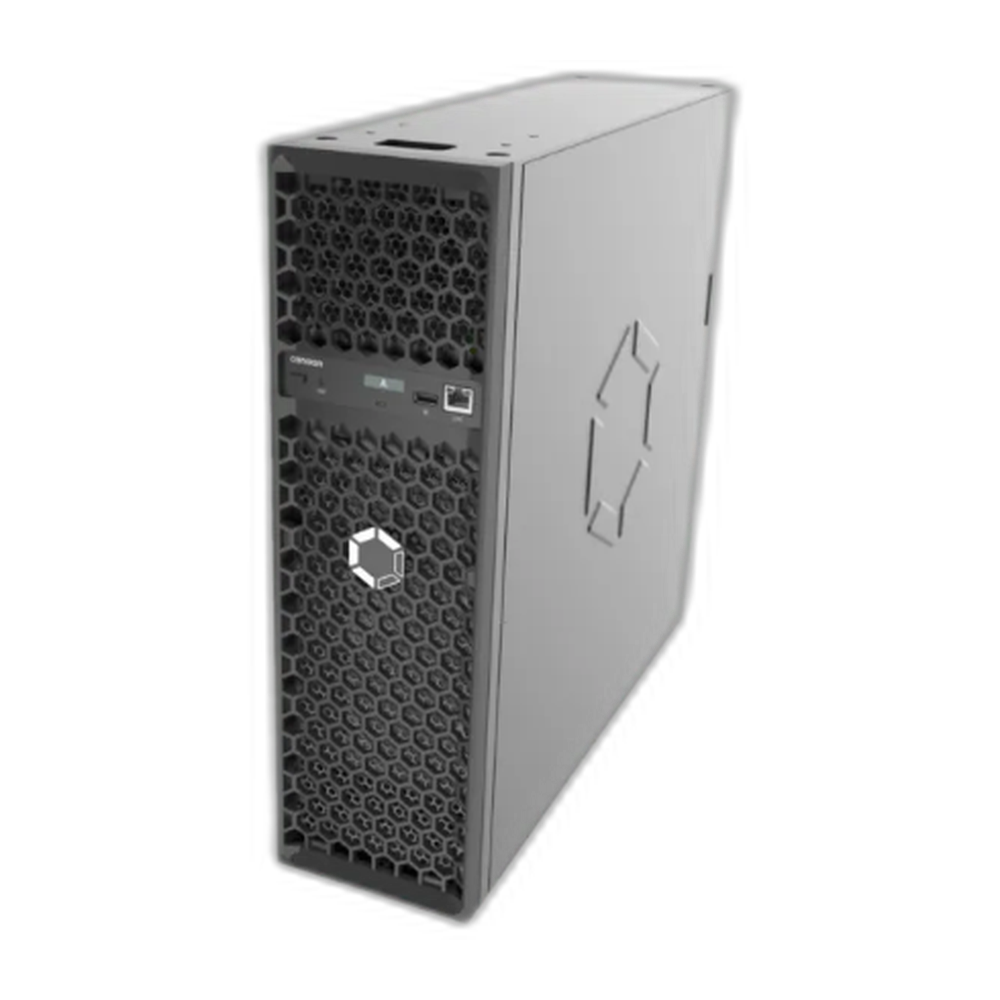
What each machine we stock would need
Grouped by what the generation requirement actually implies, smallest first.
Prices and stock are read from the shop as this page loads, so a machine showing
“price on request” here is genuinely quote-only rather than out of
date.
Every array figure below assumes 4.5 peak sun hours a day and a 80% whole-system derate; every battery figure assumes the bank has to carry the machine for 14 hours at 80% usable depth of discharge and 90% round-trip efficiency. Change any of those and the numbers move. At 6.0 peak sun hours - Arizona rather than Massachusetts - multiply every array figure by 0.75; at 3.5, the Pacific Northwest, multiply by 1.29.
Under 600 W: the band an ordinary home array can carry
A typical US residential solar system is about 7 kW DC. Everything in this table can be supplied around the clock by less than that, and the smallest of them by one or two panels. This is the only group where "I will run it on my solar" is a sentence with arithmetic behind it.
| Machine | Power at the wall | Energy per day | Array to run it 24/7 kW DC nameplate | Battery to carry the night rated kWh | Price |
|---|---|---|---|---|---|
| Bitaxe NerdQaxe++ 4.8TH/s Bitcoin Solo Miner BM1370 ASIC Fan 12V PSU NewThe only machine in the catalogue a single panel can carry, and the only one under 100 W you can buy outright today. It is a solo miner - read what that means on its listing before you buy one to "mine with solar", because the two decisions are unrelated.Wattage read from this listing: Its own copy: "roughly 60-80 W at the wall depending on how you tune it." Sized here off 80 W, the top of that range. | 80 W | 1.9 kWh | 0.5 kW | 1.6 kWh | $365.00 |
| IceRiver AE0 60 MH/s Aleo Miner – 100W zkSNARK ASIC, PSU IncludedShips with its PSU, which matters off-grid: one less DC-AC conversion to size for.Wattage read from this listing: Its own copy: "60 MH/s for about 100 W, with the power supply in the box." | 100 W | 2.4 kWh | 0.7 kW | 1.9 kWh | Price on request |
| Avalon Nano3s 6T – 6 TH/s Silent Bitcoin MinerBitmain-class efficiency it is not - 23.3 J/TH - but at 140 W it is the smallest full-node-class SHA-256 machine here. | 140 W | 3.4 kWh | 0.9 kW | 2.7 kWh | Price on request |
| Fluminer L2 1.2G – 1.2 GH/s Scrypt Miner | 280 W | 6.7 kWh | 1.9 kW | 5.4 kWh | Price on request |
| Goldshell Mini DOGE III 700M WiFi – 700 MH/s Scrypt Miner | 400 W | 9.6 kWh | 2.7 kW | 7.8 kWh | Price on request |
| Goldshell XT Box 580G Oct – 580 GH/s SHA3x ASIC Miner, 400W | 400 W | 9.6 kWh | 2.7 kW | 7.8 kWh | Price on request |
| Pinecone INI Box 850M – 850 MH/s InitVerse Miner, 480W, No PSUPublished as 480 W with a note on its own listing about a 480 W versus 500 W discrepancy. Sized here off 480 W; read that note. | 480 W | 11.5 kWh | 3.2 kW | 9.3 kWh | $1,128.70 |
| VolcMiner D1 Mini Pre 2.2G – Scrypt Miner 2.2 GH/s | 500 W | 12.0 kWh | 3.3 kW | 9.7 kWh | Price on request |
| IceRiver KS7 Lite 4.2T 500W Miner | Kaspa KHeavyHash | 500 W | 12.0 kWh | 3.3 kW | 9.7 kWh | Price on request |
| Goldshell AE-BOX II 54 MH/s Aleo Miner – 530W zkSNARK ASIC | 530 W | 12.7 kWh | 3.5 kW | 10.3 kWh | Price on request |
600 W to 2 kW: a large residential array, and only if the roof is already there
These need most or all of a full residential array to themselves, around the clock, before the house has been fed. Adding generation for a machine in this band is a capital decision of the same order as the machine; running one on surplus you already have is a different and much better decision.
| Machine | Power at the wall | Energy per day | Array to run it 24/7 kW DC nameplate | Battery to carry the night rated kWh | Price |
|---|---|---|---|---|---|
| ElphaPex DG Home1 2.1G – 2.1 GH/s Litecoin & Dogecoin Miner | 630 W | 15.1 kWh | 4.2 kW | 12.2 kWh | Price on request |
| Avalon Mini3 37.5T – High-Performance 37.5 TH/s Bitcoin Miner | 800 W | 19.2 kWh | 5.3 kW | 15.6 kWh | Price on request |
| Fluminer L1 Pro 6G – 6 GH/s Scrypt Miner | 1,400 W | 33.6 kWh | 9.3 kW | 27.2 kWh | Price on request |
| Avalon Q 90T – 90TH/s Bitcoin Miner | 1,674 W | 40.2 kWh | 11.2 kW | 32.6 kWh | $1,999.00 |
| Fluminer T3 115T – 115 TH/s SHA-256 Bitcoin Miner | 1,700 W | 40.8 kWh | 11.3 kW | 33.1 kWh | Price on request |
Over 2 kW: commercial-scale generation, not a rooftop
The array column here is a commercial installation and the battery column is a shipping container. If you are looking at this group, the question is not whether to add panels - it is whether you already sit on generation, curtailment or a load you can shed, and the machines are the cheap part of that project.
72 machines, every wattage taken from that machine's own published specification and every price read from the shop as this page loaded. Published power figures carry tolerances of +/-5% to +/-10% and a tuned machine draws what it is tuned to draw, so treat these as sizing figures and not as meter readings.
Which of these you can actually buy today
Worth saying plainly, because it shapes the answer more than any of the
arithmetic: ten of these machines draw under 600 W, and two of them
have a price. The band that a home solar array can genuinely carry is
also the band this catalogue is thinnest in, and most of it is quote-only.
The two you can buy outright are the
NerdQAxe++
at 80 W and the
Pinecone
INI Box at 480 W. Above them, the
Avalon Q at 1,674 W
is the largest machine you can buy here that a big residential array could carry
on its own, and it is the one we would point a serious home buyer at — its
listing publishes 45–65 dB, which makes it the quietest full-size
machine in the catalogue with a price on it, and that matters when it is going in
a building you live in. The rest of the priced stock is
used S19-class hardware in the
2.6–3.6 kW band, where solar stops being a roof decision.
The three different things people mean by “I’ll run it on solar”
1. “I already have panels on the roof.” If that
array is grid-tied and you are on net metering, adding a miner does not run it on
solar in any meaningful sense. Your generation does not change. What changes is
that you stop exporting and start consuming, and the honest comparison is
the credit you were getting for the export against what the machine
earns. That is often still a good trade — export credits are frequently
poor — but it is a different calculation from the one people think they are
doing, and it does not need a battery or a bigger array.
2. “I’m off grid.” Then the tables above are
your shopping list, the battery column is real, and the honest answer is that
only the small end of this catalogue is on the table. A 3 kW machine will
dominate an off-grid system that also has to run a house.
3. “I have generation and nowhere to put it.”
Curtailment, an oversized commercial array, a site with an interconnection limit.
This is the case where mining genuinely is the best available answer, because the
alternative is throwing the energy away — and it is the case where the
machines are the cheap part of the project. If this is you, the useful reading is
how the different
farm types handle the power problem, and then a conversation about fleet
pricing rather than a single machine.
What we would tell you on the phone
Buy the machine that fits the generation you already have.
Nearly everybody arrives having picked the miner first and then asks what array
it needs. Doing it the other way round is cheaper every time: take your surplus
in kilowatts, look at the wattage column, and buy from the band you can actually
feed.
Do not buy a battery bank to keep a miner running at night.
Of everything on this page this is the one we would argue hardest. A battery
sized to carry a 3 kW machine through the dark is a large capital purchase
whose only job is to let a depreciating machine hash while you sleep. Run it in
daylight. If you want more hashes, another panel is almost always a better buy
than another kilowatt-hour of storage.
Solar does not rescue a machine that is already marginal. If a
miner does not pay at the electricity price you would otherwise be on, cheap
daytime power extends its life rather than changing the verdict — and a
machine running four hours a day earns four hours a day. The
comparison table is where to check
efficiency before you commit, and
the power-price ranking is
where to find the rate at which each machine stops making sense.
The 80 W machine is not a small version of the 3 kW
machine. The NerdQAxe++ is a solo miner. Running it on one panel is a
genuinely charming project and it is not an income plan, and those two facts are
unrelated to each other. Read the listing.
Everything else about the machine still applies. Solar changes
where the electricity comes from and nothing else: the
circuit and voltage the machine
needs are unchanged, the
heat still has to go somewhere, and a
3 kW miner is still somewhere around 70–80 dB whether the
electrons came off a roof or out of a socket. If the room is the constraint,
start with
what these machines actually sound
like.
Frequently asked questions
How many solar panels does it take to run an Antminer S19?
About forty-eight, and a battery bank as well. A used S19 in our catalogue draws 3,250 W at stock settings, which is 78 kWh a day. Supplying that around the clock takes roughly a 21.7 kW DC array – about 48 modules at 450 W each – plus about 63 kWh of usable battery to carry the machine overnight. Those figures assume 4.5 peak sun hours a day and an 80% whole-system derate; in Arizona at 6.0 peak sun hours the array drops to about 16.3 kW, and in the Pacific Northwest at 3.5 it rises to about 27.9 kW.
Can I run a Bitcoin miner on solar without batteries?
Yes, and for most people it is the better answer – but understand the duty cycle. An array sized only to carry the machine at midday runs it for about the number of peak sun hours in your location, which on our 4.5-hour assumption is under a fifth of the day. You are not buying a machine that mines less efficiently; you are buying a machine that mines for four or five hours and sits dark for the rest. That is a legitimate way to run a miner off surplus generation, and it is far cheaper than the battery bank that would fix it. It is not the same purchase as a machine that runs continuously.
What is the smallest Bitcoin miner I can run on solar?
The NerdQAxe++ at about 80 W, which needs roughly a 0.5 kW array – one or two modules – and about 1.6 kWh of battery to run overnight. It is the only machine in our catalogue a single panel can carry. Read its listing before you buy one on that basis, though: it is a solo miner, which is a lottery ticket rather than a yield, and that decision has nothing to do with how it is powered. The Avalon Nano3s at 140 W and the IceRiver AE0 at 100 W sit in the same band.
Does solar make Bitcoin mining profitable?
It changes what a kilowatt-hour costs you, and nothing else. We do not publish a profitability figure here, because any such number is wrong within a week – difficulty and the coin price both move. What you can do is work out the all-in cost of a solar kilowatt-hour where you live, including the capital amortised over the array’s life, and compare it against the electricity price at which the machine you are looking at stops paying. That threshold is per machine and it is the number that decides this.
Can I mine Bitcoin completely off grid?
For small machines, yes. For a modern SHA-256 miner, you are building a commercial installation: the 3 kW to 4 kW machines in our catalogue need 20-26 kW of array and 60-76 kWh of storage each to run around the clock, and the hydro machines need two to three times that. Off-grid is a real answer at the small end of this catalogue and a capital project at the large end.
Is it cheaper to run a miner on solar than on grid power?
Sometimes, and it depends on a number we cannot look up for you: your installed cost per watt. We sell miners, not panels, so we are not going to quote a solar price. What we will say is that the comparison people usually make is the wrong one. If you already have a grid-tied array and net metering, adding a miner does not run it on solar – it stops you exporting, and the real comparison is your export credit against what the machine earns.
Where to go next
Everything we stock is the full shelf. If you have
worked out the band you can power, the
comparison table sorts it by efficiency and
running cost, and power
requirements tells you what circuit each one lands on. If a number here does
not match what you have been quoted for an array, call
and tell us what you are working with — the
wattage is the only part of this we can be certain about, and it is the part we
publish.