
Avalon Q vs Antminer S19 XP: What Quiet Actually Costs
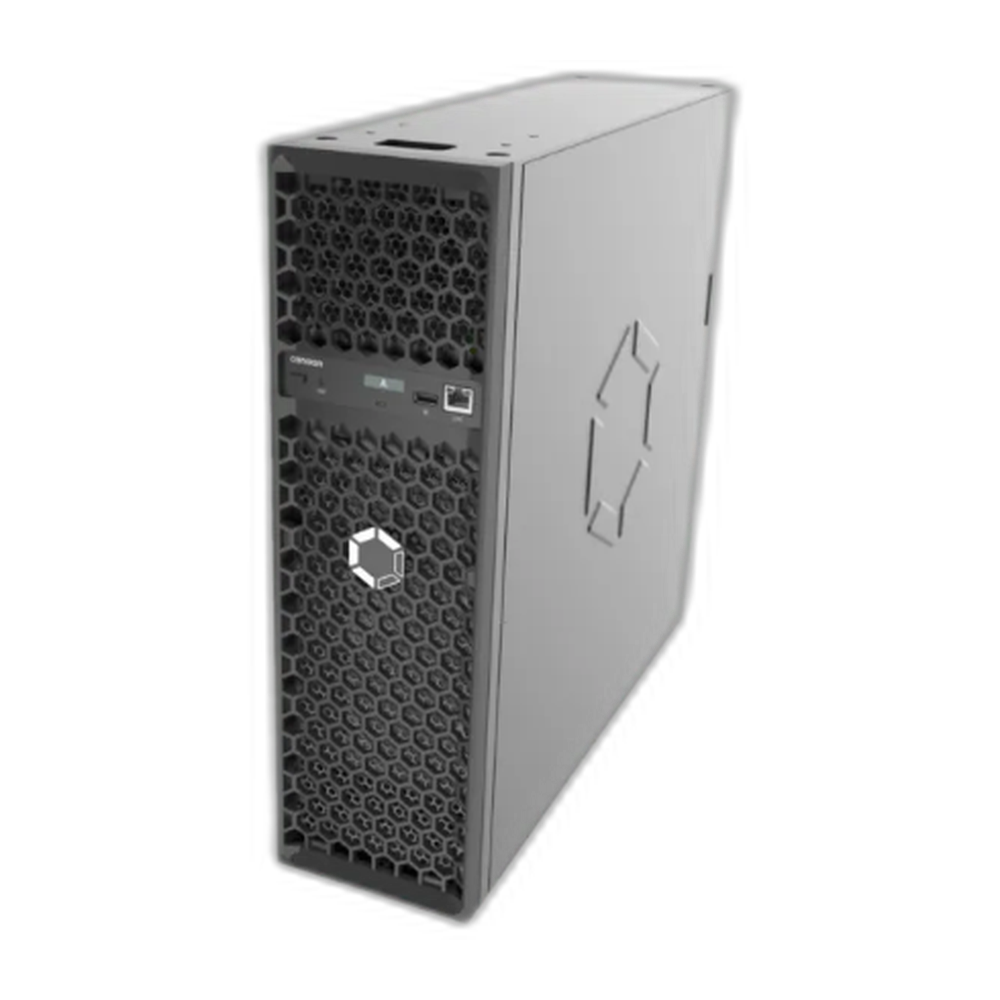
If the machine is going in a garage, a shed, a warehouse or a hosted rack, buy the refurbished Antminer S19 XP and do not think about it again. In the Avalon Q vs Antminer S19 XP question it wins on the only number that decides a hardware purchase: it costs $4.96 per terahash against the Canaan Avalon Q‘s $22.21. The Avalon Q is the better-engineered machine and the more efficient one, and it is still the wrong purchase for almost everybody — because the one thing it is genuinely worth paying for is permission to install it somewhere the S19 XP is not allowed to go.
That is the whole comparison in a paragraph. The rest of this page shows the arithmetic, including the part that surprised us: the Avalon Q’s efficiency advantage is real, and it never pays for itself.
The two machines, as they actually sit on our shelf
| Canaan Avalon Q 90T | Antminer S19 XP 141T | |
|---|---|---|
| Our price | $1,999.00 — new | $699.99 — refurbished |
| Hashrate | 90 TH/s | 141 TH/s |
| Wall power | 1,674 W | 3,010 W |
| Efficiency | 18.6 J/TH | 21.35 J/TH (Bitmain publishes 21.5) |
| Capital per TH/s | $22.21 | $4.96 |
| Input voltage | 110–240 V, integrated PSU | 200–240 V only |
| Noise | 45–65 dB by power mode | ~75 dB, four fans |
| Heat | 5,712 BTU/hr | 10,270 BTU/hr |
| Weight | 10.5 kg net | 14.2 kg net, 16 kg gross |
| Warranty | Canaan 360 days from first device registration | None — this model first shipped July 2022 |
Both are SHA-256 machines mining the same coin on the same network, which is what makes this comparison legitimate at all. Joules per terahash only means something between machines running the same algorithm — a rule we apply strictly enough that our own Kaspa listings refuse the comparison outright. Here, the units line up and the numbers can be argued with directly.
The number that decides it: $4.96 a terahash against $22.21
Hashrate is the thing you are buying. Everything else — efficiency, noise, voltage — is a constraint on how cheaply you can operate what you bought. On the primary number the S19 XP is 4.47× cheaper, and that is not a close enough margin for a spec-sheet advantage to overturn.
Put $7,000 on the counter today and the shelf answers plainly:
- 10 × Antminer S19 XP — 1,410 TH/s drawing 30.1 kW
- 3 × Avalon Q — 270 TH/s drawing 5.0 kW
Same money, 5.2× the hashrate. The Avalon Q’s answer to this is that it uses a sixth of the power, and that is a real answer — it just is not worth what it costs. The next two sections are that argument in full.
Where the Avalon Q genuinely wins
At 18.6 J/TH against 21.35, the Avalon Q is 13% more efficient. That is not marketing; it is a straight consequence of newer silicon, and it has a specific consequence: the Avalon Q keeps covering its own electricity at a higher power price than the S19 XP does.
| Electricity rate | Avalon Q net | Antminer S19 XP net |
|---|---|---|
| 3¢/kWh (own cheap power) | +$49/mo | +$68/mo |
| 4.96¢/kWh — the crossover | identical | identical |
| 6.09¢/kWh | +$11/mo | $0 — break-even |
| 6.99¢/kWh | $0 — break-even | −$20/mo |
| 9¢/kWh (top of the hosted band) | −$25/mo | −$64/mo |
| 18.44¢/kWh (US residential average) | −$140/mo | −$271/mo |
Two boundaries matter here. Below 4.96¢/kWh the S19 XP’s extra 51 TH/s earns more than its extra 1,336 W costs, so it nets more per day as well as costing less to buy. Above that rate the Avalon Q nets more per day. And between 6.09¢ and 6.99¢ there is a genuine band — 0.90¢ wide — where the Avalon Q is still covering its power bill and the S19 XP has stopped.
That band is the strongest honest argument for the Avalon Q, and we are not going to oversell it. It is nine tenths of one cent.
The efficiency premium never repays itself
Here is the test that settles it, and it is the one a spec-sheet comparison never runs. The Avalon Q costs $17.25 more per TH/s of capital. It gives back 2.75 J/TH, which is 0.066 kWh saved per TH/s per day. So: how long until the electricity it saves pays back the extra you spent on it?
| Electricity rate | Years for the Avalon Q premium to repay |
|---|---|
| 3¢/kWh | 23.9 years |
| 5¢/kWh | 14.3 years |
| 6.09¢/kWh — where the S19 XP stops paying | 11.8 years |
| 6.99¢/kWh — where the Avalon Q stops paying | 10.2 years |
| 18.44¢/kWh — where both lose money outright | 3.9 years |
At every electricity price where either machine is worth switching on, the premium takes more than a decade to repay. No ASIC has a ten-year economic life — we have written separately about the gap between an ASIC’s physical and economic lifespan, and the economic one runs out first, usually well inside five years. The only rates at which the premium repays inside a plausible service life are rates at which you are losing $140 a month anyway.
So the efficiency is real, and it is not a reason to buy this machine. Anyone selling you an Avalon Q on its J/TH figure has not done this division.
Payback, which is the number you should actually shop on
Capital repayment tells the same story from the other end. Days to earn back the purchase price, at today’s inputs:
| Electricity rate | Avalon Q | Antminer S19 XP |
|---|---|---|
| 2¢/kWh | 997 days | 237 days |
| 3¢/kWh | 1,246 days | 313 days |
| 4¢/kWh | 1,663 days | 463 days |
| 5¢/kWh | 2,497 days | 887 days |
| 7¢/kWh and above | never | never |
The S19 XP repays three to four times faster at every rate where either repays at all — 4.2× at 2¢ power, narrowing to 2.8× at 5¢ as the S19 XP’s larger power bill starts to bite. At 3¢ it is back in ten months and the Avalon Q is still three and a half years out — by which time the machine is a different kind of asset entirely.
Today’s numbers, and the date on them
Every figure above rests on four inputs, read on 16 August 2026:
- Hashprice $31.21 per PH/s per day — derived here, not copied, from the measured total reward across the last 144 blocks including fees
- Difficulty 127.48 T, confirmed against two independent sources to the digit
- Bitcoin $63,002, the median of three price feeds
- Network ~912 EH/s implied
Electricity references: 18.44¢/kWh US residential average (EIA Table 5.3, May 2026), and 6.5–9¢/kWh all-in for hosted power, taken from rates four named US hosts publish on their own pages.
These move. Hashprice fell about 3.5% in the six days before this was written, and every fall widens the loss on the more power-hungry machine faster. To re-run any figure here: multiply the payback days by today’s hashprice divided by $31.21. Difficulty is estimated to retarget about −1.9% in roughly 960 blocks, which would help both machines slightly. We do not publish forward earnings projections, because nobody can honestly make one.
Buying more than one makes the gap worse, not better
Most of what we sell goes out as used hardware in lots, so the fleet arithmetic is the version that matters to most of our buyers. Normalise both machines to one megawatt of wall power — the constraint an operator actually builds against:
| Per 1 MW of wall power | Avalon Q 90T | Antminer S19 XP 141T |
|---|---|---|
| Machines | 597 | 332 |
| Hashrate | 53.8 PH/s | 46.8 PH/s |
| Capital | $1,194,000 | $233,000 |
The Avalon Q delivers 15% more hashrate for 5.1× the capital. On a megawatt build that is $961,000 of extra spend to buy 7 PH/s, in a business where the constraint is almost always capital rather than power. It also means 597 machines to rack, cable, monitor and eventually repair instead of 332 — and 597 warranties to register within Canaan’s 360-day window.
There is no fleet case for the Avalon Q. If your problem is a hard megawatt ceiling and unlimited money, the honest answer is not the Avalon Q either — it is a current-generation machine at 15 J/TH or better, and we work that comparison through in Antminer S19 XP vs S21 Pro. Our cost-per-megawatt page carries the same arithmetic across the whole used shelf.
What the $1,299 actually buys: a circuit and a noise floor
Strip out the efficiency argument, which we have just shown does not pay, and the Avalon Q’s premium buys exactly two things. Both are real, and for some buyers they are decisive.
It runs on a North American household circuit. The Avalon Q takes 110–240 V with an integrated supply. At 120 V and full 1,674 W it draws 13.95 A, so it needs a dedicated 20 A circuit and a NEMA 5-20R outlet — a miner is a continuous load and the NEC lets a breaker carry 80% of its rating, which puts a standard 15 A circuit out of reach. At 240 V it drops to 6.97 A and the wiring stops being the limiting factor. The S19 XP has no 120 V mode at all: 200–240 V only, 12.54 A at 240 V, also a 20 A circuit, and on a 208 V commercial feed it pulls 14.47 A. There is no adapter that changes this. If all you have is a bedroom outlet, the S19 XP is not a cheaper option — it is not an option.
It is quiet enough to be near people. 45–65 dB against a flat ~75 dB. Read that honestly, though, and our own listing does: 45 dB is the Eco mode figure, not the 90 TH/s one. The power modes are roughly Eco 800 W, Standard 1,300 W, Super 1,674 W, and Canaan does not publish hashrate per mode — so the quiet number and the fast number are not the same operating point. At full output the Avalon Q is around 65 dB, which is a loud conversation that never stops. Quieter than an Antminer by a wide margin; still not furniture.
Heat is the third thing nobody plans for: 5,712 BTU/hr from the Avalon Q, 10,270 BTU/hr from the S19 XP. The S19 XP puts out roughly what a small domestic heater does, continuously. Our power requirements page covers circuit sizing and heat load properly, and the cooling page covers what you have to build around it.
Condition, warranty, and what refurbished means here
This is a new machine against a second-hand one, and pretending otherwise would make the price comparison dishonest.
The Avalon Q is new stock with Canaan’s 360-day warranty, counted from first device registration rather than from purchase — so register it the day it lands or you are giving away cover you paid for.
The S19 XP is professionally refurbished and bench-tested, and it carries no manufacturer warranty. The model first shipped in July 2022; any factory cover expired years ago. Refurbished on our bench means cleaned, re-pasted, tested at the stated hashrate and shipped working — it does not mean new, and it does not mean a warranty. Ask us for the test method, the DOA window and the return terms in writing before you order, and we will put them in writing. On a lot, ask how many units the DOA allowance covers.
The honest way to hold this: a $699.99 machine with no warranty and a four-times-faster payback carries a different risk profile from a $1,999 machine with 360 days of cover, and the S19 XP’s payback is fast enough to absorb a failure that the Avalon Q’s is not. We wrote the general version of this argument in used vs new ASIC miners, including what repairs actually cost and when a unit is not worth fixing.
Freight, and what turns up on the pallet
The S19 XP is 14.2 kg net but 16 kg gross, and freight is quoted on gross, not net. The Avalon Q is 10.5 kg net; Canaan does not publish a boxed weight, so we will not invent one. Per machine the S19 XP costs more to ship, and across a pallet that difference is real money — it does not come close to closing a 4.47× gap in capital cost, but budget for it rather than being surprised. Shipping for any specific item is on our shipping and delivery page, and receiving a used miner lot covers what to photograph and check the day a pallet arrives.
Neither listing includes anything not named on it. The Avalon Q has an integrated PSU so there is no separate supply to buy; on the refurbished S19 XP, confirm cords and plug standard with us before you pay rather than assuming.
So which one should you buy?
Buy the Antminer S19 XP if the machine will live in a garage, shed, outbuilding, workshop, warehouse or hosted rack; you have or can run a 240 V, 20 A circuit; 75 dB is nobody’s problem; and your electricity is under about 6¢/kWh. That is most buyers, and at $4.96 a terahash it is not a close decision. If you are buying more than one, this is the answer — there is no volume at which the Avalon Q’s economics improve.
Buy the Canaan Avalon Q if the machine has to go where people are: a house, an apartment, an office, a room with a 120 V outlet and neighbours. It is the only one of the two you can physically install there, and that is worth paying for when it is true. Buy it knowing you are paying for siting, not for efficiency, and knowing that at the US residential average it loses about $140 a month. At residential rates this is a heat-and-hobby purchase or a bet on price, not an investment — and it is a defensible one, as long as you have decided that on purpose. If your power is your own and cheap — solar, hydro, curtailed gas — the picture changes for both machines, and the Avalon Q’s narrow 6.09–6.99¢ band is where it earns its keep.
Buy neither if you are shopping on residential grid power and expecting profit. Both lose money there. That sentence costs us sales and it is still the correct advice.
The machine we would actually point most people at
If the S19 XP is the right shape for you, look at the used Antminer S19k Pro at $379.99 before you commit. It is 115 TH/s at 23 J/TH — less efficient than both machines here — but it costs $3.30 per TH/s against the S19 XP’s $4.96, and per dollar of capital that is a wider margin than the efficiency gap costs you at most power rates. We ran that comparison properly in Antminer S19k Pro vs S19 XP, and there is a ten-unit lot if you are buying at volume. Telling you about a cheaper machine on a page about two others is the point of writing these.
The full shelf is on compare ASIC miners, with the used miners and Avalon shelves alongside. Recent used sale prices are on what used miners actually sold for.
Questions buyers ask about this comparison
Is the Avalon Q more efficient than the S19 XP?
Yes. 18.6 J/TH against 21.35 J/TH, about 13% better. It does not follow that it is the better buy: the extra capital that efficiency costs takes between 10 and 24 years to repay at any electricity rate where either machine is profitable, which is longer than an ASIC’s economic life.
Can I run an Antminer S19 XP on a normal household outlet?
No. It takes 200–240 V only and there is no adapter or configuration that makes a North American 120 V outlet work. The Avalon Q accepts 110–240 V, and at 120 V it draws 13.95 A, which needs a dedicated 20 A circuit and a NEMA 5-20R outlet — not a standard 15 A one.
How much quieter is the Avalon Q really?
45–65 dB against roughly 75 dB, depending on power mode. The 45 dB figure is the Eco mode, not the 90 TH/s mode; Canaan does not publish hashrate per mode. At full output expect around 65 dB, which is much quieter than an Antminer but still too loud for a room where people sleep.
Which pays for itself faster?
The S19 XP, by three to four times, at every electricity rate where either pays back at all. At 3¢/kWh it repays in about 313 days against the Avalon Q’s 1,246. Above about 7¢/kWh neither repays, because neither covers its power bill. Figures are at 16 August 2026 inputs and move daily.
Does the S19 XP come with a warranty?
No. It is professionally refurbished and bench-tested, and it carries no manufacturer warranty — the model first shipped in July 2022. The Avalon Q is new and carries Canaan’s 360-day warranty, counted from first device registration rather than from the date you buy it. Ask us in writing for the test method, DOA window and return terms on any used unit.
Which is better for a fleet or a lot purchase?
The S19 XP, decisively. Per megawatt of wall power the Avalon Q needs 5.1 times the capital to deliver 15% more hashrate, and it puts 597 machines in the building instead of 332. There is no order size at which the Avalon Q’s economics improve.
What would change this verdict?
A large fall in the Avalon Q’s price, or a sustained rise in electricity prices into the 6.09–6.99¢ band where only the Avalon Q covers its power. A rising hashprice helps the S19 XP more than the Avalon Q, because it earns on 51 more TH/s. A falling hashprice hurts the S19 XP more, because it burns 1,336 more watts to do it.