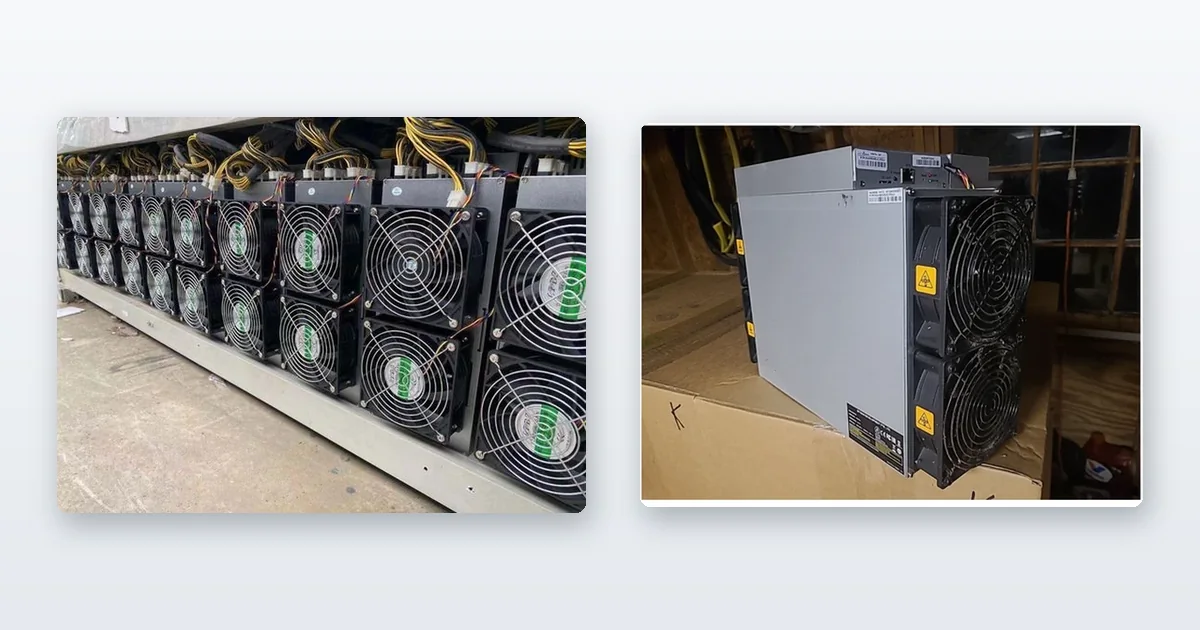
A Bitcoin block is a list of transactions plus an 80-byte header,
and your miner only ever touches the header. It changes four bytes of it, hashes
those 80 bytes twice with SHA-256, checks whether the result is a number below a
target, and repeats — about 95 trillion times a second on a used Antminer S19.
That is the entire job. Everything else written about blockchain is true and
almost none of it changes what you should buy.
We buy, test, repair and resell this hardware, so this is the version we give
someone before they spend money: what the chain is, what the machine does to it,
and the three chain-level numbers that land on your power bill.
What is actually inside a block
A block has two parts. The body is a list of transactions. The header is 80
bytes and contains six fields:
- Version (4 bytes) — which consensus rules this block follows.
- Previous block hash (32 bytes) — the hash of the block before
it. This single field is what makes it a chain: change any old block and
every hash after it breaks. - Merkle root (32 bytes) — one hash that commits to every
transaction in the body. Change one transaction and this changes. - Timestamp (4 bytes).
- Bits (4 bytes) — the current difficulty target, encoded.
- Nonce (4 bytes) — the only field that exists purely to be
changed at random.
The first transaction in the body is the coinbase transaction,
and it is the one that pays you. It creates the block subsidy out of nothing —
3.125 BTC since the April 2024 halving — and collects the transaction fees from
everything else in the block. There is no other way a new bitcoin comes into
existence; the detail is in where new bitcoins come
from.

What your machine physically does
The miner takes those 80 bytes, runs SHA-256 over them, then runs SHA-256 over
the result. It reads the 256-bit output as a number and asks one question: is it
below the target? Almost always the answer is no, so it increments the nonce and
tries again.
The nonce is four bytes, which is about 4.3 billion values. A refurbished Antminer
S19 at 95 TH/s burns through all 4.3 billion of them in roughly 45
microseconds. So the nonce alone is nowhere near enough search space, and the
machine also varies an extranonce inside the coinbase transaction, which
changes the merkle root, which gives it a fresh 4.3 billion nonces to try. That
loop is what the fans are cooling.
This is also why a graphics card is not slow at mining Bitcoin — it is
irrelevant to it. An ASIC is silicon that can do this one operation and literally
nothing else. A Canaan
Avalon Q puts 160 chips on the problem at 18.6 J/TH. The comparison is
covered properly in ASIC vs
GPU mining.
Nobody “solves a complex mathematical problem”
That phrase appears in almost every beginner’s guide and it makes the work
sound like something a clever machine could shortcut. It cannot. There is no
method, no partial credit and no way to be smart about it — SHA-256 is designed
so that the only way to find an input producing a small enough output is to try
inputs. It is a lottery where a terahash per second buys a trillion tickets a
second, and the network prints new tickets as fast as buyers arrive.
That is the honest reason efficiency is the only spec that matters long-term.
You cannot out-think the problem. You can only buy more tickets per joule.
The three chain numbers that reach your power bill
Difficulty adjusts every 2,016 blocks — roughly two weeks —
so that blocks keep arriving about every ten minutes no matter how much hardware
is plugged in. As of 29 July 2026 it is 126.23 T, the last
retarget moved it -0.74%, and the next one is estimated at
-4.46% with 1,548 blocks to go (mempool.space). When other
people buy machines, your machine earns less. Nothing about your machine
changed.
The block subsidy halves every 210,000 blocks. It has gone 50,
25, 12.5, 6.25 and now 3.125 BTC, with the next cut expected around 2028. Any
guide still quoting 6.25 is describing a different economy. The halving is the
only event that halves industry revenue overnight while leaving its electricity
costs identical, which is exactly why the secondary market floods with good used
machines after each one.
Fees are the rest of the coinbase transaction, and they are
currently small — about 0.69% of the block reward. They matter because the
subsidy is temporary and fees are permanent, but they are not a rounding error
you should build a purchase around today.
Roll those three together and you get hashprice: what the
network pays per unit of hashrate per day. On 29 July 2026 it is
$32.21 per PH/s per day, derived from a difficulty of
126,231,507,121,868, a BTC price of $64,223 and that 0.69% fee share. It is the
number that turns a spec sheet into a decision, and it has its own page — what a miner actually
earns.
What this means when you buy
Break-even electricity price is hashprice divided by (24 x J/TH). Below that
rate the machine makes money on power; above it, it burns money on power, and no
firmware tune fixes a number on the wrong side of the line. Here is that
arithmetic against machines actually on our shelf today, using their own
published efficiency:
| Machine | Efficiency | Break-even power price |
|---|---|---|
| Bitdeer SealMiner A2 Pro Air 255T | 14.9 J/TH | 9.0 ¢/kWh |
| Antminer S21+ 216T | 16.5 J/TH | 8.1 ¢/kWh |
| Avalon Q 90T | 18.6 J/TH | 7.2 ¢/kWh |
| Antminer S19 XP 141T | 21.4 J/TH | 6.3 ¢/kWh |
| Antminer S19k Pro 120T | 23.0 J/TH | 5.8 ¢/kWh |
| Antminer S19 95T | 34.2 J/TH | 3.9 ¢/kWh |
The uncomfortable line under that table: the US residential average is
18.44 ¢/kWh (EIA, May 2026). Not one machine on
that list breaks even on average household power, and that is true of
every machine anyone sells, not just ours. Home mining works where power is
genuinely cheap, where the heat is displacing a heating bill you were paying
anyway, or where you have decided the hobby is worth the cost. Those are all
defensible. “It pays for itself on normal power” is not.
Notice also that the cheapest machine has the hardest break-even.
That is the whole trade: a $250 S19 is affordable to buy and expensive to run;
a $4,200 S21-class machine is the reverse. Which side of that you want depends
entirely on your power price, and it is worked through in the ASIC
miner buying guide and in how to buy a used ASIC
miner without getting burned.
What “decentralised” and “immutable” actually buy you
Both words are accurate and neither should influence your purchase. Immutable
means nobody rewrites old blocks — useful, not a spec. Decentralised means no
single party controls issuance — useful, not a spec. The property that does
affect you is duller: because the rules are enforced by everyone independently,
nobody can change what your machine earns as a favour to you.
Difficulty will rise when it rises. The subsidy will halve on schedule. There is
no appeal, no support ticket and no relationship that helps.
Plan for hardware on that basis and you will not be surprised. That is the
actual practical value of understanding the chain.
Ready to look at machines? Start with the full catalogue or the used ASIC
miners, and if you want the shopping list version first, read what you need
to start mining Bitcoin.
Frequently Asked Questions
What is the difference between Bitcoin and blockchain?
Blockchain is the data structure; Bitcoin is one network that uses it. A block is a list of transactions plus an 80-byte header, and each header contains the hash of the previous block, which is what chains them together. Bitcoin adds the rules around that structure: a fixed issuance schedule, proof-of-work mining, and a difficulty adjustment every 2,016 blocks. For a hardware buyer the distinction rarely matters — what matters is the issuance schedule and the difficulty, because those two decide what a machine earns.
What does a Bitcoin miner actually calculate?
It hashes an 80-byte block header twice with SHA-256 and checks whether the result is below the current target. If not, it changes the 4-byte nonce and repeats. There is no shortcut and no partial progress — SHA-256 is built so the only way to find a qualifying input is to try inputs. A 95 TH/s machine exhausts all 4.3 billion nonce values in about 45 microseconds, then varies an extranonce in the coinbase transaction to get a fresh batch.
Why can’t a GPU or a CPU mine Bitcoin competitively?
Because an ASIC is silicon built to do double-SHA-256 and nothing else, so it is orders of magnitude more efficient per joule. The comparison is not close and has not been since 2013. GPUs remain relevant on other algorithms, but for SHA-256 a graphics card will spend far more on electricity than it earns, at any power price.
What is the Bitcoin block reward in 2026?
3.125 BTC per block, plus the transaction fees in that block. The subsidy halved from 6.25 to 3.125 in April 2024 and the next halving is expected around 2028. Fees are currently a small share of the total — about 0.69% of the block reward at the end of July 2026 — so the subsidy is still almost all of mining revenue.
How does network difficulty affect what my miner earns?
Directly and continuously. Difficulty retargets every 2,016 blocks, about every two weeks, so that blocks keep arriving roughly every ten minutes regardless of how much hardware is running. When difficulty rises, your share of the same reward falls even though your machine is unchanged. On 29 July 2026 difficulty was 126.23 T, the previous retarget was -0.74% and the next was estimated at -4.46%.
At what electricity price does mining stop making sense?
Break-even in dollars per kWh is hashprice divided by (24 x J/TH). At a hashprice of $32.21 per PH/s per day on 29 July 2026, a 14.9 J/TH machine breaks even at about 9.0 c/kWh and a 34.2 J/TH machine at about 3.9 c/kWh. The US residential average is 18.44 c/kWh (EIA, May 2026), so no current machine breaks even on average household power. Re-run the arithmetic on the day you buy, because hashprice moves daily.