
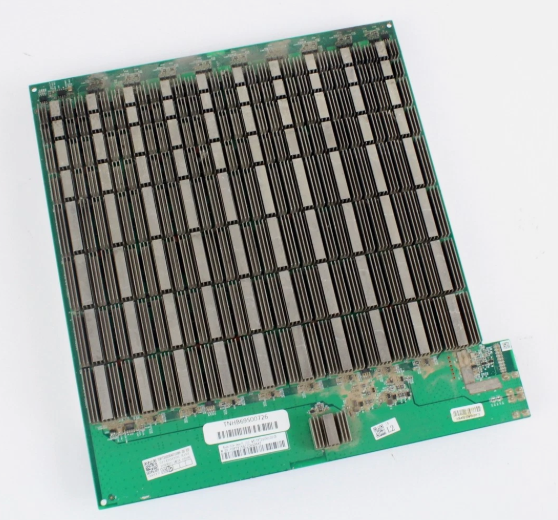
Every bitcoin in existence was paid to a miner. There is no other source. No pre-mine, no treasury, no issuing authority — the only way a new coin enters circulation is as the reward for finding a valid block. That single fact makes the issuance schedule the most important long-run number in mining economics, and it is written into the software rather than decided by anyone.
We sell the machines that do that work, so here is the schedule, what it has already done to the price of the hardware on our own shelves, and what it does next.
The block subsidy: where new bitcoins come from
Bitcoin was launched in 2009 by the pseudonymous Satoshi Nakamoto. Roughly every ten minutes, one miner finds a valid block and receives two things:
- The block subsidy — newly created bitcoin, issued by the protocol itself
- The transaction fees paid by everyone whose transactions are in that block
The subsidy is the newly issued part. The fees are not new coins; they are existing coins changing hands. Together they are the block reward, and together they are the entire income of the mining industry.
What the subsidy is actually worth, measured
Numbers read live on 30 July 2026, because this section is meaningless without them:
- 3.125 BTC per block, and 146 blocks were found in the preceding 24 hours — 456.25 new BTC, about $29.2 million at $63,960 a coin. That is the mining industry’s daily gross revenue from issuance.
- Fees added about $224,000 over the same day, across roughly 704,000 transactions. That is 0.76% of miner revenue. The subsidy is not the main part of the reward; it is essentially all of it.
- Spread across a network running at about 917 EH/s, that whole payout works out at $32.10 per PH/s per day — the number the industry calls hashprice, and the one every purchase on this site should be checked against.
The chain of causation is worth stating plainly, because most explanations stop before it: the issuance schedule sets total revenue, the network’s hashrate divides it, and what falls out is what your machine earns. You cannot influence the first, you compete against the second, and the third is what pays your power bill. Hashprice is unpacked in what a miner actually earns.
The halving, and why it is the defining event in mining
Every 210,000 blocks — roughly four years — the block subsidy is cut in half. This is not a policy decision that gets debated. It is arithmetic in the code, and it has happened on schedule every time.
- 2009: 50 BTC per block
- 2012: 25 BTC
- 2016: 12.5 BTC
- 2020: 6.25 BTC
- April 2024: 3.125 BTC — the current subsidy
- Block 1,050,000: 1.5625 BTC — on 30 July 2026 the chain stood at block 960,216, so that is about 89,800 blocks away, or roughly 20 months at ten minutes a block, putting it in the first half of 2028
A halving is the only event that instantly halves the industry’s revenue overnight without any change to its costs. Nothing about the electricity bill changes; nothing about the machines changes; the payout simply drops by half. That is why every halving is followed by older, less efficient hardware being switched off and sold — and it is a large part of why the used market exists at all. A meaningful share of the used machines we resell reached the secondary market for exactly this reason.
Note that stale information about this is common. Plenty of pages online still quote 12.5 or 6.25 as the current reward. Anything written before April 2024 that has not been updated is describing a different economy from the one you would be buying into.
What 2028 does to your break-even, in one table
Break-even electricity price is hashprice ÷ (24 × J/TH). Since the subsidy is 99.2% of hashprice, halving the subsidy halves the number your power price has to beat. Holding difficulty and the coin price at their 30 July 2026 values, this is what the schedule alone does:
| Machine | Efficiency | Break-even now | After the 2028 cut |
|---|---|---|---|
| SealMiner A2 Pro Air 255T | 14.9 J/TH | 8.98 ¢/kWh | 4.52 ¢/kWh |
| Antminer S21 Pro 234T | 15.0 J/TH | 8.92 ¢/kWh | 4.49 ¢/kWh |
| Canaan Avalon Q 90T | 18.6 J/TH | 7.19 ¢/kWh | 3.62 ¢/kWh |
| Antminer S19k Pro 120T | 23.0 J/TH | 5.82 ¢/kWh | 2.93 ¢/kWh |
| Used Antminer S19 95T | 34.2 J/TH | 3.91 ¢/kWh | 1.97 ¢/kWh |
Read the right-hand column as a warning, not a prediction. Difficulty and the coin price have never stayed still across a halving, and either can move the result in either direction — the 2024 halving was followed by a higher coin price that offset a good deal of the cut. What the table does show honestly is which side of the line each machine starts on. At the US residential average of 18.44¢/kWh (EIA, May 2026), every machine here is already under water on grid power today; the question a halving settles is whether hardware that works at 5¢ still works at 3¢.
The rule we give buyers: if a machine only pays for itself on today’s subsidy, it does not pay for itself. Run the division at half the current hashprice before you buy anything you intend to keep past 2028. The method is in the break-even arithmetic.
What the last halving did to the price of a machine
The clearest evidence for what a halving does to hardware is what the hardware costs afterwards, and we can quote our own shelf rather than someone’s chart.
The Antminer S19 95TH/s was flagship equipment in the 2021 build-out. Two years past the April 2024 halving, a tested used one on a low-power tune is $159.99 here. Bought three hundred at a time the per-machine figure is quoted rather than listed. Nothing is wrong with them. They hash exactly as designed.
They are priced that way because of one number. A stock S19 at 95 TH/s draws about 3,250 W — 34.2 J/TH, break-even 3.91¢/kWh. The 2,800 W tune on that $159.99 unit brings it to 29.5 J/TH and 4.54¢/kWh, which is what half a cent of break-even is worth in practice and why we bother tuning them. Either way, the operators who paid flagship money for these machines do not have power at 4¢.
That is the trade the halving creates, and it runs in both directions. If your power is expensive, a halving is the event that ends a machine’s working life. If your power is genuinely cheap, it is the event that hands you that machine at scrap prices. Both sides of that are honest; which one you are on is decided entirely by your electricity rate, and the practical checks are in how to buy a used ASIC miner.
The 21 million cap
Because the subsidy halves indefinitely, the total that will ever exist converges to just under 21 million coins. About 20.06 million had been issued by 30 July 2026 — roughly 95.5% of the eventual supply. The remaining 900,000-odd trickle out over the coming century, with the last fractions arriving around 2140.
The practical implication is not the romantic one about scarcity. It is this: the subsidy is temporary and the fees are permanent. At 0.76% of revenue, fees are nowhere near able to replace the subsidy today. Over the long run they have to. Anyone modelling a machine’s lifetime earnings over many years is implicitly betting on how that transition goes — which is one more reason to model a purchase over the two or three years you can actually see, rather than over a decade you cannot.
What issuance means for a hardware buyer
Three things follow directly, and they are the ones we tell buyers:
- Your revenue per unit of hashrate falls over time by design. Between halvings, difficulty rises as more machines join; at halvings, the subsidy is cut. Both push the same direction. Any calculation you run today is the best case for the rest of the machine’s life, not the average.
- Model with the subsidy schedule, not with today’s payout. If a machine only pays for itself assuming today’s reward continues, it does not pay for itself. Efficient hardware survives a halving; marginal hardware does not, which is precisely what the break-even arithmetic is for.
- Halvings are when used hardware gets cheap. If you have genuinely cheap electricity, that is the moment the market hands you machines that others can no longer run. It is the whole basis of the used-fleet trade — see how to buy a used ASIC miner.
Related reading: what Bitcoin is and what mining actually does, what a miner actually earns, and every machine ranked by break-even power price. Our stock is in the full miner inventory.
Frequently Asked Questions
Where do new bitcoins come from?
Only from mining. Roughly every ten minutes one miner finds a valid block and receives the block subsidy — newly created bitcoin issued by the protocol — plus the transaction fees paid by everyone in that block. There is no other issuance mechanism: no central bank, no company treasury and no pre-mine. Every coin that exists was paid to a miner for work done.
What is the current Bitcoin block reward?
The block subsidy has been 3.125 BTC since the April 2024 halving, plus whatever transaction fees are included in that block. On 30 July 2026 fees were running at about 0.76% of what miners were paid, so the subsidy is effectively the whole reward. Many older pages still quote 12.5 or 6.25, which were correct before the 2016 and 2020 halvings respectively. If a mining calculation you are reading uses one of those figures, it is describing a different economy from the current one.
What is the Bitcoin halving?
Every 210,000 blocks — about four years — the block subsidy is cut in half by a rule written into the software. It has gone 50, 25, 12.5, 6.25 and now 3.125 BTC. The next cut, to 1.5625 BTC, happens at block 1,050,000; on 30 July 2026 the chain was at block 960,216, so it is roughly 89,800 blocks and about 20 months away, which puts it in the first half of 2028. It is the only event that halves the mining industry’s revenue overnight while leaving its electricity costs completely unchanged.
How many bitcoins will ever exist?
Just under 21 million, because the subsidy halves indefinitely and the total converges. About 20.06 million had been issued by 30 July 2026 — roughly 95.5% of the eventual supply — and the remaining 900,000-odd trickle out over the coming century, with the final fractions arriving around 2140. The more consequential implication for miners is that the subsidy is temporary while transaction fees are permanent, so mining revenue must eventually shift from newly issued coins to fees.
How does the halving affect mining hardware prices?
It typically makes used machines much cheaper. When revenue per unit of hashrate is cut in half overnight, operators whose electricity is expensive can no longer run older, less efficient hardware, so that hardware is switched off and sold into the secondary market. Two years after the April 2024 halving we sell tested used S19 95TH/s units at $159.99 each, and quote rather than list the three-hundred-unit lot — the flagship hardware of the 2021 build-out, priced now like the 34 J/TH machine it is. For a buyer with genuinely cheap power, that is the moment the market hands over machines that still earn for them but no longer earn for the seller.
What will the 2028 halving do to my break-even electricity price?
Halve it, on the arithmetic alone. Break-even $/kWh is hashprice ÷ (24 × J/TH), and a halving cuts the subsidy — which is 99.2% of hashprice — in half. At the hashprice measured on 30 July 2026, a 15 J/TH machine breaks even at 8.9¢/kWh and would break even at about 4.5¢ on the same difficulty and coin price after the cut; a 34 J/TH used machine goes from 3.9¢ to about 2.0¢. Difficulty and the coin price never actually stay still across a halving, so treat this as the floor the schedule puts under your planning, not a forecast.