
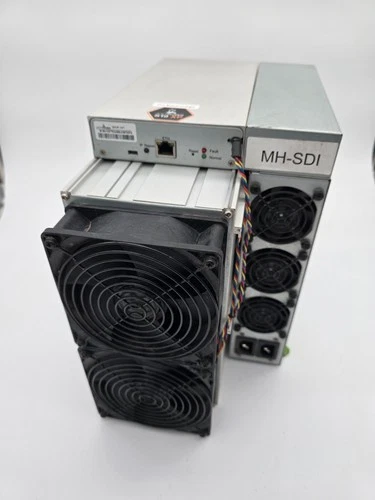
If your electricity costs less than about 5.5 ¢/kWh, the used Antminer S19 XP returns your money faster than a new S21 Pro — roughly 301 days against 815 at 3 ¢/kWh. Above 5.5 ¢ that reverses. Above 6.2 ¢ the S19 XP stops covering its own power bill entirely while the S21 Pro keeps earning up to 8.8 ¢. That is the entire Antminer S19 XP vs S21 Pro decision, and it is decided by your power contract rather than by either spec sheet.
Both machines are on our shelves right now: a refurbished Antminer S19 XP 141 TH/s and a new Antminer S21 Pro 245T. We buy, test, repair and resell both, so what follows is the arithmetic we use ourselves, with the assumptions written down so you can re-run it on the day you actually buy.
The two machines on paper
| Antminer S19 XP 141T (used) | Antminer S21 Pro 245T (new) | |
|---|---|---|
| Hashrate | 141 TH/s | 245 TH/s |
| Power at the wall | 3,010 W | 3,675 W |
| Efficiency | 21.35 J/TH (Bitmain publishes 21.5) | 15.00 J/TH |
| Break-even electricity | 6.21 ¢/kWh | 8.84 ¢/kWh |
| Silicon | BM1366AL — 110 chips × 4 boards | BM1370 |
| Input voltage | 200–240 V | 220–277 V — not 208 V |
| Noise | ~75 dB | ~75–76 dB |
| First shipped | July 2022 | 2024 |
| Warranty | None — used hardware | Bitmain publishes 365 days from shipment |
| Condition | Professionally refurbished | New, sealed |
Published dimensions and weights for both machines disagree between sources — the S19 XP is quoted at both 400 × 195 × 290 mm and 430 × 195 × 290 mm, at anywhere from 14.4 to 21.3 kg; the S21 Pro at both 400 × 195 × 290 mm and 450 × 219 × 293 mm, and at either two or four fans. We have not put a tape measure and a scale on our own units, so we are not going to pick a winner between those sources here. If you are booking freight or building racking, ask and we will measure the actual unit. The three numbers that decide the purchase — hashrate, wall watts and the efficiency that falls out of them — are consistent everywhere.
Efficiency decides which machine earns more — and it is not close
The S21 Pro is 42% more efficient per terahash. Run both at any rate you like and the S21 Pro produces more profit per day, every time:
- Antminer S19 XP: 141 TH/s earns $4.49/day gross and burns 72.24 kWh/day.
- Antminer S21 Pro 245T: 245 TH/s earns $7.80/day gross and burns 88.2 kWh/day.
The two only earn the same daily profit where the extra revenue exactly pays for the extra power — at 20.7 ¢/kWh. That number is a curiosity, not a decision boundary, because both machines passed into loss long before you get there. So on daily margin the new machine simply wins, at every rate that matters.
This is the opposite result from our Avalon Q vs S19k Pro comparison, where the crossover fell inside the profitable band and created four real decision zones. It is worth understanding why the two pages disagree: there, the cheaper machine was also the more efficient one. Here it is not. When the more efficient machine is also the more expensive one, daily margin can no longer answer the question on its own.
Antminer S19 XP vs S21 Pro: the payback crossover at 5.54 ¢/kWh
Daily margin is the wrong measure when the two machines cost wildly different amounts. What a buyer with a fixed budget actually wants to know is how long until I have my money back, and that is capital divided by daily margin.
We do not print our prices in articles, because they move and an article does not. Do the division yourself against the two live listings. What we can tell you is the shape of it: at the prices listed today the S19 XP is about a sixth of the capital for 58% of the hashrate, which works out at roughly 3.5× less capital per terahash. That is a very large head start, and it is what the efficiency gap has to overcome.
| Your power rate | S19 XP margin | S19 XP payback | S21 Pro margin | S21 Pro payback |
|---|---|---|---|---|
| 3.00 ¢ | $+2.32 | 301 days | $+5.15 | 815 days |
| 4.00 ¢ | $+1.60 | 438 days | $+4.27 | 983 days |
| 5.00 ¢ | $+0.88 | 798 days | $+3.39 | 1,239 days |
| 6.00 ¢ | $+0.15 | 4,526 days | $+2.51 | 1,675 days |
| 7.00 ¢ | $-0.57 | never | $+1.63 | 2,583 days |
| 18.44 ¢ | $-8.83 | never | $-8.46 | never |
Read the payback columns and the answer falls out:
- Below 5.54 ¢/kWh — the S19 XP returns your capital faster, and at genuinely cheap industrial power it is not close: about 301 days against 815 at 3 ¢.
- 5.54 ¢ to 6.21 ¢ — the S21 Pro returns capital faster, and the S19 XP’s margin has collapsed to almost nothing. At 6 ¢ the XP is technically positive and needs over twelve years to pay for itself, which is another way of saying no.
- 6.21 ¢ to 8.84 ¢ — only the S21 Pro makes money at all. The S19 XP is now burning more electricity than it mines.
- Above 8.84 ¢ — neither machine is worth switching on. At the US residential average of 18.44 ¢ the S19 XP loses about $8.83 a day and the S21 Pro about $8.46.
The crossover itself is worth keeping, because it generalises. Two machines pay back at the same speed when price ÷ (revenue − power cost) is equal, so cheap-and-thirsty beats expensive-and-efficient exactly until your power rate is high enough that the efficiency gap outweighs the capital gap. Cheap power favours old hardware. Expensive power favours new hardware. Everything else on this page is detail.
The assumptions, so you can re-run it
| Input | Value | Source / date |
|---|---|---|
| Hashprice | $31.84 / PH/s / day | derived, 27 July 2026 |
| Network difficulty | 126,231,507,121,868 | mempool.space, 27 July 2026 |
| Network hashrate | ~860 EH/s | mempool.space, 27 July 2026 |
| Bitcoin price | $63,488 | mempool.space, 27 July 2026 |
| Block subsidy | 3.125 BTC | post-2024 halving |
| US residential power | 18.44 ¢/kWh | EIA, May 2026 |
Every one of these moves, and the answer moves with them. We derive hashprice rather than copying a published figure, and we check the derivation against a known result before using it: fed the 13 July 2026 inputs, the same formula returns $30.88/PH/day, which is exactly what Luxor published that day. Revenue figures here are gross of pool fees. None of this is a profitability promise — it is arithmetic on inputs that change every single day, and you should re-run it on the day you buy. The ASIC miner buying guide has the one-line break-even formula for exactly that.
What the payback number ignores: the machine has to survive it
A payback of 301 days assumes the machine runs for 301 days. The S19 XP shipped its first batch in July 2022, so a unit bought today is about four years old, and that is the real risk sitting under the cheerful column in the table above.
What actually goes wrong on hardware of that age, in the order we see it on the bench: fans first, by a wide margin, because they are the only moving parts and they run in dust; then power supplies; then individual chips or voltage domains on a hashboard; then control boards, usually after a firmware event rather than a hardware fault. That ordering is our operating judgement from the machines that come through our workshop — it is not a published failure statistic, and we are not going to dress it up as one.
The S21 Pro answers all of this with a warranty: Bitmain publishes 365 days from the shipment date on new hardware. The S19 XP has no warranty of any kind, and anyone who offers you one on a four-year-old miner is selling you something. What a refurbished unit gets from us instead is testing before it ships, and the honest condition terms on the listing itself. Our guide to buying a used ASIC miner covers what to demand before you pay — as-tested hashrate, as-tested wall draw, and who pays the freight when it arrives dead.
The practical version: if the payback table says four years and the machine is already four years old, that is not an investment, it is a coin toss. The S19 XP only makes sense on the cheap end of the power curve, where it pays for itself in well under a year and everything after that is upside.
The electrical difference almost nobody checks: 208 volts
This one decides purchases on its own and it never appears in a comparison table. Bitmain rates the S21 Pro at 220–277 V. 208 V is below that minimum, and 208 V is what an enormous number of US commercial buildings actually have on three-phase service. The S19 XP is rated from 200 V and runs on it.
So if you are putting machines into a leased commercial unit with 208 V service, the older machine is the one that works, and no amount of efficiency advantage helps a miner that is out of spec on voltage. Measure your service before you order either one. Neither machine will run on 120 V under any circumstances, and no adapter changes that.
On circuits, both are one-machine-per-breaker devices. At 240 V the S19 XP draws about 12.5 A and the S21 Pro about 15.3 A. The NEC continuous-load rule gives you 80% of the breaker rating, so a 20 A circuit provides 16 A continuous — enough for one of either, nowhere near enough for two. Even a 30 A circuit at 24 A continuous will not take a pair. Budget one dedicated circuit per machine and size the feed accordingly.
What breaks, and whether we can actually fix it
This is where a dealer’s answer should differ from a spec sheet, and where the result is genuinely awkward for the more expensive machine. We can support a broken S19 XP considerably better than a broken S21 Pro, and we would rather say so than let you find out later.
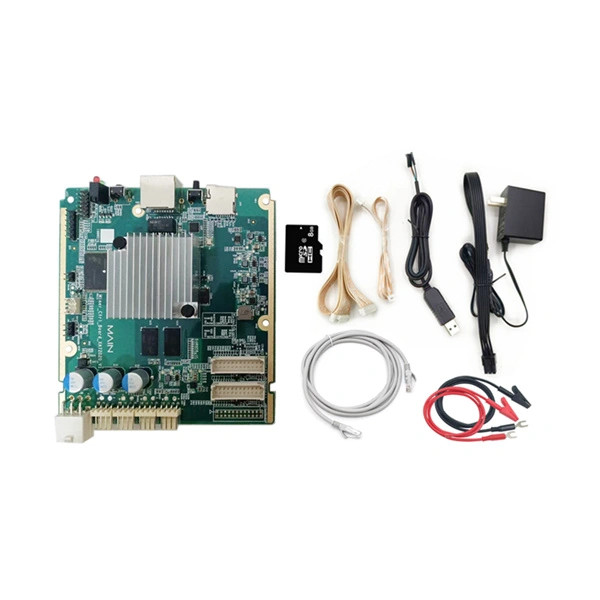
For the S19 XP we carry used S19 XP-class hashboards sold as-is for parts — 110 BM1366AL chips across 11 voltage domains per board, four boards to a machine, which makes chip-level repair a real option rather than a theory. We carry an Amlogic control-board unlock kit that lists the S19 XP explicitly by name, and it turns a bricked control board back into a working miner for a fraction of a board replacement.
For the S21 Pro we carry the K3L hashboard tester, which covers S19 and S21 boards, and the S19/S20/S21 dual fan assembly, which fits both machines and addresses the failure we see most often. Beyond that, the replacement silicon on our shelf is the BM1368 generation used in the S21, T21 and S21 Hyd — that is not listed for the S21 Pro, and we are not going to imply that it drops in. Chip suffixes are not reliably interchangeable across board revisions, which is exactly the kind of detail that turns a repair into a scrapped board.
Read that trade honestly and it is a fair fight rather than a win for either side. The used machine is cheap and repairable but unwarranted. The new machine is warranted for a year, and after that year you are relying on a parts market for BM1370 hardware that is still thin.
Noise, heat and where these actually go
Both machines are around 75–76 dB. That is workshop noise — closer to a shop vacuum than to a computer — and it is continuous. Neither is a home machine, and no enclosure fixes it without creating a thermal problem that costs you more than the noise did.
On heat, the S19 XP puts 3,010 W into the room and the S21 Pro 3,675 W, essentially all of it as heat. Both need real airflow and a way to get hot air out of the building, not just away from the machine. If you want a Bitcoin miner that can live in a house, neither of these is it — that is what the Avalon Q exists for, and we compared it against a used machine on exactly that basis.
If you are choosing between two new machines rather than across generations, our S21 Pro vs SealMiner A2 Pro Air head-to-head covers that decision, where the efficiency gap is under 1% and the choice comes down to everything except the numbers.
What we corrected on our own listings while writing this
Comparing two machines properly means reading your own product pages closely, and ours did not come out of it clean:
- The S21 Pro 245T listing stated “air, dual fans” as settled fact. Published sources disagree — two fans and four fans are both quoted for this model, alongside two different sets of dimensions. The listing now reports the disagreement instead of quietly picking one.
- The S19 XP listing said the machine suited “both home and industrial mining environments”. That is false and it is the kind of false that generates returns. A 3,010 W, ~75 dB, 200–240 V machine does not belong in a house and will not run from a 120 V outlet at all. Replaced with the real siting terms.
- It also called 21.35 J/TH “industry-leading”. It was in 2022. It is not in 2026, sitting next to 15.00 J/TH hardware on our own shelf. The listing now gives the published figure and shows the division behind it.
- The S19 XP listing described a firmware boost without saying what it costs. Third-party firmware can push throughput above the factory rating, but power rises faster than hashrate, so a boosted machine is worse than 21.35 J/TH, not better. The listing now says so.
- It published no input voltage, no noise figure, no condition terms and no running cost. All four are now on the page, along with the silicon and the machine’s age.
We publish these corrections rather than quietly editing them because the understated version of a spec is the one that produces an unexpected electricity bill, and you are entitled to know which direction our errors ran. Every figure in this article uses factory ratings, because those are the only numbers with a manufacturer behind them.
So which one should you buy?
Buy the used Antminer S19 XP if your power is genuinely below about 5.5 ¢/kWh — hosted at an industrial rate, behind curtailed or stranded generation, or on a site where you are the one paying wholesale. At those rates it returns its capital in months rather than years, the capital at risk is small, and we can repair it down to the chip. It is also the machine to buy if your building is on 208 V.
Buy the new Antminer S21 Pro 245T if your power is between about 5.5 ¢ and 8.8 ¢, if you need the machine to still be earning in three years, or if you want a warranty and a supported unit rather than a repair project. It earns more per day at every rate either machine can survive, and it keeps earning at rates that shut the S19 XP off entirely.
Buy neither if you are paying anything close to a retail residential rate. At 18.44 ¢/kWh both machines lose money every day they run, and the more efficient one merely loses it slightly slower. That is an uncomfortable thing for a hardware dealer to put in writing, and it is true, and we would rather you spent your money on the right machine or on none at all than send it back to us in ninety days.
Still narrowing it down? The buying guide covers what the specs mean and how to total up running costs, the used-miner guide covers what to demand before you pay for second-hand hardware, and the whole used ASIC miner range and the full catalogue are worth a look if neither of these two is the right fit.
This page’s argument — cheap and thirsty against expensive and efficient — is visible as two rows in our comparison table, and they sit at opposite ends of it. The S21 Pro is near the top at 15 J/TH; a used S19 on a low-power tune is last at 34.2 J/TH, and the gap in what the two cost to buy is wider still. That is the whole trade in two lines, and the table is the fastest way to check where any other machine you are weighing falls between them.
Frequently asked questions
Is a used Antminer S19 XP better value than a new S21 Pro?
Only below about 5.5 ¢/kWh. At that rate and under, the S19 XP returns its purchase price faster because it costs a fraction of the capital for 58% of the hashrate. Above 5.5 ¢ the S21 Pro pays back faster, and above 6.2 ¢ the S19 XP stops covering its own electricity while the S21 Pro keeps earning up to 8.8 ¢.
Which machine earns more per day?
The S21 Pro, at every electricity rate where either machine is worth switching on. Its 15.00 J/TH against the S19 XP’s 21.35 J/TH means the two only cross at about 20.7 ¢/kWh — far above the point where both are already losing money. Earning more per day and returning capital faster are different questions, and they have different answers here.
Can I run either of these at home?
No. Both are 200–277 V machines at roughly 75–76 dB, so neither will run from a North American 120 V outlet and neither belongs anywhere people sleep. At the US average residential rate of 18.44 ¢/kWh the S19 XP burns about $405 of electricity a month and the S21 Pro about $495, and both lose money at that rate.
Will the S21 Pro run on 208 V three-phase power?
Bitmain rates the S21 Pro at 220–277 V, and 208 V is below that minimum. 208 V is very common on US commercial three-phase service, so this is worth checking before you buy rather than after delivery. The S19 XP is rated from 200 V and does run at 208 V. If your site is 208 V, that difference can decide the purchase on its own.
How old is a used S19 XP in 2026?
The S19 XP shipped its first batch in July 2022, so a unit bought today is around four years old. That is the single biggest risk in the comparison: a payback period measured in days only means something if the machine survives it, and nobody can promise you a warranty on hardware that old.
Do you stock repair parts for both machines?
We stock more for the older one, which is the honest answer rather than the flattering one. For the S19 XP we carry donor hashboards, an Amlogic control-board unlock kit that lists the XP explicitly, a hashboard tester and fan assemblies. For the S21 Pro we carry the same tester and the same fan assembly, but the replacement silicon on our shelf is the BM1368 generation used in the S21, T21 and S21 Hyd — it is not listed for the S21 Pro. What the S21 Pro has instead is a manufacturer warranty.
Does overclocking the S19 XP change the maths?
It makes it worse per terahash, not better. Power rises faster than hashrate on the voltage-frequency curve, so a tuned machine produces more hashrate at a higher J/TH than the factory figure. Every number on this page uses the factory 141 TH/s at 3,010 W, because that is the only pair with a manufacturer behind it. If you want a tuned figure, ask us to meter the specific unit.