
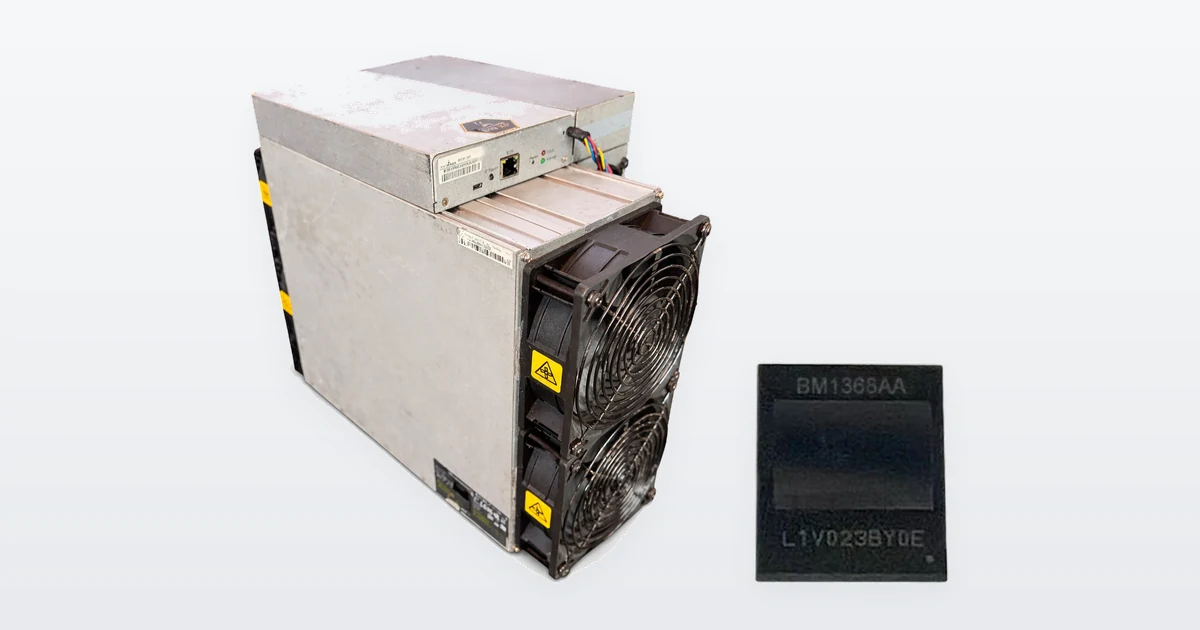
Bitcoin mining is a race to guess a number. That is the whole mechanism. Everything else — the warehouses, the noise, the electricity bills — exists to make the guessing faster than everyone else’s. This page explains what the machines are actually doing and why the answer decides what hardware is worth buying.
If you already understand the mechanism and want the shopping list instead, read what you actually need to start mining. If you want the arithmetic that decides whether a machine pays, that is the ASIC miner buying guide.
What a miner is really doing
Bitcoin has no company running it and no server holding the balances. It has a shared record — the blockchain — and roughly every ten minutes someone has to add the next page of transactions to it. The question the network has to answer is: who gets to write the next page, and why should anyone trust them?
The answer is that writing a page has to be expensive. To add a block, a miner takes the pending transactions, bolts on a number nobody has used yet (the nonce), and runs the whole bundle through SHA-256, a hash function that turns any input into a fixed-length string of digits. The output is unpredictable. Change one character of the input and the entire result changes.
The network demands a hash that starts with a certain number of zeros. There is no clever way to produce one. You try a nonce, look at the hash, and if it does not qualify you try the next. A modern machine does this about 100 trillion times per second, forever, until it wins or somebody else does.
That is the whole job. A miner is a machine that computes SHA-256 as fast as electricity allows and checks whether the answer starts with enough zeros.
Why the wasted work is the point
The obvious objection is that this is enormously wasteful, and it is — deliberately. The cost is the security. Rewriting history would mean redoing all the guessing for every block since the one you want to change, faster than the entire rest of the network is extending the chain. The electricity already burned is what makes the record expensive to forge. Take away the cost and you take away the guarantee.
The three numbers that describe any miner
Once you know the machine is a guessing engine, the specification sheet stops being jargon. Everything reduces to three numbers.
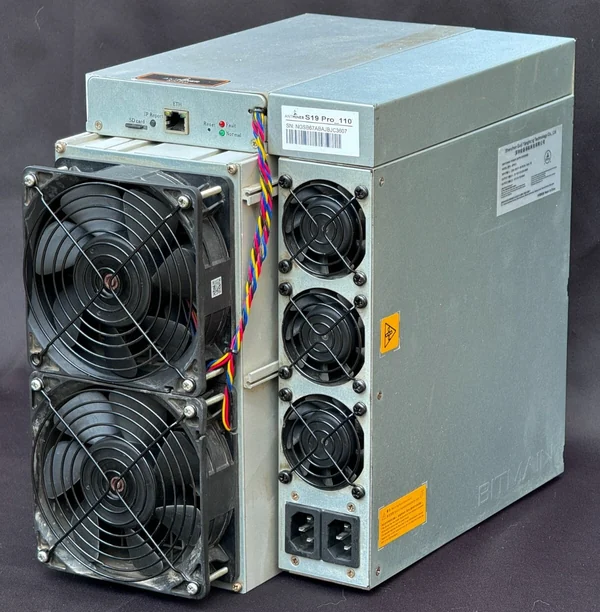
- Hashrate, in terahashes per second (TH/s) — how many guesses per second. An Antminer S19 does 95 TH/s: 95 trillion guesses every second.
- Power, in watts — what it costs to run. That same S19 pulls about 3,250 W, continuously, which is roughly two American households.
- Efficiency, in joules per terahash (J/TH) — power divided by hashrate. The S19 is 3,250 ÷ 95 = 34.2 J/TH.
Only the third number matters for whether you make money. Hashrate tells you your share of the network; power tells you your bill; efficiency tells you the ratio, and the ratio is what you are actually buying. A current machine like the Antminer S21 Pro does about 15 J/TH — it produces the same guesses for less than half the electricity.
Difficulty: why the goalposts move
Every 2,016 blocks — roughly a fortnight — the network counts how fast blocks were found and adjusts how many leading zeros it demands. More machines join, blocks come too fast, the target tightens. This is called the difficulty retarget, and it is the single fact beginners most often miss.
It means your machine’s earnings fall over time even if you change nothing. Your hashrate is fixed the day you buy it; the network’s total hashrate keeps climbing. Your slice of the pie shrinks. As of 27 July 2026 difficulty sits at about 126.23 T against a network of roughly 866 EH/s. Any calculation that assumes today’s difficulty forever is an overestimate by construction.
What the winner actually gets
A miner who finds a valid block collects two things: the block subsidy, which is newly created bitcoin, and the transaction fees paid by everyone whose payments were in that block.
The subsidy halves every 210,000 blocks — about every four years. It started at 50 BTC in 2009, and after the April 2024 halving it is 3.125 BTC. A great deal of material still online quotes 6.25, which has been wrong since 2024 and overstates mining revenue by a factor of two. If you are reading any profitability calculation that uses 6.25, discard it.
Because the subsidy shrinks on a schedule and fees do not, fees become a larger share of mining income over time. Today they are a small fraction of it. The industry tracks the combined figure as hashprice — dollars per petahash per day — which on 27 July 2026 was around $32.7/PH/day with Bitcoin near $65,247. It moves constantly, and it is the number that decides whether a machine is worth switching on.
Why almost nobody mines alone
A single S19 at 95 TH/s against a network of 866 EH/s wins a block roughly once every 90 years on average. You would earn 3.125 BTC in one enormous lump, eventually, or more likely never. That is not an income.
So miners join a pool: thousands of machines guess together, the pool collects whatever blocks the combined effort finds, and pays each member in proportion to the work they contributed. You trade a lottery ticket for a wage. Choosing between the payout models is a real decision with real money in it — see how to choose a mining pool.
Why ASICs won, and why that closed the door on GPUs
In 2009 you could mine Bitcoin on a laptop. Then people moved to graphics cards, then to FPGAs, and by about 2013 to ASICs — application-specific integrated circuits, chips that can do SHA-256 and nothing else at all.
A GPU spends most of its silicon on things a miner never uses: texture units, video decoders, general-purpose shader cores. An ASIC spends all of it on hash pipelines. The efficiency gap is not a few percent, it is several orders of magnitude. Bitcoin has not been meaningfully mineable on a graphics card for over a decade, and any guide that tells you otherwise was written for a different era or not written by a miner.
The same applies to Ethereum, for a different reason. Ethereum stopped using mining entirely when it moved to proof-of-stake on 15 September 2022. It cannot be mined on any hardware, at any scale. A surprising amount of beginner material still says otherwise.
What GPUs remain useful for are the smaller ASIC-resistant chains that deliberately design their algorithms to blunt specialised hardware. That is a different business with different risks, covered in non-Bitcoin mining hardware and chain risk.
Putting it together: what decides whether mining pays
Combine the pieces and you get one line of arithmetic that answers most beginner questions at once:
Break-even electricity rate ($/kWh) = hashprice ÷ (24 × J/TH)
Hashrate cancels out completely, which is why efficiency is the spec that matters and hashrate is mostly marketing. At $32.7/PH/day, a 34.2 J/TH Antminer S19 breaks even at about $0.040/kWh. A 15 J/TH S21 Pro breaks even around $0.091/kWh.
The US average residential electricity price was 18.44 ¢/kWh in May 2026, according to the EIA. Compare that with the two figures above and the conclusion is uncomfortable but honest: at typical household power rates, no machine on the market currently breaks even. Mining is a cheap-electricity business that happens to involve computers. People make it work with sub-5-cent industrial power, flared gas, curtailed renewables, or by counting the heat as home heating.
That is also why the used market exists. An older machine that cannot survive on grid power is still worth real money to somebody with stranded generation — which is the trade covered in how to buy a used ASIC miner without getting burned.
When you want to put numbers against actual hardware, the machines referenced above are in used ASIC miners and Bitcoin miners, or browse the full ASIC miner inventory.
Frequently Asked Questions
What is cryptocurrency mining in simple terms?
Mining is a competition to guess a number. Machines repeatedly run pending transactions plus a changing nonce through the SHA-256 hash function, looking for an output that starts with enough zeros to satisfy the network. The winner adds the next block to the blockchain and collects the block subsidy plus transaction fees. The electricity spent guessing is what makes the record expensive to forge.
Can I still mine Bitcoin with a graphics card?
No, not economically. Bitcoin mining moved to ASICs — chips that compute SHA-256 and nothing else — around 2013, and the efficiency gap over a GPU is several orders of magnitude. A graphics card would spend far more on electricity than it could ever earn in block rewards. Guides that recommend GPUs for Bitcoin are describing hardware from more than ten years ago.
Can Ethereum still be mined?
No. Ethereum switched from proof-of-work to proof-of-stake on 15 September 2022, which removed mining from the network entirely. No hardware of any kind mines Ethereum today. A lot of beginner material has never been updated and still lists it as a GPU mining target.
How much bitcoin does a miner earn per block?
The block subsidy is 3.125 BTC following the April 2024 halving, plus whatever transaction fees are included in that block. It halves roughly every four years. Older articles quoting 6.25 BTC have been wrong since 2024 and overstate mining revenue by a factor of two, so treat any calculation using that figure as unreliable.
Why do my earnings fall even though my machine has not changed?
Because difficulty rises. Every 2,016 blocks the network adjusts how hard the puzzle is so that blocks keep arriving about every ten minutes. As more hashrate joins, your fixed share of the network shrinks and your revenue with it. This is why any projection that assumes constant difficulty is optimistic by design.
What single specification should a beginner compare?
Efficiency in joules per terahash. Hashrate tells you how big the machine is and power tells you what it costs to run, but the ratio between them is what determines whether it earns more than it burns. Divide hashprice by 24 times the J/TH figure and you get the electricity price at which that machine breaks even.