
Antminer S19 Heat Output: BTU, Ventilation and Ducting
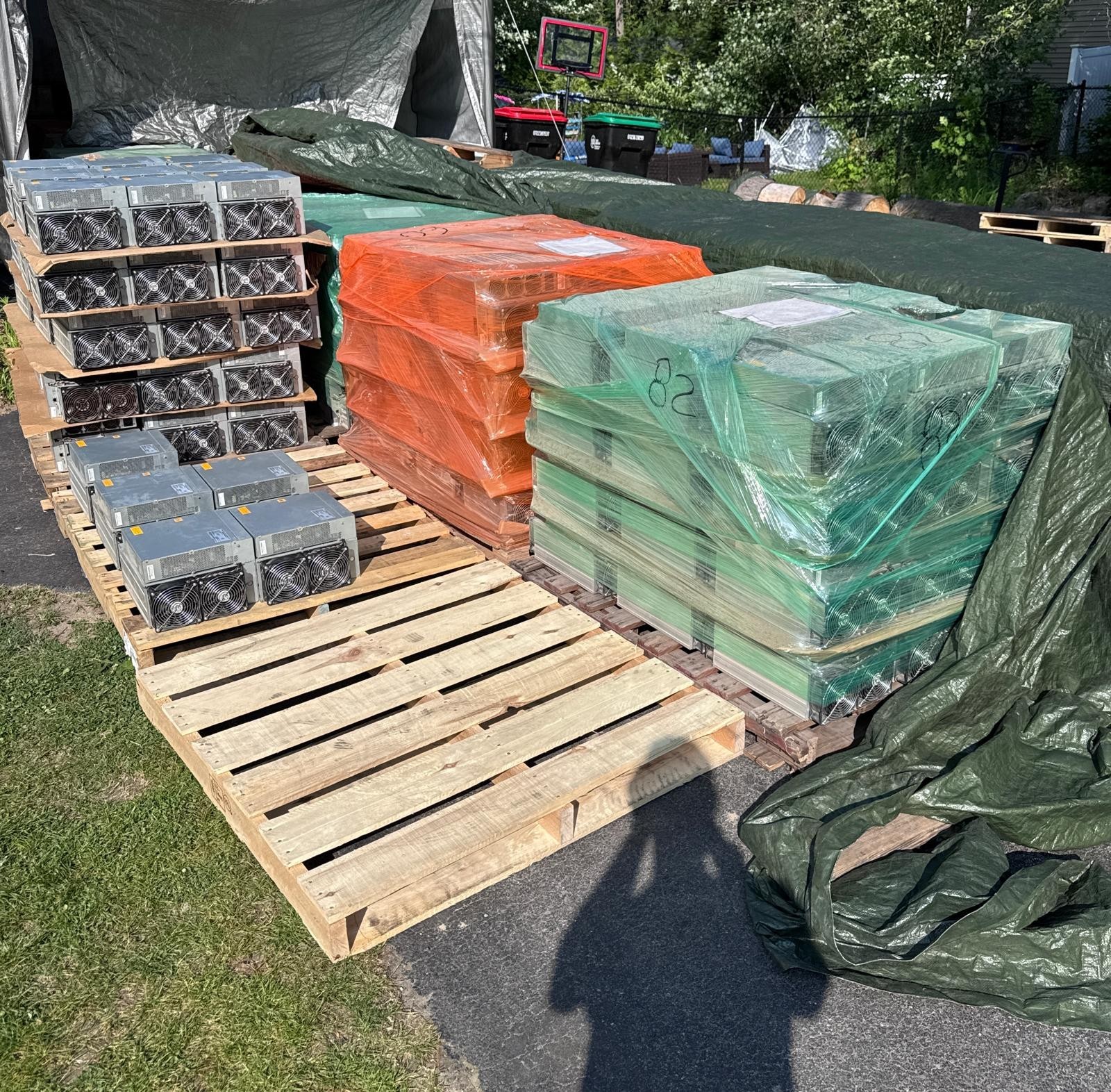
Antminer S19 heat output is almost the same number as its electrical input, expressed in a different unit. A stock 3,250 W S19 releases roughly 11,100 BTU per hour into the room. That is close to one ton of cooling load from a single metal box, running all day.
The fans can move heat through the miner, but they cannot make it disappear. If the hot air stays in the room, inlet temperature rises, fan speed climbs, noise gets worse, and the machine can throttle or stop. Good cooling begins by giving the exhaust somewhere to go.
How to calculate Antminer S19 heat output
The U.S. Energy Information Administration publishes the standard conversion of 1 kilowatt-hour to 3,412 BTU. For equipment running at a steady power level, that means 1 kW becomes about 3,412 BTU per hour.
Bitmain lists the S19 and S19 Pro at 3,250 W at the wall, with a ±5% tolerance at 25°C. The calculation is therefore:
3.25 kW × 3,412 BTU/h per kW = 11,089 BTU/h
Nearly all of that electrical energy ends up as heat inside the room. A tiny amount leaves as network signals, light, and sound, but those forms also become heat eventually. For ventilation planning, treating watts in as heat out is the useful and conservative model.
| Model | Wall power | Approximate heat output |
|---|---|---|
| Antminer S19 95T | 3,250 W | 11,089 BTU/h |
| Antminer S19 Pro 110T | 3,250 W | 11,089 BTU/h |
| Antminer S19k Pro 120T | 2,760 W | 9,417 BTU/h |
Check the exact model before using those numbers. Bitmain’s S19 specification and S19k Pro specification show why the family name alone is not enough.
What 11,100 BTU per hour feels like
A miner is a space heater that also hashes. However, it concentrates the heat into a fast exhaust stream. Stand behind a running S19 and the problem becomes obvious: the outlet air needs a low-resistance path away from the intake.
Air conditioning can remove the heat, but it is often the expensive answer. You pay once to power the miner and again to run the compressor. In cool or moderate weather, separating hot exhaust from cool intake air and venting outside can use far less power.
Nevertheless, outside-air cooling has limits. Hot weather, humidity, smoke, dust, insects, salt air, and wind-driven rain can all turn a simple vent into a maintenance problem. Our broader ASIC miner cooling guide covers those site choices.
How much ventilation does one S19 need?
There is no honest single CFM number for every room. Required airflow depends on how much warmer the exhaust air may become than the intake air. A common sensible-heat estimate is:
CFM = BTU/h ÷ (1.08 × allowed temperature rise in °F)
Using 11,089 BTU/h for one stock S19 gives the following planning values:
| Allowed exhaust temperature rise | Approximate airflow per S19 |
|---|---|
| 15°F | 684 CFM |
| 20°F | 513 CFM |
| 25°F | 411 CFM |
This formula estimates room airflow, not the fan label on the miner. Duct bends, filters, grilles, screens, and long runs add resistance. As a result, a fan advertised at 600 CFM in free air may deliver much less once installed.
Measure the finished system. Record miner inlet temperature, exhaust temperature, fan percentage, chip temperatures, and room pressure while the door is closed. If opening the door improves everything, the room lacks make-up air or has too much restriction.
Antminer S19 heat output at five and ten machines
Heat scales quickly because each additional miner is another 3.25 kW heater. A five-machine trial produces roughly 55,445 BTU/h. Ten machines produce about 110,890 BTU/h, before the fans and other equipment are counted.
| Stock S19 count | Miner power | Approximate heat | Cooling tons equivalent |
|---|---|---|---|
| 1 | 3.25 kW | 11,089 BTU/h | 0.92 ton |
| 5 | 16.25 kW | 55,445 BTU/h | 4.62 tons |
| 10 | 32.5 kW | 110,890 BTU/h | 9.24 tons |
Dividing BTU/h by 12,000 gives the cooling-ton equivalent. It does not select an air conditioner. Real HVAC sizing includes outdoor design temperature, humidity, solar gain, insulation, duct losses, equipment performance, and margin. Ask an HVAC professional to size a compressor-based system.
The airflow layout that usually works
The basic goal is simple: cool air reaches the miner intake once, and hot air leaves without circling back. You can achieve that with a hot aisle, an exhaust plenum, individual shrouds, or a divided room. The right layout depends on scale.
Give the room enough make-up air
Every cubic foot exhausted must be replaced. An extraction fan cannot move its rated volume if the room is sealed. Provide filtered intake area with low resistance, and keep it far enough from the discharge that hot air does not return immediately.
Keep hot and cold air physically separate
Distance alone often fails. Air takes the easiest path, and turbulent exhaust can curl around a shelf. A partition or plenum gives the airflow a rule it cannot ignore. Seal gaps around the machines so the exhaust side pulls through the miners rather than around them.
Use smooth, generous ducting
Small ducts and sharp bends increase static pressure. Flexible duct is convenient, yet its ridges and sagging sections add resistance. Keep runs short, support them properly, and use broad-radius bends. In addition, avoid placing loose material where a fan can pull it into the miner.
Filter intake air without starving the fans
A filter protects heat sinks from dust, but a loaded filter reduces airflow. Choose a large filter area, monitor the pressure or temperature change, and set a replacement schedule. A tiny furnace filter taped over a miner fan is not a ventilation design.
Why exhaust temperature alone can mislead you
Hot exhaust does not automatically mean the miner is overheating. It can mean the cooling path is doing its job by carrying energy away. In contrast, unexpectedly cool exhaust can appear when a hashboard is offline and the machine is producing less heat.
Therefore, judge the system with several signals: inlet temperature, chip temperatures, hashrate, fan speed, board status, and wall power. Our ASIC acceptance-testing guide shows how those readings fit together during the first 48 hours.
Noise and ventilation are the same mechanical problem
Restrictive airflow makes the fans work harder, which increases noise. A smooth exhaust route can lower fan speed, but ducting can also carry sound outdoors like a horn. Long lined plenums, larger ducts, isolation mounts, and careful outlet placement help more than a thin foam box around the miner.
Never trade temperature safety for quiet. If an enclosure reduces noise while raising inlet temperature, it has stored the problem instead of solving it. Read our ASIC miner noise guide before building an enclosure.
Cooling checklist before adding another miner
- Convert the measured wall watts to BTU/h, not just the brochure rating.
- Choose the highest indoor temperature you will accept.
- Provide enough filtered make-up air for the exhaust flow.
- Separate the intake path from the exhaust path physically.
- Allow for filters, bends, grilles, duct length, and fan pressure.
- Measure inlet temperature, chip temperature, fan speed, hashrate, and power.
- Test the hottest expected weather before scaling the room.
If the room handles one miner comfortably, the next step is measured expansion. Browse our used Antminer S19 inventory, or ask us about a small trial lot before committing to a full rack.
Frequently asked questions
How many BTU does an Antminer S19 produce?
A stock 3,250 W S19 produces about 11,089 BTU per hour. Actual heat follows actual wall power, so a tuned profile can raise or lower that figure.
Can I cool an S19 with a portable air conditioner?
Possibly, but one stock S19 is already close to one ton of cooling load. Portable units also lose capacity through ducts and room pressure. Verify performance under the hottest expected conditions.
Is 500 CFM enough for one Antminer S19?
About 513 CFM carries 11,089 BTU/h with a 20°F air-temperature rise in the ideal sensible-heat calculation. The installed fan must also overcome filters, screens, bends, and duct resistance.
Should I duct directly to the miner fans?
A well-fitted shroud can work, but the duct must not choke the miner or transmit damaging force to the fan housing. A plenum is often easier to balance across several machines.
Does underclocking reduce Antminer S19 heat output?
Yes. Lower wall power means lower heat output. Measure the tuned miner at the wall, then multiply kilowatts by 3,412 to estimate BTU/h.
Design note: These are planning calculations, not a stamped HVAC design. Fire safety, make-up air, humidity, electrical capacity, and local code require site-specific review.