
Reselling used ASIC miners: the work that transfers to you with the lot
A used miner lot is priced as a transfer of work, not as a discount. If you are buying one to break back up into single machines, the spread is your wages — so cost the work before you cost the hardware, and know exactly what you are allowed to claim about the machines when you re-list them.
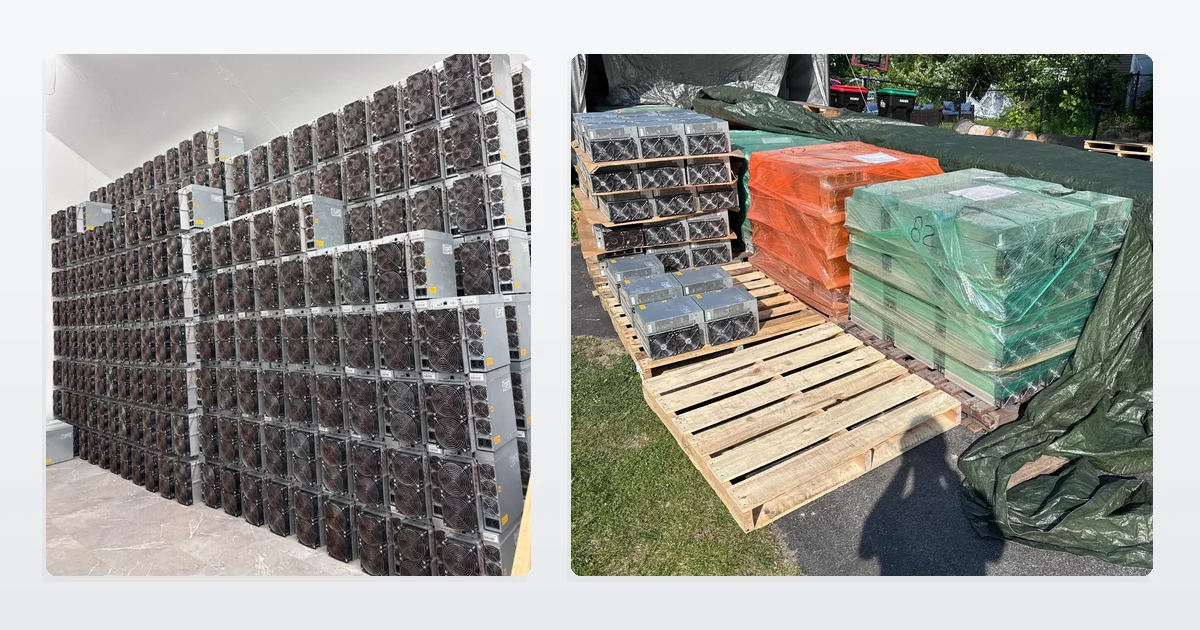
Reselling used ASIC miners is a labour business, not a trading business. The spread between what a lot costs and what the machines fetch one at a time is real — it is the reason we sell lots at all — but it is not profit. It is payment for work you have just agreed to do: unpacking, powering up, testing, photographing, writing, answering questions, packing and shipping every machine individually, and carrying the ones that never sell. Price that work before you place the order, because the spread is roughly the size of it.
We are the upstream seller here, so there are two things on this page that a general reselling guide cannot give you: exactly what you inherit from our description when you re-list one of our machines, and what that inheritance does and does not let you claim. The rest is arithmetic you should do before you commit. If you want the shelf, the grades and the quote form instead, that is our bulk used miner page.
What you inherit with the lot, and what you do not
A lot is one description covering many machines, and everything in that description travels with them into your listings. Six things transfer:
- The grade word. Every lot we list states its condition in its own title — tested, refurbished, or no grade stated — and each of those words is defined in one place. You inherit the word and the evidence behind it. You may repeat it. You may not improve it.
- The firmware. Every used S19 lot on the shelf names Braiins OS or VNish in its title. That is a disclosure, not a feature: a tuned machine draws what the tune makes it draw, and a buyer expecting a stock box is a dispute waiting to happen. Firmware is the trap on used S19 lots and it becomes your disclosure the moment you re-list.
- The sample, not the census. Individually listed machines get individually tested. Lots get sampled — that is normal in this trade and it is exactly why you should ask what the sampling rate was on the batch you are buying. Ask us; we will tell you; then tell your buyer the same thing.
- The PSU answer, if there is one. Power-supply inclusion is stated on one of the lots listed today and not on the others. Do not assume it either way — ask, and get the answer written on the quote rather than inferred from a photograph.
- The warranty term, whatever it is. You cannot pass on more than you were given. If you offer your own return window on top, you are self-insuring the repair tail with your own money, which is a legitimate business decision and not a free one.
- What does not transfer: our bench, our parts shelf, our fixtures and our willingness to take a machine back. From the moment the pallet leaves, the repair tail is yours.
What you may claim about our machines in your own listing
The rule is one line: you may repeat what we measured, in the words we measured it in, and you may not upgrade it. That sounds restrictive and it is the opposite — a re-listing that says exactly what was found on a bench sells faster than one that says “should work”, because the buyer can tell the difference and so can the marketplace when the case is opened.
In practice:
- If our listing says tested and working, say tested and working, and say who tested it and roughly when. Attribution is worth more than an adjective.
- If our listing states no grade, your listing states no grade. Untested is an honest word and it sells; should work is not a grade and it is how a partial refund starts.
- Never re-publish a rated hashrate as a measured one. A used S19 tuned to a measured figure on Braiins OS is a fact about that unit. A number off a datasheet is a fact about a machine that left the factory years ago — the S19 trap is that “110 TH/s” is two different machines.
- Never quote a new machine’s efficiency for a used one, and never quote profitability at all unless you state the electricity rate, the hashprice and the date you used. Those move every day and a buyer who checks will find you out.
- Photograph the machine you are actually shipping, not a stock image of the model. Serial label, fan side, the PSU if it is included. Every dispute we have ever watched starts with a buyer comparing the photograph to what came out of the box.
- If you replace a part, say so. A board you fitted yourself is not the same claim as a refurbishment, and describing it accurately costs you nothing.
- If you intend to promise your buyer a serial number, ask us for it before you promise it. And know that a manufacturer warranty lookup returning not found is the normal result on any secondhand unit — explain that to your buyer before they ask, not after.
Sort the lot into three piles before you write a single listing
The sort decides how many listings you are writing, what they say and what you can charge, so it comes first. Power each machine up, read the hashrate at the wall, look at the board count, and put it in one of three places.
- Sells as a working machine. All boards up, stable, draws what it should. This is the pile you priced the lot on.
- Sells as parts, and this pile is not worth nothing. A machine with one dead hashboard is two good boards, a control board, a power supply, two fans and a chassis. Our own repair parts and spares shelf is made almost entirely of components pulled from machines like that — hashboards, PSUs, control boards, fans, chips and testers — which is the plainest evidence you will get that there is a real market for the middle pile.
- Keep it for spares. The third pile is not scrap, it is your inventory of parts for the first pile. A reseller with no spares ships a machine with a fan rattle rather than fixing it, and pays for that later.
Whether a unit is worth repairing before you list it is a cost-per-recovered-terahash question, not a judgement call, and it is worked through properly in our parts compatibility and repair guide. The short version an operator uses: a hashboard restores about a third of a machine, while a power supply, control board or fan restores all of it — so the cheap parts are almost always worth fitting and the expensive one usually is not.
The freight bill reverses when you break the lot up
This is the arithmetic most first-time resellers get wrong, and it is not the per-unit price of the lot. Inbound, you pay for one freight event: a pallet or a set of pallets, one carrier, one delivery. Outbound, you pay for as many shipments as there are machines. Inbound freight per machine falls as the lot gets bigger. Outbound freight per machine does not fall at all.
Use our own published rate as the reference, because it is the retail end of exactly the journey you are about to make: shipping a single used miner inside the United States is $49.99 on this store, and that is a real configured rate rather than an estimate — the full rate card is here. An S19 is around 14.5 kg bare and more boxed with its supply, and at that weight freight is a line item, not a rounding error. Multiply the retail-end figure by the number of machines you intend to ship one at a time, and you have the number that actually comes out of the spread.
Two consequences worth acting on. The first is that packing materials, labour and outbound freight scale linearly with the machine count, so a bigger lot does not make them cheaper — it makes them a bigger share of what you are doing. The second is that per-unit lot pricing is not a smooth curve on anybody’s shelf, including ours: divide the lot price by the machine count on every listing before you compare anything. Do it on whatever we quote you as well — a per-machine figure is the only form in which two lots of different sizes can be compared at all.
How much testing per machine can you actually afford
The procedure is not the interesting part — the six-step bench process we use is written down and you can follow it. The reseller’s question is different: how much of it can you afford per machine before the testing costs more than the information is worth?
Work it as a comparison rather than a rule. Testing pays for itself while the price difference between tested and working and untested in your own completed sales is larger than the minutes per machine at your own labour rate, plus the value of the units the test tells you not to list at all. Both sides of that are yours to measure, not ours to assert — you have the completed listings and we do not.
Where we will take a position: a full burn-in on a cheap used machine is almost never worth the hours, and a power-on with a hashrate read at the wall and a short stability check almost always is. The cheapest test in the business is the one that stops you shipping a dead machine, because a return costs you the freight twice, the packaging, the hours and the case. And if you are sorting machines at any volume you want a fixture rather than a bench — there is a crossover point where the fixture pays for itself and below it you should not buy one.
Which of our lots make sense if you are reselling
The live shelf, with the machine counts and the condition each lot states, is on the bulk used miners page, and the whole used catalogue including single units is on the used shelf. Three filters matter if your plan is to re-list rather than to deploy:
- A matched batch re-lists far more easily than a mixed one. Every lot we publish is one model at one hashrate on one firmware, which means one set of photographs, one description to adapt and one set of questions to answer. Mixed pallets are cheaper for a reason and the reason is your time.
- Get the freight number in writing whatever lot you pick. Every lot on this store is quoted rather than sold through the cart, so there is no checkout total to read a freight number off: ask for the freight figure on the same quote as the per-machine price and do not treat a checkout total as the final number — a four-tonne shipment is not a parcel and it should not be priced like one.
- Prefer a lot that states its power supplies. A machine arriving without a supply is a harder sale to a first-time buyer and an extra purchase for you.
Concretely, for a first lot: the five-machine refurbished S19 95TH/s lot and the ten-machine version of the same batch are the two smallest things we sell that behave like a real lot, and the ten-machine S19k Pro lot states that its power supplies are included. Do not start at a hundred machines. Not because the big lots are bad — some of them are the best per-unit value on the shelf — but because five or ten machines is the cheapest way to find out what the work costs you, and you only get that lesson once.
If you are listing on a marketplace, we build the tool we use for it ourselves: ING eBay AutoLister turns a photograph into a draft listing, which is the single most repetitive part of the job you have just taken on.
What we will not tell you
Being direct about the limits is cheaper for both of us than finding them out after a wire transfer.
- What the machines are worth once you own them. We do not publish a resale price and we will not estimate your margin. What you get depends on your market, your timing, your feedback history and where hashprice sits that week. Any figure we gave you would be a guess that you acted on, and we are not willing to be that.
- A failure or dead-on-arrival rate. We have not measured one we would be willing to defend, so we do not publish one. What happens when a machine in a lot arrives dead is written down instead, which is the part you can actually rely on.
- Anything about your buyers. We are not a broker for your onward sales, we will not take machines back because they did not sell, and we do not price-match a competitor of yours.
What we will do is put the grade, the firmware, the power-supply answer and the freight in writing on the quote before you pay anything, and tell you if a lot is the wrong buy for what you are trying to do. We would rather lose an order than have three hundred machines come back at us through somebody else’s returns.
Ask about a lot before you commit to reselling it
There is one quote form on this site and it is on the bulk used miners page — tell it the model, the quantity, whether you need power supplies and where it is going, and you get a person, a grade in writing and a freight number rather than an automated reply. If you are weighing a lot against buying single units, the used buyer’s guide covers landed cost per terahash and the fleet guide covers the power and freight side at scale.
Questions resellers ask before their first lot
Can I resell ASIC miners I buy from you?
Nothing on our listings restricts resale, and we do not publish a reseller agreement, a territory or a minimum advertised price. If you want that confirmed in writing before a five-figure order, ask for it on the quote — wanting your terms in writing on an order that size is reasonable, and we would ask for the same.
What is the smallest used miner lot worth buying to resell?
Five or ten machines. Not because it is the cheapest per unit — on our shelf it often is not — but because it is the smallest quantity that behaves like a real lot: sampled testing rather than individual testing, palletised freight, and a repair tail you have to handle yourself. Ten machines teaches you what the work costs for a fraction of what three hundred would charge you for the same lesson.
Does it matter to a reseller whether the lot includes power supplies?
It matters twice over, because you pay for it and then your buyer asks about it. One of the lots listed today states that its power supplies are included; the others do not state it either way, so do not infer it from a photograph — ask, and have the answer written on the quote. On a hundred machines the supplies can be worth more than the gap between two lots, and a machine going out without one is a harder sale to a first-time buyer.
Can I say “tested and working” in my own listing?
Only where our description says it, and only in the same terms. You may repeat what we measured and you may not upgrade it: if the lot states no condition grade, your listing states no condition grade, and untested is the honest word for it. Also ask what the sampling rate was on the batch, because on a lot the testing is a sample rather than a census, and your buyer deserves the same sentence you were given.
If a machine in the lot does not hash, can I still sell it?
Usually yes, as something other than a working miner. Sort it before you list it: all boards up and stable, it sells as a working machine; one board down, it is two good hashboards, a control board, a power supply, fans and a chassis, all of which have a market — our own parts shelf is built from exactly those components. Whether to repair it first is a cost-per-recovered-terahash calculation: cheap parts like a supply, control board or fan restore the whole machine, while a hashboard restores about a third of one.
Will you tell me what these machines are worth on the resale market?
No. We do not publish a resale price or estimate a margin, because the answer depends on your market, your timing, your feedback history and hashprice on the day. A number from us would be a guess you made decisions on. What we will put in writing is what the machines are, what was measured on them and what the freight costs.
Can I get the serial numbers for the machines in a lot?
Ask before you promise one to a buyer of yours, rather than after. And set the expectation early that a manufacturer warranty lookup returning not found is the normal result for any secondhand unit — it is not evidence of anything wrong, and explaining that up front prevents a question that otherwise arrives mid-sale.
Will you take machines back if I cannot sell them?
No, and we do not offer sale-or-return. Buying hardware in is a separate conversation on separate terms, described on the bulk used miners page — it is a purchase at a price, not a safety net underneath a resale plan, and you should not buy a lot on the assumption that one exists.