
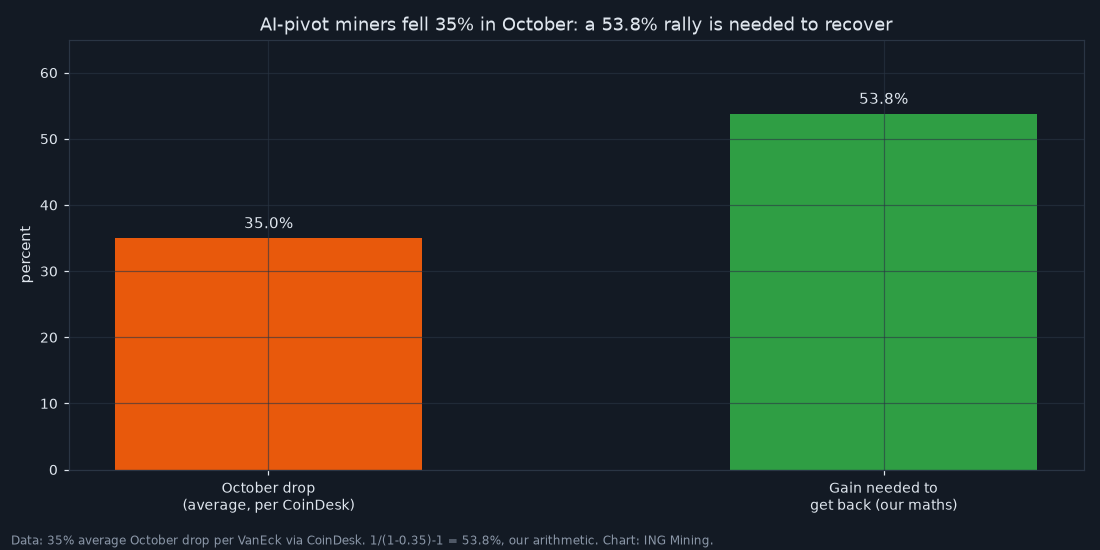
VanEck says bitcoin miners oversold in October are now a buying opportunity, because their grid connections are scarce. CoinDesk reports that shares of miners that pivoted to AI data centers fell an average of 35% in October. VanEck calls that a “dislocation,” not a rejection of the business model. Here is what it means if you still run ASICs.
What VanEck says about bitcoin miners oversold
Per CoinDesk, VanEck blames contagion from GPU rental firms (“neoclouds”) struggling with higher AI debt yields, plus a hot September CPI print and midterm election nerves. It names Hut 8 and Core Scientific as “powered shell providers,” and CoreWeave as the source of the credit fear. VanEck adds that no signed leases were canceled. Its argument: power is the binding constraint on AI compute, and long grid-connection queues put a scarcity premium on the sites miners already hold.
A second outlet, Phemex, carries the same 35% figure and the same financing-cost explanation. Both are summaries of one VanEck note. We could not open the VanEck page itself, so the sample behind the 35% is unknown to us. Also, “oversold” is an opinion. It is not a promise that the bottom is in.
The arithmetic of a 35% drop
A 35% fall needs a 53.8% rise to get back to even. That is our arithmetic, shown in the chart. So even if VanEck is right, the recovery is slow money. Meanwhile, these are equities. You cannot pay a power bill with them.
Miner math: what the AI-pivot sell-off means for your margin today
Here is the live maths on November 5. Bitcoin is $80,332 and the network is 1032 EH/s, so hashprice is about $35.21 per petahash per day. That is what one PH/s of hashing earns before power.
| Machine | 5c/kWh | 8c/kWh | 12c/kWh | Break-even |
|---|---|---|---|---|
| Antminer S19 (95 TH/s, 3250 W) | -$0.55 | -$2.89 | -$6.01 | 4.3c |
| Antminer S19k Pro (115 TH/s, 2645 W) | $0.88 | -$1.03 | -$3.57 | 6.4c |
| Antminer S19 XP (141 TH/s, 3010 W) | $1.35 | -$0.81 | -$3.70 | 6.9c |
| Antminer S21 Pro (234 TH/s, 3510 W) | $4.03 | $1.50 | -$1.87 | 9.8c |
Numbers are profit per day after electricity, at the three power prices shown. Break-even is the most you can pay per kilowatt-hour before the machine loses money. Specs are the manufacturer ratings; network data comes from mempool.space. Try your own power price in our free bitcoin mining profit calculator. See what these machines really sold for in our used ASIC miner price index. Want to run the same numbers on a machine you can buy today? See our used ASIC miners, or buy several at once through bulk lots.
If more listed miners shift megawatts to AI and network hashrate slips 3%: the break-even power price on an S19k Pro rises from 6.4 to 6.6 cents per kilowatt-hour. At 8 cents, daily profit goes from -$1.03 to -$0.90.
The blunt answer for ASIC owners
Nothing in this story changes your hashprice today. Network hashrate is near 1032 EH/s per mempool.space, and the table above shows who loses money at your power price. What the story does show is that the market values a powered site more than the bitcoin it produces. We think that is the real lesson. If your site has cheap power, it is worth more than your old machines. If it does not, those machines are the weak link. See our we buy used miners page, browse all miners, or read the mining economics guides.
-Nick
ING Mining
This is general information, not financial advice. Crypto is volatile, and exchanges can fail. Please do your own research.
How this story was made: drafted with the help of AI tools from public sources, then edited by Nick Squires. See our editorial policy. Spot an error? Email ns@ingmining.com.