
Samsung Wallet USDC accounts went live on Solana on Thursday, November 5, for eligible U.S. Galaxy users. Decrypt and The Block both report it, citing Samsung’s own statement. It is a big reach for stablecoins. It does nothing direct for bitcoin miners, and we say why below.
What the Samsung Wallet USDC launch includes
Users can buy, hold, send and receive Circle’s USDC on Solana inside the app. They do not need a separate crypto app or private keys. Samsung says about 82 million compatible Galaxy devices in the U.S. can reach it. That is a device count from the announcement, not a user count. Neither outlet gives adoption numbers.
Both outlets say Bastion, a licensed stablecoin custodian, runs the accounts. Both say Coinbase holds the USDC as Bastion’s sub-custodian. Decrypt notes that Samsung stresses this is a crypto wallet, not a bank account.
Samsung Wallet USDC fees, limits and who can use it
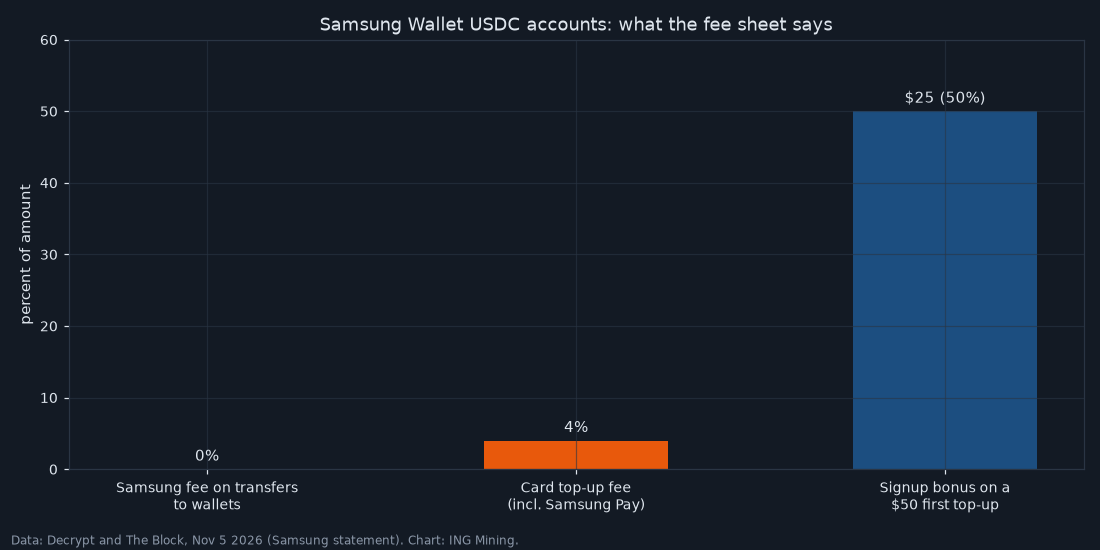
Both outlets say Samsung charges no fee on transfers to other Samsung Wallet users or compatible external wallets. Decrypt adds that other providers may charge. However, Decrypt also reports a 4% fee on credit card top-ups, including through Samsung Pay, and a $25 USDC bonus for a first top-up of $50 or more. The Block does not mention those two items. Bank transfers work in more than 60 countries, with fees that vary.
You must be a U.S. resident, 18 or older, on Android 13 or later. New York is excluded. The Block adds that a Samsung Account is required. Also, Samsung says it will explore online and in-store stablecoin payments and more markets, subject to local rules. That is a plan, not a launch.
Miner math: what this stablecoin launch does to your margin today
Here is the live maths on November 5. Bitcoin is $79,435 and the network is 1031 EH/s, so hashprice is about $34.86 per petahash per day. That is what one PH/s of hashing earns before power.
| Machine | 5c/kWh | 8c/kWh | 12c/kWh | Break-even |
|---|---|---|---|---|
| Antminer S19 (95 TH/s, 3250 W) | -$0.59 | -$2.93 | -$6.05 | 4.2c |
| Antminer S19k Pro (115 TH/s, 2645 W) | $0.83 | -$1.07 | -$3.61 | 6.3c |
| Antminer S19 XP (141 TH/s, 3010 W) | $1.30 | -$0.86 | -$3.75 | 6.8c |
| Antminer S21 Pro (234 TH/s, 3510 W) | $3.94 | $1.42 | -$1.95 | 9.7c |
Numbers are profit per day after electricity, at the three power prices shown. Break-even is the most you can pay per kilowatt-hour before the machine loses money. Specs are the manufacturer ratings; network data comes from mempool.space. Try your own power price in our free bitcoin mining profit calculator. See what these machines really sold for in our used ASIC miner price index. Want to run the same numbers on a machine you can buy today? See our used ASIC miners, or buy several at once through bulk lots.
This story is not a hashrate event, so test the risk that matters: if bitcoin moves up 5%: the break-even power price on an S19k Pro rises from 6.3 to 6.6 cents per kilowatt-hour. At 8 cents, daily profit goes from -$1.07 to -$0.87.
The blunt answer for ASIC owners
Nothing here changes hashprice today. Network hashrate is near 1031 EH/s per mempool.space, and the table above is what decides who makes money. USDC on Solana is a dollar rail. It does not pay block rewards and it does not touch mining difficulty. We think the useful read is this: the easier it is to hold dollars on a phone, the more people can move in and out of crypto without leaving the Galaxy app. Therefore, that could add volume. It could also keep money in dollars. We do not know yet, and no source says.
If your power costs more than the break-even column, no wallet launch fixes that. See our we buy used miners page, browse all miners, or read the mining economics guides.
-Nick
ING Mining
This is general information, not financial advice. Crypto is volatile, and exchanges can fail. Please do your own research.
How this story was made: drafted with the help of AI tools from public sources, then edited by Nick Squires. See our editorial policy. Spot an error? Email ns@ingmining.com.